
South Africa celebrates Easter as a public holiday so why are Yom Kippur, Eid or Diwali just another day at work?
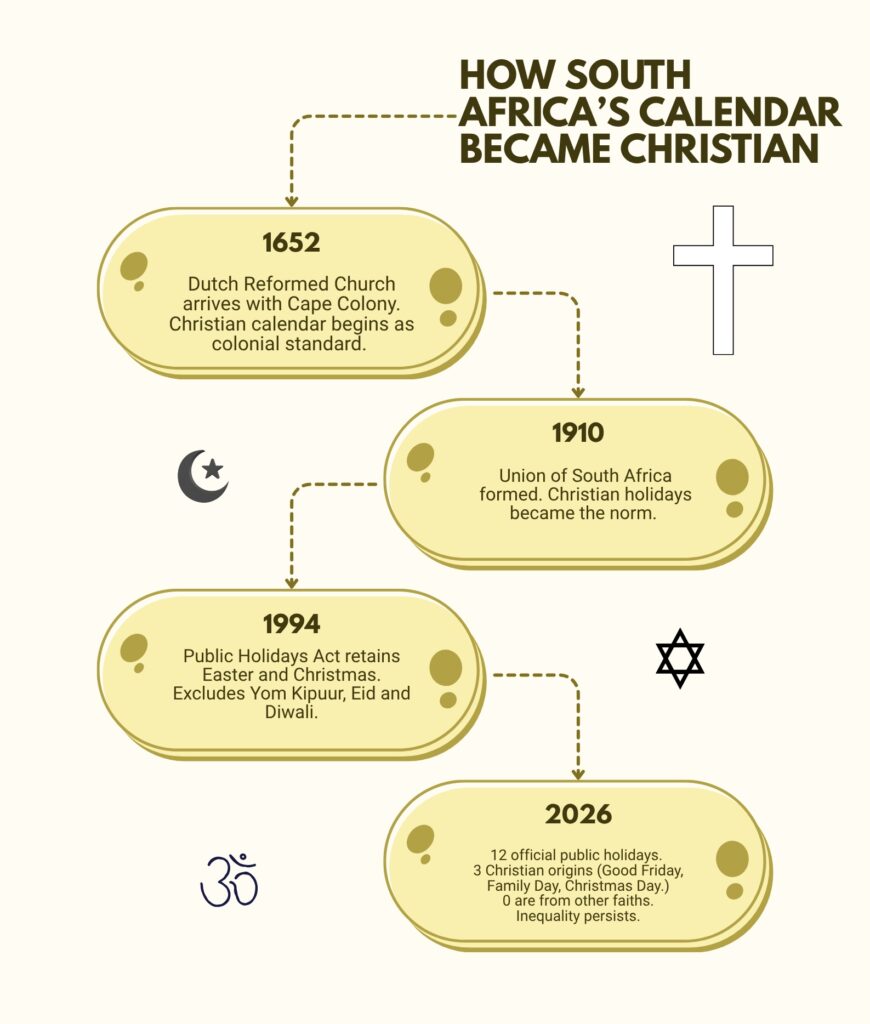
South Africa has 12 public holidays under the Public Holidays Act (No 36 of 1994). The Act recognises Easter and Christmas but does not recognise significant holy days of other major religions practiced in South Africa. Although South Africa’s constitution protects the right to religious observations, the public holiday calendar leans more towards Christianity. For a country with one of the most inclusive constitutions in the world, this appears to be a misnomer in our imagination of what our nation is and should be.
According to the DITSONG: National Museum of Cultural History , the arrival of Jan van Riebeeck marked the start of the South African colonial era and the introduction of Christianity to the region. As noted by Ancestors Research South Africa , the foundation of Christianity shaped the country’s public holiday calendar through the various colonies, as each colony observed Christian holidays before the South African Union in 1910.
Easter celebrates the resurrection of Jesus Christ after his sacrifice. This comes after 40 days of Lent for some Christians who use this time to reflect and fast. Easter Sunday (usually in March or April) is the biggest holy day preceded by the public holiday Good Friday and followed by Easter Monday, another public holiday.
Yom Kippur, the holiest Jewish day, known as “Day of Atonement,” is a 25 hour fast and five prayer services observance asking for forgiveness from God and people (usually in September or October). During this period, work is forbidden leading to many South African Jews taking an annual leave or a personal day off as South Africa does not consider Yom Kippur a public holiday. Eid al-Fitr (usually in April or May) an Islamic holiday that marks the end of Ramadan and celebrated with morning prayers, feasts, family gatherings and charity confirmed by the Jamiatul Ulama and not as a South African public holiday. Diwali (usually in October or November) known as “Festival of Lights” and falls on a Sunday symbolising light over darkness and good over evil. It is observed with lighting diyas, rangoli designs, exchanging sweets and prayers to goddess Lakshmi.
The Public Holidays Act does not reflect the country’s diverse religious culture. It reflects the assumption that there is only one dominant religion, Christianity, with holidays being built around that one religion while other religions must make amends to miss work. Considering South Africa’s multiculturalism, the religious calendar should include elements of each religion’s holy days allowing everyone to celebrate and understand their true meaning.
Academic, Benedict Anderson, defines a nation as an imagined community. What if in that imagination other religious holy days were made public holidays? The country would get the chance to stop and allow Jews to fast, Muslims to pray and Hindus to light up lamps while everyone else celebrates it as a long holiday.
The argument is not whether Easter should be or not be a public holiday. It is whether other religions deserve the same recognition given to Christianity. In a country as diverse as South Africa with 12 official languages and a constitution that protects religious freedom, the public holiday calendar should reflect this diversity.
With no change to the calendar, Jewish students will continue to ask for leave during test and exam season, Muslim families will continue to celebrate Eid after a long day at work, Hindu homes will continue to light up diyas at night and Easter will remain the same, a religious holiday for everyone but a holy day for Christians.
FEATURED IMAGE: Graphic titled “How South Africa’s calendar became Christian”. Graphic showing how South Africa’s official public holidays include Christian holy days while excluding other faiths. . Graphic by Reatlehile Mashamba
RELATED STORIES:
- Wits Vuvuzela, Ancestral calls in the boardroom, December 2025
- Wits Vuvuzela, INFOGRAPHIC: The origins of Easter traditions, March 2015
- Wits Vuvuzela, SLICE OF LIFE: ‘I don’t like your christians’, July 2018

