A mere Women’s Month special ‘pat on the back’ does not do justice to the contributions women make to South African sport. It is high time we call a spade a spade.
Every August for Women’s Month, a familiar and performative tradition unfolds across South Africa. Corporate brands flood their social media with daring graphics celebrating iMbokodo and sporting authorities release sleek press statements praising the ‘unshakable resilience’ of our female athletes; an obviously calculated, annual performance intended to score cheap public relations points on the backs of women who spend the other eleven months of the year fighting for proper recognition, infrastructure and financial support.
This hypocrisy deserves to be exposed. Resilience should be celebrated as a personal triumph, not weaponised as a convenient excuse for corporate and systemic neglect.
The 2026 Commonwealth Games, a multi-sport event hosted in Glasgow, Scotland, began on 23 July until August 2, 2026. A total of 112 athletes represented Team South Africa, 53 of whom were female athletes, accounting for more than half of the team. Of the 28 medals won, 11 medals, plus 1 shared medal in a mixed event, came from our sportswomen.
On August 1, the Minister of Sport, Arts and Culture, Gayton McKenzie, congratulated Team South Africa on its brilliant performance: “This team went to Glasgow and did us proud.” Post the congratulatory speech, the obvious reality remains unchanged.
These victories were achieved despite the unequal system, considering what our women had to overcome simply to stand on those stages.
After multiple health setbacks, Lara van Niekerk refused to allow hardships to further dictate her success. After successfully defending her women’s 50m breaststroke title in 30.43 seconds, she stated that this victory “means more than the one four years ago because of the difficulties I’ve had to overcome.” Behind her stood a sisterhood of excellence. Aimee Canny won two silver and bronze medals; Erin Gallagher won a silver and three bronze medals; Kaylene Corbett came in with a silver medal and Olivia Nel with a bronze medal. Javelin star Jo-Ané du Plessis, despite having undergone an emergency back surgery for a herniated disc, finished in sixth place.
But why must our sportswomen constantly play the martyr?
Sporting organisations and commercial sponsors thrive on the narrative of resilient women who continuously ‘overcome the odds.’ It makes for a heartwarming marketing campaign, while conveniently skipping over why these odds exist in the first place. Jo-Ané du Plessis was praised for her recovery, but her injury exposes how fragile an athlete’s support system can be. While she received professional medical assistance, the system at large remains broken.
Truthfully, hashtags, shout-outs and branded campaigns during women’s month are not empowering. Financial backing that equals that of sportsmen is.
The South African sports authorities need to put money where their mouth is and start funding our sportswomen like the champions they are. Romanticising the struggles of our athletes to mask administrative incompetence and putting up patronising Women’s Month banners is just not going to cut it anymore.
FEATURED IMAGE: A graphic of South African sportswomen. Graphic by: Naledi Maraisane
After five years of waiting, Spider-Man swings back onto our screens, and straight into his identity crisis.
After swinging into the Ster-Kinekor cinema at Rosebank and witnessing the long queues of people lining up in anticipation for the fourth installment in Tom Holland’s Spider-Man franchise, I completely understand how it was the biggest opening weekend in South African cinema history, according to Sony Pictures South Africa.
Brand New Day was a breath of fresh air. It felt as if it were the first raindrop after years of drought, which is somewhat true. This year marks five years since Spider Man! No Way Home last graced the big screen. The Marvel Cinematic Universe, which adapts the Marvel Comics characters and storylines created by Stan Lee, Jack Kirby, and Steve Ditko, seems to have been experiencing quite the dry spell since its most successful era ended. Due to the immense success of the last movie, all eyes were on Tom Holland to save the MCU – and save the day, he did.
After the events that led to the ending of the last movie, the audience was left biting their nails in worry for our closepersonal friend, Peter Parker. Over the years, I found myself wondering if he was okay and how he could be dealing with Aunt May’s death as well as the loss of not just his best friend, Ned (Jacob Batalon), but his girlfriend, MJ (Zendaya), too.
He took it just as I expected: not well. Obviously.
Peter chooses to isolate himself altogether, even from the only people he has left. One of the only connections he appears to have is with Jean DeWolff, played by Liza ColonZayas, who is the police captain that Spider-Man works very closely with. However, he is hardly close to her, if at all. DeWolff makes this a talking point in the first act, essentially calling him out on the fact that he knows nothing about her outside of work. When having a meeting with Florence Pugh’s character, Yelena, and speaking to Frank, (The Punisher,)played by Jon Bernthal, Peter never takes the mask off. This is done to mirror that Peter does not engage with anything or anyone outside of his Spider-Man persona. It is no longer his alter ego as Peter Parker, but rather his sole identity. It really does feel as though Peter Parker never existed.
The film centers on Peter’s want and need to only be Spider-Man, while ignoring everything that made him into the fantastic superhero he had grown into. While the first three movies followed him along his journey of Peter trying to become Spider-Man, this one focused on Spider-Man trying to figure out how to be Peter Parker.
Tom Holland knocked it out of the park with the most genuine and realistic portrayal of this allegory. He has always excelled at playing Peter Parker, but this film cemented his legacy as the current generation’s Spider-Man. Oftentimes when we watch movies, especially ones with high-status actors, we tend to pay extra attention to how they act. We notice how their eyebrows slightly crinkle, or how their mouths twitch when trying not to break character, and we realise that we are watching an actor act. Yet, as I sat in the movie theatre, that was the last thing on my mind. Holland did an incredible job capturing my attention. It felt as though I was pulled into the screen.
Visually, this is one of the most stunningly shot Spider-Man films. The creativity of the cinematography truly added to the audience’s experience of joining Peter’s grief, stress, and anxiety of facing the inevitable. The scenes of New York City helped us feel as if we were right there with Peter, with the web-swinging scenes beautifully executed. Brand New Day was visually dynamic and vibrant, the opposite of the blandness that has plagued cinema over the past few years. All of these aspects added to the comic book illusion. Destin Daniel Cretton, the director of Brand New Day and Shang-Chi, has also solidified his position as one of the MCU’s top directors.
Brand New Day gave us more than just a fourth Spidey movie. It gave us a superhero who resembles pieces of us that we would not normally expect them to. We have all been this version of Spider-Man: still in the process of becoming, struggling between doing what is required from us and doing what we desire to do. This is what made this movie so enjoyable. Instead of following the usual formula of villains trying to kill Peter, it showed us an emotionally charged street-level Spidey story. No Avengers intervention, no multiverse concerns, and no “end of the world” problematic threats.
Instead, it raises the question: what happens when a superhero becomes more than just the man wearing the mask? A person like you and me, figuring out their identity, while ignoring who we really are, because it frightens us?
This is why the antagonist of this film not being necessarily evil is so impactful. The secrecy surrounding Sadie Sink’s character had us in a chokehold for months, and the wait was definitely worth it.
The heart and soul of this film were the scenes between Peter, Ned, and MJ. Their presence emphasised the sadness of Peter succumbing to his loneliness. One thing that movie did incredibly well was not having Peter’s grief categorised in a hierarchy. He missed Ned just as much as he missed MJ. The writing spectacularly delivered us with the purest portrayal of Peter Parker when he shows MJ unconditional love.
Brand New Day proved that Peter does not have to face life alone in order to be successful as Spider-Man, if anything, it is the complete opposite. Although Ned and MJ will never be able to remember the Peter they once knew and loved, it does not mean that Peter cannot build something new with them.
Vuvu Rating: 9/10
FEATURED IMAGE: Spider-Man logo drawn on a red background. Photo: Kerese Govender
There is something distinctly inherited about misogyny.
It lingers and creeps in your veins as if it were a dormant disease. It flows through your blood and poisons the mind. It is almost buried beneath and before you know it, you find yourself looking sideways at the girl you deem promiscuous because she is not docile. You will not realise it is there, even when you pray for a baby boy because they are ‘so much easier to raise’ than girls. Without knowing it you uphold patriarchy in small ways.
This topic is a dead horse that will never stop getting beat. It is constantly on my mind. How can it not be when we live in a world where an abuser can sell out stadiums globally. A world where violence and injustices against women are constantly ignored. Men claim to care but prove daily that they do not. In my opinion, men rarely consider your feelings the same way a women would.
This is evident in the support problematic male celebrities continue to garner. These men are defended and uplifted irrespective of how irredeemable their actions are.
A comment under a TikTok about the recent arrest of Chris Brown.
A comment under a TikTok about Connor McGregor’s court case.
Society expects women to sit idly by, with no bark or bite, because we should be pleased to have a seat at the table. We still have to hope that asking, “What if that was your mother or daughter?” is enough for a man to be empathetic. A woman should not be reduced to her role in a man’s life for her pain to be empathised with.
It does not matter what type of woman you are or aspire to be, nine times out of ten, there is a word out there to demean you. My favourite out of the bunch lately is ‘bird,’ used to refer to a woman who is being wistfully naïve when it comes to seeking male validation. Have you not found the courage to leave your abusive boyfriend yet? Bird. Do you forgive cheating? Bird. Do you complain about your manipulative boyfriend but stay with him? Bird. People on the internet say, “too many birds on the ground and not enough in the sky.”
The latest example are the women on Love Island 2026, namely Melanie Moreno and Aniya Harvey. The term has shifted from holding women accountable for enabling men to blaming women for being mistreated by men. People should be capable of calling out a woman’s wrongdoings without diminishing her entire character, especially without using terms that were created to police women and their actions.
Misogyny shows up in the jokes we find funny; in the memes we reshare; in the bullying we endorse and the two-cent comments we dismiss. It does not just spring up suddenly in unexpected violent outbursts.
It is when we dislike a woman for being too loud, or for taking up too much space, instead of staying in the tiny corner designated for her. We see this experience the most among famous women. From Taylor Swift to Megan Thee Stallion to Chappell Roan, all women hated for different reasons but with one noticeable similarity. In most cases, even if there are valid reasons to dislike these women, rarely are those the reasons why people do.
These ‘jokes’ test your morals and what you deem as okay to say and hear. They question how ignorant you are toward those you love when they make such takes.
Comments under a TikTok about Chappell Roan’s controversy.
Women who are complicit in men’s misogyny should not claim to care about our issues. If you associate yourself with this kind of man, you are complicit. You are the company that you keep. By associating yourself with this type of man, you are that man yourself.
This is the part of the article where I confirm I am not some all-men hating, bitter misandrist. If this is bitter, then bitter is what I will be. As it is, I do not believe we are bitter enough.
A creative powerhouse whose legacy is defined by life experiences, grit, passion and purpose.
Malcolm Purkey is famously known as a multifaceted genius. A playwright, director, actor, lecturer and an experienced Dean of AFDA Johannesburg. From humble beginnings, Purkey carved his own path in theatre and education rooted at Wits University.
Born in 1951, Yeoville, Johannesburg, Purkey spent his life moving around the city. His parents came from Britain; his father Harold Purkey was a jazz pianist and his mother, Kay Purkey was a hardworking singer. It is no surprise, then, that Purkey inherited all the artistic talent from both his parents.
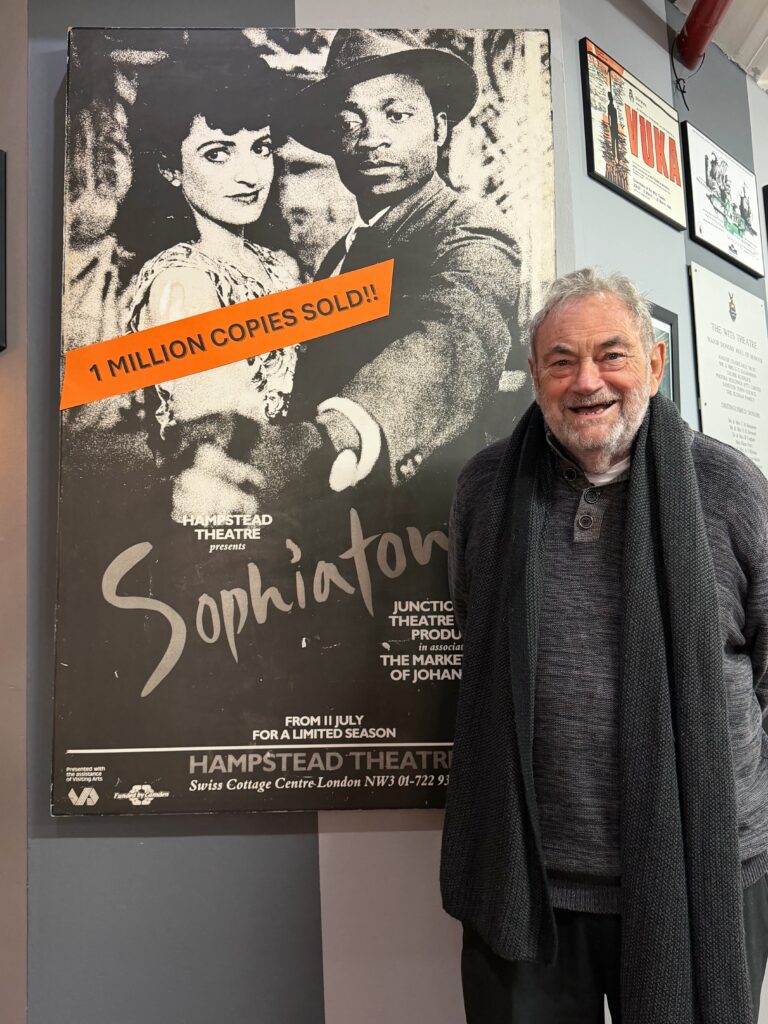
A photo of Malcolm Purkey standing next to Sophiatown board. Photo: Sikelelekile Pahlana
Purkey is a true Witsie, he started at Wits in 1970 and studied English, Sesotho and Ancient Greek. He initially dropped out because he had failed his undergraduate modules and found his way back to Wits, completing English One. Afterwards, he left school and worked in a theatre for six months, which marked the beginning of his theatre career. He left South Africa to go to Britain, and realised Britain was not home, in fact he came to the conclusion that: “I am neither African nor European, I am both.”
His return to Wits to complete his honours in English, built a box theatre in the Matrix alongside an architect and he also built The Nunnery theatre.
As Purkey spoke to Wits Vuvuzela, a vivid recollection of being taught the absurdist play, Waiting for Godot by Samuel Beckett by former English lecturer, Hilary Semple. A seminal moment for him.
“I’m an absurdist. Oh my God. There is no God. Oh, my God what am I supposed to do? So, what I did is I wrote [sic] an answer. Where the two characters who are looking, waiting for Godot, they finally get to heaven, and they find out that the realisation of a dream is hopelessly inadequate. The journey is all…That was the play I wrote, and it got professors saying nice things about it,” he shared.
The play in question was Sequel to Jeso (1971), which was one of his first plays shown at Wits, in the Great Hall.
Decades on, Purkey’s imprint in theatre continues to be felt the resurgence of the play Sophiatown (1986), which was recently on show at the Wits Theatre. Sophiatown has successfully sold one million copies of the play text published by Wits University Press and Macmillan Publishers which happens to also be a part of the current grade 11 first additional language curriculum.
Purkey believes that drama, as both a subject and medium, is a powerful tool. “Drama teaches you a whole lot of power, language, talking and being in the world.” He first learned just how powerful when he co-founded the Junction Avenue Theatre Company in 1976 and later joined forces with Workshop 71 to form a non-racial theatre group that could shed a light on the injustice of the Apartheid regime.
A guiding principle for the company was “history from below.” It “was the idea that we have to reveal the hidden history that the apartheid state wanted hidden, such as the destruction of Doornfontein, the destruction of Sophiatown, the ANC in exile,” he shared.
His first award followed shortly after in 1978, when Purkey won best director of the year for the play Travesties.
Through his work and life experience Purkey has been able to not only achieve much but also live up to his sense of purpose, which is: “To use theatre to communicate wonderful, contradictory, and telling ideas that reveal part of our worlds to ourselves and part of ourselves to ourselves that otherwise remain hidden”.
FEATURED IMAGE: A photo of Malcolm Purkey. Photo by: Sikelelekile Pahlana
South Africa celebrates Easter as a public holiday so why are Yom Kippur, Eid or Diwali just another day at work?
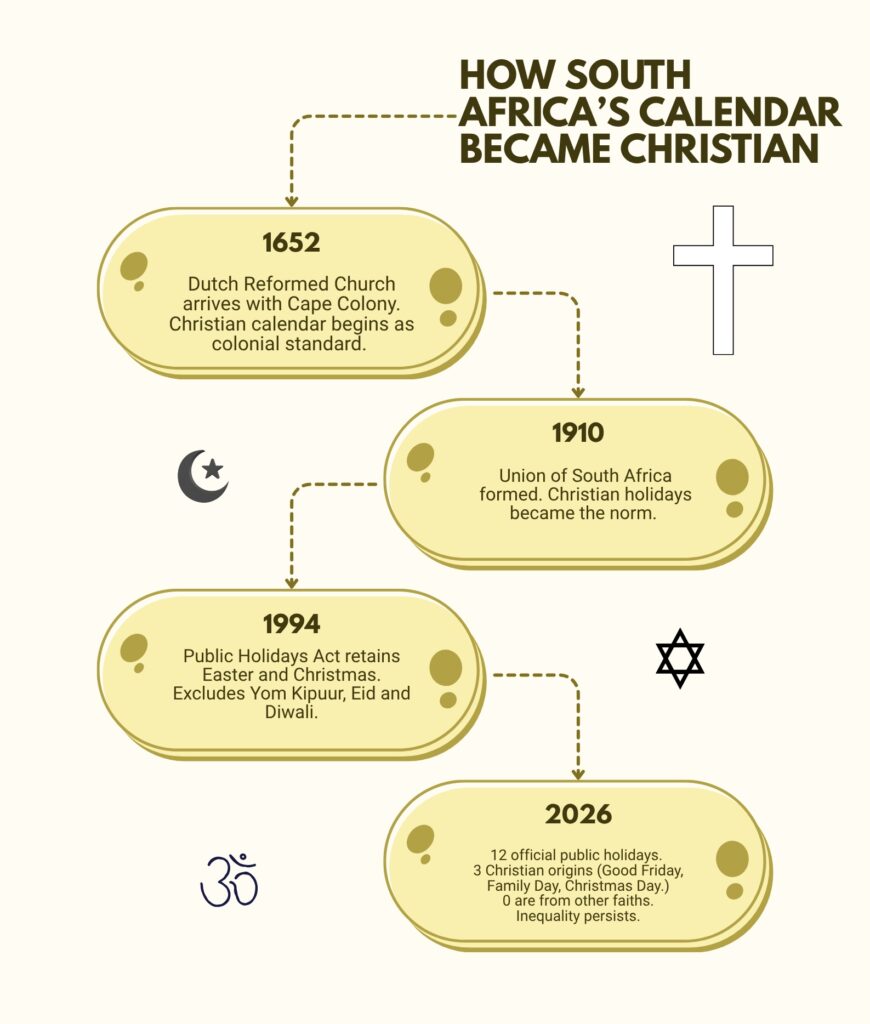
South Africa has 12 public holidays under the Public Holidays Act (No 36 of 1994). The Act recognises Easter and Christmas but does not recognise significant holy days of other major religions practiced in South Africa. Although South Africa’s constitution protects the right to religious observations, the public holiday calendar leans more towards Christianity. For a country with one of the most inclusive constitutions in the world, this appears to be a misnomer in our imagination of what our nation is and should be.
According to the DITSONG: National Museum of Cultural History , the arrival of Jan van Riebeeck marked the start of the South African colonial era and the introduction of Christianity to the region. As noted by Ancestors Research South Africa , the foundation of Christianity shaped the country’s public holiday calendar through the various colonies, as each colony observed Christian holidays before the South African Union in 1910.
Graphic showing how South Africa’s official public holidays include Christian holy days while excluding other faiths. Graphic by: Reatlehile Mashamba
Easter celebrates the resurrection of Jesus Christ after his sacrifice. This comes after 40 days of Lent for some Christians who use this time to reflect and fast. Easter Sunday (usually in March or April) is the biggest holy day preceded by the public holiday Good Friday and followed by Easter Monday, another public holiday.
Yom Kippur, the holiest Jewish day, known as “Day of Atonement,” is a 25 hour fast and five prayer services observance asking for forgiveness from God and people (usually in September or October). During this period, work is forbidden leading to many South African Jews taking an annual leave or a personal day off as South Africa does not consider Yom Kippur a public holiday. Eid al-Fitr (usually in April or May) an Islamic holiday that marks the end of Ramadan and celebrated with morning prayers, feasts, family gatherings and charity confirmed by the Jamiatul Ulama and not as a South African public holiday. Diwali (usually in October or November) known as “Festival of Lights” and falls on a Sunday symbolising light over darkness and good over evil. It is observed with lighting diyas, rangoli designs, exchanging sweets and prayers to goddess Lakshmi.
The Public Holidays Act does not reflect the country’s diverse religious culture. It reflects the assumption that there is only one dominant religion, Christianity, with holidays being built around that one religion while other religions must make amends to miss work. Considering South Africa’s multiculturalism, the religious calendar should include elements of each religion’s holy days allowing everyone to celebrate and understand their true meaning.
Academic, Benedict Anderson, defines a nation as an imagined community. What if in that imagination other religious holy days were made public holidays? The country would get the chance to stop and allow Jews to fast, Muslims to pray and Hindus to light up lamps while everyone else celebrates it as a long holiday.
The argument is not whether Easter should be or not be a public holiday. It is whether other religions deserve the same recognition given to Christianity. In a country as diverse as South Africa with 12 official languages and a constitution that protects religious freedom, the public holiday calendar should reflect this diversity.
With no change to the calendar, Jewish students will continue to ask for leave during test and exam season, Muslim families will continue to celebrate Eid after a long day at work, Hindu homes will continue to light up diyas at night and Easter will remain the same, a religious holiday for everyone but a holy day for Christians.
FEATURED IMAGE: Graphic titled “How South Africa’s calendar became Christian”. Graphic showing how South Africa’s official public holidays include Christian holy days while excluding other faiths. . Graphic by Reatlehile Mashamba
Wits students win their second film competition despite facing finance, logistics, and resource challenges.
Three Wit students won the Nikon ZR Filmmaker Challenge 2026.
As part of the competition, their film was premiered in the SK IMAX Cinema in the Mall of Africa.
The trio plans to start a joint film company.
Three Wits film and television students won the 2026 Nikon ZR Filmmaker Challenge for their short film, Threads of a Memory, which was screened as part of the competition at the SK IMAX Cinema in the Mall of Africa on March, 24.
The three, Sesethu Ledwaba, Blessing Tsebe and Hanani Mbam were partly sponsored by Nikon South Africa who provided them with a Nikon ZR camera and three lenses.
Photo of the three winners with film equipment. Photo: Zebrena Ralph
The trio told Wits Vuvuzela that they competed against some renowned filmmakers in a selection process that they saw only the best eight films being premiered at the Ster Kineker IMAX Cinema.
They had the task of outsourcing their own lighting and tripods which they got from the Wits Film and Television Department. On top of this, they funded their own transport, props, and food for their crew by doing side jobs as students, completing production in just three days. Mbam told Wits Vuvuzela that, “luckily for me I had been working at my res from January, so at least that money I was able to make made things a little easier.”
This win comes after the trio won the Italian-South African Short Film Competition in 2025 with their film, The Art of Tricolore.
Speaking to Wits Vuvuzela, Tsebe said, “It shows that we are a winning formula to some point.”
Despite the Nikon ZR Filmmaker Challenge not having a cash prize, the trio won the Nikon ZR camera, which is a high-performance professional camera.
“It’s better than money” said Tsebe who added that they plan to use it to create more of their own films as a joint film company.
FEATURED IMAGE: Photo of the three winners with film equipment. Photo: Zebrena Ralph
The fund set up to save students leaves many students begging for assistance.
As the second block of the semester begins at Wits University, some NSFAS beneficiaries are not only worried about academic pressures but also about survival. Awaiting allowances has made students anxious about where their next meal will come from and the possibility of being locked out of their residences.
The National Financial Aid Scheme (NSFAS) has gone to shambles. On March 30 2026, the Auditor-General issued a “disclaimer opinion” due to systemic issues that left their books unverified.
The findings revealed funds being paid to over 822 deceased students, 14,000 wealthy ineligible beneficiaries, while legitimate beneficiaries are left to starve, and thousands of fraudulent recipients are benefiting from the fund. The systematic collapse and mismanagement of documents result in hungry students facing possible eviction.
“In the beginning of the year there are four to five funding lists, your name not being on the list means you will not receive an allowance and in that time you have to rely on your family or see for yourself until your name is on the list,” Tariana Botha, a Wits alumni, holds a BA in Psychology and Geography and is now pursing her BA Honours in Psychology, commented,
Perfect Maphumulo, a first-year mining engineering student, shared that his cousin had to borrow money after not receiving his allowance, “He called home and told them he didn’t receive his allowance. His parents had to go borrow money.”
Although some students remain silent about the delay of allowances, they remain hopeful. Waiting for a bank notification with their allowance, the wait is mentally daunting and affects the academics of many students.
The Wits Student Representative Council (SRC) has been making efforts to fill the gaps left by NSFAS through the SRC Access Fund, supported by the university. “NSFAS should be dissolved, and the Department of Higher Education should directly work with universities, and the university should directly work and communicate with the eligible recipients,” Wits SRC President Gilbert Nchabeleng said. The SRC stands with students and continues to fight for them. Until NSFAS is rebuilt and restructured, students will continue to anxiously wait for an allowance.
FEATURED IMAGE: The Financial Aid and Scholarships Office showing students waiting for assistance. Photo: Reatlehile Mashamba
The oppressive regime of Israel echoes eerily with our own Apartheid history, calling for greater South African solidarity.
“When we choose indifference, we consent to someone else’s cruelty.”
― Lawrence Nault
Israel just passed a new law issuing the death penalty for Palestinian political prisoners, revealing a striking resemblance to South Africa’s Apartheid state.
The systemic erasure of the Palestinian people has been ongoing despite claims of a ‘ceasefire’ in October 2026. In fact, a total of 73, 000 deaths have resulted from Israeli attacks, according to a UN report.
Israel’s new death penalty doesn’t just highlight an institutional injustice but also signals an eerie repetition of history.
Hand-drawn animation of the freedom flotilla. By: Jamie Ho.
“For many years, South Africa had the doubtful honour of being a world leader in the number of judicial executions carried out,” says Deputy Minister Andries Nel. During the period from 1948 to 1994, the country, under the Apartheid regime, utilized the death penalty to suppress the political opposition of black activists.
Now the same thing is happening in Israel. The death penalty grants the Israeli state the legal authority to kill any Palestinian held in detention, many of whom have never been charged or received a fair trial. Under this mandate, systemic discrimination and genocidal violence will be a part of the Israeli constitution.
As South Africans, we are no stranger to oppressive regimes; it is a part of our history. And now history is repeating itself. We cannot be complicit.
As the fleet of over 100 boats from countries all over the world prepares to sail towards Gaza to break Israel’s siege on Palestine, the spirit of international solidarity rings clear.
The Global Sumud Flotilla is the biggest maritime mission set to disrupt Israel’s siege on Gaza with 3,000 activists sailing from 52 countries, South Africa included. The goal is to break Israel’s blockade, deliver life-saving aid and confront international complicity.
In the words of Dr Zaheera Soomar, a participant of the Flotilla, “Some moments in history demand more from us than comfort or safety. They demand conscience.”
Now more than ever, it is necessary to take a stance. Just because we are distant from the conflict doesn’t mean we can’t have an impact.
Donate to the Global Sumud Flotilla. Boycott pro-Israel organizations. Spread awareness by sharing the message. Don’t forget Palestine.
FEATURED IMAGE: Photo taken outside of the Wits School of Digital Arts depicting a graffiti mural of the word ‘Free’ in solidarity with Palestine. By: Jamie Ho.
Would you sacrifice your sleep for a chance at success? In Johannesburg, this is more than just something to think about—it’s something many people live with every single day.
The culture of constant work and hustling wears down people, especially young workers striving to succeed. This leads to chronic anxiety and exhaustion that is often hidden beneath the surface.
Powerful stories of individuals like street vendor Ausi Nandi Nkosi, Uber driver Siya Zwide, and young professional Lerato Kopano* reveal a side of Johannesburg often left unseen.
What looks like strength on the surface often hides a much more vulnerable reality and values mental health, allowing time for rest, and nurturing genuine human connections.
Yet within South Africa’s own imagination, Egoli — the City of Gold — glows differently. The nostalgia of Johannesburg is embedded in the movies we watch, the songs we sing, the stories we tell. Egoli is a city of wealth, success, and luxury; a place where the promise of building something from nothing feels tangible.
The media has long shaped this image. From soap operas like Generations and Isidingo to films like Kedibone, and in headlines celebrating business moguls and breakout stars, Johannesburg is consistently portrayed as a land of opportunity — a city where every main character has a dream and a reason to fight.
Yet the same media also warns of danger: fast money, fast burnout, and an even faster descent. This contradiction forms the city’s pulse: ambition wrapped in fear. You start to walk faster, keep your shoulders tight, say less, and always stay alert. You build a shield around yourself against everything unknown.
Fear captures one part of the experience, but anxiety may be more precise. Anxiety in Johannesburg doesn’t always show up as panic. At times, it hides behind a hectic schedule and nonstop productivity. It’s the feeling of waking up before the sun even rises, pushing yourself to chase a version of success that might no longer feel real or meaningful.
The city that demands your soul
By 5am in the morning, the streets are already congested with minibuses and delivery vans. At the Bree taxi rank, merchants look for a place for their trade early in the morning. The weak sunlight was barely pushing through a haze of exhaust fumes when I met Ausi Nandi Nkosi. She was dressed in a bright doek (headscarf) and a faded Orlando Pirates T-shirt, already frying vetkoek on a makeshift charcoal stove balanced on bricks.
Nkosi, who is nearly 50 years old, has lived through it all. She left her home in rural Mpumalanga back in the 1990s, carrying nothing but a suitcase and hopes of finding a job. “Sometimes I feel like Johannesburg owes me,” she says, leaning on the wall.
Most of Nkosi’s frustration comes from years of patting dough and folding it into small circles to sell for R2 each. This hustle generates a small turnover in profits, which is not enough to raise two orphaned grandchildren in Johannesburg. Diesel fumes hang heavy in the air, filling her lungs with the scent of both sustenance and struggle. She drops the round dough into the sputtering fat. The vetkoek bubbles and turns golden, like little suns.
Nkosi’s sleep is inconsistent, stolen between shifts at the rank as she stands long hours cooking. She describes a pressing heaviness in her muscles. “Joburg never sleeps,” she says with a laugh. According to Mediclinic research this shows what Nkosi describes as being more than exhaustion — it is a risk factor for mental health issues, which includes persistent fatigue and stress on the body. “When people live in environments that demand constant alertness, it affects cognitive function, emotional regulation, and overall resilience,” said Thembelani Nyathi, a regional counsellor.
Humour and warmth are Nkosi’s tools. She jokes around while handing customer’s change. Neglecting one’s body is a mechanism many use to survive in high-stress environments like Johannesburg.
Joburg demands endurance. And every morning, Nkosi delivers.
The Uber Steering Through Fear and Fatigue
Thirty-four-year-old Siyanda Zwide sits in his grey Suzuki Swift at a petrol forecourt in Braamfontein. He wipes sweat off his brow when his phone buzzes with a map notification – my Uber request to head to Wits Junction. The engine hums softly beneath him, but his mind races ahead – the route, the traffic, streets, people. I get into the car, Zwide starts the trip back to residence, navigating the road and answering my questions.
Zwide’s main business is in construction. Now that he works as an Uber driver, he juggles between being the company manager and making his e-hailing trips. “I took the car on instalment in 2017; these cars usually pay for themselves [referring to instalment cars e-hailing drivers take to start their business],” he says.
Zwide complains about the rise in fuel prices as he is receiving low fares on Uber, which consequently makes him struggle to raise the vehicles R8,000 monthly instalment. Zwide is left pressed working two jobs daily, without any breaks. He sacrifices sleep and family time to meet the monthly costs of living.
When asked about the safety of driving in Johannesburg. His grip on the steering wheel tightens and his knuckles whiten. Every stoplight, every junction, every pedestrian trigger calculation. “Drivers get robbed and killed,” he says, “That is why I only drive during the day.”
That vigilance, “always looking over your shoulder,” is a hallmark of chronic anxiety, says Councillor Nyathi. “Chronic anxiety often shows as hypervigilance — constantly scanning your environment, anticipating threats, even small ones. It’s exhausting for the nervous system, and in a city like Joburg, it’s almost a learned survival mechanism.”
There is evident fear threaded through Zwide gestures: the way he checks rearview mirrors twice, the way his hands hover over the steering wheel even when parked, the way he tilts his head at every approaching car. Psychologists call this hyper-vigilance, a symptom of chronic anxiety triggered by repeated exposure to real and perceived threats. In Gauteng e-hailing drivers have been victims of crime on duty and passengers have also been killed or robbed in e-hailing services.
Every pick-up comes with a silent prayer: that you arrive safely, that no one’s aggression finds you, that the city’s hustle doesn’t sweep you into harm. The dashboard light flickers across his face; the road stretches ahead. Deliveries, taxis, pedestrians… Jozi moves with an energy both intoxicating and intimidating. “People outside the city don’t understand,” he says. “Everyone here is scared. We live with the fear and the rush.” It is reflected in the slight tremor of his hands, the exhaled breath only when stopped, the continuous scan of his mirrors. The psychological toll of balancing two jobs with real danger and emotional labour is quiet, almost invisible, yet it breathes in the tension in his back, the rigidity of his shoulders, the measured patience behind his smile could fool you.
When night falls, Johannesburg does not fold into sleep — it rewires. The city’s drive only changes gear: neon signs replace the sun, late deliveries replace early deadlines, and the day’s tension moves into bars, clubs and kitchen tables. The noise softens but the pressure stays. Here, hunger for success takes a different shape: culture, connection, a reclaiming of time that daytime steals.
At the KFC on the corner of De Korte and Biccard, the fryer’s bright red light throws everyone into a small, shared glow. The place smells of salt and oil and spilled cola; the chairs squeak under bodies that have been sitting too long. I run into Lerato Kopano sitting at a corner table. The 21-year-old remote executive assistant exudes confidence, but one that wraps around thinly veiled fatigue. She balances a phone, a bag and a laugh that arrives like a practiced line.
“My life is measured in deadlines, not days,” she says, adjusting the strap of her bag. She jokes about Jozi: “You have to act like you own it.” Her LinkedIn profile is immaculate; her CV rehearsed; her Instagram curated evidence of survival and success. But when she speaks of clients and late-night calls, her fingers drum the table — a small rhythm of counting the time she has left to herself. At one point she scrolls to a photo on her phone, taps it, and reads aloud a quote printed on her wall: “Be the person you need to be.” It is part instruction, part armour.
Around the table the talk is practical — near-misses with rideshares, cruel clients, the tiny humiliations of contract work — and then it softens into something else: confessions, jokes that fold into real, raw sentences. We laugh; someone cries quietly into a napkin. These post-shift gatherings are therapy by improvisation: a circle of witnesses who say, without medical words, you are not crazy; living here is hard. In a city where formal mental-health help is difficult and stigma is stiff; these pockets of honest venting keep people afloat.
Lerato keeps a stack of printed quotes on her wall — Bible verses slipped in by a friend, motivational lines she pins to mornings she needs to meet. “If I’m feeling off, I Google a quote,” she says, almost apologetic. “Sometimes a verse shows up in my chat from a friend and it’s like someone handed me a cup of water.” The ritual is small but steady: words as scaffolding, optimism as habit. This pattern is a constructed persona, the performative quotes, the collective venting sessions is more than being Gen Z. It is a set of coping moves for a city that demands nonstop performance. According to the South African Depression and Anxiety Group (SADAG), Joburg ranks among the country’s most stressed cities. Long hours, high unemployment, crime, and cost of living all blur into a perfect storm.
Psychologically, you see this in tiny ways: the rehearsal of confidence (masking), the rapid shifts between humour and seriousness (emotional regulation), the use of mini-rituals —quotations, verses, group venting — to patch up the frayed edges of the day. They’re coping strategies. They’re also indicative of distress when they become the only ways of mending. Sleep gets squeezed in, rumination goes late, and hope is calibrated towards the promotion that comes as the definition of success.
The Mask of Success
We met in Sandton at one of those minimalistic aesthetic cafés, where success seems to show off. The kind of place with comfy velvet chairs and the perfect amount of light, surrounded by people who wear productivity like it’s a signature scent. Monique Gey van Pittius makes her way in five minutes early with a laptop bag slung over her shoulder and phone in hand. She moves with purpose — not hurried. Her gaze remains alert, scanning the room with as if she’s always moving, even when she’s still. Her hair is sleek and her blazer freshly-pressed.
Gey van Pittius is 26-year-old television producer who grew up within the city. Her resume tells a story of rapid progress: assistant, coordinator, senior producer each role arriving faster than the one before, like proof that her climb up the ladder was working. “Joburg gets you where you want to be faster,” she says. “What takes two years in Cape Town? Two months here. Sometimes even two weeks.” She smiles, remembering projects she’s working on — the steady building of a reputation you can see. Those wins mattered. They paid rent, bought security, and opened doors.
But the cracks show in small, sharp moments. When she says, “I had a midlife crisis at twenty-four,” I am amazed at her disarming honesty. It is not just a rhetorical twist. Before she knew it, the career ladder towered before her, the target was far, and her personal life, fortunately not down the drain, but down. She arrived late at important moments, missed weddings. She looked at pictures of friends’ children growing up and suddenly saw that she couldn’t remember being there for their very first steps.
As she stands, she says, “You know what the hardest part is? You can’t even tell when the exhaustion starts to feel normal. It just becomes… you.” Johannesburg rewards velocity. It teaches you that rest is laziness, and stillness is failure. Everyone is sprinting toward a version of stability that keeps moving further away.
Gey van Pittius does not suggest leaving Joburg. She urges people to come and experience the city. “This place will move you,” she says. “It will teach you things you won’t find anywhere else.” But she offers a word of caution. When you come, bring a toolkit with you for example going to therapy even if nothing is wrong. Ambition is important but so is making time to be human. Find a mentor who can guide you and true friendships. And have a plan for recovery in case the fast pace turns into a lifetime sprint.
A quieter verdict
Monique Gey van Pittius thesis [Ed1][Bm2][Bm3] idea is a clever little experiment that tests the values of the city. It involves a simple poll with just one question: Do you love to work, or do you work to love? From the answers, she plans to explore how people define luxury in their lives.
The question she keeps returning to is straightforward, yet powerful. The poll aims to reveal what life feels like when you get to choose your own pace instead of having the city dictate it to you. It’s about understanding the freedom to live on your own terms and what that means to people’s sense of luxury and fulfilment.
For this city to truly become world-class, the way we measure success must change It should not only concern the car you drive or the apartment you live in, or the deals you make. Instead success should be about people’s ability to preserve their health, sustain their relationships, and their mental well-being as they chase their dream.
*Not their real name
FEATURED IMAGE: An Uber vehicle waiting for a pickup near the Wits Arts Museum. Photo: File
The Wits Pharmacy Student Council (WPSC) and the Sefako Makgatho Health Science University (SMU) explored the pros and cons of PIMART in South Africa.
Pharmacists from both Wits University and SMU debated the issue of HIV treatment relating to the Pharmacist-Initiated Management of Antiretroviral Therapy implementation at the Wits Education Campus on Friday, July 28.
The Wits team argued in favour of the treatment, while SMU argued against it.
PIMART appeared in the Government Gazette for implementation in August 2021. This type of therapy would allow pharmacists to administer HIV medication without a script or medical consultation from a general practitioner.
Former South African Medical Association chairperson, Dr. Angelique said the move would allow for “unfair competition”, as pharmacists would “compete with general practitioners whilst not having the necessary qualifications.”
A pharmacy student from the SMU team, Covenant Ngomana, argued that PIMART is needed to address the “high volume of HIV-related deaths in South Africa” due to lack of treatment. Statistics show that 94.2% of South Africans know their HIV status but only 75% seek treatment.
Wits pharmacy student, Maria Phalane, disagreed, she said pharmacists mainly work in the private sector with only “27% of South Africans in private healthcare, leaving 73% [of the majority] uncatered for.”
Dr. Maria Eksteen, a professional in pharmacy education, told Wits Vuvuzela that “PIMART has a valuable place in the South African healthcare context,” and added that pharmacists are the “most accessible healthcare professionals, [changing] the game in terms of accessibility to treatment for employed and uninsured patients.”
Eksteen adds that PIMART is definitely “part of many solutions to Africa’s high HIV infection rates,” with an estimated 13.2% of South Africans living with HIV in 2022.
It is unclear at this point whether PIMART will be fully implemented in South Africa, but the debate was meant to help “raise awareness and promote a discussion around PIMART,” said WPSC member, Lethokuhle Ndaba.
Although the IPA and some practitioners are against PIMART, the debate highlighted how it could help increase the treatment rates of HIV positive patients throughout South Africa.
FEATURED IMAGE: Students watching and discussing the PIMART Debate at Wits’ Education Campus in Parktown. Photo: Georgia Cartwright
A young and energetic long jumper excels with unwavering passion and dedication in long jump.
Born in the Democratic Republic of Congo and raised in South Africa from an early age, Kalanga Olivia Muya (20) recently set a new personal best of 5.54 metres at the University Sport South Africa (USSA) long jump qualifiers.
Muya’s journey began when she enrolled at the University of Johannesburg in 2020, studying towards a degree in BCom business management. She caught the attention of her current coach, coach Patience Ntshingila.
Long jumper Kalanga Muya in action at the Free State athletic stadium. Photo: Supplied
Recognising her potential at the UJ stadium when Muya participated in the first-year athletics. Ntshingila, who is also a former long jumper herself, scouted Muya into the world of long jump.
Muya said she has always been athletic. “In my primary school years, I played netball, tennis and ran cross country. “While in high school, I played soccer and did high jump, sprints and short hurdles,” Muya said.
Her sister Hervine Muya told Wits Vuvuzela that, “Olivia has dedication and perseverance when it comes to athletics, when her first jumps are not always the best or up to her standards, she doesn’t give up easily.”
Muya said that sports not only sculpted her physique but also instilled vital life lessons. She added, “achieving my goals requires commitment, a lot of focus and hard work, because you can’t get to where you want just by simply showing up to training sessions but putting in effort.”
Bethel Makoni, a BCom honours in quantitative finance student and Muya’s teammate, told Wits Vuvuzela that Muya’s greatest strength is how she embodies hard work. “[Olivia] understands that great performances don’t come easy and she’s willing to do the work that yields those performances,” said Makoni.
Muya believes that her own capabilities have been boosted by the inspiring performances of athletes such as Tara Davis and Shaunae Miller-Uibo. Muya said her peers are also a source of inspiration, “I look at other athletes that I am surrounded by and seeing how hard they work and how well they perform pushes me to want to become better.”
Muya said her most memorable achievement in her long jump career was “hitting a new personal and seasonal best of 5.54 metres at the USSA championships” which were held on May 5, 2023.
Juggling school and sports has been difficult. “I don’t really think there is even a balance if I am being real, but my school timetable is usually favourable to my training times, if I am not training or competing then I am focusing on academics,” Muya said.
While long jump dominates Muya’s life, she remains grounded in her faith. She considers herself a ‘prayer warrior’, acknowledging that her strength, energy, and support system are gifts from God.
FEATURED: Kalanga Muya landing after a jump at the Germiston stadium. Photo: Supplied
Wits highlights how digital platforms, through marketing, can be used as a tool to combat issues that society faces
The Wits Business School hosted Africa’s first social marketing Association Conference at the professional development hub on east campus, last week, from April 24 to 26.
The conference was held to promote the use of social marketing — an advertising approach which focuses on influencing people’s behavior with the primary goal of achieving a common good.
The aim of the conference was to highlight how this form of marketing can combat some of the serious health, social, and environmental issues Africa faces, especially South Africa.
The event brought together hundreds of academics, practitioners, and social policy makers from across the world to discuss the work they do; and how social marketing is practically solving real life issues.
Andy Du Plessis, managing director of Food Forward SA discussed how their non-profit company uses a system of virtual food banking to reduce hunger. This is a digital platform that links its beneficiary organisations to the closest participating retail store to collect perishable and non-perishable foods, which in turn is used to feed thousands of people daily.
The conference included discussions around corruption, which is an extremely prevalent issue in South Africa. Social justice activist Kavisha Pillay at Corruption Watch said besides working to provide a platform for reporting corruption, the organisation has also done campaigns that allow people to denounce wrongdoing.
One of those campaigns is the “My hands are clean” initiative which encouraged South Africans to post a photo of themselves online holding up one hand, which is a sign that they are taking a stance against corruption.
Pillay said they did this because, “confronting corruption begins with behavioural change.”
Head of the Wits Business School, Helen Duh told Wits Vuvuzela, that the conference created opportunities for social marketing scholars to learn “from practitioners and practitioners to learn from scholars”.
Duh then said that the school’s focus area of research was, “sustainability and well-being,” and that the conference allowed for scholars to, “reflect, debate, discuss, and recommend solutions to the various societal and environmental problems.”
She said she hopes the discussions will attract more workshops and seminars in these areas in the future.
Chair Head, Professor Debbie Ellis from the University of Kwa-Zulu Natal, Professor Gael O’Sullivan from Georgetown University, USA, and Leah Taub from Premise, USA preparing to engage in a discussion with scholars at the African Social Marketing Association Conference on April 25, 2023. Photo: Georgia Cartwright
FEATURED IMAGE: Leah Taub from Premise, USA giving a talk on Crowdsourcing and how it can be used to gather useful information at the Social Marketing Conference on April 25, 2023. Photo: Georgia Cartwright
Since her announcement as the Democratic Alliance’s mayoral candidate for Johannesburg, Helen Zille has dominated national headlines. In this bonus episode of We Should Be Writing podcast, hosts Lulah Mapiye and Bonolo Mokonoto dissect a media meet-and-greet with the mayoral hopeful. From her extensive political résumé to her controversial public utterance, we examine why the Democratic Alliance has chosen Hellen Zille as their candidate for the 2027 local mayoral elections. Additionally, […]