Amid South Africa’s escalating housing crisis, one mother fights through the chaos to build a home for her family.
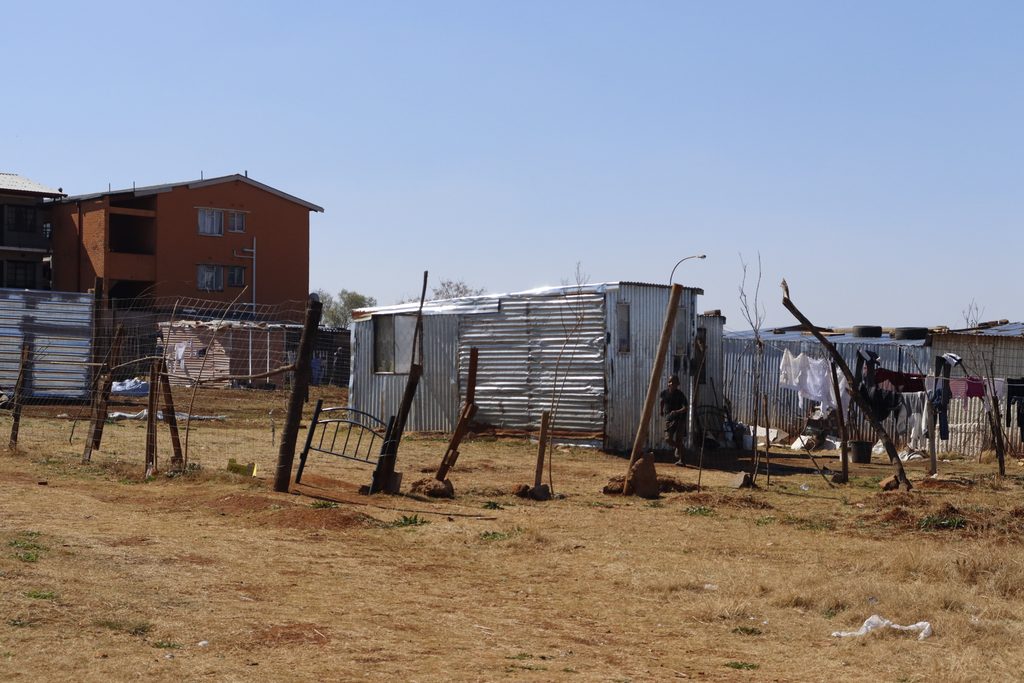
Right before night spills into day, the valleys of Eldorado Park are bathed in shadows of deep purple. Nestled in the grassy plains stands a makeshift house no larger than six paces in length. Almost a year into its existence, the shelter stands tall as one of the first built in the informal settlement of Actionville. Steadily, life unwinds within the corrugated iron and rusted zinc walls of this little matchbox.
In the inky black darkness, Elizabeth Percent (41) peels back the covers and rises before the sun to make breakfast for her children. She walks to the gas-stove, guided by the weak glow of her phone flashlight. Tick-tick-tick. A tiny blue flame erupts from the cylinder with a hiss. Methodically, Elizabeth sets her pot on the metal stand and begins slicing bread.
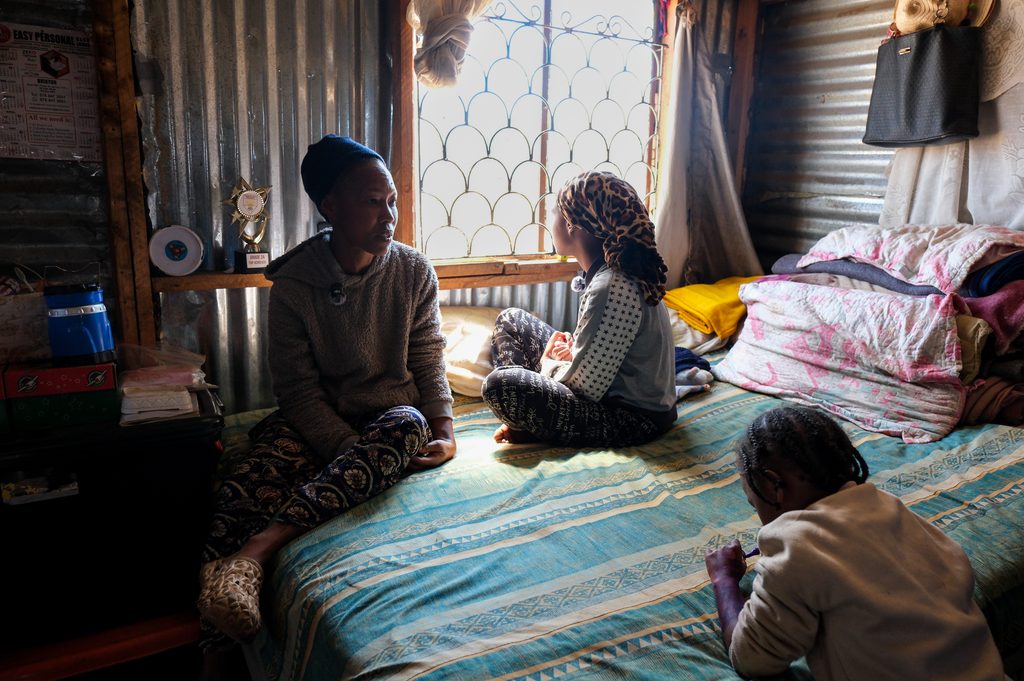
Elizabeth seated on the bed with her children. Photo: Hannah Brown.
“We had to make fires in the beginning,” Elizabeth says with a distant gleam in her eye. “Everything was on a fire. Your home smelled like a fire even.” She pans her gaze to her children scattered around on the bed, her eyes lowered. “I now cook on a gas-stove. If it was me 3 years ago, I would’ve never done gas.”
Her four children stir in the dark from the commotion. Willow (3), her granddaughter whom she was babysitting, remains within the warm nest of blankets, unwilling to budge. Spurred by their mother’s commands, each child begins performing their morning rituals like clockwork under the dim glow of a battery-powered lamp.
Cleotus (10) is lacing up his shoes. Anastacia (9) is pulling her hair into elastics. Tarryn (5) and Willow sit huddled together under the covers, squealing as big sister Hayley (16) comes to wipe their grinning faces with a cloth.
The shelter where Elizabeth and her children reside. Photo: Jamie Ho.
As the sun peeks over the valley into the lace-adorned windows, a soft golden light trails up the corrugated walls, illuminating the cheery faces huddled on the bed. Elizabeth carries steaming bowls of porridge to them. Excited squeals are silenced by the hasty shovelling of spoons into hungry mouths.
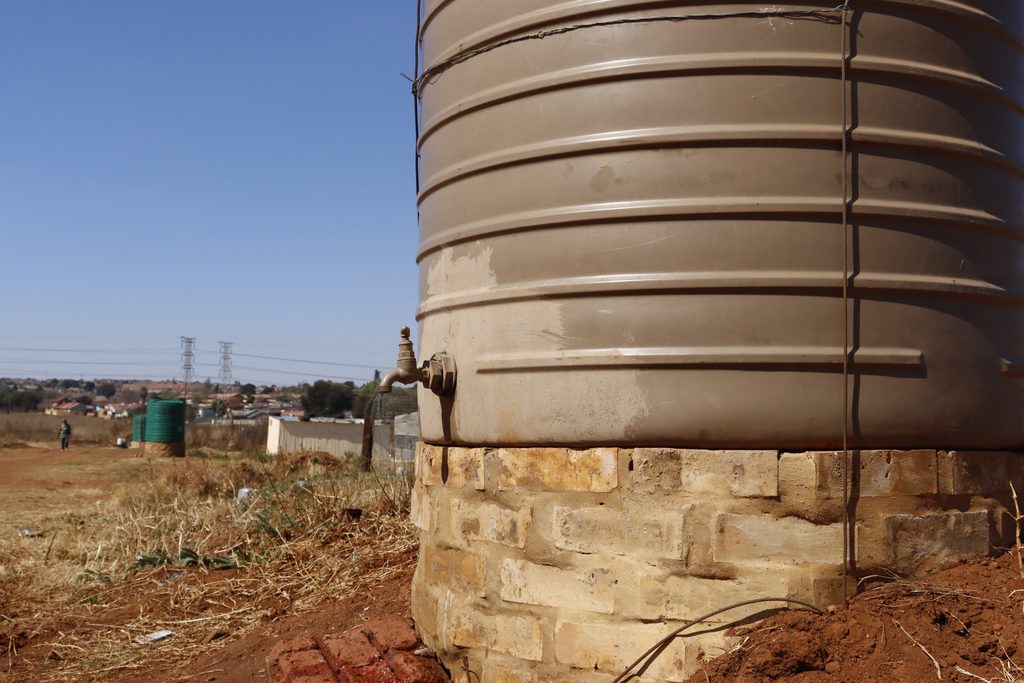
At the far end of the room is an old sink bowl, disembodied from any pipes, where dishes pile high, but no water trickles from the spout. Instead, Elizabeth carries water back and forth from the JoJo tanks installed around the settlement, storing them in containers under the table. She empties one into the pot, which she sets on the stove.
“We never used to have JoJo tanks,” she explains, “The surrounding community used to assist us with water.”
A JoJo tank installed along the path in Actionville. Photo: Jamie Ho.
However, despite having access to the tanks, the community still faces many problems with sanitation, especially since there is no running water for toilets. “We have manholes,” Elizabeth says, “We dig a hole and we use the bucket system. Or you do it in the house, or if you’re comfortable, in a small area outside and then you go and throw it away and wash your bucket.” This process, however, fills her with dread as it exposes her children to unsafe, unhygienic conditions.
Now the warm sunlight has filled every crevice of the shack and has ignited a burst of energy in the children. They begin soaring onto the bed, charging out of a home too small to contain their joy. Bursting out of the door, the cold morning wind pools over their tender faces as they sprint around the four corners of their fenced-off yard.
“I feel like a superintendent sometimes,” Elizabeth says with a slight chuckle. “Everything needs to be in order. If each one stays in their lane and just follows through on what [their] responsibility is, it’s easier.” She casts a stern glance at Tarryn and Willow, who are fighting over a mic.
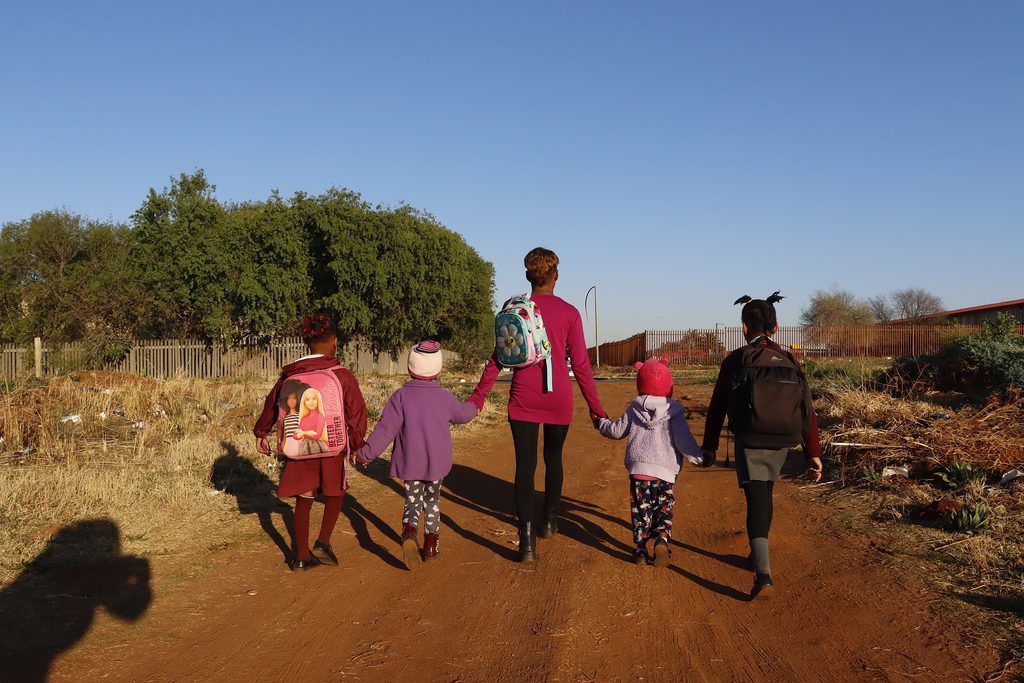
Hayley pulls open the low metal gate, and the children spill out from the yard into the copper-red plains. Elizabeth chides each one to make a line, and, like magnets, her children form a chain-link of hands.
Down the open dusty road, they strut like soldiers. The chants of an army of children carry through the air.
“We walk straight. We walk straight. If you don’t move out the way, we will kick you in the face,” they sing, lifting their legs up high to kick the air in front of them.
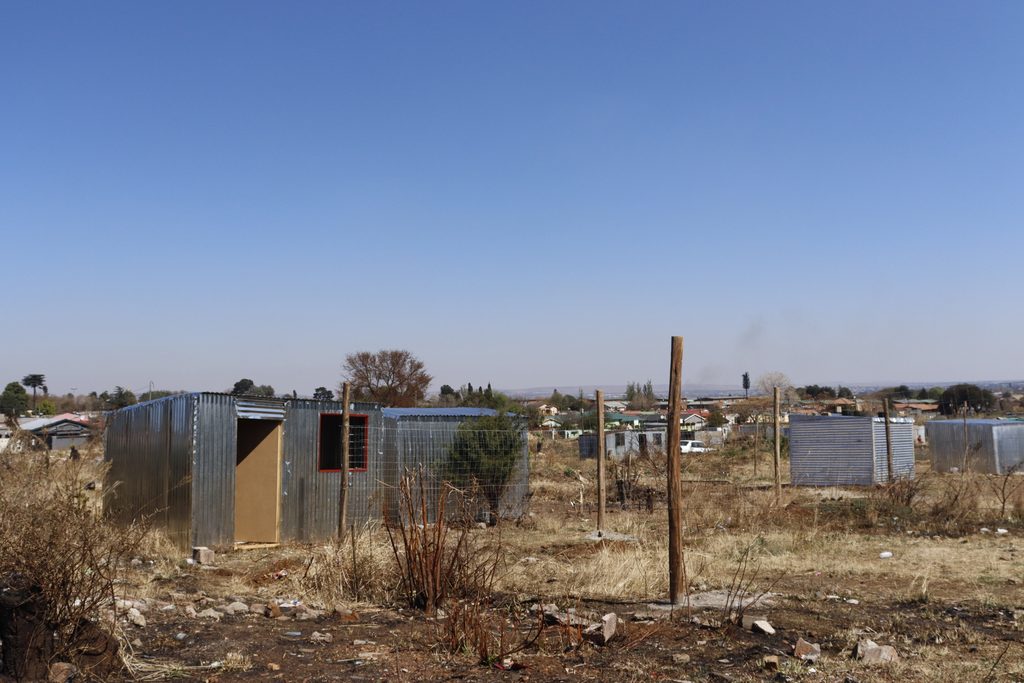
“This used to be an open field,” Elizabeth states, gesturing towards the settlements dispersed around the grassy plains.
Informal dwellings scattered across the grassy plains. Photo: Jamie Ho.
Actionville is one of thousands of informal settlements that have sprouted across the country born out of a desperate, decades-long housing backlog that has left millions waiting on government waiting lists.
A year ago, during the early days of Actionville, residents faced constant pushback from law enforcement, with Elizabeth’s home under threat of being bulldozed. To comply with their demands, she chose to dismantle the shelter herself.
“If they do get it right, it’s a demolish,” Elizabeth explains, “They use their bulldozer and they drive over your home so it’s damaging everything that’s in there, and this was my home. It’s been my home for the longest time.”
Eviction threats are a recurring reality for informal dwellers. Time and again, police have raided communities to tear down newly erected shacks, only to meet fierce resistance from residents determined to protect their homes.
Under the current Prevention of Illegal Eviction (PIE) Act, authorities must secure a court order before demolishing homes. Proposed amendments would remove this requirement, making evictions far easier. While officials claim the changes target illegal land syndicates, housing rights advocates warn the loss of these legal protections will leave vulnerable families like Elizabeth’s with nowhere else to go.
“If they make this amendment, we could lose everything,” Elizabeth says solemnly.
Her grip remains firm on her children’s hands as they approach the school. As she hugs each one goodbye, she watches them depart, their chattering and giggles fading round the bend.
Elizabeth and her children walking to school. Photo: Jamie Ho.
FEATURED IMAGE: Elizabeth seated on the bed with her children. Photo: Hannah Brown.
Women in journalism face online abuse – threats, harassment and silencing – but their courage and solidarity, show that storytelling and seeking truth matter more than hate.
We live in a remarkable but complex time of converging crises. The shift from ‘traditional’ journalism to digital platforms has transformed the field. Journalists no longer wait for print deadlines or broadcast slots; they speak directly to audiences, explain issues, challenge power and help people make sense of a world that often feels overwhelming.
This excites me, as it opens new creative ways to engage, but it also scares me. Visibility comes with risks and for women, the price is disproportionately high – harassment designed to discredit, exhaust and silence. Threats of physical harm, sexualised abuse and online attacks have become the new ‘normal’.
On August 6, I attended a discussion in Johannesburg between Karyn Maughan, Qaanitah Hunter and Redi Tlhabi, titled Women VS. The Digital Machine. These are three prominent women in journalism, and they spoke about navigating digital hostility while remaining visible and credible. For women, visibility often comes with targeted abuse that is designed to drive us out of the conversation.
A SANEF study found that 75% of South African women journalists face online misogyny. I don’t need statistics to believe it. It is a lived reality for many of the women I look up to. The hostility is not random. It is ‘manufactured anger’, heightened by platforms whose business models thrive on outrage and misinformation.
Women covering politics or corruption are especially targeted. In 2024, Women Press Freedom identified 12 Strategic Lawsuit Against Public Participation (SLAPP) suits against women reporting on gender issues.
As a postgraduate journalism student, I often think about the work of photojournalist Lynsey Addario. Her career reshaped my understanding of journalism’s power. Addario is a strong advocate that women should not be limited in the assignments they work on. “Men and women have different access, we relate to people on different levels, and people respond to us differently, so certainly that will create a different dynamic with a camera, but I don’t think that, for example, as a woman I see differently,” she said. “What I choose to capture is possibly different from what my male colleagues do.”
Social media, the same tool that connects us to readers, also amplifies anger and division. Anonymous accounts and bots spread lies and hate. We are living in a time that some call ‘hyperpolitics’ – a state of politicisation without corresponding political action.
Yet women journalists continue to report, hold power to account and to tell stories that matter. Their dedication inspires me. It reminds me that journalism is not about ourselves; it is about trying to tell the truth, empathy and refusing silence. As Tlhabi said, “If we get obsessed with the hate we get, then they have won.” Section 16 of the South African Constitution protects freedom of expression. The question Tlhabi always comes back to is, “What is the cost of my silence? If I stay quiet, who benefits and who suffers?”
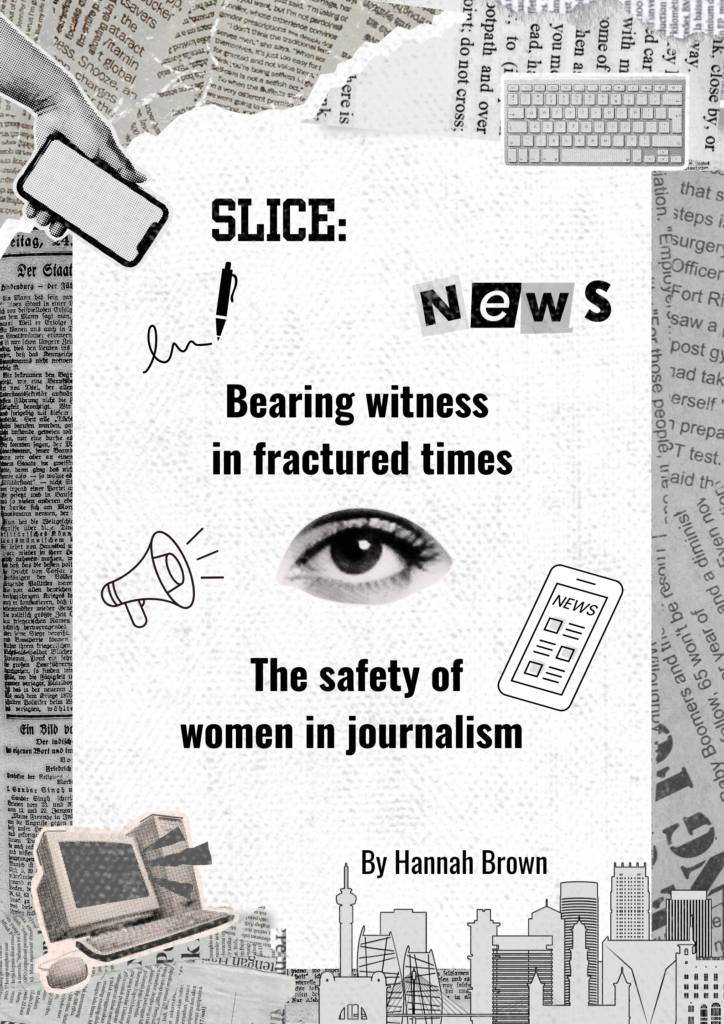
Safety of women in journalism. Graphic: Hannah Brown
There are no easy solutions. Governments and media institutions must take cyber misogyny seriously. Platforms must be held accountable for the anonymity that shields abusers. Newsrooms, even as they shrink, need stronger support systems. And as journalists we must find solidarity, because joy is a form of resistance too.
As Hunter shares, “Don’t become what you fight. Foster joy. There is nothing that can contend with hate more than seeing a happy woman.”
Journalism has the power to change how people see the world. That is worth fighting for and it is worth protecting. As filmmaker Alice Aedy stated, “how to bring stories to life in a landscape that feels more challenging but perhaps riper with possibility than ever.”
Despite the hostility, I feel hopeful entering this field. Women in journalism have already transformed the industry, but the attacks are disproportionate, and we must continue to stand together. The advice I hear repeated is simple: never stop learning, never stop reading, and never forget the privilege and responsibility of this work.
FEATURED IMAGE: Safety of women in journalism. Graphic: Hannah Brown
Hundreds took to the streets, calling for protection of housing rights and an end to rising xenophobia.
Operation Ubuntu marched to the Premier’s Office to oppose the PIE amendment and rising anti-migrant sentiment.
Housing activists and informal settlers argue that the revision to the PIE Act criminalises poverty.
The march’s memorandum calls for greater state accountability in handling anti-migrant hostility.
On the morning of August 8, a coalition of over 60 social justice organisations under the name Operation Ubuntu led a march to the Premier’s Office demanding an end to xenophobia and a rejection of the proposed amendment to the Prevention of Illegal Eviction (PIE) Act.
The march was one of many coordinated protests taking place in Johannesburg, Cape Town and Durban in response to two issues affecting marginalised communities: ongoing xenophobia and housing insecurity.
Marchers charging through the streets holding banners and placards. Photo: Jamie Ho.
Woman holding a placard condemning xenophobia. Photo: Jamie Ho.
Frustration as protestors march for housing rights and an end to xenophobia. Photo Jamie Ho.
Central to the protest was the recent proposal for an amendment to the PIE Act. Currently, people cannot be evicted from their homes without a court order as the Act operates in accordance with Section 26 of the Constitution, which stipulates that “everyone has the right to access adequate housing”.
Activists fear the proposed amendments would weaken these protections, particularly for people living in informal settlements and other forms of insecure housing. They are particularly concerned that courts could order evictions without requiring municipalities to provide alternative accommodation.
“The municipality cannot have that power of evicting us without meaningfully engaging with us and without even understanding our background,” said Operation Ubuntu coordinator, General Moyo.
Housing activists condemn the proposed revision for failing to address the structural causes of housing insecurity that stem from poverty, entrenched inequality and poor governance. Instead, it places further strain on already vulnerable communities by forcing them out of their homes.
“Critics have long referred to this approach as pounding the tip of the ice-berg or swatting at the flies when a corpse is rotting,” explained Marie Huchzermeyer of Siyafana Sonke, a civic movement aligned with Operation Ubuntu.
Furthermore, the government’s persistent failure to address housing insecurity has left residents with few options. “In 33 years, not one RDP house was built in our community,” said Fagmedah Edeies, who resides in an informal settlement within Eldorado Park. “As a mother, I must remember that I have children and I have grandchildren. Where will they then go if this amendment is passed?”
Data visualisation showing housing backlog. By: Jamie Ho.
Beyond housing insecurity, the march also confronts escalating waves of xenophobia across the nation. “We are in solidarity with all the African brothers and sisters that are facing the crisis,” Moyo affirmed.
In their memorandum, Operation Ubuntu called for greater action from state institutions in handling matters of anti-migrant hostility.
Firstly, it singled out SAPS for not protecting vulnerable migrant communities from vigilantism. “We are calling on the police,” Moyo explained, “to make sure that they abide by their obligation which is to serve and protect without discrimination and without favour.”
Secondly, they highlighted the issue of documentation as a systemic failure by Home Affairs and demanded a two-year moratorium on all arrests and forced repatriations to allow migrants sufficient time to obtain documents.
Thirdly, in light of the upcoming elections, Moyo warned political parties against scapegoating migrants for electoral gain. “We will be watching those that will be campaigning trying to use the platform of hate and violence in communities to get votes.”
Held on the eve of Women’s Day, the march highlighted the broader demand for dignity, security and equal protection. For protestors, xenophobia and housing rights are part of the same struggle: a move to ensure that vulnerable communities, and the women and children within them, are not left without a home or a voice.
A mother holding a placard advocating for women and children safety. Photo: Jamie Ho.
Protestors chanting through the streets against the PIE Act amendment and xenophobic violence. Photo: Jamie Ho.
“Stop treating us like animals” reads sign at protest. Photo: Jamie Ho.
FEATURED IMAGE: A placard advocating for women and children safety during the Operation Ubuntu protest. Photo: Jamie Ho.
The closure of City Press feels symbolic for journalism students growing up in the digital era.
The closure of City Press reflects the decline of traditional print journalism.
Journalism students are preparing for an industry increasingly dominated by digital media.
Despite the shift of digital journalism, newspapers still represent an important part of journalism culture.
As a journalism student, I always imagined my future inside a busy newsroom. Pictured reporters rushing to meet deadlines, newspapers stacked on desks and the sound of keyboards filling the room as stories came together before print. Growing up, newspapers felt permanent. They felt important. The closure of City Press in addition to several other titles shut down by Media24, felt like a violent wake up from a beautiful dream. One never gets used to that.
When news of the newspaper’s closure broke, it felt bigger than the loss of a publication. It felt like the end of a version of journalism many students like me had hoped to become part of one day.
Growing up, I witnessed the slow decline of print newspapers as more people turned to digital media for news. As journalism students we already publish stories online and use websites during practicals, so digital journalism already feels normal to us. However, the closure of City Press still felt significant because it marked the end of one of South Africa’s last major print newspapers.
Most people now consume news through their phones before it ever riches print. Social Media updates appear faster and are easier to access, which explains why fewer people still buy newspapers. Although digital newspapers have become the norm, newspapers still carried a sense of tradition that made the closure of City Press feel Symbolic.
Even though many journalism students are already preparing for digital media spaces, the closure of City Press still feels emotional because newspapers were once seen as the centre of journalism. Watching another print title disappear makes the shift from print to digital feel more final.
Despite this uncertainty, the closure of City Press also reminded me why journalism still matters. Even if newspapers disappear, people will always need stories that inform, expose and reflect society honestly. Journalism may no longer look the same as it once did, but its responsibility remains important.
The closure felt personal because it represented more than the loss of a newspaper. It represented change and uncertainty. Still, while many aspiring journalists continue studying, writing and preparing themselves to tell stories in whatever form journalism takes next they are faced with this uncertainty.
The newsroom may be changing before we even enter it, but the passion to tell meaningful stories remains.
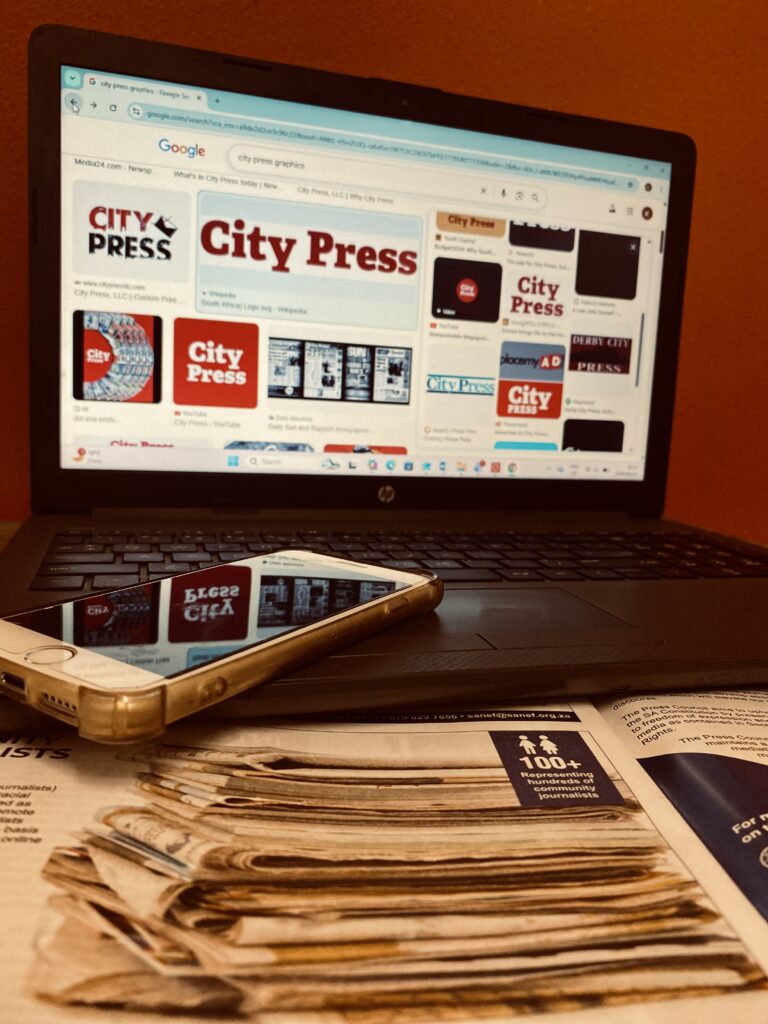
Print in the magazine, phone and laptop: City Press visuals, Photo: Khutso Ngwatoana
FEATURE IMAGE: Print in the magazine, phone and laptop: City Press visuals, Photo: Khutso Ngwatoana
Growing violence, censorship and political attacks against journalists have driven press freedom to its lowest point. Speakers at the Investigative Journalism Summit highlight the urgent need to defend truth in an era where “reality itself feels fake”.
The 2026 RSF World Press Freedom Index reports lowest global score in its 25-year history.
The 2026 Investigative Journalism Summit warns that intimidation, online harassment and imprisonment is silencing journalists worldwide.
129 journalists were killed in 2025, highlighting the important need to protect press freedom.
As the world observed World Press Freedom Day on May 3, 2026, journalist safety came under the spotlight more than ever before. Around the world, intimidation, harassment and imprisonment are increasingly used to silence reporting. 2025 was the deadliest year on record with 129 journalists killed worldwide. According to the 2025 Human Rights Watch Report, approximately 72% of the world lives under authoritarian regimes, where they are locked within state-controlled information. The latest Reporters Without Borders (RSF) World Press Freedom Index shows that press freedom is now categorised as “difficult” or “very serious” in more than half of the world’s countries – the lowest global score in the Index’s 25-year history.
Journalism helps the public make informed, fact-based decisions and hold power to account. In a time of misinformation and disinformation, no one knows what to believe anymore. At the 2026 Truth Tellers, Sir Harry Evans Investigative Journalism Summit, held on May 6, Katherine Viner, Editor-in-Chief at The Guardian, reflected on our changing information landscape. “We used to talk about fake news, but now reality itself feels fake,” she said.
The theme of World Press Freedom Day 2026 was ‘Shaping a Future at Peace’, highlighting the important role of independent media in conflict zones. Accurate and timely reporting can save lives, counter disinformation and expose state violence. Yet, despite protections under international humanitarian law, journalists are increasingly treated as targets.
Governments are weaponising laws to silence reporters. RSF warns that journalism is being “asphyxiated” by political attacks, reduced media funding and a system that is criminalising reporting. As the RSF Index revealed – the United States dropped seven places, signalling a loss in media independence, following cuts to international broadcasters and repeated attacks on the press by President Donald Trump. In Latin America, Ecuador fell 31 places after the murders of journalists Darwin Baque and Patricio Aguilar. While Peru dropped 14 places following the killing of four reporters.
South Africa ranks in 27th place, the highest on the African continent and includes a range of media outlets. Although, many independent journalists still face challenges, and public broadcasters sometimes deal with political pressure. In a 2023 statement, SANEF highlighted “trends of trolling and doxing, (the act of disclosing a journalists full name, address, contact number, and other identifying details without their consent).”
Israel continues to commit violations of international law, and the military were responsible for killing two-thirds of journalists last year. According to RSF, since October 2023, more than 220 journalists have been killed in Gaza, including at least 70 while reporting.
Across the Sahel, countries such as Niger have experienced a collapse of press freedom under armed groups and military juntas. Sudan has become one of the most dangerous places to work; the ongoing civil war has created a climate of fear as Government targeting and military violence continues.
Online harassment, particularly against women reporters continues to rise. During the Summit, Maria Ressa, a Filipino journalist and co-founder of Rappler, said she received “an average of 90 hate messages per hour” online, adding that, “you’re targeted because you’re a journalist, because you determine fact from fiction.”
World Press Freedom Day poster. Photos: Hannah Brown
In Iran, thousands were killed during protests, and journalists were jailed under cybercrime laws. Similar methods have also been seen in Bahrain, Kuwait, and the wider Gulf region, where reporters have faced imprisonment for documenting conflicts. Despite the dangers, Ressa insists there is no better time to be a journalist, and we must rebuild how we are doing things. “The battle is now. So, if you’re a journalist today, man, this is the time to jump in.”
Press freedom advocates argue that attacks on journalists are a warning of wider threats to freedom. Speakers at the conference also explained deliberate strategies to weaken journalism – slandering and discrediting reporters, weaponising visas and targeting support systems. Caoilfhionn Gallagher KC, International Human Rights Lawyer stated, “the idea of undermining the journalist so you undermine the messenger, and therefore you undermine the message.
Organisations around the world are pushing governments to end crimes against journalists and protect those reporting from conflict zones. As photojournalist Lynsey Addario stated, “we all suffer when we can’t see the truth.” Without safeguards, the world risks losing not only its reporters but also the public’s access to information.
FEATURED IMAGE: World Press Freedom Day poster. Graphic and photos: Hannah Brown
Being a first-year can conjure up a rollercoaster of emotions, and navigating it can turn survival into belonging.
The moment my parents’ car disappeared down the road outside my residence four years ago, reality hit me. Standing there in a new place, surrounded by unfamiliar faces and unpacked boxes, I felt a knot in my stomach and my chest tightened with anxiety. It was bittersweet watching them leave, I felt a mixture of both excitement and fear settling in all at once. As shy as I was, I knew this was an opportunity of a lifetime.
Around me, students laughed as their parents helped them carry boxes upstairs, rooms and corridors buzzed with conversation, and new friendships seemed to form effortlessly. I knew no one. I kept questioning if I truly belonged here. I did not realise then, what I know now, which is that almost everyone around me was feeling the exact same way I did. Even in my loneliness, I promised myself that I would make the most out of this experience.
Walking onto the Wits University campus for the first time can be both exciting and terrifying. Your first year at Wits represents a sense of freedom and possibility, but also pressure and uncertainty, this marks the beginning of a journey that will test you in ways you never expected.
Wits is more than just attending lectures and keeping up with submission deadlines. Outside of classes you will quickly come to realise that this university has so much more to offer. Whether you are grabbing something to munch on at the Matrix, sitting on the Lawns with your new formed friends, or doing the occasional people-watching on the Great Hall steps, these spaces become the heart of student life on main campus.
The fountain separating the Great Hall from the Library Lawns, it brings a relaxing white noise during stressful days. Photo: Bonolo MokonotoThe Matrix, located on east campus. This is a busy student center, with food vendors, banks and the Campus Bookshop. Photo: Bonolo MokonotoThe Main campus bus stop. This is where you will catch the Wits bus that takes you to the other wits campuses and residences. On the same road is AMIC Deck which is the bridge that connects east and west campus. Photo: Bonolo Mokonoto
Hundreds of events are hosted by various clubs and societies and pop- up performances are frequent; this is to remind you that Wits is a community, as much as an academic space. Ensure that you get involved as it will help make campus feel less stressful and more like home.
Speaking of stress, the change from high school to university is drastic and this can be overwhelming. No one is here to remind you of deadlines or check if you are keeping up academically, it is important that you take agency over your own life. First year is not about being perfect, it is about learning how to manage your time efficiently to avoid unnecessary stress later on.
Making friends can be tricky, campus is constantly busy and it is easy to feel alone in the crowd, as was I upon arrival. People might seem like they have it together, but they are silently navigating the confusion and anxiety just as you are. Do not be afraid to talk to the person sitting next to you in a lecture or ask questions in tutorials, you would be surprised how many people feel exactly the way you do.
Zesti Lemonz on west campus, this eatery provides light meal takeaways for students on the go and provides an outdoor seating area to mingle with friends. Photo: Bonolo MokonotoJimmy’s, located on west campus with a corresponding location at the Matrix. Photo: Bonolo MokonotoThe Wits Anglo American Digital Dome is a 360° immersive digital facility on east campus. It provides a state- of -the art venue showcasing science, arts and culture. Photo: Bonolo Mokonto
As the year continues, it is important to know where you can seek out help. Wits offers academic development units such as the Wits Writing Centre, tutors, and libraries that are there to support you. Make use of these facilities early on, there is no shame in seeking help.
Recreational sports facility located on west campus, this is where you can bond with other sports lovers and engage in the ever therapeutic team sport. Photo: Bonolo MokonotoOutdoor gym on west campus close to Barnato Hall Residence. Photo: Bonolo MokonotoA deeply hidden dam and water feature located on west campus next to Barnato. This is known to the seasoned witsies as a secret getaway from the constantly hectic wits campus. Photo: Bonolo MokonotoAlumni House on the lower end of west campus, it houses Olives and Plates a restaurant on campus for all to enjoy. Photo: Bonolo Mokonoto
First year will test you, you might fail a test, or question whether you belong or not. Do not give up, keep showing up and take it one day at a time.
Oh and remember, once a Witsie always a Witsie!
FEATURED IMAGE: The Great Hall at Wits University. Photo: Bonolo Mokonoto
A moving memorial service honoured Tshidi Madia’s dedication, mentorship, and enduring passion for journalism.
Tshidi’s memorial program. Photo: Dikeledi Ramabula
Tshidi Madia, passed away, at age 42, after a short illness.
Remembered as a passionate journalist, mentor, and friend at her memorial.
Her dedication and influence have left a lasting mark on South Africa’s media community.
The South African media fraternity bid farewell to veteran journalist Tshidi Madia (42), Associate Editor for Politics at Eyewitness News (EWN), who died last week, on August 27, 2025 after a short illness.
On Tuesday,September 2, friends, family, and colleagues gathered at Primedia, Sandton for a memorial service that celebrated her life and lasting impact. The ceremony opened with a moving performance by the Greenside High School choir, whose soft, tender hymn wrapped the hall in an atmosphere of sorrow and grace.
Madia, remembered for her warmth and lively spirit, was described as a journalist who deeply loved her country, her profession, and the people around her. Nisa Allie, EWN’s Editor-in-Chief, spoke on behalf of the newsroom, recalled Madia’s tireless passion for political reporting.
“Even when she was not on diary, Tshidi would pop into our WhatsApp groups just to say she was going to stop by an event or gathering to see what she could get or who she could talk to. That’s how passionate she was,” Allie said.
For younger journalists, Madia was more than a colleague. Alpha Ramushwana, a news reporter at EWN, shared how she became his mentor when he first joined as an intern in 2022.
Tshidi’s memorial venue in Sandton. Photo: Dikeledi Ramabula
“Tshidi saw something in me that I didn’t see. She told me I would have a great career in journalism, and for the past three years, she kept affirming that,” Ramushwana said.
Her family, too, paid tribute to her unwavering dedication. Reabetjoe Makoko, Madia’s sister, said: “My sister worked hard, she loved what she did, and so many people didn’t know until that moment of the US, but trust me she’s been working so hard for many years.”
As memories and tributes flowed, a portrait emerged of a woman who was not only a formidable journalist but also a loving sister, mentor, and friend. Tshidi Madia will be remembered for her beautiful heart, her relentless work ethic, and the love she shared with all who knew her.
FEATURED IMAGE: Tshidi Madia’s image at the memorial. Photo: Dikeledi Ramabula
When boy problems or heartbreak have you on shaky ground, Shekhinah’s Less Trouble comes in like a wave, and it’s strong enough to drown you in your feelings.
Crowned as one of South Africa’s most celebrated voices, Shekhinah is back to prove that her music still hits where it hurts. Four years since the last album, Trouble in Paradise, her return is a reminder of just how good she is at what she does.
Shekinah’s album Less Trouble features several artists including Lordkez, Moliy, Young Stunna and Mars Baby.
A year ago, she released two singles, “Steady” and “Risk”, offering listeners a preview of the upcoming album’s direction.
“Devil in disguise, trouble in your eyes, every single time all we do is fight.” With these lyrics, Shekhinah sets the tone from the very start. The opening track, “Break up season”, lays the foundation, hinting that the album will centre on the highs and lows of relationships.
From her album Rose Gold to now, she’s stayed true to her signature sound, rarely chasing trends or charts, and instead focuses on making music that ages like fine wine.
Shekhinah’s album cover. Photo: Shekhina’s IG
On track 3, “Bare minimum”, Shekhinah strikes a chord with anyone who’s ever been given the bare minimum in a relationship. She reflects on asking for little yet receiving even less and ultimately reaching the point where letting go becomes inevitable.
The playlist opens with a sense of tension and frustration but soon transforms into bursts of pure joy. By the time you reach track 7, “Spoonky”, it feels like freedom itself, like cruising down the freeway with the windows rolled all the way down, warm wind rushing against your face, palm trees swaying past in a blur. You’re singing off-key, laughing uncontrollably with the love of your life in the passenger seat, every worry dissolving into the sunset. It’s a moment of pure happiness bottled in sound.
“Less trouble” isn’t just an album; it’s a celebration of love, happiness, and the freedom to finally feel complete, just as she says on “Spoonky”, “you’re the one that I want”.
Rating: 8/10
FEATURED IMAGE: Shekhina’s album cover. Photo: Shekhina’s IG
Israel adds to the already harrowing death toll of media workers reporting from Palestine.
Journalists Against Apartheid take a moment to commemorate lost Al-Jazeera colleagues.
Anas al-Sharif was among the six journalists recently targeted by Israel.
South African journalists and supporters emphasise the need for the media to speak up and to report the truth.
It was a sombre and almost muted affair, as a handful of South African journalists gathered on August 14, to honour slain colleagues in Palestine.
Journalists Against Apartheid gathered outside the Al-Jazeera office in Auckland Park, holding candles, placards and some draped in keffiyehs to remember those who have been killed by Israeli forces.
Journalist holding a candle in commemoration of lost media workers in Gaza. Photo: Ekta Seebran
Housed in a tent outside Gaza City’s al-Shifa hospital, Anas al-Sharif, a Palestinian journalist for Al-Jazeera Arabic, along with colleagues Mohammed Qreiqeh, Ibrahim Zaher, Mohammed Noufal, and freelance journalists Mohammed al-Khalid and Momen Aliwa, were killed in a targeted Israeli airstrike.
Israel admitted to targeting al-Sharif on the belief that he was the head of a Hamas terrorist cell but has yet to produce any evidence of this.
Faseegah Davids, coordinator of the Palestine Solidarity Committee, said, “making people feel powerless is the tool of the oppressor, journalists being silenced and killed in Gaza are used to misguide the world in terms of narrative and truth. But we know the truth. They have already been exposed.”
Since October 2023, 272 journalists and media workers have been killed in Israel.
Placards made by supporters. Photo: Ekta SeebranSupporters taking a moment of silence for the lost journalists. Photo: Ekta Seebran
Josephine Kloekner, freelance journalist and organiser of the vigil, said, “It’s not a time we can just be hesitating, because all our colleagues are dying, we have to show our faces and speak up, because if we don’t, who will do it for us.”
The gathering heard voices from not only journalists and supporters of Palestine, but also from media workers on the field sent a message to be read to the crowd, which said:
“The target is truth. We knew them not as bylines, but as friends, as colleagues. Whenever we could get coffee, we shared it with them […] We ran towards danger, not away from it, because we are fearless. But in actual fact, we live in fear. It’s our natural state, and we know that the world must see. We mourn today, but we pick up our cameras tomorrow […] We can never allow Gaza to die without us.”
FEATURED IMAGE: Photos of Al-Jazeera journalists killed on 10 August 2025. Photo: Ekta Seebran.
South Africa was crowned the country with the most press freedom in Africa after moving up 11 positions this year.
South Africa guarantees media freedom, as indicated by the recent World Press Freedom Day Index.
The 2024 general elections are to owe for the increase in ranking.
Despite improvement, some challenges still need to be addressed.
South Africa climbed the ladder and ranked 27th globally for press freedom, a jump from last year’s 38th ranking, according to the 2025 World Press Freedom Index released on May 2. Earning the top spot in Africa.
The World Press Freedom Index (WPFI) is an annual report, published by Reporters Without Borders (RSF) on World Press Freedom Day, ranking 180 countries according to the degree of freedom available to journalists in the previous year.
The country’s media freedom ranking is identified as ‘satisfactory’.
South Africa’s global media freedom ranking over five years. Graphic : Lukholo Mazibuko
“There is no question that journalists in South Africa work freely across the spectrum,” says Slindile Khanyile, Sanef’s (South African National Editors Forum) media freedom subcommittee chairperson.
But she adds, “Of course, it is not to say that there are no attempts to intimidate or censor them, but these are rare.”
The shift in position is believed to be indicative of the prominent 2024 elections. “I think being able to freely cover the 2024 general elections, which led to a coalition government at national level, for the first time since the dawn of democracy contributed to this,” says Khanyile.
On the elections, Reggie Moalusi, executive director of Sanef, adds, “Fortunately, we saw very few incidents when it comes to journalists being harassed and media freedom transgression where journalists or media houses were not allowed to do their work.”
Despite the progress, Moalusi critiques that the improvement on the mitigation of online harassment among female journalists would positively agitate the country’s ranking, for though the critical importance of media freedom is highlighted in the index, the treatment of journalists should not be overlooked. “There’s still a whole lot more of work that still needs to be done,” he said.
Khanyile also believes that “the continuation of investigative journalism in the public and private sector(s) played a role and contributed to the growth of independent media ownership.”
Waste Land covered by News24’s Sikonathi Manthshantsha and The Laundry by Dewald Van Rensburg of amaBhungane are examples of award-winning investigative series that reflect quality journalism.
Therefore, as Khanyile says, “[The index] reaffirms the country’s commitment to freedom of the press and freedom of expression.”
University students in South Africa, like their counterparts globally, experience substantial mental health issues characterised by high levels of psychological distress and limited access to professional help.
A nurse allegedly dismissed a student experiencing depression, advising that more sleep would resolve her condition.
A student having an anxiety attack was allegedly scolded by a nurse while seeking help.
The Centre scheduled additional sessions for the student to resolve the matter, but she never showed up.
The student raised serious concerns about the quality of mental health support provided by Wits Campus Health and Wellness Centre.
“Sister Simangele Sitoe told me I was lazy and dismissed me with sleeping pills and antidepressants,” the student said.
Only after filing a complaint with a former intern named Karabo Molefe, was psychiatric assistance made available.
However, the issue continued in 2025. During an anxiety attack, the student returned to the Centre, only to be scolded by another nurse, Sister Ntombi Dantjie. “She shouted that she’s been a psychiatric nurse longer than I’ve been alive and that I was wasting her time”, the student alleged.
Wits’ Campus Health And Wellness Centre – Photo: Dikeledi Ramabula
Wits Vuvuzela reached out to both psychiatric nurses. Dantjie was unavailable for comment.
However, Sitoe denied the allegations, “I only interacted with the student once, after the first session, she decided that she does not want to interact with me ever again. After we referred her to another doctor here at the centre, the student would not avail herself and she did not come to collect her medication.”
In response, former intern, Molefe said, “The student came to me and complained about Sister Sitoe. I proceeded to book her multiple times to get assistance and sort out her issues with the nurse, but she never came.”
The head of department is currently not in the country to comment, standing in for him Mr. Brian Jele, the Primary Health Care Nurse at the Centre said: “There is a suggestion box available to all our patients here at the Centre, if any student has an issue, they have a right to voice out their matters, write everything down and put it in a box and everything will be investigated”.
Mr. Jele added, “When Mr. Ntshabele returns on Monday, I will report the matter to him and proper investigation will be conducted from there.”
FEATURED IMAGE: The Campus Health and Wellness Centre’s working hours. Photo: Dikeledi Ramabula
Artificial intelligence has the power to enhance journalism, but is journalism in more danger because of it?
Amid the chaos of a digital landscape currently being agitated and renovated by generative artificial intelligence, the news industry is no exception to its explosive impact. UNESCO aims to address this at a conference in Brussels on May 7 in commemoration of the 32nd World Press Freedom Day.
World Press Freedom Day takes place annually on May 3 to highlight the press’s current challenges and to raise awareness.
This year, the focus is on ‘Reporting in the Brave New World – the impact of artificial intelligence (AI) on press freedom and the media, highlighting the opportunities and challenges that AI has brought to journalism.
Unsurprisingly, generative AI is taking centre stage, as its disruption to the world of technology is too stark to ignore, especially in the news industry.
Principally, we know that news summarises and simplifies information. Broadcasts and articles essentially catch you up on current, recent or ongoing events and weave in analysis or interpretation.
So, does involving AI in this process really pose a threat as a technology that can soak up information in one form, drawing from existing sources to pour the same information into a different mould after?
Yes and no. I believe that anything involving AI means walking a tightrope and, as journalists, falling off that rope means jeopardising the foundation within which journalistic practice is built on — ethics.
A 2025 report by Thomas Reuters Foundation (TRF), paints the nuances of AI use in journalism in the Global South.
It states that 81.7% of journalists already use AI tools like CHATGPT in their journalistic work for drafting and editing content, research, fact-checking and idea generation to save time, reach new audiences and work more efficiently. Starkly, only 13% report using any official AI policy with 79.1% reporting an absence of any clear guidelines.
Of the few non-users, lack of awareness or knowledge of AI tools, insufficient training and support, lack of access to necessary technology, concerns about accuracy and reliability, ethical concerns, preference over traditional methods and fear of job displacement were some of the main reasons for not using AI.
Where newsrooms lack formal guidance and self-education on using AI tools prevails, transparency becomes fragile which is concerning when trust in journalism and the media is already tainted. I am at a crossroads because if AI use is disclosed in news articles, I’m not entirely sure if that would make me trust a news agency more.
That is because I value journalism’s core ethics and skills: original reporting, quality, accuracy, fact-checking and source verification.
Where ethics are concerned, one may question if post-evaluation of AI produced content was done because AI is known to sometimes hallucinate information, supercharging the spread of misinformation. So, as journalism is defined, it still leads as a reliable, fact-checked source of information.
Another ethical concern, as highlighted by The Conversation, is that while journalists may ask for the generation of summaries or idea prompts, sensitive information or copyrighted material is inadvertently uploaded into these public generative AI tools, which not only contravenes company policies but journalistic integrity.
TRF recommends that journalists “understand the ethical implications of AI”. These include “advocating for policies and practices that protect journalistic integrity, while also ensuring fairness and accuracy, and promoting trust with audiences.”
All of this considered, I cannot downplay the ease that AI has brought journalists. It should be welcomed in newsrooms as long as originality and critical thinking isn’t destroyed in the process.
FEATURED IMAGE: Live news broadcast by robot news anchor with breaking news lower thirds and a digital world backdrop. Graphic: Lukholo Mazibuko
In episode six of We Should Be Writing season 7, the team unpacked the evolution of music as a form of expression and protest, through four decades in the South African context. The episode explores the journey of South African music and its consumers from the 80s, 90s, early 2000s and contemporary listeners. From the […]