Lesotho’s frozen Maluti Mountains is home to Club Maluti – a rustic, analogue sanctuary where generations of Witsies have found lifelong bonds and adventure on its slopes.
Founded in 1968, Club Maluti remains the cradle of African snow sports.
A nearly 60-year partnership with Wits Snow Ski Club turns the remote mountain cabin into an iconic student rite of passage.
The hand-built, member-run lodge offers an analogue escape where phone screens give way to fireside traditions.
Up at 3,200 metres in the Maluti Mountains, where sub-zero air bites your cheeks and river gorges freeze into solid glass, sits a rustic timber lodge. Its living heartbeat the generations of snow-seekers that visit during the colder months. Tucked away in Lesotho, ten minutes down the pass from Afriski, Club Maluti (Club M) is a place where city stress dies on the switchbacks and generations of Witsies have found a second home.
Stepping through the timber door of Club Maluti after the 5-hour drive up from Johannesburg, the first thing that hits is not the cold; it is the immediate warmth of woodsmoke, room-wide laughter, and decades of lived history. Shedding my heavy winter coat as the sound of music hums through the room, I realise I haven’t just entered a cabin; I’ve stepped into a living time capsule and close-knit community.
How a crazy idea built a legacy
Sitting near the fireplace listening to older members share stories over cold beers, the roots of the place come into sharp focus. The story began in the mid-1960s with Syd Chaplin, who ran pony treks in the region before establishing Oxbow Lodge near the Malibamat’so River. Looking to draw winter crowds to the frozen highlands, Chaplin connected with Phillip Lloyde, a ski enthusiast, alongside Joburg-based friends Brian de la Harpe and Stan Flemming.
The four friends saw the snowy Maluti peaks as an ideal and natural playground for winter sports. Driven by a shared love for skiing and working through official channels, they secured permission from King Moshoeshoe II of Lesotho. They signed a 100-year lease on the land, under the strict condition that no one could profit from the club, before officially forming Club Maluti. What followed in 1967 was endless weekend work parties where members hauled timber up unpaved tracks; they completed the original A-frame in April 1968.
When their initial slope proved too sunny, local mine manager Keith Whitelock pointed them ten kilometres east to the Mahlasela Bowl, a cold, shaded natural amphitheatre. It proved to be the finest natural slope in Lesotho, establishing the cradle of African snow sports. Throughout the 1970s and 80s, South African families crossed the border to escape city life, skiing, ice-skating on frozen gorges, and dancing on lodge tables late into the night.
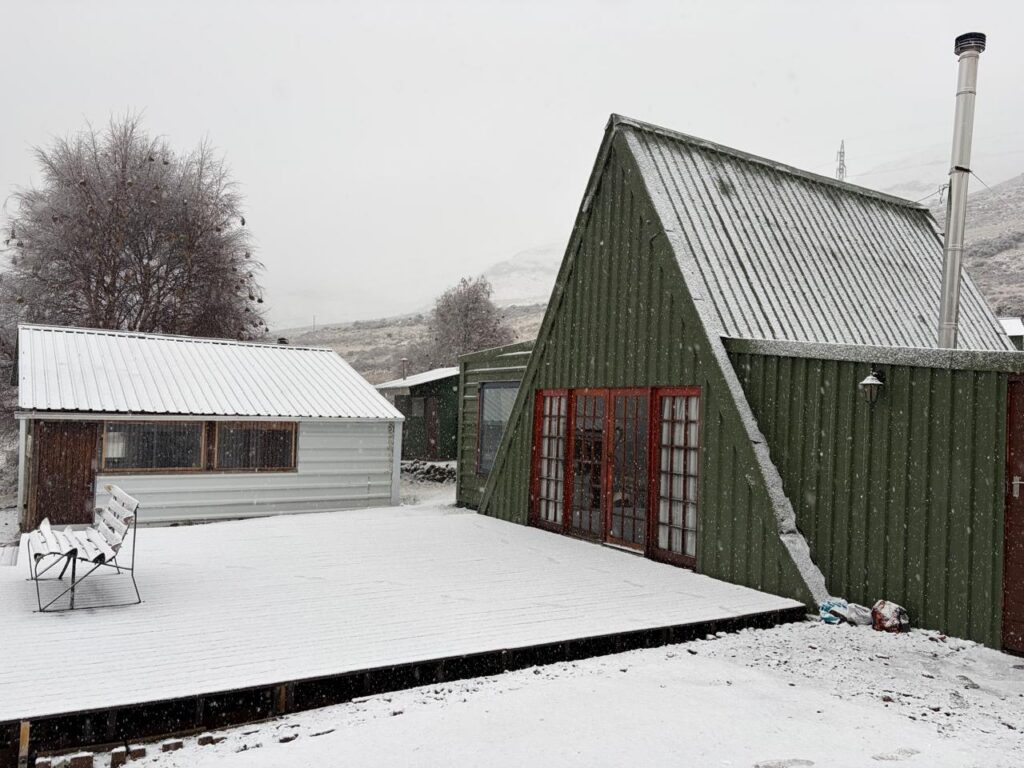
Original A-frame building during winter. Photo by: Daniella Ripamonti
When campus met the mountain
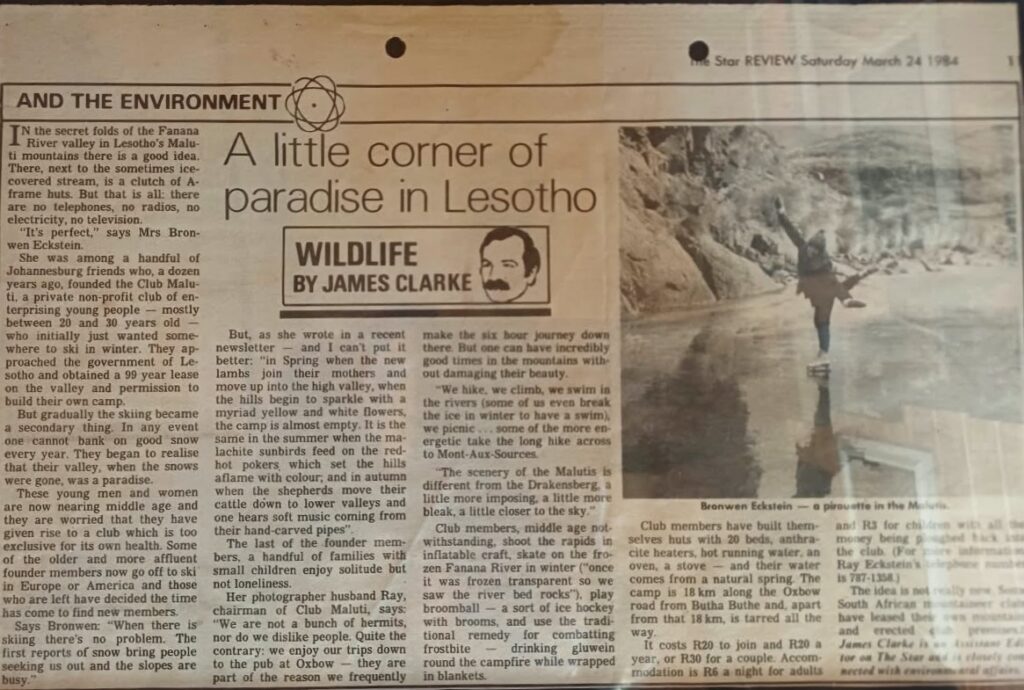
Walking through the cabin, I quickly notice how deeply Wits University is woven into the floorboards. In 1984, Wits student Ivan van Eck saw a newspaper photo of someone ice-skating in Lesotho. Entranced, van Eck drove up to investigate, fell in love with the place, and founded the Wits Snow Ski Club (WSSC) to bring campus along.
Van Eck eventually took over ski rentals and set up makeshift rope tows at the club in 1991. However, his push to create commercial ski packages directly violated the King’s non-profit mandate, famously leading to his deportation by Lesotho border officials in 1992 for operating a business without a hotel licence.
Meanwhile, through the late 1980s and 90s, Club M member Ernesto Casserino conducted feasibility and environmental studies with the Lesotho government. His work laid the groundwork for fellow members Graham Joyce, Oliver Schwankhart, and Peter Pyper to partner with Wessel Bosman and open Afriski resort in 2000.
Through changing resort developments and shifting border regulations over the decades, the bond between WSSC and Club M remained untouched, creating a bridge between varsity life and the peaks of Lesotho. Former Club M Chairman Mehow Granicki explained that this pipeline is what makes the club unique: “If you get involved with Wits Ski Club, you’re always welcome to continue [as a full member] at Club Maluti after you finish your studies. Your varsity mates become your winter mates.”
Archive newspaper article from 1984 that made Evan van Eck go to Lesotho and later establish the Wits Snow Ski Club.
The shift to boardsand living walls
Standing in front of photo archives from the 80s and 90s, I watched the club’s visual story unfold on its lounge walls. The black-and-white photos of the 70s, the bright clothes of the 80s, and the rise of snowboarding on the continent in the 90s.
“The students are a great litmus test,” Granicki noted. “They come like every generation with their music, quirks, and ideologies. The club absorbs, welcomes, and adapts. We had electro, now it’s drum & bass. We charged camera batteries, now cell phones, but it’s still the same sound system, and it’s still the same generator.”
When snowboarding exploded internationally in the late 80s, students brought back overseas VHS tapes, cut a window into an A-frame wall, mounted a monitor, and looped snowboard videos. Student energy brought freeride trick culture, vibrant gear, and fresh music to the slopes.
Today, almost every member snowboards. The communal shed is packed with shared boards and boots, keeping snow sports accessible for students. Down at Afriski, supportive members help newcomers set up their gear and carve their first turns.
The rituals that build a family
Experiencing the lodge firsthand reveals how much care keeps it running. Completely member-run, the property features the main A-frame lounge, the timber B-frame bunkhouse, and the Park Home sleeping quarters kept warm by anthracite stoves.
Every couch and timber beam represents collective effort. As Granicki reflected: “Each building had an era, a crew, a mission.” From wrap-around seating to the wood-fired hot tub steaming under sub-zero skies, everything was hand-built during voluntary off-season work parties. At the heart of daily life are Basotho hosts Maskok and Ntja Sepatla. Living on site, Maskok lights the fires before dawn while Ntja maintains the generator and water systems.
Access remains strictly word-of-mouth through member referrals. Every trip kicks off with Friday night introductions around the fire, where guests share their names, trip count, and a claim to fame before receiving a mandatory weekend nickname.
“That drive and weekend in the mountains bonds you in such a healthy way,” Granicki explained. “By maintaining rituals, we maintain culture across generations.”
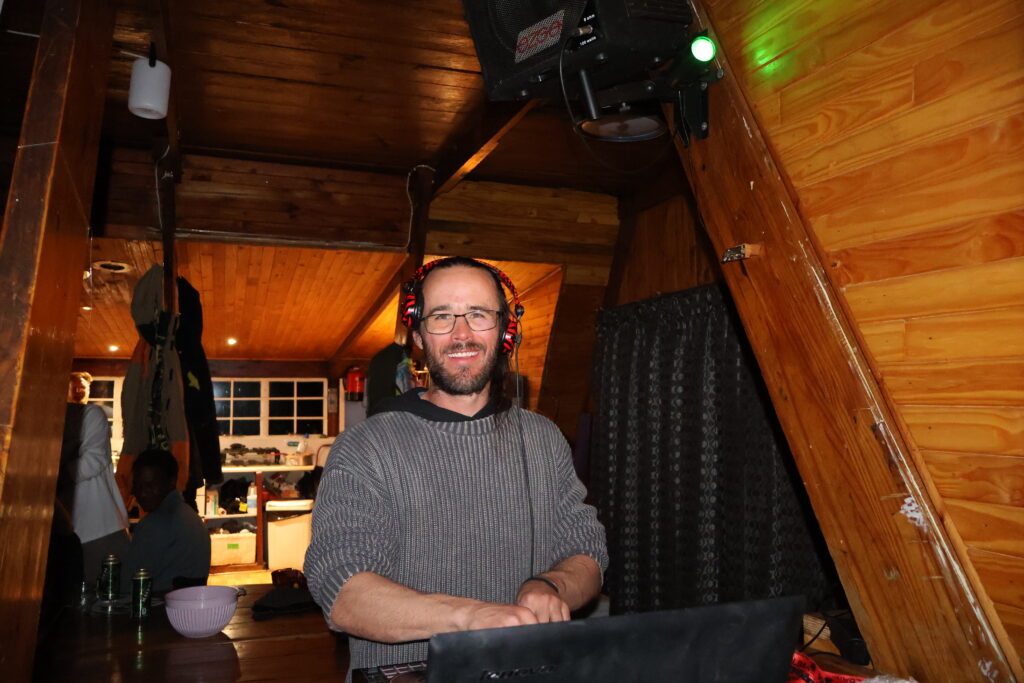
Jason Roberts DJing in A-Frame. Photo by: Daniella Ripamonti
The soul of Club M
For Vishaylin Mahadeo, who joined WSSC in 2011, the lodge became his anchor: “It’s home to me; it’s my family, my safe space. When going through a difficult time, my first thought is, ‘let’s go to the mountain.’ I have snowboarded everywhere in the world, and this mountain is still so special to me. My university experience was created through Ski Club; I even extended my degree just because I loved it so much!”
Granicki, who first visited as a matric student, feels that same pull: “Club M is home to misfits, geniuses, daredevils, and lost souls [who are] funny, beautiful, and live for the moment… My favourite personal memory is meeting my wife up there. Our adventure began from loving winter and the outdoors.”
In a world driven by screens, Club M remains fiercely analogue.
“It represents freedom, exploration, and self-discovery. You’re in the middle of two mountains, under stars, in a cabin when it’s snowing. My hope is that it remains a time capsule that forces you to be more of yourself, having fun, being human. Here’s to the snow!”
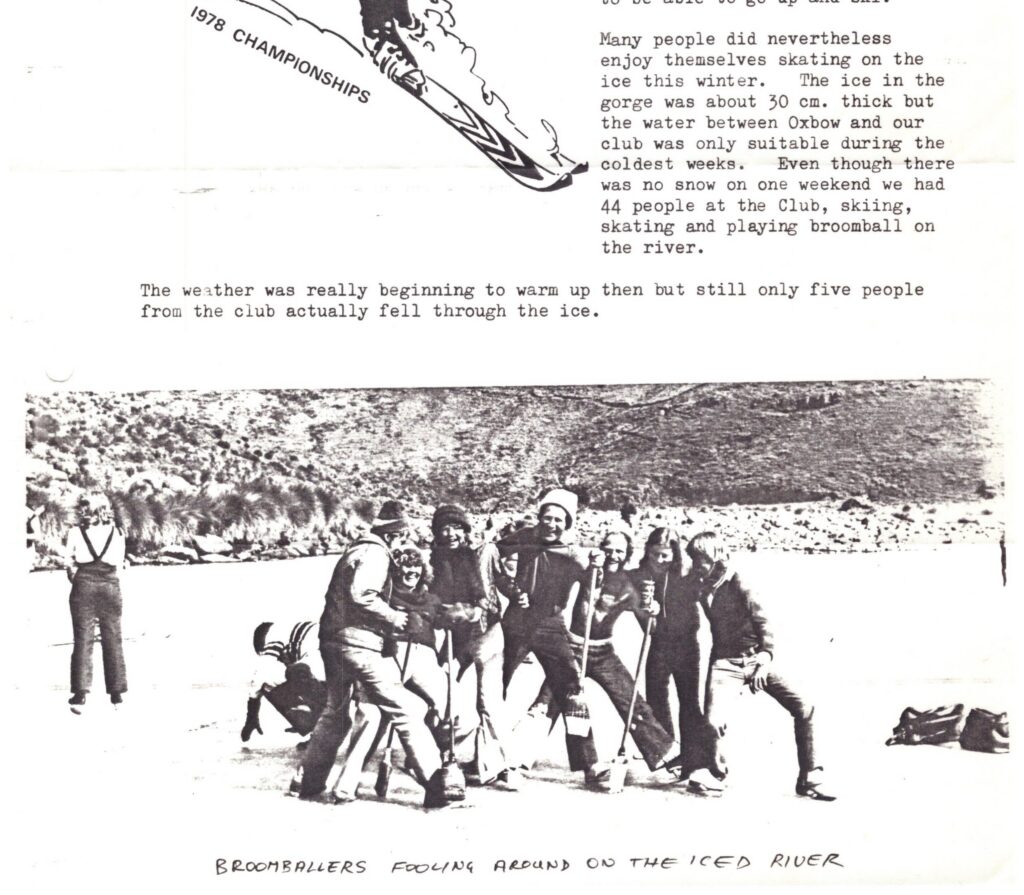
Archive newspaper from 1978 showing members broom balling on the iced river.
FEATURED IMAGE: Photo of Club M members at Afriski. Photo by: Daniella Ripamonti
An immersive journey through the city’s alternative art spaces.
Johannesburg’s inner-city became the backdrop for Contra: an art festival spread across various rooftops, warehouses and galleries across the city during the weekend.
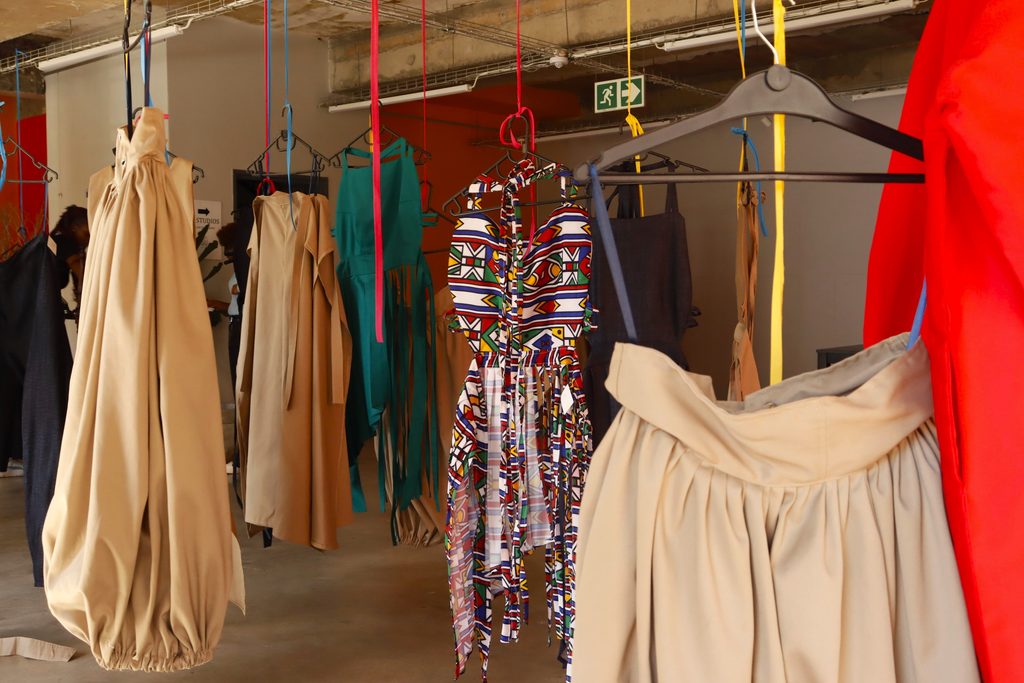
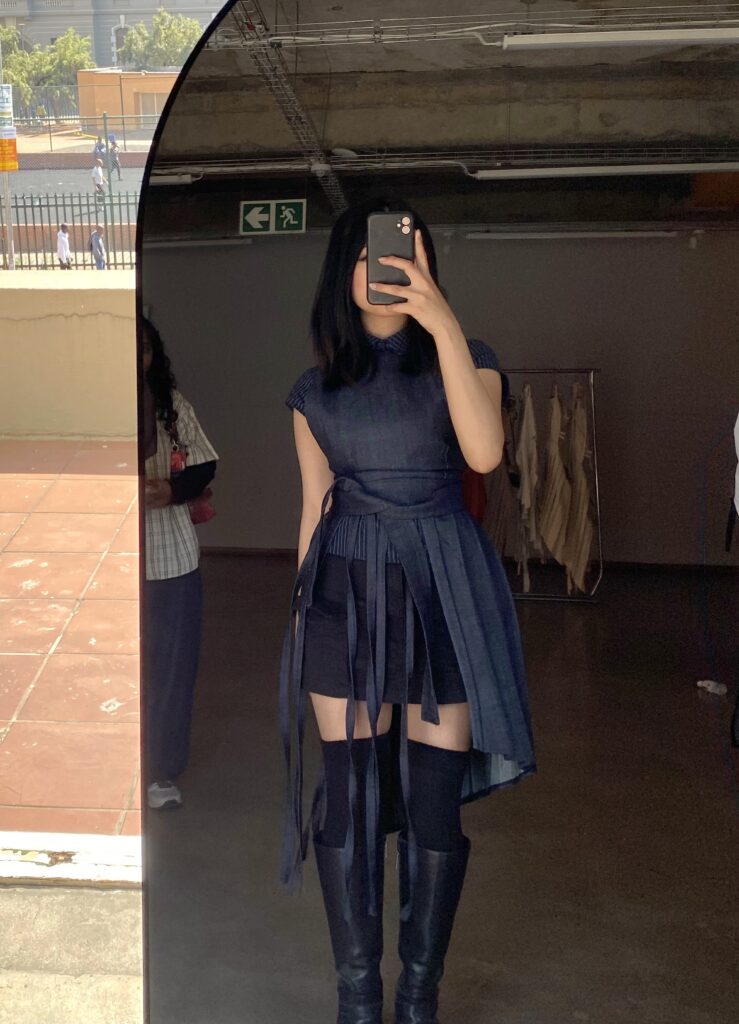
I started my journey in Asisebenze Art Atelier, an urban art studio in the heart of downtown Jozi. There, I found myself in a labyrinth of different textiles suspended by ribbons from the ceiling. At the centre of this colourful maze was stylist Nqobile Nxumalo who graciously helped fit me into a unique denim pinafore-style dress: one of her favourite pieces. As she weaved the straps around my figure, I watched the dress slowly take shape.
Nxumalo’s collection on display. Photo: Jamie Ho.My fitting of the denim phinifa. Photo: Jamie Ho.
“These are called ‘phinifa’,” she explained, as she tightened the straps. “It’s a traditional outfit for married women mostly.” Nxumalo’s work subverts the conventional roles assigned to women in African culture, allowing for a reimagining of societal expectations. Staring at my silhouette in the mirror, I admired her handiwork: the pleats and folds perfectly hugging my figure to create a bold and flattering silhouette.
Suddenly, a loud boom echoed from the next room. After unravelling myself from the dress, I went to investigate the source. A performance was being held by a few African spiritual healers seated around an assortment of candles and spiritual offerings. Every beat of the drum, piercing note of the trumpet, and squeal of the flute pulsed into a steady melody. I was entranced by how powerfully they commanded the room, warping the air with music.
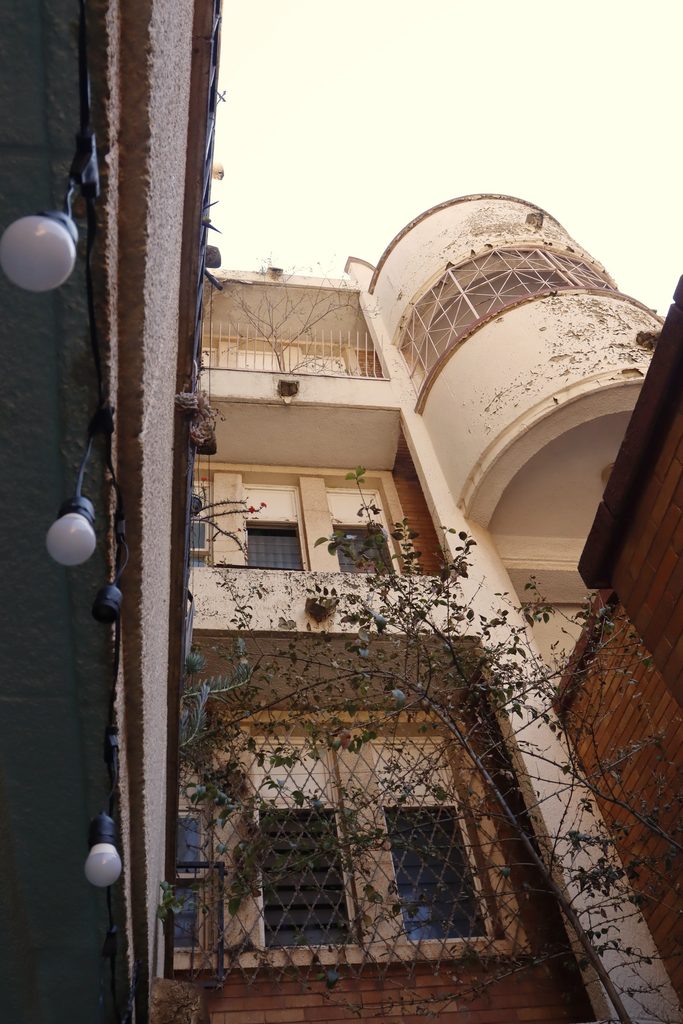
My next stop was Transwerke, a towering building of crumbling brick and oval terraces originally built as a maternity hospital but now functioning as a creative hub for artists. I descended into the basement first. I stepped into the first room where a few children were busy painting. An array of patterned puzzle pieces were littered across the table: each one a country ready to be assembled into the continent of Africa.
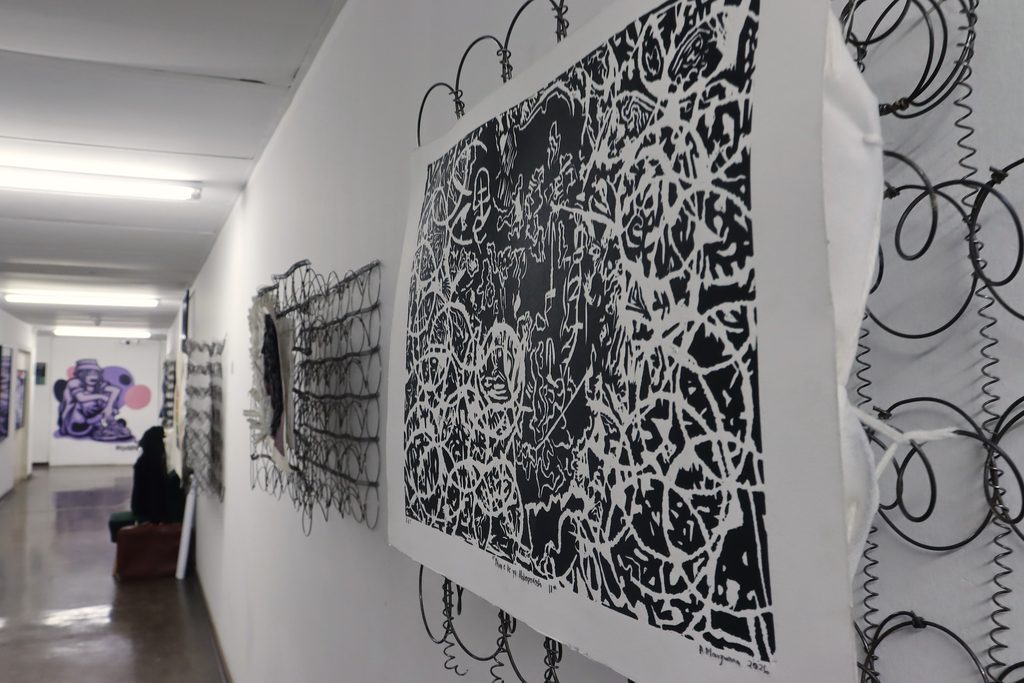
The crumbling yet imposing architecture of Transwerke. Photo: Jamie Ho.Mixed media installation adorning the Transwerke halls. Photo: Jamie Ho.
After spending a few minutes here, an eerie rumble rippled through the echoey halls. I followed the sound and found myself in an open courtyard at the centre of the building. Red, yellow, green and pink streamers rained down from the treetops onto the central patio which breathed with loud, clashing sounds.
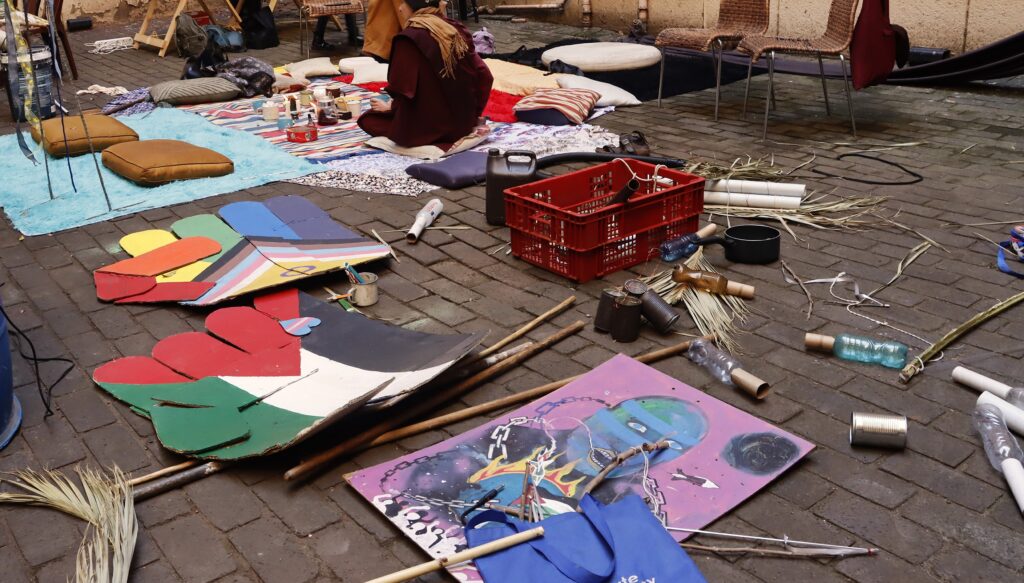
A woman was banging a bamboo stick against an empty drum barrel while children shook rattles engineered from cutlery and wire. I seated myself on the blankets at the centre of this whirlwind of sound and colour (a soundscape, I learned it was called). We were encouraged to pick up a few of the makeshift instruments, so I rattled a pan filled with bottlecaps and rice. My skin prickled as the sounds raised and waivered, bouncing off and around the tall walls surrounding the courtyard.
An assortment of instruments fashioned out of recycled materials. Photo: Jamie Ho.
Admittedly before this experience, I had only known the city from afar. CONTRA allowed me to step foot into a range of unconventional spaces that I would have never otherwise ventured into. I was able to plunge headfirst into art in all its various forms: from painting sessions to fashion pop-ups to sonic escapes. It felt like I wasn’t just viewing the art; I was in some way a part of it. And while the experience was vastly different across each location, it never felt incongruent or out of place.
Whether it be in the courtyards pocketed away between buildings, the basement of a dilapidated hospital, or the studios overshadowed by towering urban centers, each space was blossoming with life. It was comforting to know that art will always find a way, that it will creep up through the cracks in whatever concrete jungle it finds itself in, to exist in a very beautiful, very plain way.
Vuvu rating: 9/10
FEATURED IMAGE: A musician blowing a trumpet during a live African spiritual performance. Photo: Jamie Ho.
Through drums, song and dance, Hey Hillbrow! Let’s Dlala! filled the inner city with a celebration of art and belonging. During a time marked by xenophobic tension, it was a reminder that community and creativity are powerful forms of resistance.
The theme ARISE centred on birds, with the grey go-away-bird reframed as a call of hope.
More than 350 children and young people collaborated with artists at the Windybrow Arts Centre, designing costumes and choreography.
Coming only weeks after marches demanding the removal of foreign nationals, the parade’s imagery offered a counter-narrative of unity and shared streets.
On August 8, Hillbrow’s streets became a stage for music, dance and joy, as the Hey Hillbrow! Let’s Dlala! parade transformed the inner city. In a neighbourhood too often reduced to headlines of crime and decay, it tells a different story – one of collaboration and creativity, and one that celebrates freedom and belonging.
People took to the streets of Hillbrow in bird costumes. Photo: Hannah Brown
The event is organised by Windybrow Arts Centre alongside Shade, and since its launch in 2017, the festival has been reimagining public space. It is about “giving young people, across binaries, age and places of origin the space to play, to express and to have agency over their voices, their version of the inner city and how this place can be perceived,” states Tamzyn Botha, curator of the parade and director of Shade.
The parade carried a particular weight as South Africa continues to grapple with xenophobic violence. Only a few weeks earlier, Hillbrow had been shaken by the June 30 marches demanding the removal of foreign nationals.
Protests took place across South Africa. Photo: Hannah BrownProtests by the group ‘March and March’ took place on June 30, marking the unofficial ‘deadline’ set for undocumented foreign nationals to leave South Africa. Photos: Hannah Brown
Birds were at the centre of this year’s theme, ARISE. The festival’s mascot was the grey go-away-bird, or lourie, known for its sharp warning call. This was reframed as a call of hope, a reminder that communities can raise their voices in unity against hatred. Within this context, it felt like the festival answered back with colour, laughter and carried an important message: Hillbrow belongs to everyone.
The parade began at the Windybrow Arts Centre, which is a prominent hub of creativity in Johannesburg, before making its way through the streets. Hillbrow came alive with drums, costumes and singing. More than 350 children and young people ‘took flight’ across borders, their feathers fluttering as they danced, signifying freedom of movement and connection across divides.
Artistic expression was central to the parade’s formation. Children and teenagers spent two weeks learning new creative skills and collaborating with artists at the Windybrow Arts Centre to design costumes, choreography and music. As Botha said, “the ripples of this work, of the parade and the relationships made during this process, far outweigh the ‘end result’.” It brings young people together in a city where they are often excluded from decision-making. The creative process shows how, through art and performance, Hillbrow’s story can be shaped by its own residents and connectedness.
Hundreds of young people took to the streets for the seventh annual Hey Hillbrow! Let’s Dlala! parade. Photo: Hannah BrownHillbrow’s streets came alive with music and dancing. Photo: Hannah BrownYoung people dancing to the music during the parade. Photo: Hannah BrownSingers performing at the festival. Photo: Hannah Brown
The annual parade takes place on the eve of Women’s Day, marking 70 years since the historic 1956 Women’s March, when thousands of women stood against apartheid pass laws. This year’s theme felt especially poignant, as debates about who belongs in South Africa’s cities remain tense.
The contradictions felt impossible to ignore. Only weeks earlier, the same streets had been filled with chants of division.
Just as those women fought against restrictions on movement, the imagery of birds gliding through Hillbrow challenged today’s ‘cages’ of xenophobia. The festival did not erase the xenophobic tensions, but filling Hillbrow’s streets with birdsong, dance and laughter for an afternoon reminded Johannesburg that art can be resistance and hope.
In the years ahead, the organisers hope the parade will continue to offer “a shared sense of possibility through wonder, inside what feels like chaos”, says Botha. They envision it becoming more youth-led, “and this type of framing gives the parade over to those it represents.”
FEATURED IMAGE: People took to the streets of Hillbrow in bird costumes. Photo: Hannah Brown
The inaugural Wits International Vocal & Chamber Music Festival begins on a powerful note, blending music, memory and meaning in a moving tribute to the youth of the Soweto Uprising.
The first-ever Wits International Vocal & Chamber Music Festival launched with a powerful opening concert at Seabrooke Music Hall.
The programme centred on Gabriel Fauré’s Requiem, honouring the children of the 1976 Soweto Uprising.
Performers delivered a technically refined and emotionally gripping experience that set a high standard for the festival.
A quiet anticipation filled the Seabrooke Music Hall on Wits East Campus on April 22, as audiences gathered for the opening of the inaugural Wits International Vocal & Chamber Music Festival. What unfolded was not just a performance, but a deeply moving musical tribute rooted in history, memory and collective reflection.
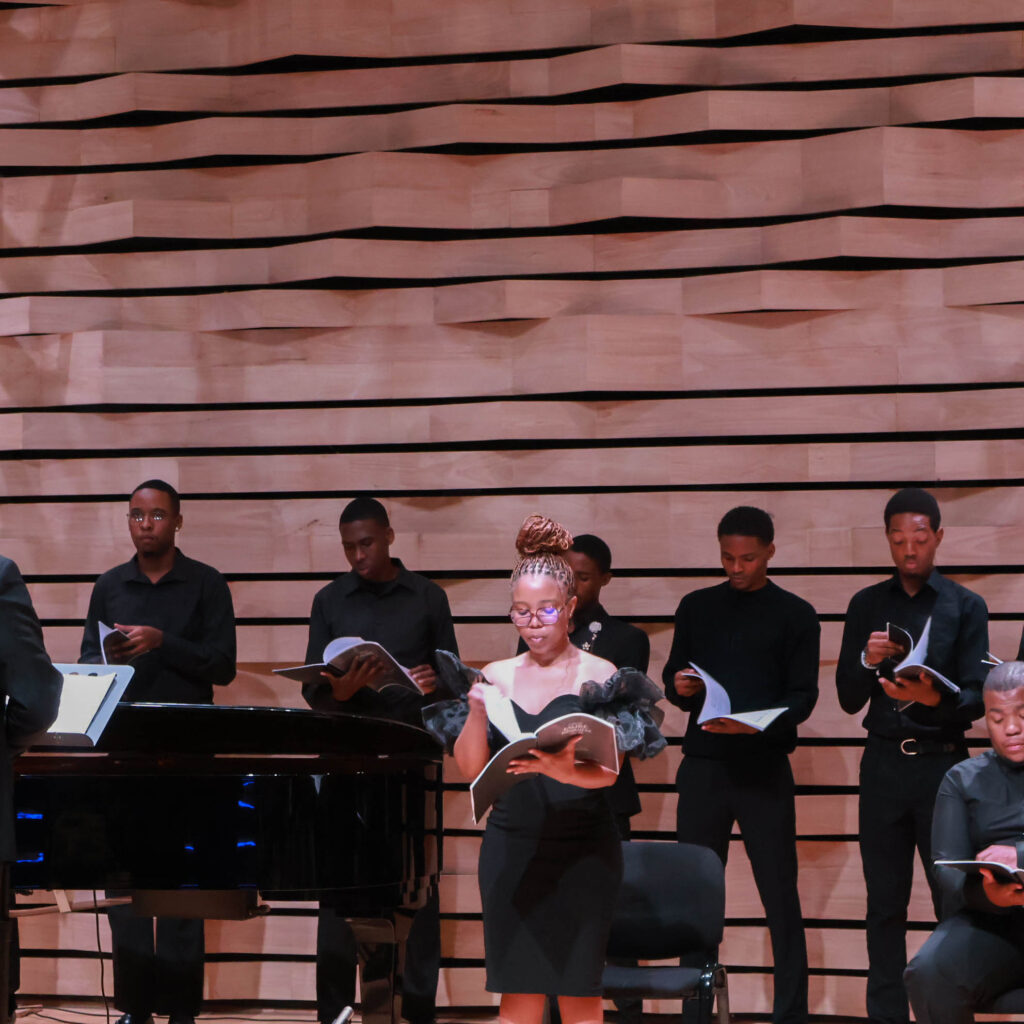
Hosted by the Wits Music Department, the festival spans eight concerts running from April 22 to May 2 across various venues on campus. This festival is the first of its own at Wits hosted by the department. The opening set the tone with a powerful presentation by the Wits Music Department Choir, accompanied by pianist David Butlin and conducted by Head of Department Musa Nkuna.
The programme drew from Gabriel Fauré’s Requiem, Op. 48, reimagined as a memorial for the children of the 1976 Soweto Uprising. Through seven movements, the performance carried a spiritual weight, each hymn a plea for rest, peace and refuge from suffering. The reinterpretation grounded the classical work in a distinctly South African context, bridging European composition with local history.
A picture of Charmaine Nkuna. Photo by: Sanele Sithole
Soprano Charmaine Nkuna, and bass Thato Morutle delivered standout solo performances, their voices cutting through the hall with clarity and emotional depth. Their presence added a personal dimension to the piece, elevating the performance from technically strong to profoundly affecting.
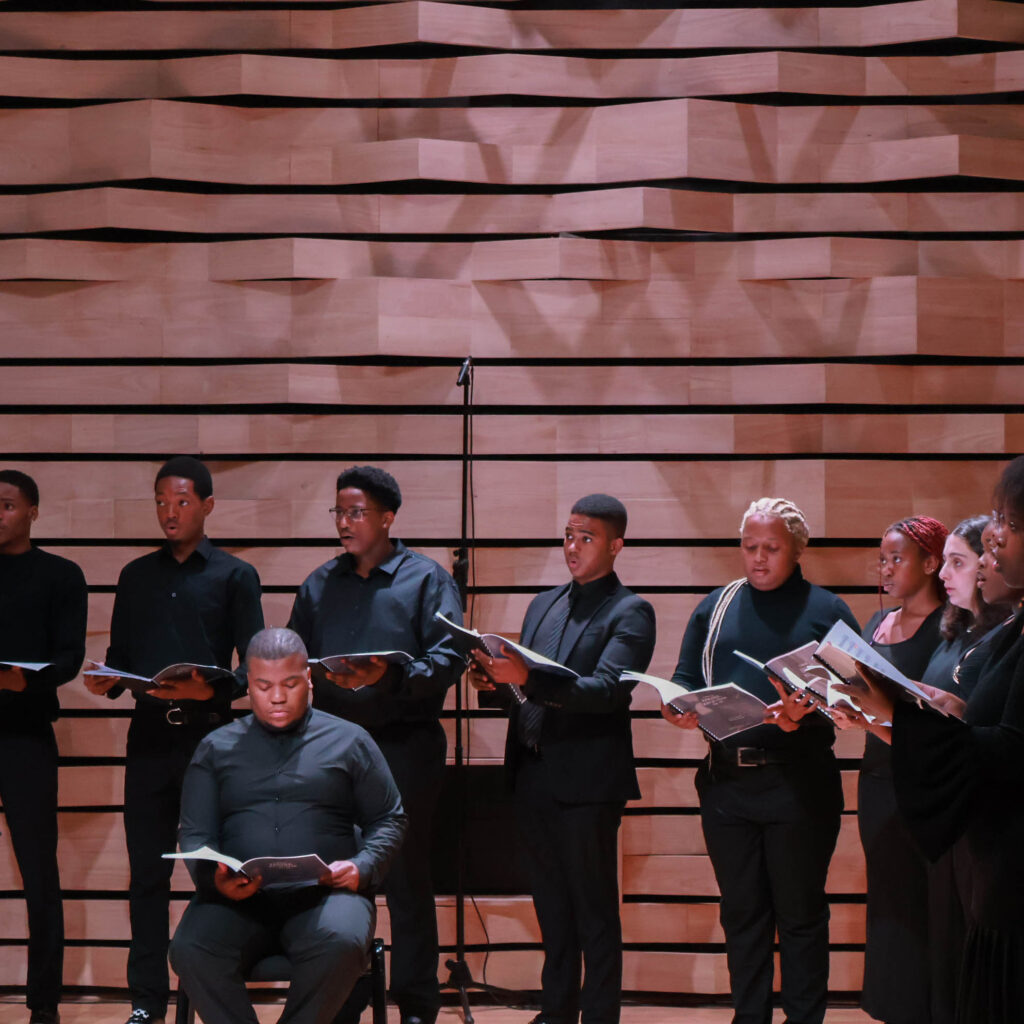
As the choir entered the stage dressed in black, the symbolism was immediate. The uniformed ensemble visually reinforced the tone of mourning and remembrance, aligning with the concert’s dedication to lives lost. What followed was a seamless performance marked by strong ensemble unity and precision — not a single note out of place.
The emotional impact resonated with the audience. First-year Film and Television student Luthando Skenjana described the experience simply: “It was an amazing performance; I quite enjoyed the show.”
For organisers, the festival represents more than a series of concerts. Choir chairperson Lesedi Masela, final-year Bachelor of Music student, described it as “a high-impact platform that brings together choral, chamber and orchestral performances within one integrated programme.”
Masela emphasised the significance of the festival’s timing, marking 50 years since the Soweto Uprising. “The opening concerts being requiems reflect that commemoration,” he said, adding that hosting performances across multiple venues transforms the festival into “a full-scale artistic ecosystem.”
That ambition is evident. Beyond musical excellence, the festival aims to create an immersive cultural experience — one that is intellectually engaging while remaining emotionally accessible. The opening concert achieved this balance, offering both technical sophistication and a deeply human narrative.
At its core, the performance was about young people remembering young people — a generational echo carried through music. It is this layering of meaning that makes the festival stand out, positioning it as both an artistic and commemorative space.
If opening day is anything to go by, the Wits International Vocal & Chamber Music Festival is not just an event to attend, but one to experience.
Vuvu Rating: 10/10
A picture of the choir. Photo by: Sanele Sithole
FEATURED IMAGE: A picture of the choir on stage. Photo by: Sanele Sithole
In the high-octane world of South African Fashion Week, a runway is usually a transition, a place where models move from point A to point B to showcase a garment. But for House of Olé, the Spring/Summer 2026 showcase transformed the runway into a breathing, multidisciplinary studio. It was a bold statement of ‘The Comeback,’ signalling that after a strategic hiatus from the runway, the brand’s return was about more than just clothes; it was about a new philosophy of survival.
The show was a sensory assault in the best way possible. Before a single look walked, the stage was set with the ‘invisible’ architects of beauty. A makeup artist stood at the start of the ramp, applying live finishing touches to models as they sat, before embarking on their walk. In the centre, a visual artist stood with a brush in hand, painting onto the suits as they passed.
The result was a ‘Human Art Gallery.’ Models did not just walk; they performed. Some lounged on velvet sofas positioned along the runway, remaining still as statues, inviting guests to observe the textile and the tailoring as they would a masterpiece in a gallery. This was not just a fashion show; it was an immersive performance piece, underscored by the raw vocals of a live singer that echoed through the Hyde Park studio.
Photo of the Runway from the House of Olé at SAFW SS2026. Photo by: Daniella Ripamonti
“They really have lived up to the anticipation”, noted guest and choreographer Nomza Monake. “I’ve seen Olé’s work before, but today just took it to another level. I loved how they fused the arts together. It was not just a fashion show, but a fashion show with a difference… I’m just so sold.”
Behind this theatricality lies the sharp business mind of Ole Ledimo, the designer and founder of House of Olé. Ledimo is acutely aware that the industry he returned to is different from the one he left. “When times are tough, it forces us creatives to dig even deeper,” Ledimo explained backstage. His response to the economic squeeze during his time away from the runway was to embrace a radical variety, mixing high-end, hand-painted couture with accessible ready-to-wear to maintain and win new clients.
When asked about the defining piece of the night, Ledimo pointed to a garment aptly titled “Collaboration.” It served as the anchor for his vision of the season. “It’s something I feel like as artists and human beings we need to do often,” he said. “Coming together, I think that’s what made the collection amazing, bringing the guys that have been my friends, working together for many years, from backstage into the actual show.”
The collection itself challenged the rigid boundaries of the “modern gentleman.” Ledimo’s suits, architectural, bold, and defiant, were worn by models of all shapes and heights, pushing back against the stereotypes of how men “should” dress. “The colour pink doesn’t define your masculinity. It’s a colour,” Ledimo asserted, defending the need for self-expression. “Sometimes it’s people’s opinions that hold us back.”
House of Olé Spring/Summer 2026 collection lineup for SAFW 2026. Photo by: Daniella Ripamonti
As the final model took their seat on the runway sofa and the live singer’s last note faded, the message was clear: Ole Ledimo has moved House of Olé beyond the stitch. By bringing the “behind-the-scenes” directly onto the ramp, he proved that the future of South African luxury is not just about the clothes; it is about the collective power of the artists who bring them to life.
Vuvu Rating: 9/10
FEATURED IMAGE: Photo of a model surrounded by art pieces on the runway for the House of Olé, SAFW SS2026. Photo by: Daniella Ripamonti
Main Street in Johannesburg transformed into a car-free zone, inviting people to take back the city centre through art, community, cycling and music.
Johannesburg reimagined its city centre, as Main Street closed to cars and reclaimed by the people.
Music, art, cycling and children’s activities filled the streets, creating a sense of community, safety and connection.
Inspired by cities globally, Main Street Sundays is part of an experiment to revitalise the city .
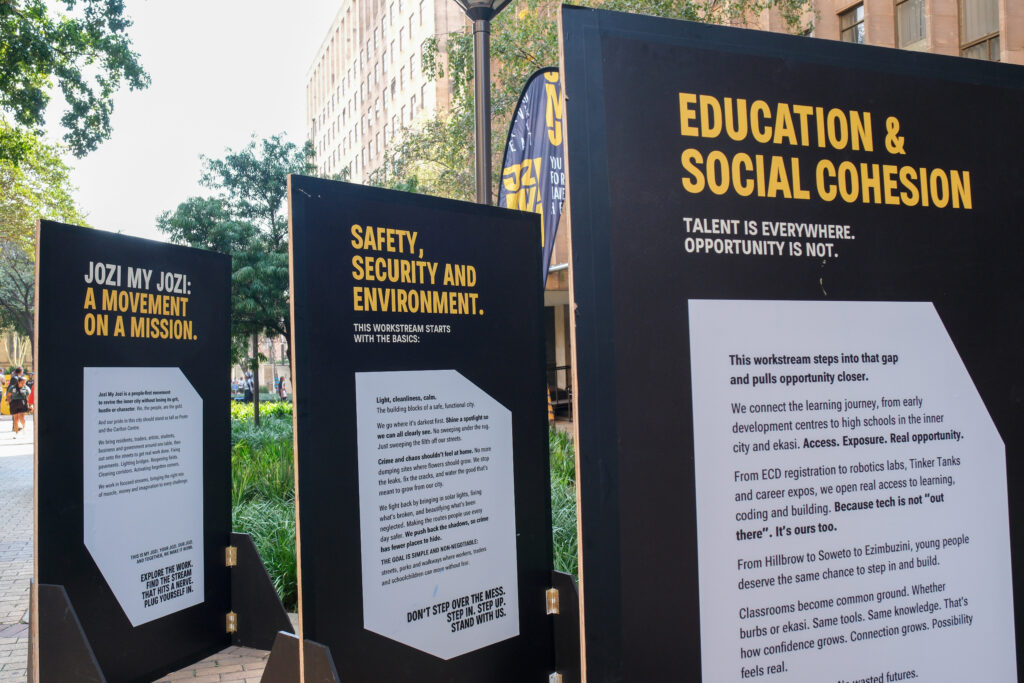
On Sunday, April 12, Johannesburg reimagined how we can experience the city. What is usually jammed with traffic, became a space for walking, cycling, art and connection. The initiative was led by Jozi My Jozi in partnership with Young Urbanists. For one full day Main Street in Marshalltown was closed to motor vehicles and belonged to the people.
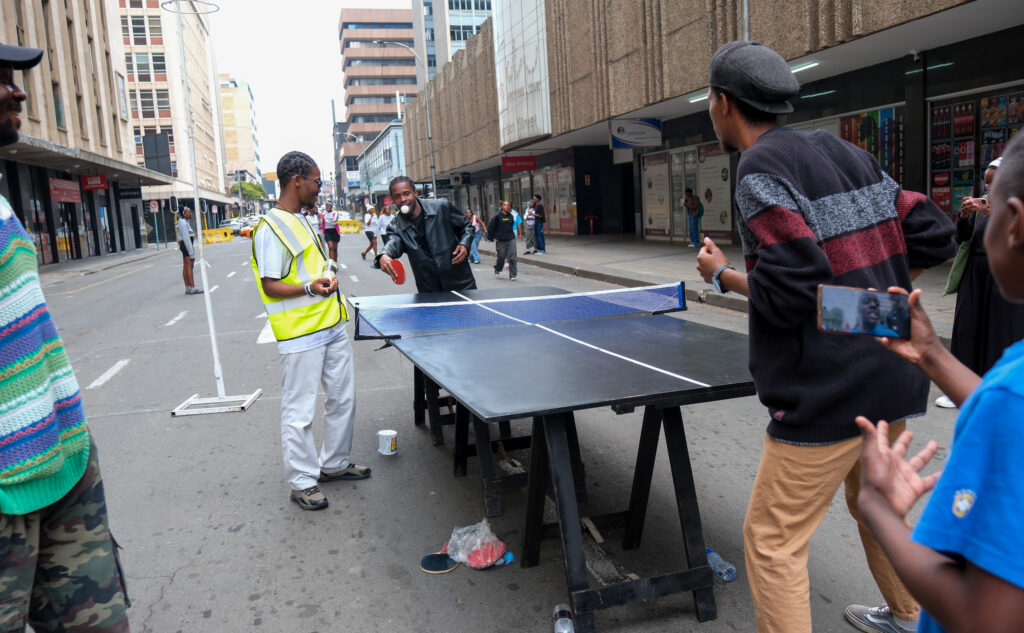
There was something happening on every corner. Music played, book clubs met in the open, art filled the streets, people skated, played games and searched the stalls. It was more than just a street closure, it was a reclaiming of public space from cars.
“Our mission is to bring people back to the city,” said Jozi My Jozi Education Workstream Coordinator, Senty Maphosa. “Let’s relove, let’s reimagine what the city could look like.”
Globally, cars dominate 80% of public space. But as Thandile Manyifolo, BA Architecture Student and Deputy Chairperson of the Jozi My Jozi Chapter at Wits University reminds us, “urban spaces were designed for people to live in. If people come secondary to that, are they really fulfilling their purpose?”
Organisers emphasised that reclaiming the streets is not just about daytime activities but also creating more opportunities and innovation for young people into the evenings.
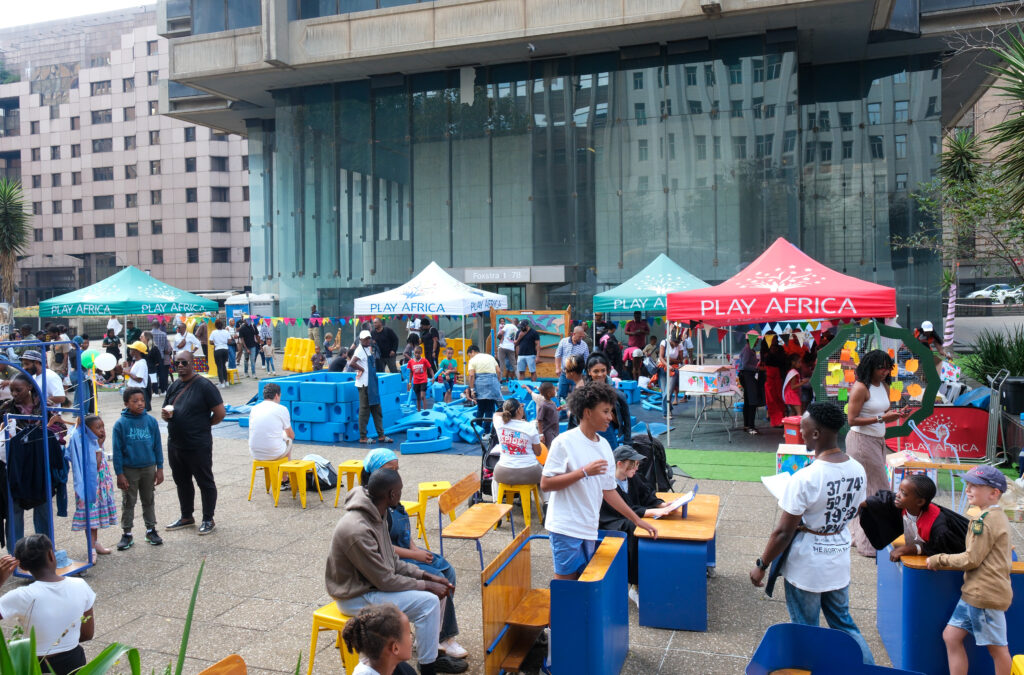
The event offered a glimpse into how urban space can return to being people centric. Children played freely, with a programme created in partnership with Play Africa, the day included interactive learning activities, face painting, chalk art, sports and a gallery.
People felt at ease, walking around taking photos on their phones, dancing and laughing. There was a sense of belonging. “Today is all about community, it’s all about collaboration and it’s all about bringing back a sense of pride and inspiring people,” said Maphosa.
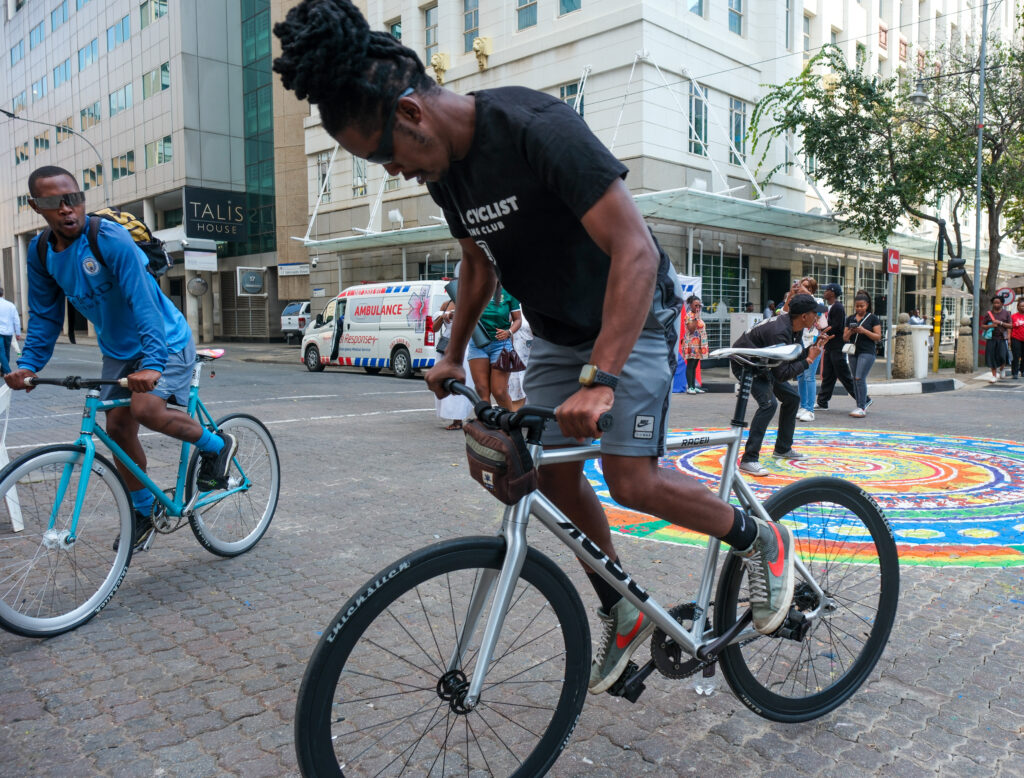
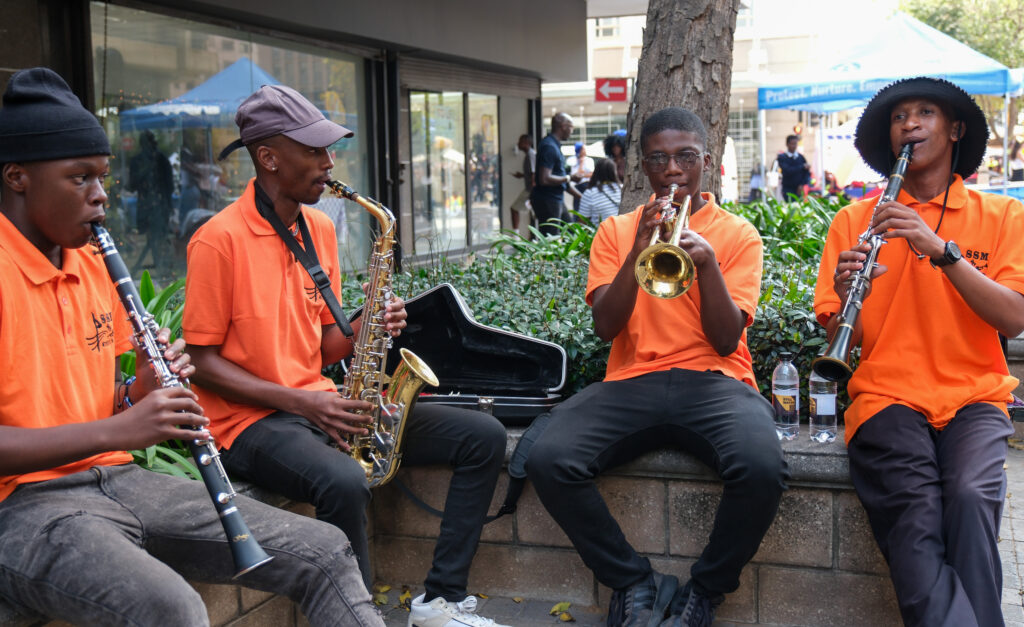
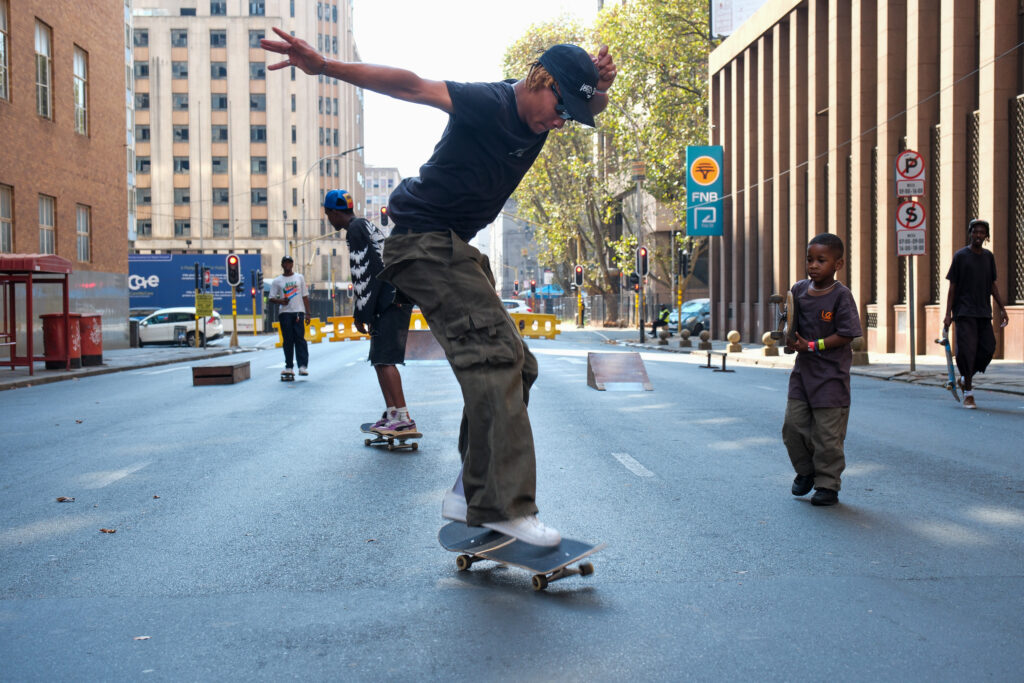
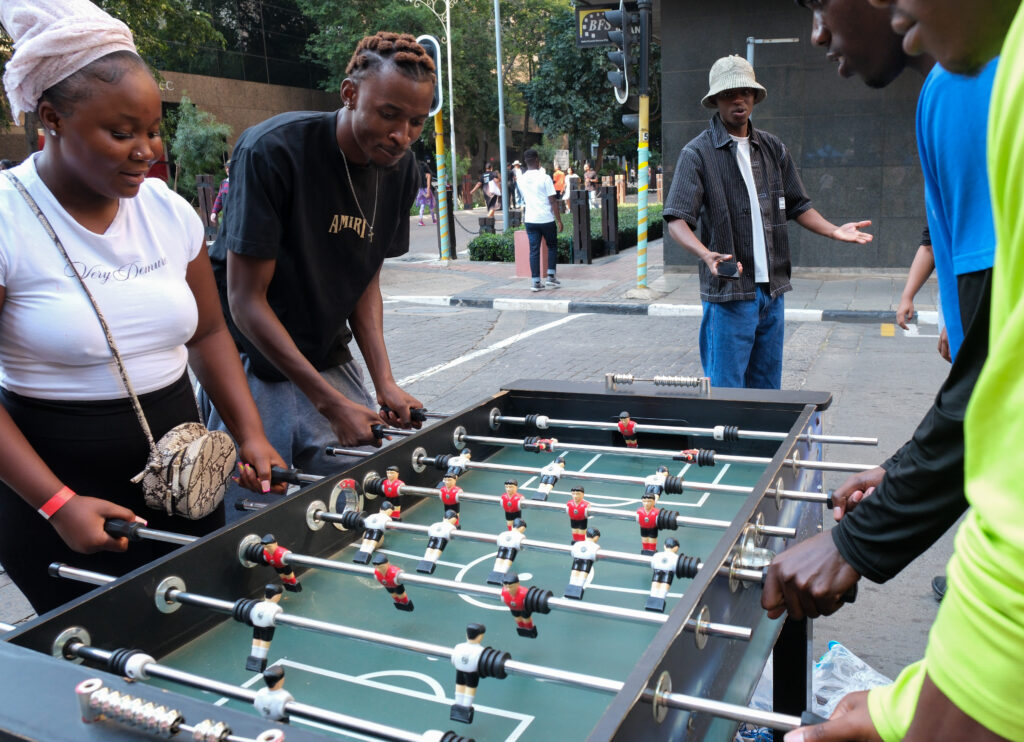
Jozi My Jozi is reimagining Joburg’s CBD. Photo: Hannah BrownA game of table tennis is held on the street. Photo: Hannah BrownKids area in partnership with Play Africa. Photo: Hannah BrownAs Main Street closed to cars, cyclists rode through the CBD. Photo: Hannah BrownA music group performs at the event. Photo: Hannah BrownSkateboarders took to the city streets, performing tricks. Photo: Hannah BrownVisitors play a game of foosball. Photo: Hannah BrownJozi My Jozi signs during Main Street Sundays. Photo: Hannah Brown
Inspired by cities including Bogotá, Paris and Cape Town’s Bree Street. The event is part of a larger experiment to revitalise the city, reimagine the use of urban space and see what happens when streets are closed to cars and given to pedestrians.
For Johannesburg, Main Street Sundays was the first of what many hope will become a regular event. “We are starting something that will have a domino effect in the long term to open up the streets of Jozi, not just Main Street, but the entirety of the city,” said Manyifolo.
It showed us what Joburg can feel like, where the city is not just a place to quickly pass through, but one where we can come together, connect and move safely.
FEATURED IMAGE: Cyclist from the Sentech Croozers rides a stance bike at Main Street Sundays. Photo: Hannah Brown
Joburg Theatre’s Tribute to Hugh Masekela unites and uplifts the community, revealing the enduring and powerful influence of his music.
Joburg Theatre hosts a 4-day concert to honour the legacy of Hugh Masekela.
A lineup of artists delivered heartfelt performances celebrating his music.
The community united to show their love for the cherished musician.
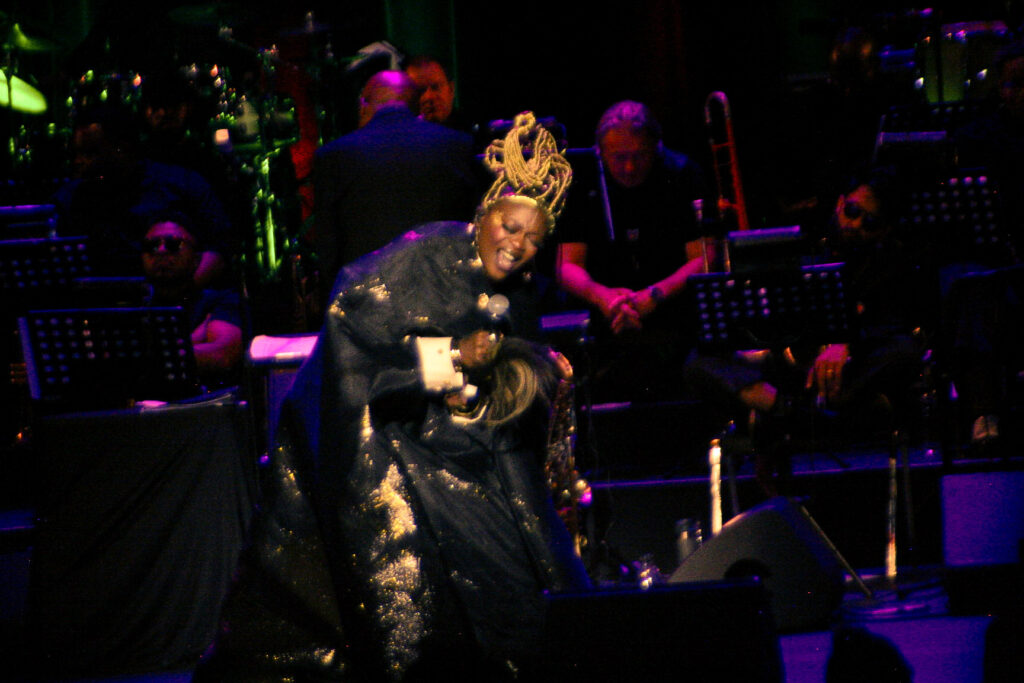
Picture of Zoe Modiga singing at Joburg Theatre on Friday evening. Photo: Jamie Ho.
The Joburg Theatre held a 4-day musical tribute to Hugh Masekela from Thursday April 9 to Sunday April 12, with performances from some of South Africa’s renowned jazz artists including Tresor, Baobab Sisters, iComplete, Vusi Mahlasela, Judith Sephuma, and Zoe Modiga – all to celebrate the legacy of a man affectionately known as Bra Hugh.
Wits Vuvuzela was thrust into the magic of the event on both Friday and Sunday evening. Pulsing through the stage was the rich lifeblood of Masekela’s music. It flowed through the vocals of the performing artists and poured into the crowd creating a tangible, powerful bond.
On both evenings, the theatre was alive not only with the sounds of his music, but with the liveliness of the crowd. People were dancing, throwing their arms in the air, spinning with loved ones. Every hip sway, every chuckle, every cheer: a testament to their love for Hugh.
No longer were we seated in an auditorium, but in a living breathing piece of history. Infected with rhythm, infused with soul, each song trembled with passion, sending ripples across the sea of luminescent faces.
Those that attended the concert were deeply moved by the power of its performances. One attendee, Oratile Morotolo summed it all up saying, “We were witnessing something we had no business witnessing. As though we were seeing something unseen. A transcendent catapult in time.”
Born in Emalahleni, near Johannesburg, Hugh’s passion for music started at an early age. He contributed massively to the struggle movement against Apartheid, with songs like Soweto Blues and Stimela. Most famously he is known for his protest-anthem Bring him Home (Nelson Mandela) demanding the release of Mandela from prison in 1987.
Not only is he a voice for freedom, but a voice for Africa. Every note of his music pays homage to what he describes to be “the wealth of African culture.”
He passed away on January 23, 2018, at 78 years of age. But his soul continues to live on, not only in his music, but in the people as well.
Even as the lights dimmed and the performers took their last bow, there remained something sacred in all of us that night: something that can never die, a heart that will go on beating.
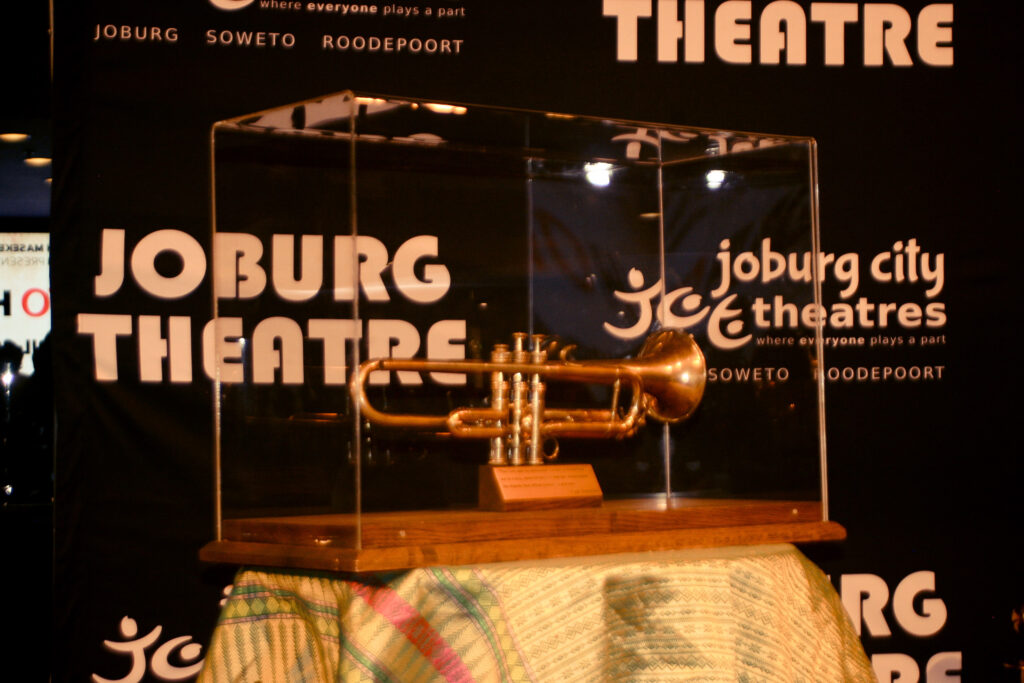
Picture of Hugh Masekela’s famous trumpet. Photo: Jamie Ho.
FEATURED IMAGE: Picture of the stage during the concert at Joburg Theatre. Photo: Jamie Ho
An ode to Motown is for the lovers of classic nostalgic music and is a must-see performance.
On February 22, I attended An Ode to Motown, a production staged in celebration of Black History Month, at Joburg Theatre. What unfolded was more than a tribute concert; it was a vibrant, high-energy homage to one of the most influential musical movements to emerge from 20th-century America.
Motown, founded in Detroit in 1959, became the heartbeat of Black American music, introducing the world to artists who would shape pop, soul and R&B for generations. The show paid tribute to this rich history, revisiting classics that still resonate across continents.
There was not an empty seat in sight.
From the opening notes, the audience was transported into a world of polished harmonies, synchronised choreography and timeless storytelling.
The singing was exceptional, powerful yet controlled, capturing the emotional depth that defines Motown. The performers, Liesl Penniken, Lerato Mvelase, Tamara Dey, Hlengiwe Pearl, and Anele Precious Mthethwa, moved effortlessly through beloved hits.
An ode to Motown show image. Photo: Supplied/B Sharp entertainment
Hits such as “Mr. Postman,” “Ain’t No Mountain High Enough,” and “I’m Coming Out,” each song greeted with cheers and nostalgic excitement. The inclusion of “Cruisin”, “Call Tyrone,” and “Water Runs Dry,” along with two soulful renditions of songs by Erykah Badu, broadened the tribute to include neo-soul influences that echo Motown’s legacy.
Quotations from songs by Smokey Robinson added a poetic thread, reminding us of the lyrical genius that defined the era.
Visually, the production was stunning. The performers dazzled in gorgeous, extravagant gowns that shimmered beneath the stage lights. The intricate choreography was both elegant and dynamic, matching the vibrancy of the live band. The theatre itself seemed to pulse with the vibrations of an enthusiastic crowd, their energy feeding the performers on stage.
Yet the show also raises an interesting question: what relevance does Motown’s history hold for South Africa? In some ways, staging this tribute here is like hosting a concert in the United States commemorating the artists of Sophiatown. It is a celebration of a distinctly American Black cultural movement, performed for lovers of classic American music and for those who admire the monumental Black artists who emerged from that era. At the same time, it highlights the global reach of Black music and its power to connect polarizing histories.
Ultimately, An Ode to Motown was a joyful, nostalgic, and beautifully executed celebration. One that proves Motown’s rhythm still moves audiences, no matter where they are in the world.
Vuvu rating 9.5/ 10
FEATURED IMAGE: An ode to Motown, performance on February 22 at the Joburg theatre. Photo: Bonolo Mokonoto
There is so much more to Danya Dev’s album than compliments to beautiful women and a flashy lifestyle, his story is worth listening to closely.
With the recent release of his debut solo album, Danya Dev (Sphelele Dunywa) officially took a hiatus from the Blaq Diamond duo to reintroduce himself. Titled Bayede, a Zulu greeting for a King meaning all hail, the project serves as both a grand entrance and a mission statement.
Across 18 tracks spanning 51 minutes, Danya Dev crafts a sonic world that is remarkably consistent: laid-back, atmospheric, and tailor-made for late-night drives or slow Saturdays.
While some listeners might think the use of typical Afro-pop and Hip-Hop themes, i.e. the allure of beautiful women, female gold-diggers, and flashy lifestyle, was a default genre move, the album is in fact thoughtfully structured as a two-act narrative.
The first act is about the temptation of fame. The journey begins with a man caught in the whirlwind of celebrity. He depicts a reality where his accomplishments and fame act as a magnet for women. On tracks like Uber Eats and Where were you, he highlights the transactional nature of modern romance, where status and ‘’nice things’’ drive attraction.
Danya Devs debut solo album playlist. Photo: Lulah Mapiye
The second act brings the story to a close with a sense of maturity. We see a man who has traded the chaos of the ‘’fast life’’ for the desire to build a home. The lyrics in Ola Sbali (Hi brother inlaw), Abakhongi (lobola negotiators) and 1 million signal a newfound respect for stability and partnership.
While the album features a heavy-hitting roster of guest stars, including Sjava, Kwesta, Cassper Nyovest, Ndu, Mawelele, most are given much time to shine except Sjava who sings for eight seconds in Uber Eats, which is extremely disappointing.
Be that as it may, Bayede does not try to reinvent the wheel, instead, it leans into a singular, steady vibe. It is a cohesive body of work that proves Danya Dev is more than capable of carrying a kingdom on his own.
Vuvu rating: 7/10
FEATURED IMAGE: Danya Devs debut solo album cover. Photo: Danya Devs
Johannesburg may often be defined as the economic hub of Africa but the quiet drum of a beat, is what makes it the capital of African entertainment.
What exactly constitutes a world-class city? Some would define Johannesburg as world-class purely on its standing as the financial and economic hub of South Africa, as the city is home to Africa’s largest stock exchange, the JSE. Others, however, would designate it as world-class city because of its rich culture.
What most South Africans have in common is their love and passion for entertainment, and specifically for music. The ever-readiness to have a good time. And for many South Africans, the common denominator to having a good time often involves music, whether it’s at a small braai, a sports gathering or a party, an activity many have come to recognise as “groove”. Music must always be present.
But this goes far beyond a small gathering. Going to a concert is unlike any other activity. Being surrounded by thousands of people with a shared love of music creates an electrifying state of euphoria.
The excitement of being united by one singular goal: to sing your heart out and have fun with the realisation that you’re inhabiting a space designed purely for unforgettable moments. It’s the thrill of seeing your favourite artist live, knowing this might be the only time you get to experience their performance.
The deafening cheers of fans as the stage lights flash, the beams echoing the crowd’s excitement. Every moment – the fun memories of singing along to your favourite melody, the endless photos and videos that will serve as proof – is worth it, leaving you wishing you could turn back time and relive it. South Africa is becoming the leading destination for international performers and Joburg has recently re-emerged as one of the foremost tourist destinations on the continent.
Behind the scenes: the stage crew assembles stage in preparation for upcoming event. Photo: Nthabeleng Phayane
But let’s be honest, the cost of going to these events is not cheap. Beyond the actual ticket, many concert goers have to consider the transport to the venue, the cost of food and drinks and most importantly, an outfit that will leave you feeling your best self.
For 33-year-old Rushe Cawa, her dedication to concert life comes with a practical plan, “I’ve got a secret fund that I contribute to monthly for concert tickets,” she admits.
Originally hailing from Cape Town, Cawa lives and works in Johannesburg and proudly describes herself as a “Johannesgirlburg.” “I can practically say that I’m from here,” she says, “I’ve been here longer than I’ve been in Cape Town,” highlighting her strong connection to the city, along with its culture.
“This is definitely a lifestyle for me,” she says with a hint of humour in her voice. “It’s the only time I take myself out of the house.”
Only cementing her love for live music, Cawa has been to multiple concerts and festivals across the country, one month she’s vibing at a jazz festival, the next she’s singing along at a soul and R&B session and then after that she is uplifted at a gospel gathering. Her ultimate drive for the endless shows, is FOMO (fear of missing out). “I don’t like to miss out on things,” she says.
For Cawa, it’s more than just about missing an event – she explains that it’s also a learning experience. “When you go to festivals, you expose yourself to a lot more genres than what you would normally listen to,” she says.
For anyone following her active TikTok presence, which acts as her diary of show accounts and knowledge, her passion is quite clear. Her commitment began early. Her first ever concert was The People’s Celebration in 2006, headlined by US rappers Pharrel and Snoop Dogg, and has remained her fondest memory. “It was mind-blowing,” she reminisces. “I think that is where my love for concerts started.” Even with her endless list of attended shows, she is not done yet as one single R&B singer remains on her checklist, “Cleo Sol!” she exclaims longingly as her secret fund continues to grow for that ultimate ticket.
The infrastructure to back it
But what makes music events in Johannesburg so appealing? What truly cements it as Africa’s go-to city for world tours? The answer is in the infrastructure.
Live music venues are paramount in making a show feel and look world class. Some of the biggest events in South Africa have been hosted in Johannesburg, including the 2018 Global Citizen’s Festival: Mandela 100, which celebrated the life and legacy of Nelson Mandela. It was headlined by some of the world’s biggest pop superstars such as Beyoncé and Jay-Z. All which could not have been possible without the appropriate infrastructure.
To have a show of that magnitude starts with the scale. FNB Stadium (previously known as Soccer City) was originally built between 1987 and 1989. It is the largest stadium in Africa, with the capacity to hold 94 000 fans. It was upgraded in 2009 in preparation for the d historic 2010 FIFA World Cup, which was the first ever held on the African continent. Since then, it has become the primary venue for large music events.
However, Johannesburg’s appeal extends far beyond a single venue. Ellis Park Stadium, Teatro, Lyric Theatre and the Linder Auditorium are just a few of many, making Joburg the leader of entertainment on the continent.
Technical crew in action, brining the stage to life before showtime. Photo: Nthabeleng Phayane
The city’s strength lies in its reliable logistics, providing everything from the convenience of OR Tambo International Airport for touring artists to the high-speed Gautrain that quickens attendee travel. “We have the best road networks,” says Lumka Dlomo, destination marketing manager at Johannesburg Tourism Company (JTC), and who has been involved in multiple events such as Joy of Jazz and Miss World 2008.
For Cawa, having all these venues in Johannesburg comes at a great convenience as compared to other venues in the country. “I’m not [that] open to traveling to Pretoria, it’s tough to travel all the way, unless it’s someone really big that I definitely want to see” she says. “The venues in Joburg just make sense,” she says.
The audience only ever get to witness the final performance of their favourite artist. But beneath the bright lights and the towering waves of speakers, there are countless people who work tirelessly in the background to ensure that the production of a show is truly world-class.
Who, then, are the masterminds orchestrating this amazing display? That engine starts with the promoters.
Big Concerts is the undisputed live entertainment company responsible for promoting and bringing almost every major international artist to South African arenas and stadiums in the last three decades. Their impressive portfolio includes global musicians such as One Direction, Elton John, and Justin Bieber. But behind the promoters is the critical backbone, technical suppliers such as Gearhouse Group, a leading technical supplier for the live event industry in South Africa. They are the essential suppliers who are consistently able to meet the standards of putting together a world-class stage.
Technical crew coordinate to lift and install equipment during event setup. Photo: Nthabeleng Phayane
When handling a major international show, Gearhouse confirms that their planning process can typically start up to a year or more in advance. In a written reply, the company informs me that: “We work to the timeline of the clients,” This process usually involves research, logistics planning and execution of a show.
With the commitment to constantly invest in the quality of their work, the company routinely acquires equipment for both local and international events. If a specific piece cannot be sourced locally, they lean on strong international supplier relationships ensuring that no element of production is compromised.
The core technical crew on show day is a lot of hands, “We will have around 60 local crew on site,” they estimate. In addition, Gearhouse attribute the seamless execution of production to the first stages of preparation as every show and venue differs. “A big aspect of it is the pre-production preparation.”
The company confirms that their biggest focus area “involves delivering events that meet clients’ expectations and requires attention to every aspect of our services and full compliance with health and safety regulations,” echoing Dlomo’s statement that “JTC’s job is to ensure that event organisers adhere to all bylaws and conditions of the municipality.”
According to Gearhouse, there is no single one element that defines a world class production, “It starts with the performance of the artist… a happy client equals world-class.”
The rhythm to economic injection
Live music events don’t just serve as entertainment for concert goers; they also provide a big economic boost for the country.
Ticket sales for live music in South Africa generated R1,4-billion in revenue, the largest on the continent, completely overshadowing other major African markets such as Kenya and Nigeria, which both generated only R17-million in live ticket revenue, according to PwC’s Africa Entertainment & Media Outlook 2025-2029.
Moreover, according to the South African Cultural Observatory’s 2022 Economic Mapping Report, the Cultural and Creative Industries contribute approximately 3% to national GDP, and Gauteng drives 46,5% of that economic activity proving that this isn’t just culture, it’s big business.
For instance, according to an article by TimesLIVE, R&B singer Chris Brown’s two-day sold-out shows held at Johannesburg’s FNB stadium in December 2024, contributed to a major events weekendthat generated an estimated R900 million to Gauteng’s economy.
Economic development MMC in Joburg, Nomoya Mnisi, confirmed the economic boost generated for the city: “The concert (Chris Brown’s) has demonstrated the power of world-class entertainment to drive tourism, job creation and business growth in our city.” Johannesburg’s appeal translated to financial value.
She further underscored the event’s importance saying: “We are proud to have hosted an event of this magnitude, which not only showcases Johannesburg as a global hub for arts and culture but also highlights our capacity to facilitate large-scale events that stimulate economic activity.”
It is no secret that events such as this support high-skill jobs, considering the meticulous planning that goes into making them possible. Dlomo states that there are many sectors that get a boost from massive events, these include transportation, accommodation, retail and security services.
When companies and entities often seek the support of the JTC, they ensure that a great percentage of local skills is used. “We encourage that there be a share of skill and access for the smaller businesses, so that they can be uplifted and developed to reach the standards of the big guys.” Dlomo says.
This commitment ensures that hosting world-class events not only injects cash into the city but leaves local businesses with the support and experience that they need.
A creative capital
Joburg is validated not just by the artists who visit it, but by those it exports such as Grammy award winners Tyla and DJ Black Coffee.
The Global Music Report 2025 reports that in the sub-Sahara, Africa saw a recorded music revenue growth of 22,6% and these revenues surpassed US$100 million for the first time. The report also highlights South Africa as the largest market in the region and accounted for 74,6% of the region’s revenues, following a growth of 14,4%.
Additionally, the city also serves as the land of opportunity for upcoming artists. Bangi Makopo, from Johannesburg, who has the hopes of making it big in the industry one day says that Joburg is the best place to thrive as an artist. “It’s the city that has the most promise for up-and-coming artists,” he says, “all the major record labels are here,” adds Makopo.
“Amapiano has put South Africa on the map in a major way,” explains Makopo. “The world wants to know what’s happening in South Africa, what don’t we have?” he asks.
Beneath the lights, Focalistic performs to a packed audience. Photo: Nthabeleng Phayane
We don’t just host global culture, we export it. Amapiano, a South African music genre which translates to “the pianos” in isiZulu, uniquely blends a myriad of other genres such as house, kwaito and jazz. It came up in the early 2010s and has been rising to the top since.
Confirming its popularity as a global phenomenon, Amapiano was streamed on Spotify over 1,4 billion times in 2023, with countries such as the UK and Germany being in the top five listeners of the genre according to Business Day.
A world-class audience
The vibe and energy of South African audiences and the connection they feel towards them are often said to be thing that makes artists love performing in this city.
Cawa attributes the uniqueness of Joburg’ concerts to its audiences. “A Joburg crowd is the best that you can be in, we love a good concert.” She describes it as “an auditioning mindset, for the next artist to come to South Africa.”
The attitude of concert goers in Johannesburg is different. “There’s a bigger appreciation for music as a whole in Joburg compared to Cape Town.” She says that given an option to be in an international audience or being a Joburg audience, she will choose the latter “I will always choose a Joburg crowd… Joburg feels like a warm hug,” she says.
As previously asked by Makopo, what don’t we have? The truth is, there’s not much that we don’t have, we have the infrastructure, the transportation, the big promoters and production companies and lastly, the fans that make up a world-class concert. That is what makes the music and entertainment industry in this country thrive.
This is what undisputedly defines Johannesburg as a world-class African city.
FEATURED IMAGE: Technical crew constructing a stage. Photo: Nthabeleng Phayane
Connected through the stream but disconnected through ideology, the great ‘coloured’ debate.
Tyla has just released her new EP, WWP, with four songs.
Despite chatter that the EP is a ‘flop’, streaming numbers are soaring.
Many Americans refuse to respect South Africa’s ‘coloured’ history but demand respect for themselves.
The newly appointed ambassador for the South African coloured community, Tyla, has just released her new Extended Play (EP), yet the online conversation always seems to revert to her identity.
Tyla released her EP ‘We Wanna Party’ (WWP) a month ago and conversation has swirled, with discussions over whether the released music was a ‘flop’ or not. Short answer: it was not.
In an article written in OkayAfrica, it was stressed that in the digital age we can no longer measure an artist’s success through units of sold music, but rather, through number of streams, and Tyla’s streaming stats are soaring, with WWP gaining over 60 million streams on Spotify, according to the OkayAfrica.
This makes you wonder why narratives about her downfall have been spreading. Well, there is one persisting reason, she’s coloured, and African Americans don’t like – and refuse to understand – that.
Wits Vuvuzela spoke to Feven Merid, a student at Pitzer College in California who spent one month studying at Wits University earlier this year. Merid said, “I think that the way that she’s been received recently, especially with her new EP and how she has identified herself, has been mistargeted in a way.”
“Tyla, who proudly identifies with her South African culture, […] comes to the States, a place where slavery still has a very painful meaning for Black Americans, I think it kind of felt like a bit of a wound opening for many Black Americans,” she said.
The word ‘coloured’ in America, is associated with the segregated Jim Crow era. The one-drop rule was enforced, where anyone with the slightest bit of African DNA was classified as black tomaintain the purity of the white American race. So, in that context, Tyla is considered black.
The Root, an African American online magazine, attributed her EP’s perceived ‘flop’ and prospected future downfall to her racial identification, citing Joe Budden, a podcast host, who implied the ignorance of her youth caused the ‘mistake’.
“As a young artist in America, you should read the room,” he said.
However, as a South African and in a world that no longer solely caters to the US, why can’t mutual understanding and respect be foregrounded rather than forcing assimilation?
Rosey Gold, a European DJ living in South Africa, explained it well, saying that Tyla never expected Americans to use the terminology, she just expected an understanding of who she is and where she came from.
Significantly, Tyla’s audience is not limited to America. According to Music Metrics Vault, North America doesn’t even make up the top five of singer’s global streams. So, maybe Tyla isn’t the one who needs to ‘read the room’.
FEATURED IMAGE: South African artist, Tyla. Photo: Supplied/Wikipedia [WBNX-TV 55, CC BY 3.0 <https://creativecommons.org/licenses/by/3.0>, via Wikimedia Commons].
When boy problems or heartbreak have you on shaky ground, Shekhinah’s Less Trouble comes in like a wave, and it’s strong enough to drown you in your feelings.
Crowned as one of South Africa’s most celebrated voices, Shekhinah is back to prove that her music still hits where it hurts. Four years since the last album, Trouble in Paradise, her return is a reminder of just how good she is at what she does.
Shekinah’s album Less Trouble features several artists including Lordkez, Moliy, Young Stunna and Mars Baby.
A year ago, she released two singles, “Steady” and “Risk”, offering listeners a preview of the upcoming album’s direction.
“Devil in disguise, trouble in your eyes, every single time all we do is fight.” With these lyrics, Shekhinah sets the tone from the very start. The opening track, “Break up season”, lays the foundation, hinting that the album will centre on the highs and lows of relationships.
From her album Rose Gold to now, she’s stayed true to her signature sound, rarely chasing trends or charts, and instead focuses on making music that ages like fine wine.
Shekhinah’s album cover. Photo: Shekhina’s IG
On track 3, “Bare minimum”, Shekhinah strikes a chord with anyone who’s ever been given the bare minimum in a relationship. She reflects on asking for little yet receiving even less and ultimately reaching the point where letting go becomes inevitable.
The playlist opens with a sense of tension and frustration but soon transforms into bursts of pure joy. By the time you reach track 7, “Spoonky”, it feels like freedom itself, like cruising down the freeway with the windows rolled all the way down, warm wind rushing against your face, palm trees swaying past in a blur. You’re singing off-key, laughing uncontrollably with the love of your life in the passenger seat, every worry dissolving into the sunset. It’s a moment of pure happiness bottled in sound.
“Less trouble” isn’t just an album; it’s a celebration of love, happiness, and the freedom to finally feel complete, just as she says on “Spoonky”, “you’re the one that I want”.
Rating: 8/10
FEATURED IMAGE: Shekhina’s album cover. Photo: Shekhina’s IG
In episode six of We Should Be Writing season 7, the team unpacked the evolution of music as a form of expression and protest, through four decades in the South African context. The episode explores the journey of South African music and its consumers from the 80s, 90s, early 2000s and contemporary listeners. From the […]