
As soon as my foot crosses the threshold, I am sucked into the cold, bleak walls of the gallows. Looming before me are my 52 last steps. In a single file, we follow the warden.
49.
50.
51.
With each footfall, the weight in my heart grows heavier. It’s like trudging through water, with my feet being pulled down deeper and deeper. Steadily, we approach that dreaded chamber of death.
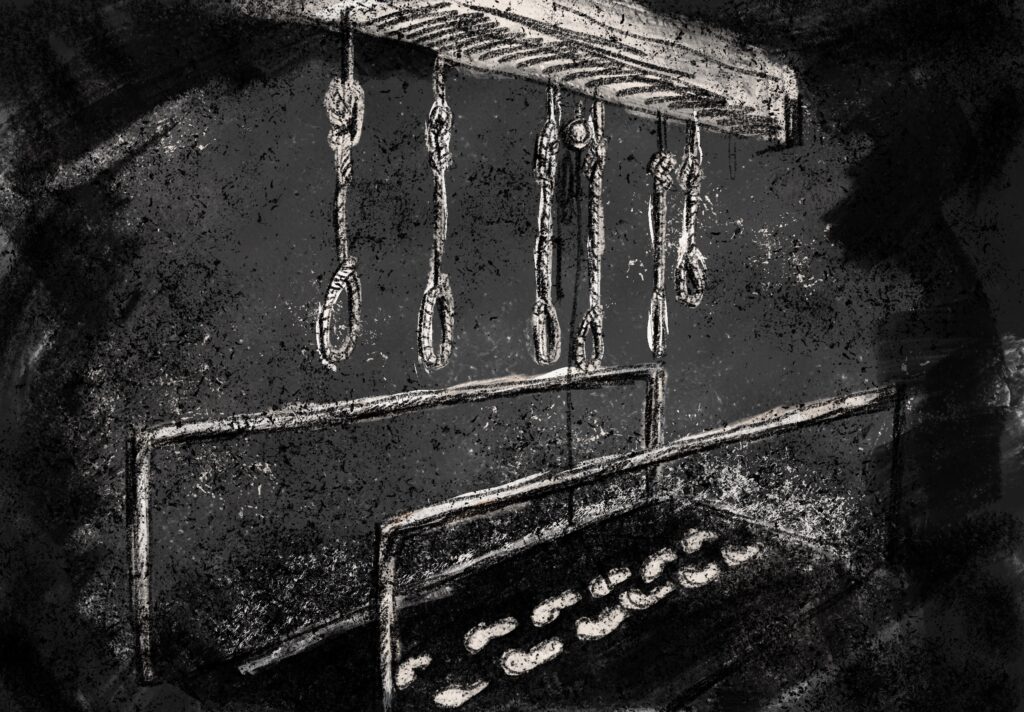
Like a constant buzz of electricity, the air is charged with the crackle of violence. Hanging from the ceiling are nooses, dangling like serpents twisting and curling their vicious tails.
We line up alongside the gallows, necks craned; eyes widened at these troubling ropes. At our feet: a wooden trapdoor which can be opened at the pull of a lever. This rickety platform is the only thing standing between life and death: the final step before the drop.
The clock is ticking. As the warden makes his way across the room, I feel my chest constrict as if the ropes have twisted around my heart. The air is now so thick; my tongue feels like lead and my neck prickles with sweat. Time’s almost up. His hand reaches for the lever.
As we all surround that limp trap door, nobody makes a sound. I can still feel it settling all around me: that cold, deafening silence. Even as we depart from the gallows, it clings to me long after.
It has been 32 years since the end of Apartheid, a period where 3 500 people were sentenced to death by the state. In the modern age, it has become concerningly easy to shrug off these injustices as a thing of the past, a forgotten by-gone.
In the gallows of Kgosi Mampuru II prison, however, history is anything but gone. It echoes through the halls, up the stairs, around the hanging rope: a lively, tangible pain that sends a jolt through your bones. It sits heavy in the air: the agony of men marching solemnly to their deaths. That violence bleeds from that pocket of history. It lives in that prison.
The day we visited the gallows, I left with a newfound understanding of the past: that just because it has passed does not mean that it is gone.
The freedom that we have today came at a hefty cost; it was built from bloodied death chambers, scavenged from towers of corpses, hacked from beating hearts that were stuffed in boxes.
It is anything but the past; it is alive, and it weaves itself indefinitely into the fabric of the present, informing the very freedom we have today. It lingers in the triumph of being able to walk freely on an open street. It sits in the warmth and laughter of a community braai. It pumps through the veins of a liberated nation.
Before Solomon Mahlangu was executed he said, “Tell my people that I love them and that they must continue to fight; my blood will nourish the tree that will bear the fruits of freedom.”
As we observe Freedom Day, we must remember the thousands of lives the fruits of our freedom are staked on. We cannot let their memories die in vain. It is our one duty: to honour their sacrifice and let the past mean more than just the past.
FEATURED IMAGE: A portrait of Jamie Ho. Photo: Alaistair Russel
RELATED STORIES:
- Wits Vuvuzela, SLICE: The filtered past: why our history education needs the hard truth., April 2026
- Wits Vuvuzela, SLICE: Don’t look away from the horrors of Apartheid in Palestine , April 2026
- Wits Vuvuzela, REVIEW: Apartheid explored ‘between the cracks’, May 2025

