
A creative powerhouse whose legacy is defined by life experiences, grit, passion and purpose.
Malcolm Purkey is famously known as a multifaceted genius. A playwright, director, actor, lecturer and an experienced Dean of AFDA Johannesburg. From humble beginnings, Purkey carved his own path in theatre and education rooted at Wits University.
Born in 1951, Yeoville, Johannesburg, Purkey spent his life moving around the city. His parents came from Britain; his father Harold Purkey was a jazz pianist and his mother, Kay Purkey was a hardworking singer. It is no surprise, then, that Purkey inherited all the artistic talent from both his parents.
Purkey is a true Witsie, he started at Wits in 1970 and studied English, Sesotho and Ancient Greek. He initially dropped out because he had failed his undergraduate modules and found his way back to Wits, completing English One. Afterwards, he left school and worked in a theatre for six months, which marked the beginning of his theatre career. He left South Africa to go to Britain, and realised Britain was not home, in fact he came to the conclusion that: “I am neither African nor European, I am both.”
His return to Wits to complete his honours in English, built a box theatre in the Matrix alongside an architect and he also built The Nunnery theatre.
As Purkey spoke to Wits Vuvuzela, a vivid recollection of being taught the absurdist play, Waiting for Godot by Samuel Beckett by former English lecturer, Hilary Semple. A seminal moment for him.
“I’m an absurdist. Oh my God. There is no God. Oh, my God what am I supposed to do? So, what I did is I wrote [sic] an answer. Where the two characters who are looking, waiting for Godot, they finally get to heaven, and they find out that the realisation of a dream is hopelessly inadequate. The journey is all…That was the play I wrote, and it got professors saying nice things about it,” he shared.
The play in question was Sequel to Jeso (1971), which was one of his first plays shown at Wits, in the Great Hall.
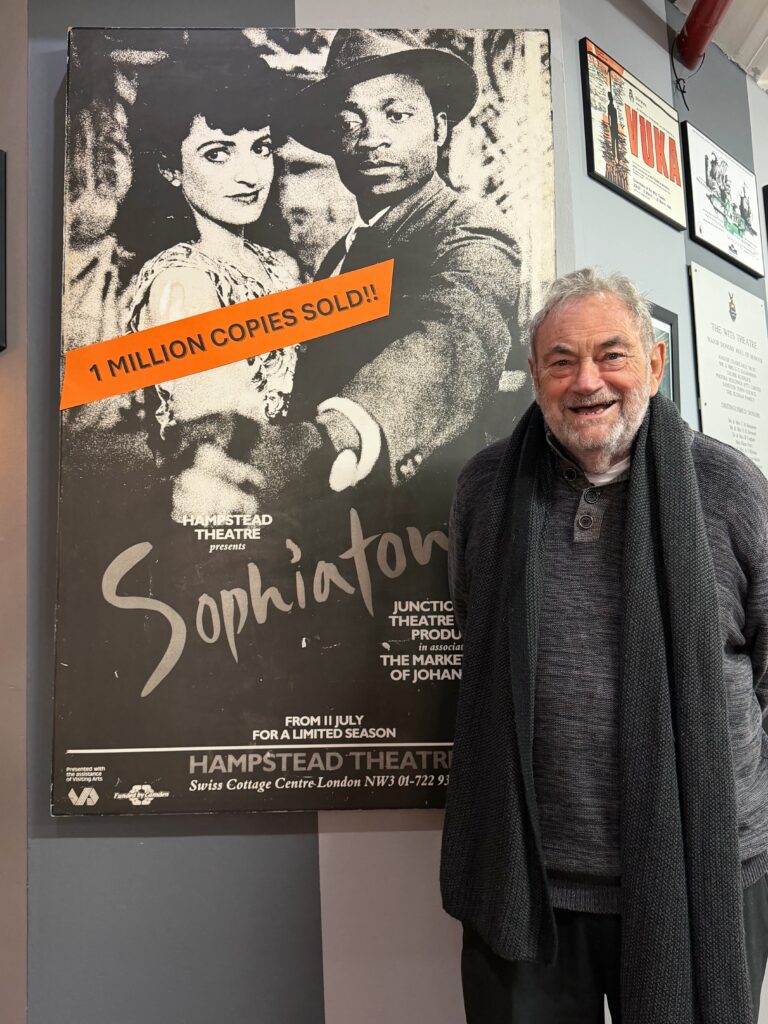
Decades on, Purkey’s imprint in theatre continues to be felt the resurgence of the play Sophiatown (1986), which was recently on show at the Wits Theatre. Sophiatown has successfully sold one million copies of the play text published by Wits University Press and Macmillan Publishers which happens to also be a part of the current grade 11 first additional language curriculum.
Purkey believes that drama, as both a subject and medium, is a powerful tool. “Drama teaches you a whole lot of power, language, talking and being in the world.” He first learned just how powerful when he co-founded the Junction Avenue Theatre Company in 1976 and later joined forces with Workshop 71 to form a non-racial theatre group that could shed a light on the injustice of the Apartheid regime.
A guiding principle for the company was “history from below.” It “was the idea that we have to reveal the hidden history that the apartheid state wanted hidden, such as the destruction of Doornfontein, the destruction of Sophiatown, the ANC in exile,” he shared.
His first award followed shortly after in 1978, when Purkey won best director of the year for the play Travesties.
Through his work and life experience Purkey has been able to not only achieve much but also live up to his sense of purpose, which is: “To use theatre to communicate wonderful, contradictory, and telling ideas that reveal part of our worlds to ourselves and part of ourselves to ourselves that otherwise remain hidden”.
FEATURED IMAGE: A photo of Malcolm Purkey. Photo by: Sikelelekile Pahlana
RELATED STORIES:
- Wits Vuvuzela, PROFILE: Wits law student advocates for body positivity and inclusion, March 2026
- Wits Vuvuzela, PROFILE: Chriselda Lewis’ story is far from over , May 2025
- Wits Vuvuzela, PROFILE: Dr. Dineo Skosana shapes justice through memory, land and scholarship, May 2025

