
The closure of City Press feels symbolic for journalism students growing up in the digital era.
- The closure of City Press reflects the decline of traditional print journalism.
- Journalism students are preparing for an industry increasingly dominated by digital media.
- Despite the shift of digital journalism, newspapers still represent an important part of journalism culture.
As a journalism student, I always imagined my future inside a busy newsroom. Pictured reporters rushing to meet deadlines, newspapers stacked on desks and the sound of keyboards filling the room as stories came together before print. Growing up, newspapers felt permanent. They felt important. The closure of City Press in addition to several other titles shut down by Media24, felt like a violent wake up from a beautiful dream. One never gets used to that.
When news of the newspaper’s closure broke, it felt bigger than the loss of a publication. It felt like the end of a version of journalism many students like me had hoped to become part of one day.
Growing up, I witnessed the slow decline of print newspapers as more people turned to digital media for news. As journalism students we already publish stories online and use websites during practicals, so digital journalism already feels normal to us. However, the closure of City Press still felt significant because it marked the end of one of South Africa’s last major print newspapers.
Most people now consume news through their phones before it ever riches print. Social Media updates appear faster and are easier to access, which explains why fewer people still buy newspapers. Although digital newspapers have become the norm, newspapers still carried a sense of tradition that made the closure of City Press feel Symbolic.
Even though many journalism students are already preparing for digital media spaces, the closure of City Press still feels emotional because newspapers were once seen as the centre of journalism. Watching another print title disappear makes the shift from print to digital feel more final.
Despite this uncertainty, the closure of City Press also reminded me why journalism still matters. Even if newspapers disappear, people will always need stories that inform, expose and reflect society honestly. Journalism may no longer look the same as it once did, but its responsibility remains important.
The closure felt personal because it represented more than the loss of a newspaper. It represented change and uncertainty. Still, while many aspiring journalists continue studying, writing and preparing themselves to tell stories in whatever form journalism takes next they are faced with this uncertainty.
The newsroom may be changing before we even enter it, but the passion to tell meaningful stories remains.
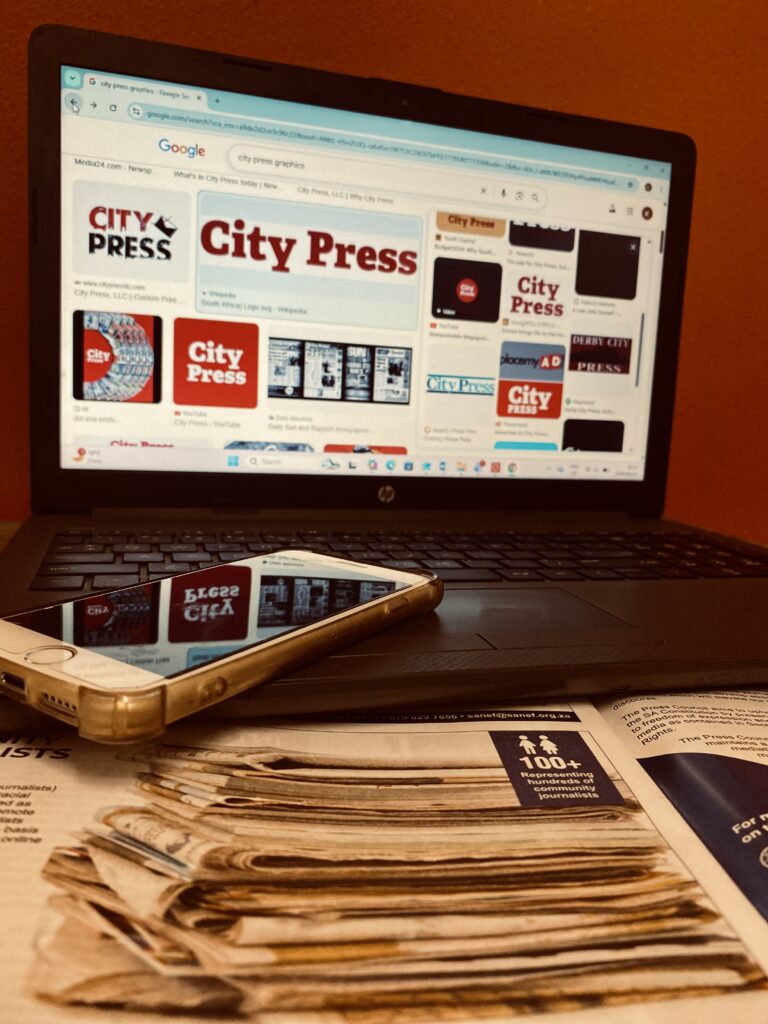
FEATURE IMAGE: Print in the magazine, phone and laptop: City Press visuals, Photo: Khutso Ngwatoana
RELATED STORIES:
- Wits Vuvuzela, profile-newspapers-are-still-one-womans-bread-and-butter, May 2024.
- Wits Vuvuzela,wits-vuvuzela-goes-into-mute-mode, Jan 2020.
- Wits Vuvuzela, wits-law-school-newspaper-says-dumelang-to-digital, Apr 2021.

