From altering oversized trousers in a university residence to turning discarded clothing into insulation for informal settlements. Bryan Lepelle is proving that a small student idea can grow into a business with a bigger purpose.
Drip Tailors is focused on sustainability, skills development and job creation.
Lepelle received a Head of School Award at Wits.
Lepelle formally registers his business in 2025.
Bryan Lepelle, a co-founder of Drip Tailors, is not the kind of entrepreneur who started with a big office, expensive machines or a large amount of funding. As an Honours student in Education, his entrepreneurial journey started in 2023 while he was a student living at Barnato residence at the University of the Witwatersrand.
Lepelle and his co-founder, Refilwe Monyela, bought trousers that were too big for them. Instead of looking for someone to alter the trousers, they decided to do it themselves. Their sewing skills were self-taught. They adjusted the trousers and, to their surprise, it worked. “We taught ourselves how to sew and we adjusted the trousers and it actually went well,” says Lepelle.
That small success made them think about other students who could be facing the same problem. With many students buying clothes online from stores such as Shein and Temu, they wondered whether there were other students who faced the same problem they did. So, they posted in university groups to find out and there were many.
What began with two students trying to fix their own trousers quickly turned into an opportunity.
“We identified a problem that students had and we had to come up with a solution,” Lepelle explains.
At first, Drip Tailors was informal. Lepelle and Monyela were simply making some extra money on the side while studying. It was not yet the serious business it would later become. In 2025, however, they took another important step by entering the entrepreneurial space at E-hub. The E-hub is a university –based entrepreneurship hub that supports students and emerging entrepreneurs in developing and growing their businesses. With the support they received there, the business was formally registered. They received mentorship, which helped them understand that what they had started could become more than just a side-hustle.
But turning an idea into a business came with its own challenges. “The biggest challenge when we were starting was funding, basically because we work with machinery and other equipment,” Lepelle says.
The lack of resources forced the young entrepreneurs to find ways to work with what they had. “When we started, we made an investment in buying two small machines. Even though we lacked some equipment, we found a way of adapting and using those two machines, and it did work,” he says. Later, they received funding after winning an Enactus competition. Other support, including funding from Ford Motor Company, also helped them move forward.
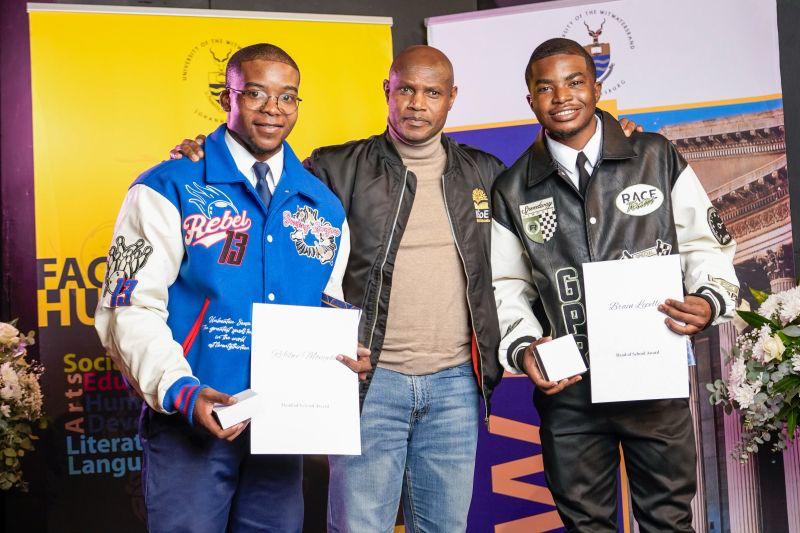
Drip Tailors Co-founders Refilwe Monyela (left) and Bryan Lepelle (right) pose with certificates after being recognized for their tailoring work. Photo: Supplied/ Drip Tailors
Learning to work with limited resources became part of his entrepreneurial education. But Drip Tailors was also changing. The business began looking beyond simply altering clothes and towards a much bigger problem: textile waste and the cold weather experienced by people living in informal settlements. This led to the development of ThermaCycle.
Drip Tailors collects unwanted clothing through clothing donation drives and other partnerships. “When we go to collect clothes, there are clothes that can’t be donated because they are seriously damaged, beyond repair and can’t be used anymore, Lepelle says. Instead of throwing those clothes away, Drip Tailors repurposes them. “We take those clothes, disinfect them and decolour them, and we make thermal wall insulation with those clothes,” he explains. The insulation is then used to help make homes in informal settlements warmer.
According to Lepelle, the material can help increase the temperature inside a house by 8 to 18 degrees, helping create a warmer and more comfortable living environment during colder months.
At the heart of Drip Tailors is the idea of finding solutions to problems.
The business has grown into a social enterprise. It is not only focused on recycling waste but also on teaching people skills that they can use to be self-sustainable. Drip Tailors has a training academy where people are taught sewing skills. Lepelle explains that the goal is not simply to train people and send them home, but to give them skills that can create opportunities for their future. As he puts it, “after someone has completed their training, they can go start their own business.” He also emphasises that Drip Tailors is focused on creating a meaningful impact in the community, stating that “Drip Tailors teaches people skills so they can be able to sustain themselves.”
This focus on skills and employment is especially important to Lepelle because of the high level of unemployment among young people in South Africa. As he explains, “trying to employ a certain portion of youth is solving one of the country’s problems.”
Being a student and a business owner at the same time is challenging. While other young people may spend their free time relaxing, going out with friends or simply enjoying university life, Lepelle often spends his spare time serving clients, managing his team and thinking about the future of the business. He admits that finding a balance has been one of the hardest parts of his journey. His solution? Organisation.
Lepelle creates weekly schedules and sets goals for each. His university timetable also gives him some flexibility because he attends classes once a week and has many classes online. Lepelle explains, “I divide my time by setting weekly schedules and setting goals for every week.” He adds that attending physical classes once a week and having the rest online gives him the flexibility to manage both his studies and business.
He believes the success of the project is not about two directors doing everything themselves.
“It’s all possible because of a team,” he says.
His journey has also taken him beyond South Africa. In 2025, Lepelle travelled to Thailand, where he made international connections and developed partnerships with people from other countries. He says the experience taught him that networking is one of the most important parts of entrepreneurship. More importantly, he learned that a company is not only about the people who own it. It is about the people it serves.
That lesson has influenced the way he looks at business. In his view, entrepreneurship should have an impact on the community. It should create opportunities, solve problems and help people. That belief has also shaped his leadership.
His advice is simple: take the risk.
“If you don’t take steps, no one will take them for you,” he says.
For Lepelle failure is also part of the process. Sometimes, he says, you have to fail in order to learn. His own journey shows that entrepreneurship does not always begin with a perfect business plan. Sometimes it starts with a problem that needs solving. For him, it was a pair of trousers that did not fit. Today, the same mindset is being used to tackle a much bigger problem: textile waste, cold homes and unemployment.
Drip Tailors co-founders Refilwe Monyela (left) and Bryan Lepelle (right) at an Enactus competition. Photo: Supplied/Drip Tailors
FEATURE IMAGE: The official logo of Drip Tailors, a Wits students’ tailoring business. Photo: Supplied/ Drip Tailors
Wits offers support for students with disabilities, but for those whose conditions are not visible, stigma and fear of judgement can make asking for help difficult.
Wits has 1,126 registered students with disabilities receiving support through the Disability Rights Unit.
Wits has identified stigma and disclosure as barriers for students with invisible disabilities.
Students say asking for accommodation can be an emotional and undignified experience.
The Wits Disability Rights Unit (DRU) hosted a seminar on Wednesday, August 19, 2026, to address invisible disabilities and the barriers students face in accessing support. For some students at Wits University, getting support for an invisible disability can mean having to explain something that other people cannot see.
These disabilities such as ADHD, autism, mental health conditions, and chronic illnesses may not be immediately visible. Zamo Mbhele, a psychologist speaking at the DRU seminar, explained that this can make it difficult for students to ask for support, as they often worry about how it will be perceived.
Wits itself has acknowledged that stigma can prevent students from disclosing their conditions. In 2024, the university released an article on disability inclusion, the university noted that for students with invisible disabilities, “fear of stigma often prevents disclosure”. It further noted that students with complex needs require tailored support and coordinated services. For those who disclose their disabilities, the DRU provides support such as academic accommodations, assistive technology, and other forms of learning support. However, students who shared their experiences at the seminar said having support available does not always mean that asking for it is easy.
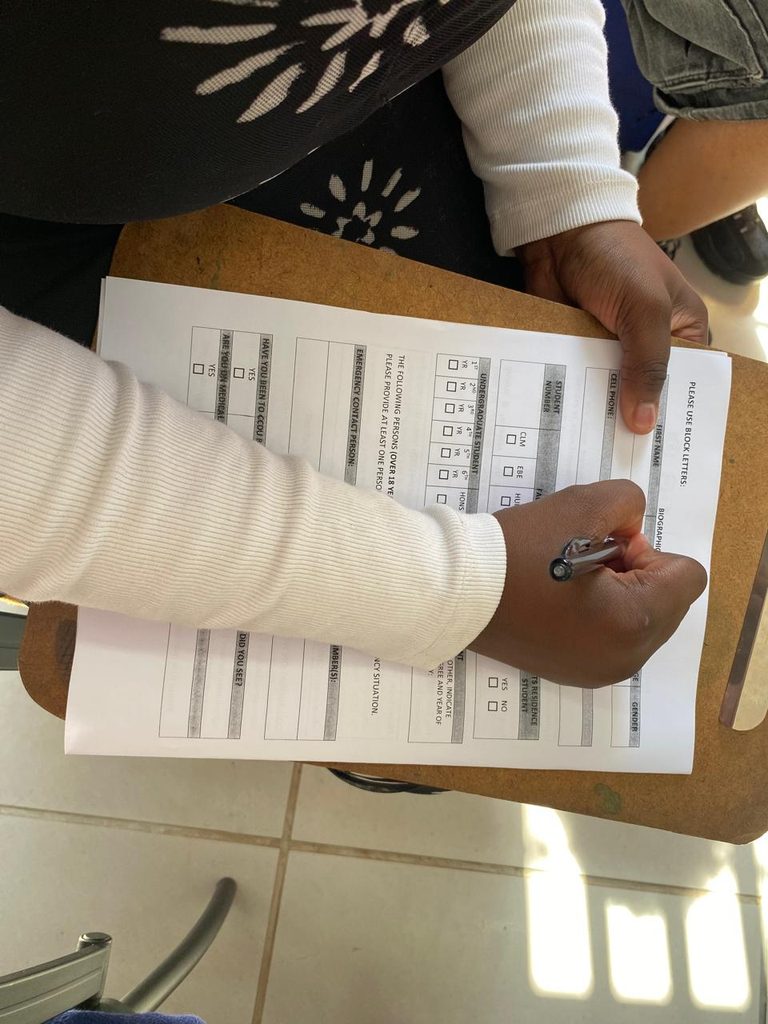
A student completes a paperwork to register for support services at Wits. Photo: Khutso Ngwatoana
According to the Wits Disability Rights Unit , 1,126 students with disabilities were registered last year. This includes 307 students with neurodevelopmental disabilities, 175 with psychosocial disabilities and 133 with chronic illnesses. Yet these figures only show students who disclosed with the DRU. Many others with invisible disabilities may be struggling in silence, reluctant to register because of stigma.
Wits student Alexandra Makhlouf said the DRU has played an important role for her by creating a social space where she can meet other students with disabilities.
“There is still stigma about disability on campus, and having to meet other disability students on campus has played an important role for me,” Makhlouf said.
Another student at the seminar, who asked not to be named because of the personal nature of their experience, described the emotional difficulty of asking for reasonable academic adjustments such as flexible deadlines, access to quiet spaces, or changes to how they participate in academic activities.
“I find it so undignifying every time I need to ask for understanding and accommodation, and I’m in tears every time at home when I am trying to get accommodation for something and putting together my motivations,” the attendee said.
Mbhele shared that, “Belonging is the experience of entering a space without having to negotiate your legitimacy within it.”
These experiences show that, for students with invisible disabilities, sense of belonging can be difficult when they feel they have to repeatedly explain or prove their needs before receiving support.
Dr Leila Abdool Gafoor, Head of the DRU, said the university must ensure that every person’s voice is heard and create psychological safety so that students do not experience stigma when speaking about their needs.
The issue is not simply whether support exists, but whether students know where to find it, feel safe enough to disclose their needs and can ask for accommodation without feeling judged.
For Wits students with invisible disabilities, inclusion goes beyond physical access. It also means creating an environment where asking for help does not feel like having to prove that you belong. The question now is whether Wits can make its existing support easier to access for students who may already be afraid to disclose their disabilities.
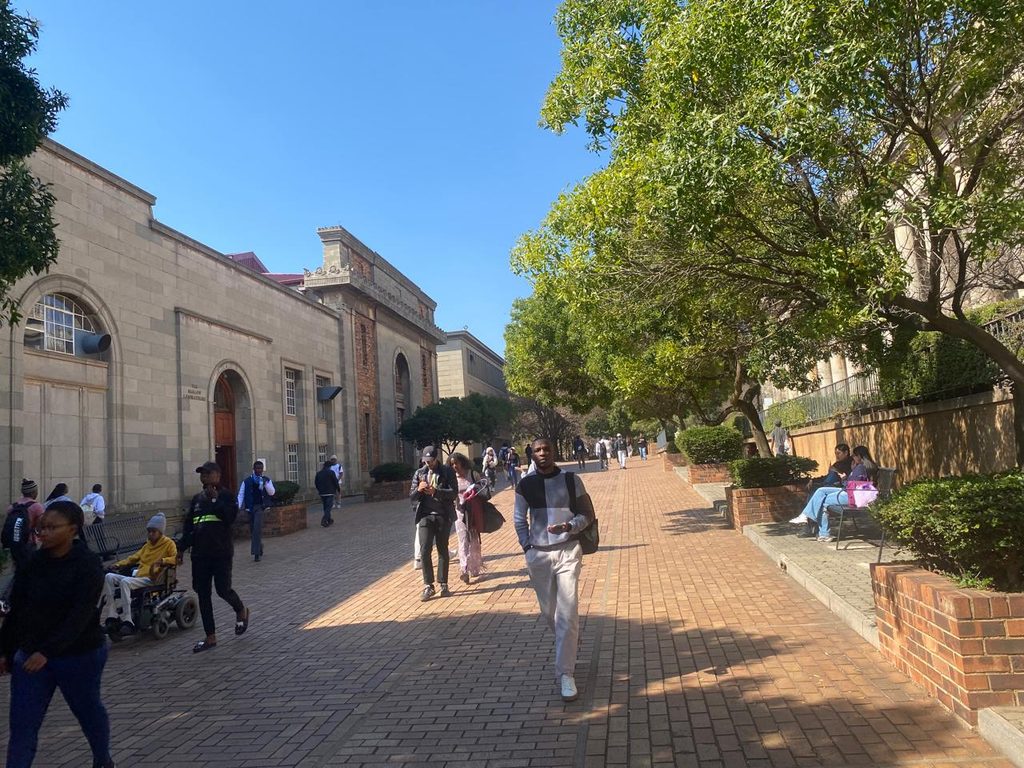
Students, including a student using a wheelchair on Wits Campus. DRU said Wits must support both visible and invisible disabilities. Photo: Khutso Ngwatoana
FEATURE IMAGE: A disability access sign on Wits campus that represent physical disability. Photo: Khutso Ngwatoana
Climate change is threatening South Africa’s books, archives, and history.
Books come from plants and they are damaged by water, insects, and humidity.
Archives preserve the stories and experiences that shape South Africa’s identity for future generations.
Climate threats to historical records grow.
When the University of Cape Town’s Jagger Library burned in 2021, South Africa lost priceless books, manuscripts and archives that could never be replaced. Literary scholar Isabel Hofmeyr says the disaster exposed an often-overlooked consequence of climate change: it is not only threatening ecosystems but also the books and records that preserve the nation’s history.
Speaking at a seminar at the Wits Club on 29 July, Hofmeyer said books are more than just paper-based objects. They exist within a broader ecosystem: paper is made from plants, insects can damage books, water can destroy archives, and environmental conditions influence how knowledge is produced and protected.
The loss of books and archives is about more than damaged paper. These records preserve South Africa’s history, culture and identity by documenting important events, people and communities. Researchers, students and future generations rely on these collections to understand the country’s past. When historical records are destroyed, valuable information is lost forever, making it harder to preserve stories that have shaped the nation.
Climate change is increasing the risk of extreme weather events such as wildfires, floods and rising temperatures, all of which can damage libraries and archives. Paper is vulnerable to heat, moisture and humidity, while insects and mould can further destroy fragile collections. As these environmental threats become more frequent, institutions responsible for protecting historical records face growing challenges in preserving them. Without proper conservation and protection, South Africa could lose more irreplaceable documents that hold historical, educational, and cultural value.
Hofmeyr said that “to reduce the risk of permanent loss, we need protection efforts” like improving storage conditions, monitoring humidity and temperature, and creating digital copies of important documents. She further added that it will also require funding and long-term planning to ensure valuable historical records remain available for future generations.
Speaking to WV after the seminar, Bachelor of Science student, Omphile Mankgaba, said the issue revealed an impact of climate change that many people do not usually consider. “I find it fascinating that in all the things we are looking at for climate change impacts, books are impacted,“ she said.
Master of Arts student Gareth Cruywagen said the discussion changed the way he thinks about environmental issues. “Climate change is destroying our history,” he said.
As climate change continues to threaten communities and the environment, protecting libraries, archives and historical records is becoming increasingly important. Preserving these collections will help ensure that South Africa’s history, knowledge, and cultural heritage remain available for future generations.
A rare volume is displayed with care ,showing how archives keep stories of the past alive for future generations. Photo by: Khutso Ngwatoana
FEATURE:A rare volume is displayed with care ,showing how archives keep stories of the past alive for future generations. Photo by: Khutso Ngwatoana
The closure of City Press feels symbolic for journalism students growing up in the digital era.
The closure of City Press reflects the decline of traditional print journalism.
Journalism students are preparing for an industry increasingly dominated by digital media.
Despite the shift of digital journalism, newspapers still represent an important part of journalism culture.
As a journalism student, I always imagined my future inside a busy newsroom. Pictured reporters rushing to meet deadlines, newspapers stacked on desks and the sound of keyboards filling the room as stories came together before print. Growing up, newspapers felt permanent. They felt important. The closure of City Press in addition to several other titles shut down by Media24, felt like a violent wake up from a beautiful dream. One never gets used to that.
When news of the newspaper’s closure broke, it felt bigger than the loss of a publication. It felt like the end of a version of journalism many students like me had hoped to become part of one day.
Growing up, I witnessed the slow decline of print newspapers as more people turned to digital media for news. As journalism students we already publish stories online and use websites during practicals, so digital journalism already feels normal to us. However, the closure of City Press still felt significant because it marked the end of one of South Africa’s last major print newspapers.
Most people now consume news through their phones before it ever riches print. Social Media updates appear faster and are easier to access, which explains why fewer people still buy newspapers. Although digital newspapers have become the norm, newspapers still carried a sense of tradition that made the closure of City Press feel Symbolic.
Even though many journalism students are already preparing for digital media spaces, the closure of City Press still feels emotional because newspapers were once seen as the centre of journalism. Watching another print title disappear makes the shift from print to digital feel more final.
Despite this uncertainty, the closure of City Press also reminded me why journalism still matters. Even if newspapers disappear, people will always need stories that inform, expose and reflect society honestly. Journalism may no longer look the same as it once did, but its responsibility remains important.
The closure felt personal because it represented more than the loss of a newspaper. It represented change and uncertainty. Still, while many aspiring journalists continue studying, writing and preparing themselves to tell stories in whatever form journalism takes next they are faced with this uncertainty.
The newsroom may be changing before we even enter it, but the passion to tell meaningful stories remains.
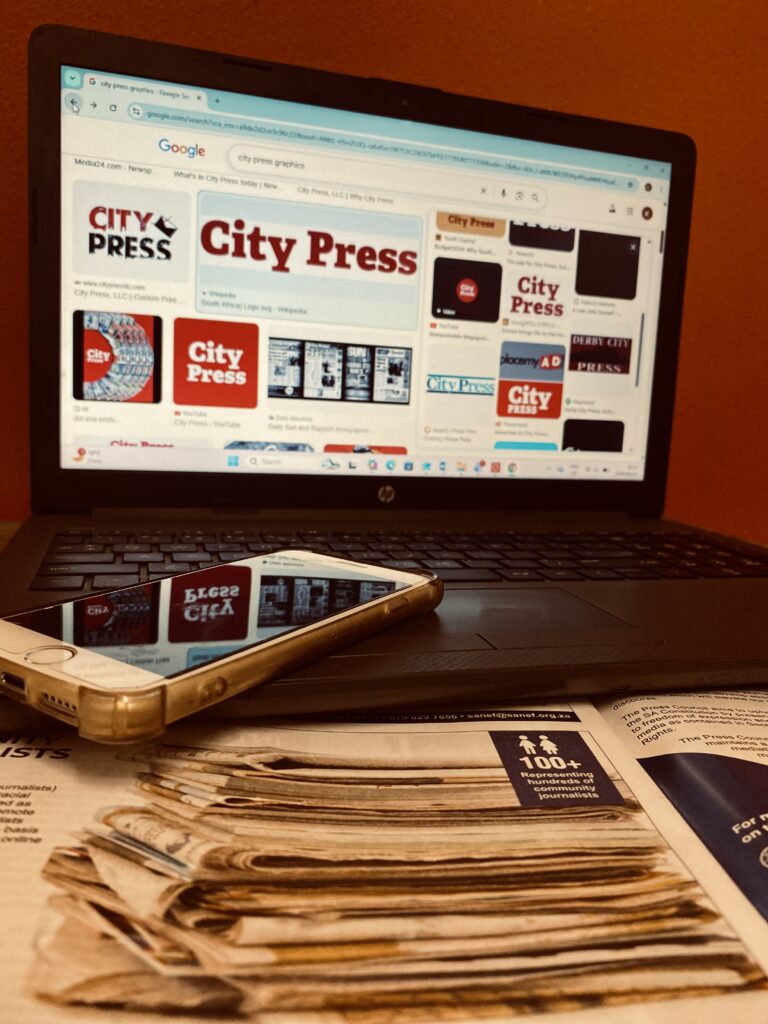
Print in the magazine, phone and laptop: City Press visuals, Photo: Khutso Ngwatoana
FEATURE IMAGE: Print in the magazine, phone and laptop: City Press visuals, Photo: Khutso Ngwatoana
Wits journalism students confront apartheid’s execution site and argue visits should be compulsory for future reporters and lawyers.
At least 130 political prisoners were hanged there, including ANC freedom fighter Solomon Mahlangu, with many buried in unmarked graves at Rebecca Street Cemetery.
The trapdoor at Kgoši Mampuru II is now a national heritage site, but between 1960 and 1990 it executed more than 3,500 people — seven at a time.
On Wednesday, April 15, 2026, Wits Centre for Journalism students took the 52-step ascent to the gallows at Kgoši Mampuru II Correctional Centre. The trapdoor is now part of a national heritage site, but between 1960 and 1990 this room executed more than 3,500 people — seven at a time. If Wits University trains the next defenders of our Constitution, then Wits should make this site compulsory for first-year Law students and Honours Journalism students.
Department of Justice records show more than 3,500 prisoners were hanged at Pretoria Central Prison, which closed in 1996 and is now known as the Gallows Memorial Museum. At least 130 to 134 of the prisoners were political activists, including ANC freedom fighter Solomon Mahlangu. Many were buried in unmarked graves at Rebecca Street Cemetery in Mamelodi. The last political execution took place on 29 September 1989, months before the government abolished the death penalty. This was the same gallows where Kgoši Mampuru II himself was executed in 1883, and later, Daisy de Melker.
Critics may argue that the site is traumatic, or that students already study S v Makwanyane where the Constitutional Court outlawed capital punishment in 1995. However, reading a judgment is not the same as standing where the law failed. Law students practise justice in moot courts at Wits. First-year Law and Honours Journalism students must also face where justice failed. The facility is 54,3km from campus. The tour exists.
This visit should be compulsory because Law and Journalism students can’t just read about historic event. Law students will stand up in court one day to talk about people’s freedom. They need to see the room where the state used to execute people. Journalism students will write news stories about jails and courts. If the visit is optional, most students will skip it because it’s hard, but protecting the Constitution isn’t optional. If Wits wants to train lawyers and journalists who care about justice, this isn’t just an educational excursion, but foundational training. If we have never faced the state’s most final act, how can we report it with the weight it demands?
I believe education without memory is incomplete. Wits should partner with the Department of Correctional Services to include an excursion to the Gallows Memorial Museum for first-year Law students and Honours Journalism students, with proper counselling support. A Constitution written to prevent 3,500 deaths cannot be understood without confronting where those deaths happened. The law is not only in textbooks. Sometimes, it’s at the top of 52 steps.
FEATURED IMAGE: Wits Great Hall. Photo: Khutso Ngwatoana
The Pretoria Correctional Service Museum displays a blood-stained cloth from a flogging and a wooden “whipping triangle” used for corporal punishment.
At the Gallows, 3,500 names are engraved on memorial slabs, including Solomon Mahlangu and the Vulindlela family, executed by the apartheid state.
I thought I was going on a class tour. At Kgoši Mampuru II, I realised I was walking into South Africa’s past.
We visited two museums that tell two sides of the same story. The first was the Pretoria Correctional Service Museum, which shows how the prison system was run. The second was the Gallows Memorial Museum, where 3,500 people were executed. I walked in as a student but I left carrying weight I didn’t expect.
The two museums work together. The Pretoria Correctional Service Museum shows the mechanics of control, how people were fed, clothed, worked, and punished. The Gallows shows the final price of that control, 3,500 lives ended by the state.
We began at the Pretoria Correctional Service Museum. Correctional officer Dimakatso welcomed us and explained that phones and cameras were not allowed inside, and then she guided us through the exhibits. We saw wood carvings and sculptures made by inmates.
The punishment displays were the most difficult part for me. A wooden “whipping triangle” showed where inmates were tied for corporal punishment, and stun belts were used to immobilise them. When I saw a white cloth stained with blood from a flogging, I gasped.
A contraband section held makeshift knives shaped from spoons and dagga pipes, which is why Dimakatso said metal dishes have been replaced with plastic. She added that inmates can study and work, although the pay is little. We ended the tour with a look at a replica of Nelson Mandela’s cell.
At the Gallows, we handed our devices before Mr Kgomo took over. His tone was firm and commanding, stating that we were privileged to be there. He showed us engraved memorial slabs with 3,500 names of the hanged, including political prisoners like Solomon Mahlangu and the Vulindlela family, and I kept asking myself how an entire family could be executed.
The first room we entered was a church beneath the hanging chamber. On execution days, bodies were lowered by 9am for families to view in closed coffins, and relatives were told “he’s no more.” I hate coffins, and my heart raced as I understood how easily dignity was stripped away.
We then climbed the 52 steps to the gallows where prisoners took their last walk. As we ascended past dark images and words on the walls, my heart pounded and I sighed with every step because the weight of what happened there felt physical.
At the top, photographs of the hanged made my eyes fill with tears that didn’t drop, and when I saw the seven ropes in the chamber my heart sank while Mr Kgomo described each stage of the process. I realised that living now is a privilege we take for granted.
We left in silence. Everyone was speechless.
As a journalism student, I cannot separate theory from place anymore. I walked the 52 steps. Visits like this should be compulsory for us, because we cannot report on justice or the law fairly if we do not face the past physically. I arrived curious but I left sad, shaken, and more responsible.
FEATURED IMAGE: A portrait of Khutso Ngwatoana. Photo: Alaistar Russell
In episode six of We Should Be Writing season 7, the team unpacked the evolution of music as a form of expression and protest, through four decades in the South African context. The episode explores the journey of South African music and its consumers from the 80s, 90s, early 2000s and contemporary listeners. From the […]