
A performance project featuring spoken words, chants, movements and musical art. It is a reimagination of Arther Rimbaud’s poem titled ‘A season in Hell’.
A season in Hillbrow, directed by Sibahle Mangena and Gerard Bester… what were my expectations? In all honestly, the performance far exceeded anything I had anticipated. I had expected an hour of a performance that somehow resembled ‘The greatest showman‘, where performers just burst into song mid-sentence. I had even thought to myself how will such an in-depth, poetic masterpiece be turned into musical play?
Safe to say, calling this performance a musical would be highly undermining its artistry. A group of high school students from the Windybrow Arts Centre took to the floor of the Southwest Engineering building an immaculate form of storytelling. A form that might make one assume is wiser than their years. Simply using school desks, their bodies, their voices, and most importantly their words.
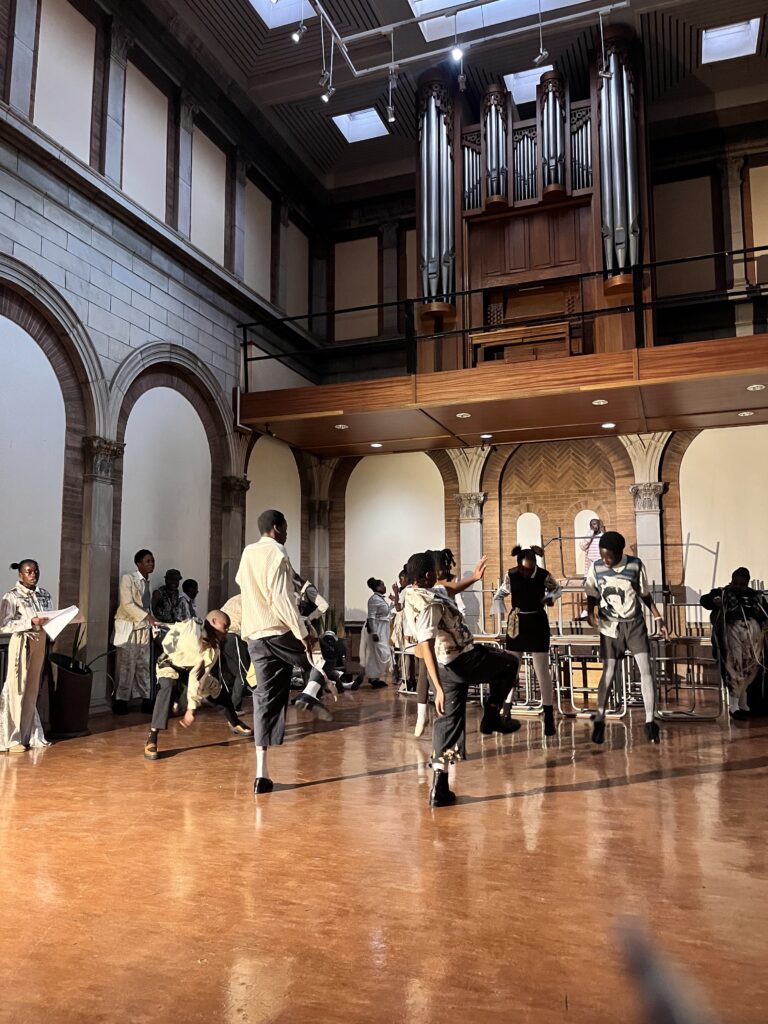
The performance started with what seemed like a recitation of the beginning of Arther Rimbaud’s poem. As someone who knows this poem well, I quickly realised, that was far from the truth. Each student in the set up classroom delivered these short, punchy one-liners that incorporated words from the poem and mixed them with the real lived experience of Hillbrow. They mingled a clever play on words that spoke to issues of education, poverty, crime, gangsters, safety, hope and love while maintaining the main themes of suffering, alienation, self-destruction, and rebellion taken from the poem.
They carefully tackled these issues from the wide spectrum of the repercussions of apartheid and xenophobia boiling all the way down to the potholes in the street and how a Mageza drives on the road. They mixed all Nguni languages with the Shakespear kind of English which made the performance identifiable to a South African context. They sang amagwijo with all their emotion, they danced on tables, they even used comedy, which only South Africans would understand, to relate to the audience. They represented the theme of rebellion by not conforming to traditional ways of storytelling but rather speaking out against rigidity, limitation, unbelief, and societal standards. Rebellion against real issues faced by South Africans and contextually South Africans who daily experience life in Hillbrow.
Their costumes were an art of rebellion themselves. Wearing torn skirts, untucked school shirts, ties pinned to their shoulders instead of their necks. Similarly to the stage they performed on which was set as a classroom, how they sat, stood and danced on the desks, how they piled desks on top of one another to create what they called “a castle”. That for me screamed a unique and unconventional take to the interpretation of Rimbaud’s work.

. It was “powerful work of emergence by emerging voices” said Stacy Hardy, one of the creators of this performance. Work of emergence to address current and detrimental issues in the heart of Hillbrow.
The high schoolers truly outdid themselves in relaying the message of reimagining such an enigmatic poem.
Vuvu Rating: 8/10
FEATURE IMAGE: Cast of A season in Hillbrow performance. Photo: Kamogelo Lesabe
RELATED STORIES:
- Wits Vuvuzela: REVIEW: Michael: Discovering the making of the King of Pop, May 2026
- Wits Vuvuzela: REVIEW: The revival of Sophiatown, April 2026
- Wits Vuvuzela: REVIEW: The Heart is a muscle, April 2026

