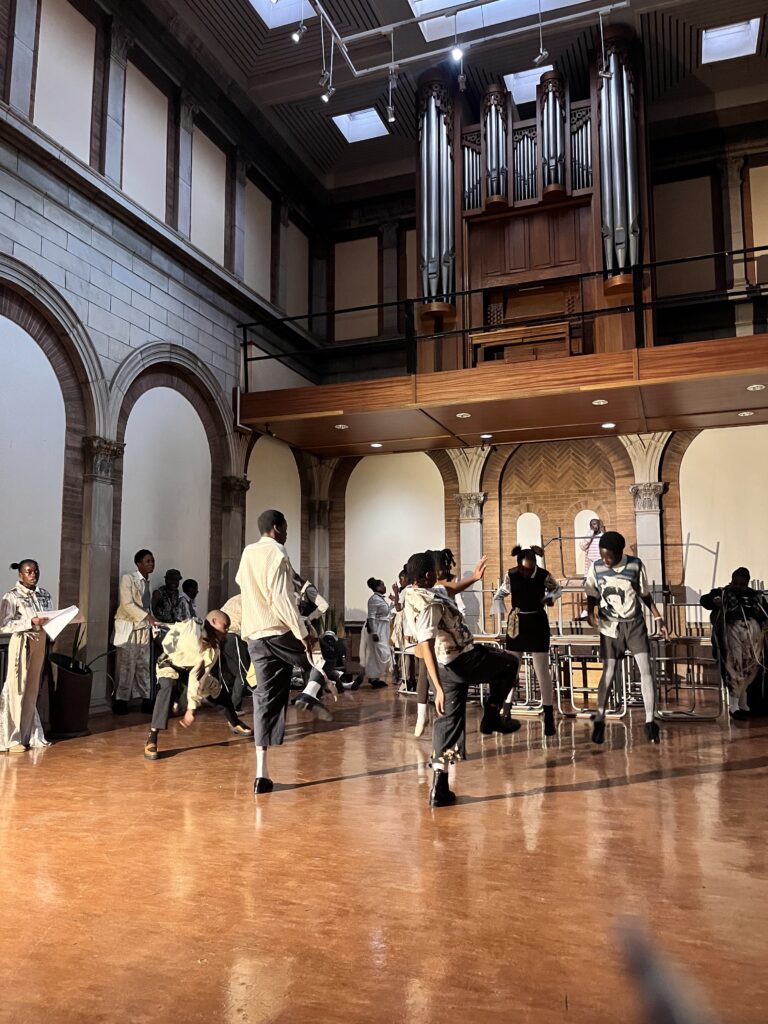
A performance project featuring spoken words, chants, movements and musical art. It is a reimagination of Arther Rimbaud’s poem titled ‘A season in Hell’.
A season in Hillbrow, directed by Sibahle Mangena and Gerard Bester… what were my expectations? In all honestly, the performance far exceeded anything I had anticipated. I had expected an hour of a performance that somehow resembled ‘The greatest showman‘, where performers just burst into song mid-sentence. I had even thought to myself how will such an in-depth, poetic masterpiece be turned into musical play?
Safe to say, calling this performance a musical would be highly undermining its artistry. A group of high school students from the Windybrow Arts Centre took to the floor of the Southwest Engineering building an immaculate form of storytelling. A form that might make one assume is wiser than their years. Simply using school desks, their bodies, their voices, and most importantly their words.
Still of cast dancing during performance. Photo: Kamogelo Lesabe
The performance started with what seemed like a recitation of the beginning of Arther Rimbaud’s poem. As someone who knows this poem well, I quickly realised, that was far from the truth. Each student in the set up classroom delivered these short, punchy one-liners that incorporated words from the poem and mixed them with the real lived experience of Hillbrow. They mingled a clever play on words that spoke to issues of education, poverty, crime, gangsters, safety, hope and love while maintaining the main themes of suffering, alienation, self-destruction, and rebellion taken from the poem.
They carefully tackled these issues from the wide spectrum of the repercussions of apartheid and xenophobia boiling all the way down to the potholes in the street and how a Mageza drives on the road. They mixed all Nguni languages with the Shakespear kind of English which made the performance identifiable to a South African context. They sang amagwijo with all their emotion, they danced on tables, they even used comedy, which only South Africans would understand, to relate to the audience. They represented the theme of rebellion by not conforming to traditional ways of storytelling but rather speaking out against rigidity, limitation, unbelief, and societal standards. Rebellion against real issues faced by South Africans and contextually South Africans who daily experience life in Hillbrow.
Their costumes were an art of rebellion themselves. Wearing torn skirts, untucked school shirts, ties pinned to their shoulders instead of their necks. Similarly to the stage they performed on which was set as a classroom, how they sat, stood and danced on the desks, how they piled desks on top of one another to create what they called “a castle”. That for me screamed a unique and unconventional take to the interpretation of Rimbaud’s work.
Still of “castle” built with tables. Photo: Kamogelo Lesabe
. It was “powerful work of emergence by emerging voices” said Stacy Hardy, one of the creators of this performance. Work of emergence to address current and detrimental issues in the heart of Hillbrow.
The high schoolers truly outdid themselves in relaying the message of reimagining such an enigmatic poem.
Vuvu Rating: 8/10
FEATURE IMAGE: Cast of A season in Hillbrow performance. Photo: Kamogelo Lesabe
RELATED STORIES:
Wits Vuvuzela: REVIEW: Michael: Discovering the making of the King of Pop, May 2026
Wits Vuvuzela: REVIEW: The revival of Sophiatown, April 2026
Wits Vuvuzela: REVIEW: The Heart is a muscle, April 2026
Age might be nothing but a number, but in South Africa, it can be the thin line between having a job or not.
A struggling economy is forcing educated South Africans into prolonged unemployment.
Petition to end unfair age restrictions in career entry job opportunities.
Young graduate ideal vs older unemployed graduate reality.
A growing online petition calling for an end to age restrictions in jobs, internships and learnerships has revealed the unsettling reality of South Africa’s chronic unemployment. Young adults who are skilled but unemployed say they are being locked out of opportunities because they are considered “too old”.
Many internships and learnerships in both the public and private sectors commonly restrict applicants to those under the age of 35. Such age caps attached to entry-level opportunities unfairly disadvantage the older, unemployed candidates.
The petition has garnered over 10 000 signatures in just five days.
Signatory, Pat Mokoena (34) said being unemployed is “like being trapped in a cycle where employers demand experience while programmes designed to provide that said experience unfortunately exclude the majority of us because of how old we are, that’s why I signed the petition”.
Amid continued economic pressure in South Africa, unemployment remains among the highest globally. Youth unemployment has remained especially severe, and slow economic growth and limited job creation have intensified competition.
According to the conclusions of Hannah MacGinty’s master’s thesis, ‘Graduate unemployment in South Africa’, graduates are no longer entering the workforce immediately after completing their studies, resulting in delayed careers that stretch well into their 30s.
MacGinty warns that even those who secure employment are increasingly finding themselves in short-term or contract-based positions with limited long-term security.
This instability makes age restrictions even more problematic. Workers who lose jobs later in life often struggle to re-enter the labour market once they exceed programme age limits.
The petition and supporters thereof argue that “recruitment should focus on skills, qualifications, experience and willingness to work instead of age discrimination.”
While some employers may defend age caps as part of youth empowerment strategies, South Africa’s unique crisis needs to be considered.
This petition is a symptom of broader economic failures. It reflects the desperation and humiliation rituals that employment seekers have to endure in a constrained environment.
FEATURED IMAGE: Screengrab of the online petition. Photo by: Kamogelo Lesabe
RELATED STORIES:
Wits Vuvuzela, FINANCE FEATURE: Why financial freedom feels out of reach for South Africa’s graduates, August 2025
Wits Vuvuzela, INFOGRAPHIC: Uptick in unemployment rate, August 2024
Wits Vuvuzela, INFOGRAPHIC: South Africa’s unemployment takes top spot, September 2021
The film is vibrant, emotional, and filled with the kind of energy that reminds audiences why Michael Jackson became known as the King of Pop in the first place
The new biographical movie Michael, does not merely attempt to tell the story of the King of Pop; it attempts something far more difficult — to search for the fragile human being buried beneath decades of noise, headlines, applause, and controversy.
From its opening moments, the movie bursts with life, overflowing with rhythm, colour, and excitement. Yet at the same time, ironically carrying an almost dreamlike sadness.Childhood dissolves beneath stage lights. Innocence disappears behind screaming crowds. The young Michael is portrayed not as a child discovering joy, but as a child being sculpted into perfection.
Still from Michael of Jafaar Jackson performing. Photo: Supplied/The Bioscope
Jaafar Jackson, who is Michael Jackson’s nephew, delivers a performance that was much more than an imitation, he literally captured the spirit that made Michael so captivating. The concert recreations are absolutely breathtaking, the camera follows him with almost religious awe as he glides across stages drenched in light filled with dazzling and electric choreography and infectious energy that make it impossible not to smile.
Whether recreating the moonwalk or commanding massive crowds, the performance radiates the charisma that made Michael Jackson one of the most influential entertainers in history.
He does not simply recreate the voice, the posture, famous gestures through the utterly shocking resemblance; he captures the contradiction at the centre of Michael Jackson himself which is the collision between extraordinary confidence on stage and profound vulnerability away from it.
Some scenes feel so alive that they almost blur the line between cinema and reality. The film stops feeling like a biography and becomes pure sensation. The heartbeat, rhythm, memory. Seeing people holding themselves down to their seats when the Thriller dance comes on. People humming softly to songs like Billie Jean and Human Nature, excluding that one person in the back who thought no one could hear them. Each song arrives carrying emotional weight, reminding audiences how deeply his music embedded itself into global consciousness. The film understands that Michael Jackson’s art was never background noise. It was cultural atmosphere.
Still from Michael of Thriller. Photo: Supplied/The Bioscope
In my opinion what makes Michael especially powerful is its refusal to portray fame as glamorous. While delving deeper into Michael’s superstardom it also shows his vulnerability, creativity, and desire to connect with others through his art. The quieter scenes give the movie emotional depth without overshadowing its celebratory tone. It balances spectacle with humanity, particularly through its portrayal of Michael’s complicated relationship with his father. Some of the film’s most emotional scenes emerge from this tension. Moments where achievement and pain seem inseparable.
Of course, no biographical film can perfectly capture a life as enormous and complicated as Michael Jackson’s and the complexity of telling Michael’s story is perhaps most visible in the absence of Janet Jackson from much of the film, despite her importance within both the Jackson family and popular culture itself.
There are moments where certain parts of the story could have been explored more deeply. But rather than becoming trapped in controversy or darkness, Michael the film reminds viewers why people fell in love with Michael Jackson in the first place while fully encapsulating one truth; Michael Jackson was never allowed to exist as an ordinary person. He lived beneath a microscope powerful enough to distort everything it touched.
Michael Jackson’s legacy continues to transcend through generations. Sitting in the cinema, it becomes impossible not to notice the unique atmosphere surrounding the movie. Older audiences reliving memories of growing up with Michael Jackson’s music, while younger viewers experience his artistry with fresh fascination and excitement. The theatre itself begins to feel like a meeting point between generations connected by the same songs, dances, and emotions. Few artists possess that kind of timeless cultural power and eternal presence. Michael Jackson was one of those rare figures who did not simply make music, but created moments that became and still become part of people’s lives.
I recommend you to experience this magic for yourself!
Vuvu Rating: 10/10.
FEATURED IMAGE: Michael Poster. Photo: Supplied/ The Bioscope
RELATED STORIES:
Wits Vuvuzela: REVIEW: The revival of Sophiatown, April 2026
Wits Vuvuzela: REVIEW: The Heart Is A Muscle, April 2026
Wits Vuvuzela: Movie Review: Sew The Winter to my Skin, February 2019
An excursion to the Kgosi Mampuru II Correctional Facility to see the gallows was an eye-opening insight into our past.
Wits Journalism 2026 class visited the Gallows museum in Pretoria and met the unexpected
Visiting the gallows was an unsettling yet needed confrontation with our South African history
A journey through the disheartening and silencing reality of the gallows
Visiting this facility was not simply an academic excursion, it was an encounter with a past that still deeply affects our present day. Stepping into an archive of South Africa’s past, which can seem distant. Yet, beneath the silence that lingered around my colleagues was something far heavier, a tension that seemed to wait, like the moment before a floor gives way.
Before the tour, I understood the prison as a historical site tied to South Africa’s complex legal and political history, particularly during apartheid, whereby 3500 executions, including political prisoners, took place. I arrived expecting to observe that history, to engage with it intellectually as part of an academic experience. That illusion collapsed the moment I stood before the gallows. In that instant, history ceased to be abstract instead, it became immediate, intimate, and deeply unsettling. I encountered a space where silence itself carried meaning, where absence spoke as loudly as presence. I began to realise that this was not merely a site of memory, but a confrontation with the unsettling realities of justice, power, and their consequences.
The gallows themselves were stark and unembellished, almost deceptively ordinary. There was no dramatic spectacle, just wood, metal, and the heavy stillness of rooms that seemed to absorb sound. Yet the simplicity of the structure amplified its meaning.
As the guide explained how executions were carried out, the space began to feel suffocating, as though the walls held echoes of final breaths and unspoken words. The chapel, which was ironically no place of comfort. The fifty- two steps leading up to final breaths, the trapdoor right by my feet, silent and unmoving, symbolised a terrifying finality. Standing there, seeing the names and pictures on the walls of the individuals who had occupied that space. Seeing the Vulindlela family, seeing Solomon Mahlangu’s last words plastered above the door, I thought about their fear, their resistance, their humanity. The morgue fridges that stored unappreciated human life.
Critically reflecting on the experience, the gallows emerged as more than a mechanism of execution. They symbolised the authority of a state capable of determining who deserved to live or die. In the context of South Africa’s apartheid history, this power becomes even more troubling. The justice system was not neutral. It was deeply entangled with racial oppression and political control. The gallows thus stand as a reminder of how legal structures can be used to legitimise injustice. They embody a form of institutional violence that dehumanised individuals, reducing them to subjects of punishment rather than recognising their inherent dignity.
Even in a post-apartheid society committed to human rights, the legacy of such spaces lingers, challenging us to reflect on how justice should be defined and practised. Walking away from the prison, I carried with me a profound sense of unease but also a deeper awareness. Some histories are not meant to be comfortable. They are meant to confront us, to unsettle us, and to ensure that we remember the cost of the freedom we celebrate today and to never allow the floor to fall away beneath our humanity again.
FEATURED IMAGE: A portrait of Kamogelo Lesabe. Photo: Alaistair Russell
RELATED STORIES:
Wits Vuvuzela, SLICE: The filtered past: why our history education needs the hard truth, April 2026
Wits Vuvuzela, Walking Through History:Experiencing the Apartheid Museum on Human Rights Day , March 2025
Wits Vuvuzela, REVIEW: Apartheid explored ‘between the cracks , May 2025
In episode six of We Should Be Writing season 7, the team unpacked the evolution of music as a form of expression and protest, through four decades in the South African context. The episode explores the journey of South African music and its consumers from the 80s, 90s, early 2000s and contemporary listeners. From the […]