
We talk about autism more than ever, but who actually gets help? In South Africa, the gap between awareness and access is leaving many behind.
- Autism is more visible than ever, but many families still can’t access the support they need.
- Overcrowded public schools and costly private options leave many learners with nowhere to go.
- Real inclusion needs better funding, trained educators, and a system that supports autistic learners.
April marks Autism Awareness Month, a time dedicated to promoting understanding and inclusion for individuals with autism spectrum disorder (ASD). In South Africa, however, awareness has not translated into access. Despite growing public conversations around autism, many families still struggle to find affordable education and support. The gap between awareness and access is stark, particularly for working class households. A recent TimesLIVE report highlighted the harsh reality for families of children with disabilities. While some are forced to pay out of pocket for transport to distant schools, others are left with no schooling options at all. This reflects a broader systemic issue: there are simply not enough specialised institutions to meet the demand.
In Johannesburg and surrounding areas, there are fewer than 10 public schools with structured autism support, compared to a growing number of private specialised centres. This highlights a clear gap between public provision and demand. Many of these schools are oversubscribed, with waiting lists stretching for years. In contrast, despite offering more specialised autism-focused centres, the private sector remains largely inaccessible due to cost.
While the Department of Basic Education has promoted inclusive education as a solution, implementation has been slow and uneven. Mainstream schools are often under-resourced and lack the training to support neurodivergent learners. Autism advocate and National Regional Development Officer (RDO) at Autism South Africa Mary Moeketsi says the system continues to fall short. “There’s a push towards inclusive education,” she explains, “but without proper support, it doesn’t work for many autistic learners.”
The lack of access to government autism support institutions pushes families toward private institutions as a desperate solution, with fees reaching up to R15,000 per month, well beyond the reach of most South Africans. “Parents are left with very few options,” Moeketsi adds. “And even then, not all private schools provide the level of support needed.”
Beyond infrastructure, awareness itself remains uneven. Most notably in Black communities, stigma and misinformation continue to delay diagnosis and intervention. “There’s still a lot of misunderstanding around autism,” says Moeketsi. “That lack of awareness directly affects access to support.”
This is not to say solutions don’t exist as organisations like the National Autistic Society provide free resources, guidance, and advocacy tools to support individuals with autism and their families. Locally, NGOs and advocacy groups are also working to bridge the gap through community outreach and education. However, autism activists argue that meaningful change requires more than just awareness campaigns. Increased government investment, better teacher training, and expanded support services are critical to making inclusive education a reality.
Autism Awareness Month raises an important question: what does awareness mean if most South African families still cannot access basic support?
Until access improves, awareness alone risks becoming symbolic rather than transformative.
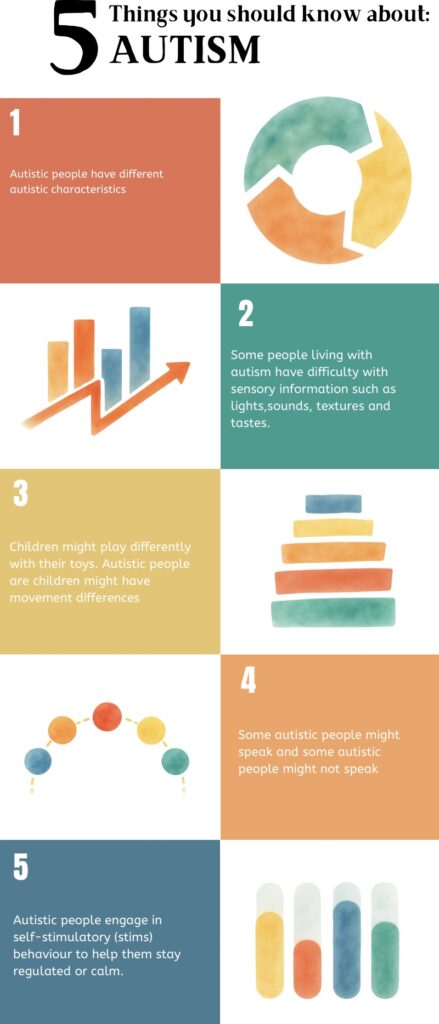
FEATURED IMAGE: Autism Awareness Month Poster: Nqobile Mtshali
RELATED ARTICLES
- Wits Vuvuzela, Student writes children’s book to educate on autism, August 2021
- Wits Vuvuzela, Wits Disability Awareness Week a benchmark for other institutions, September 2017
- Wits Vuvuzela, The South African government continues to fail whistleblowers, August 2025

