
At Decorex Joburg, “Soft Life” looked a lot like everyone else’s life, the continent was missing.
Decorex Joburg, one of Africa’s largest design and decor exhibitions, returned to the Sandton Convention Centre between July 30 to August 2, 2026, under the banner of “Soft Life”.
The theme was a move from the city’s hustle culture to a calmer, intentional design of spaces and pieces. Walking through the five floors I noticed minimalist styling with small tweaks repeated from booth to booth that demarcated exhibits. This made me question whether Africans have a sense of what soft life looks like in their own eyes, and not with a Western gaze.
What does “soft life” actually mean at a design exhibition in Africa, is it a colour palette or is it a philosophy? Decorex seemed to be a lot more about the form through the pale woods; ivory tones and muted neutrals presented as calm and intentional. The pendant lights shaped from soft, feather-like layers of ivory were undeniably elegant, but nothing in them spoke to what “soft life” is in Africa. I found myself wishing they had been exhibited in a bolder way, maybe a light carved into a traditional symbol or covered in African print.

The absence of the continent’s voice raised an unavoidable question even though the show was elegant and soft. The question is whether Africans can genuinely see themselves in this version of softness, or whether we’re being handed a Western idea and accepting it with ease.
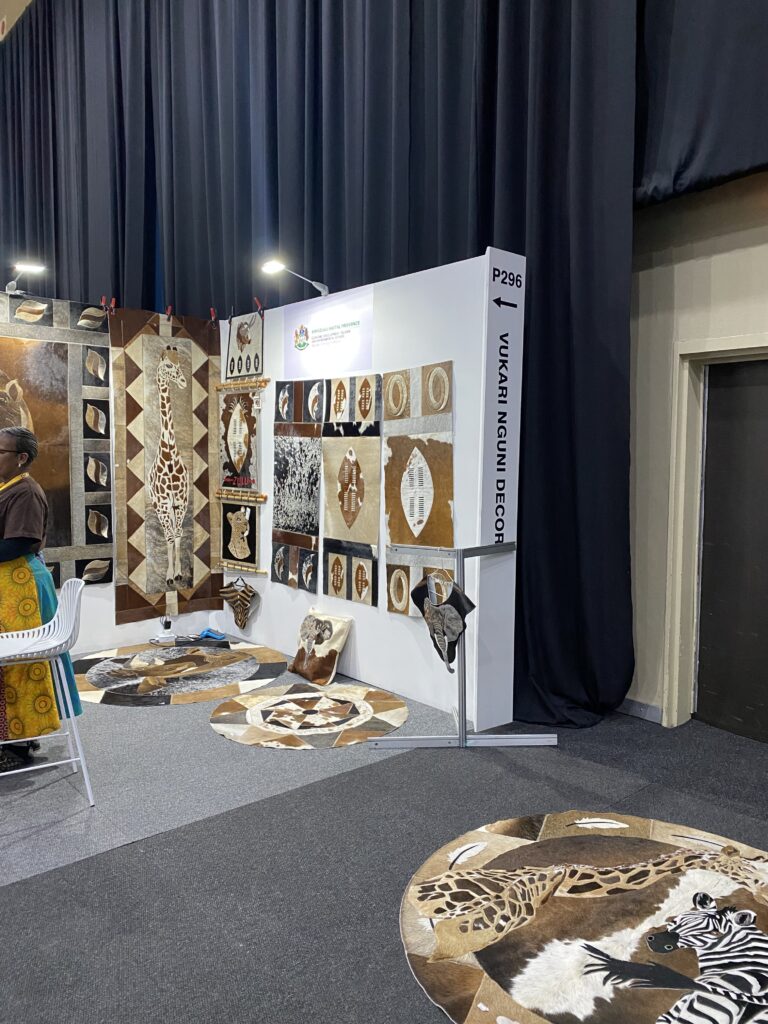
Being African is not a simplistic beige colour, it’s the bold brown colour of an animal hide that carries specific meanings, spiritual significance and ancestral meaning. Vukari Art offers a range of handcrafted luxury home decor made from 100% unique Nguni cowhides, with features such as rugs, wall hangings and matching cushion covers. Vukari’s stand was unapologetically African, it took me to my roots, gave me a feel of what Africa was before we became accustomed to a certain lifestyle. According to The Art and Heritage of African Animal Skin Rugs cowhides were traditionally valued for their utility in various contexts across the continent and remain a symbol of both functionality and natural elegance. In an exhibition centered around the “soft life” these designs offered a version of softness rooted in individuality and inherited wisdom rather than a borrowed idea of a colour palette.
In contrast, Design Week Lagos: Homeexhibited their designs using an opposite approach with carved wooden panels with a mask-like figure, a hand-thrown ceramic form and straw woven rugs underfoot, it wasn’t as bold; it was another way of portraying Africa. The mask-like figures were a symbol of Western Africa, often representing ancestral spirits, deities or serving as ceremonial objects rather than decoration. This offered two different, equally valid African expressions, proving that softness and identity aren’t always mutually exclusive.
Leaving Decorex, I kept asking myself, “what does soft life actually mean in South Africa and who does it cater to?” For some part of the exhibition, I felt that Africa’s soft life could have been borrowed from an idea that screams simplistic with a solid colour palette. An African soft is allowed to feel and look different through its unique symbolisms, materials and colour palette with no expectation on what to deliver. Decorex lived up to its promise; it was soft and intentional, but it could include some parts of Africa.
FEATURED IMAGE: Picture showing signage of the Decorex sign at the Sandton Convention. Photo by Reatlehile Mashamba
RELATED ARTICLES:
- Wits Vuvuzela, The past meets the present in new exhibition, Nkosi Sikelel’ iAzania, February 2026
- Wits Vuvuzela, REVIEW: House of Olé’s living gallery is a symphony of artistry, April 2026
- Wits Vuvuzela, REVIEW: Africa makes its mark at the Met Gala, May 2025

