
Beyond the brand, how do young entrepreneurs distinguish between the personal and the professional to ensure co-existence in the digital space?
- For Tamia Nontsikelelo, the line between person and professional is one she constantly has to negotiate.
- Her experience at Wits expanded her ambitions beyond the “small dreams” she had growing up in Dobsonville.
Before Tol’Thema was a business, it was something Tamis Nontsikelelo wore to class. A headwrap that was never supposed to become a business.
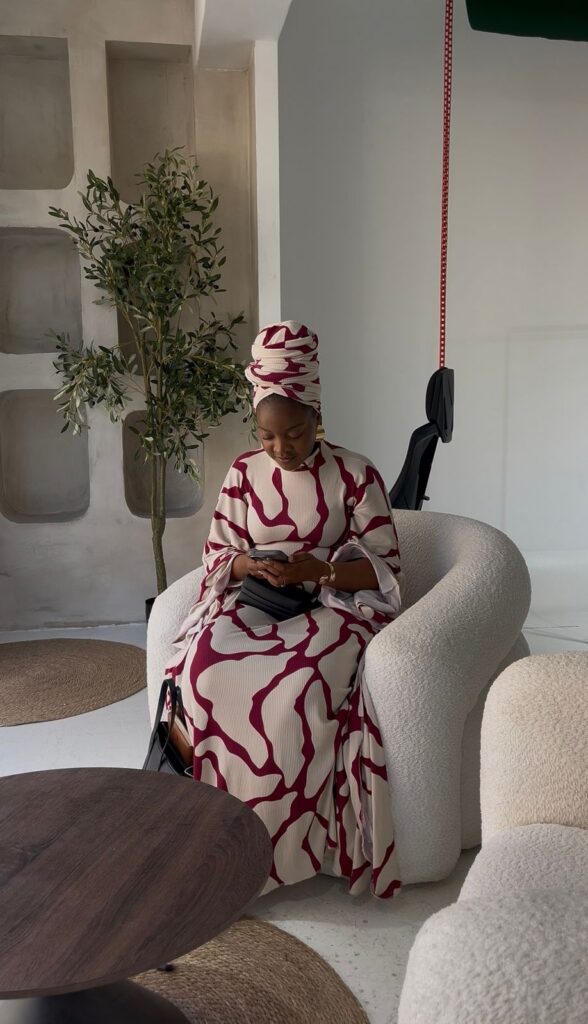
The woman who appears online as the founder of Tol’Thema, in that very headwrap, eloquently gliding through her store located in the heart of Braamfontein, turning an ordinary customer’s requests into a reality, is the same woman who walks through Braamfontein, elevates her customer’s looks and represents the brand in person. She does not see social media as a stage for creating a version of herself designed to sell.
“If I present myself to be something online, then I must carry that in person”, she says. It is a simple philosophy in an online world where the boundary between a person and their brand is increasingly difficult to see. For Nontsikelelo branding matters. So does knowing when the brand stops. At some point one has to draw the line, because beyond Tol’Thema, she remains an individual. That distinction sits at the centre of the business she has built.
Tol’Thema is a modest fashion brand based in Braamfontein, but its beginnings were not rooted in a business plan. They began during Nontsikelelo’s time as a Wits student, when a headwrap became a way of navigating an insecurity about her appearance.
When she could not afford to braid her hair, wearing a headwrap initially offered a practical solution, but over time it became something more. She began to enjoy how she looked in them. “At the time, I just learned that when I put on a headwrap, it doesn’t matter what’s happening underneath”, she says. “I could still feel confident and feel beautiful.”
“It became less about hiding and more about, ‘I just look good in it. I feel good in it,’” she recalls.
Her classmates noticed. Other women started asking where they could get the headwraps. Nontsikelelo saw an opportunity. “Everyone would ask me, so I decided, listen, let me plug you”, she says.
What began as personal expression became a business. That transition is important because Tol’Thema was built around an experience Nontsikelelo already understood: clothing could change how a woman felt about herself.
Today, the brand has expanded beyond headwraps into modest clothing designed to be versatile, adjustable and wearable across different occasions. But Nontsikelelo says appearance alone is not enough. “Is it actually wearable? Is it comfortable? Does a woman feel good in it? Does she feel confident in it?” she asks.
The business therefore sits at an intersection between fashion and identity. The clothes are designed to make customers feel confident, while Nonstikelelo’s own identity has become inseparable from how the business is presented.
She remembers questioning whether she had the right to even begin. “Who are you to start something?” she recalls asking herself. “Who are you to start a business? Who are you to turn nothing into something?”
Her response was to start anyway.
A month before Tol’Thema officially launched, Nonstikelelo opened its business page and began posting every day. She connected it to her personal page and used social media to build an audience before the business had even made its first sale.
When launch day arrived, she made six sales.
For Nonstikelelo, the significance was not simply that people had bought clothes. She had never worked before and had never earned money from her own labour. Seeing money enter her account from something she had created was confirmation that the idea existed beyond her imagination.
“These people actually gave me real, hard-earned money for this thing that I have,” she remembers.
Social media had allowed her to turn something personal into something commercial.
But it also created a different responsibility: being visible enough for the business to exist in a crowded digital space while making sure that visibility remains truthful.
Nontsikelelo does not describe this as performing.
Instead, she sees it as accountability.
If the person customers encounter online is confident, professional and representative of Tol’Thema, then that same person must exist offline. “Tamia on Instagram in that headwrap who feels confident and beautiful, is the same Tamia people will meet outside”, she says.
It is a demanding standard, but one that also gives her control over the way the business is understood. That control is significant for someone whose own journey has involved learning to take up space.
Nonstikelelo grew up in Dobsonville and describes coming from a world of “small dreams”. Getting into Wits itself felt almost impossible. Once there, she encountered people from different countries and backgrounds and began to understand that the world was larger than she had imagined.
Yet the size of the institution initially made her feel smaller.
She remembers “walking around on eggshells”, unsure whether she belonged.
Wits changed that understanding. “When I actually made it into Wits, it was huge” Nonstikelelo says. Her ambitions grew from wanting a degree and a small house in the neighbourhood where she grew up to imagining possibilities beyond what she had previously considered realistic.
Now, the challenge is different.
She is no longer trying to convince herself that she belongs in someone else’s space. She has created a space of her own but maintaining it requires her to constantly negotiate how much of herself belongs to the brand.
There is power in that ownership. Unlike traditional advertising, where someone else decides how a product is presented, Nonstikelelo controls the image of Tol’Thema through her own voice, appearance and social media presence.
But that control has a boundary. “At some point I have to draw the line”, Nonstikekelo says.
Nonstikelelo the founder and Nontsikelelo the individual may overlap, but they are not entirely the same person.
Her story raises a question that extends beyond one fashion business: as social media allows entrepreneurs to turn their personalities, stories and identities into part of their businesses, how much of a person can become a brand before the distinction between the two begins to disappear?
For Nonstikelelo, the answer is not to separate herself completely from Tol’Thema. It is to know where the line is.
FEATURED IMAGE: Owner of Tol’Thema and media personality. Photo by Keletso Zwane.
RELATED STORIES:
- Wits Vuvuzela, PROFILE: Wits law student advocates for body positivity and inclusion , March 2026.
- Wits Vuvuzela, EDITORIAL: Viral voices on social media can be empowering, August 20204.

