Beyond the brand, how do young entrepreneurs distinguish between the personal and the professional to ensure co-existence in the digital space?
For Tamia Nontsikelelo, the line between person and professional is one she constantly has to negotiate.
Her experience at Wits expanded her ambitions beyond the “small dreams” she had growing up in Dobsonville.
Before Tol’Thema was a business, it was something Tamis Nontsikelelo wore to class. A headwrap that was never supposed to become a business.
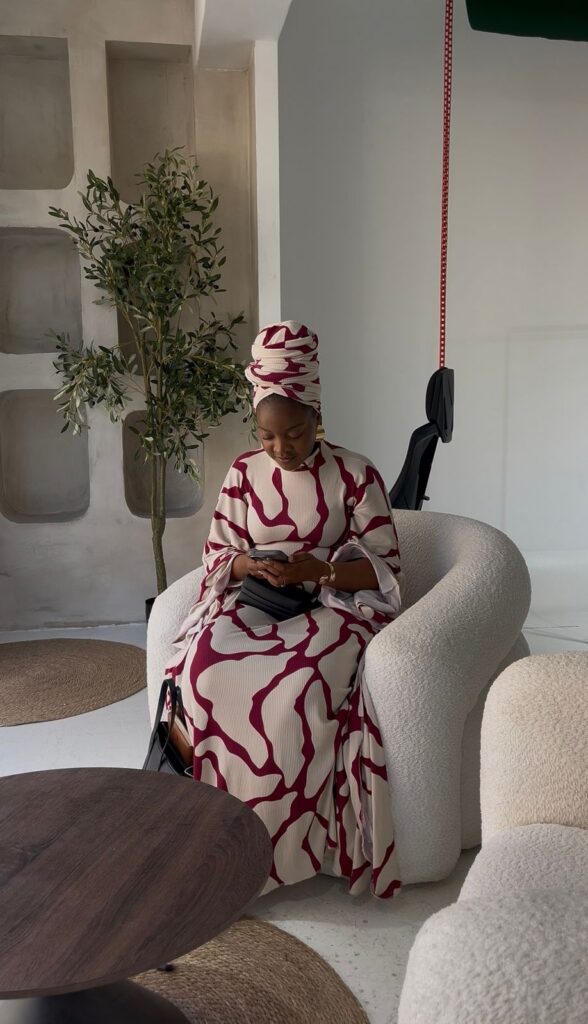
The woman who appears online as the founder of Tol’Thema, in that very headwrap, eloquently gliding through her store located in the heart of Braamfontein, turning an ordinary customer’s requests into a reality, is the same woman who walks through Braamfontein, elevates her customer’s looks and represents the brand in person. She does not see social media as a stage for creating a version of herself designed to sell.
“If I present myself to be something online, then I must carry that in person”, she says. It is a simple philosophy in an online world where the boundary between a person and their brand is increasingly difficult to see. For Nontsikelelo branding matters. So does knowing when the brand stops. At some point one has to draw the line, because beyond Tol’Thema, she remains an individual. That distinction sits at the centre of the business she has built.
Tol’Thema is a modest fashion brand based in Braamfontein, but its beginnings were not rooted in a business plan. They began during Nontsikelelo’s time as a Wits student, when a headwrap became a way of navigating an insecurity about her appearance.
When she could not afford to braid her hair, wearing a headwrap initially offered a practical solution, but over time it became something more. She began to enjoy how she looked in them. “At the time, I just learned that when I put on a headwrap, it doesn’t matter what’s happening underneath”, she says. “I could still feel confident and feel beautiful.”
“It became less about hiding and more about, ‘I just look good in it. I feel good in it,’” she recalls.
Her classmates noticed. Other women started asking where they could get the headwraps. Nontsikelelo saw an opportunity. “Everyone would ask me, so I decided, listen, let me plug you”, she says.
What began as personal expression became a business. That transition is important because Tol’Thema was built around an experience Nontsikelelo already understood: clothing could change how a woman felt about herself.
Today, the brand has expanded beyond headwraps into modest clothing designed to be versatile, adjustable and wearable across different occasions. But Nontsikelelo says appearance alone is not enough. “Is it actually wearable? Is it comfortable? Does a woman feel good in it? Does she feel confident in it?” she asks.
The business therefore sits at an intersection between fashion and identity. The clothes are designed to make customers feel confident, while Nonstikelelo’s own identity has become inseparable from how the business is presented.
Owner of Tol’Thema and media personality. Photo by Keletso Zwane.
She remembers questioning whether she had the right to even begin. “Who are you to start something?” she recalls asking herself. “Who are you to start a business? Who are you to turn nothing into something?”
Her response was to start anyway.
A month before Tol’Thema officially launched, Nonstikelelo opened its business page and began posting every day. She connected it to her personal page and used social media to build an audience before the business had even made its first sale.
When launch day arrived, she made six sales.
For Nonstikelelo, the significance was not simply that people had bought clothes. She had never worked before and had never earned money from her own labour. Seeing money enter her account from something she had created was confirmation that the idea existed beyond her imagination.
“These people actually gave me real, hard-earned money for this thing that I have,” she remembers.
Social media had allowed her to turn something personal into something commercial.
But it also created a different responsibility: being visible enough for the business to exist in a crowded digital space while making sure that visibility remains truthful.
Nontsikelelo does not describe this as performing.
Instead, she sees it as accountability.
If the person customers encounter online is confident, professional and representative of Tol’Thema, then that same person must exist offline. “Tamia on Instagram in that headwrap who feels confident and beautiful, is the same Tamia people will meet outside”, she says.
It is a demanding standard, but one that also gives her control over the way the business is understood. That control is significant for someone whose own journey has involved learning to take up space.
Nonstikelelo grew up in Dobsonville and describes coming from a world of “small dreams”. Getting into Wits itself felt almost impossible. Once there, she encountered people from different countries and backgrounds and began to understand that the world was larger than she had imagined.
Yet the size of the institution initially made her feel smaller.
She remembers “walking around on eggshells”, unsure whether she belonged.
Wits changed that understanding. “When I actually made it into Wits, it was huge” Nonstikelelo says. Her ambitions grew from wanting a degree and a small house in the neighbourhood where she grew up to imagining possibilities beyond what she had previously considered realistic.
Now, the challenge is different.
She is no longer trying to convince herself that she belongs in someone else’s space. She has created a space of her own but maintaining it requires her to constantly negotiate how much of herself belongs to the brand.
There is power in that ownership. Unlike traditional advertising, where someone else decides how a product is presented, Nonstikelelo controls the image of Tol’Thema through her own voice, appearance and social media presence.
But that control has a boundary. “At some point I have to draw the line”, Nonstikekelo says.
Nonstikelelo the founder and Nontsikelelo the individual may overlap, but they are not entirely the same person.
Her story raises a question that extends beyond one fashion business: as social media allows entrepreneurs to turn their personalities, stories and identities into part of their businesses, how much of a person can become a brand before the distinction between the two begins to disappear?
For Nonstikelelo, the answer is not to separate herself completely from Tol’Thema. It is to know where the line is.
FEATURED IMAGE: Owner of Tol’Thema and media personality. Photo by Keletso Zwane.
While the country nears the end of winter, for some residents, the weather is alreadychanging the way theyoperate.
For ordinary South Africans, the climate crisis is not abstract.
A potentially strong El Niño on the horizon.
Behind climate statistics are people like Phumzile.
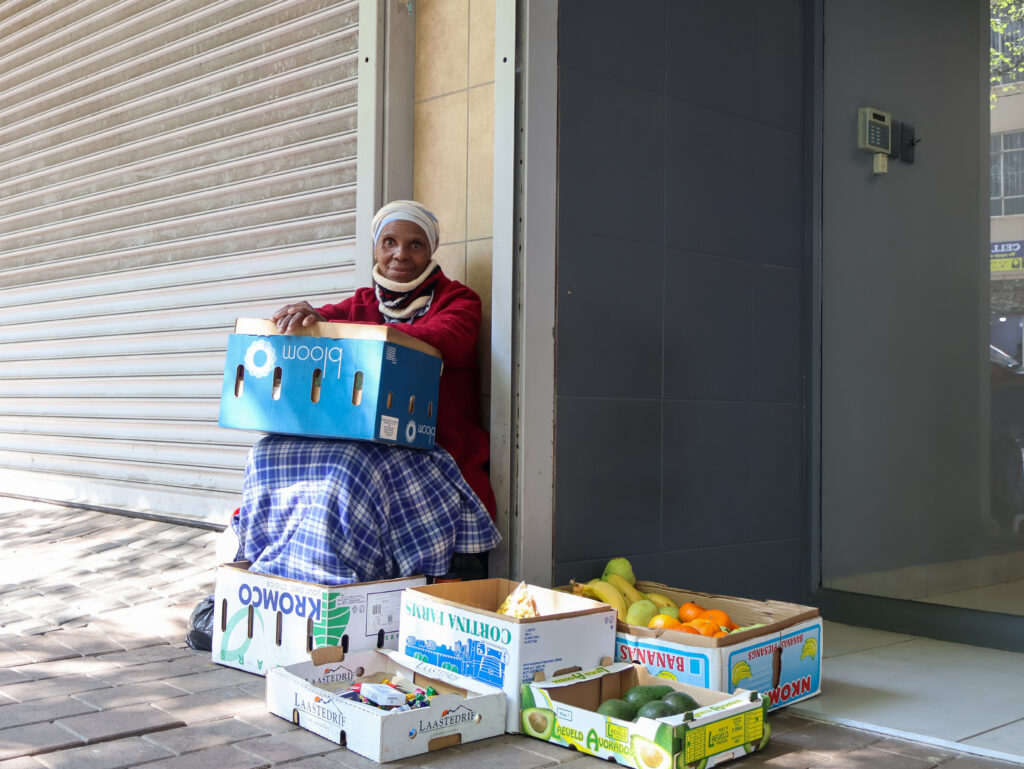
As Johannesburg nears the end of winter, the heat is already changing how some people work, study and make a living. For Phumzile Mhlangeni, a street vendor on Jorissen street, hotter days mean fresh produce is spoiling faster, forcing her to throw away stock she can no longer sell.
“I’m slower to stock now because of the heat. The fruits might rot and I fear that”, Mhlangeni said.
Her experience come as scientists monitor a potentially strong El Niño expected later this year, a warning climate change professor Jennifer Fitchett from the University of the Witwatersrand echoes.
El Niño is a natural climate pattern that affects temperatures and rainfall around the world. In South Africa, its effects can vary, but Fitchett expects Johannesburg to experience a hot summer with potentially unpredictable rainfall.
Photo of street vendor, Phumzile Mhlangeni with her limited stock. Photo: Keletso Zwane
For Mhlangeni, the heat is already forcing her to change how she runs her business.
To adapt she now keeps her produce in a fridge at home and has started selling sweets, chips and cigarettes to bring in additional income.
Finding shaded areas to protect herself and her produce poses another challenge. Moving away from her usual spot has made it difficult for her regular customers to find her.
“Business is slower and people won’t go looking for me specifically if they can find someone else selling what I am selling,” she said.
The impact is not limited to people working outdoors.
The effects of rising temperatures are also being noticed by Wits students. Jessica Williams, a final year Bachelors of Social Work student said Johannesburg has felt increasingly warmer despite August being considered a winter month. Travelling between West and East Campus means she spends more time walking in the heat, making access to shade and water important.
Fitchett said climate change is adding another layer to the problem. A warmer baseline increases the risk of heatwaves and heat stress, particularly for people who work outdoors.
However, she cautioned against treating El Niño as a guarantee of extreme weather. South Africa does not experience every El Niño in the same way and seasonal forecasts cannot predict exactly what will happen in every area.
As the country moves towards a hotter summer, the uncertainty leaves businesses and communities preparing for conditions they cannot yet predict.
For Phumzile, the forecast is not simply about what may happen this summer. The effects of hotter weather are already changing how she works, what she sells and how much she earns.
FEATURED IMAGE: Photo of Street Vendor Phumzile Mhlangeni with a customer. Photo: Keletso Zwane
Mama Africa: the image of a South African singer, songwriter and a fierce civil rights activist reduced to the representation by a British-Nigerian actor?
The Road Home is an upcoming a musical drama, set to begin filming in June 2026, with no official release date. It explores Miriam Makeba and Hugh Masekela during apartheid and their pointed efforts against the regime. Makeba will be portrayed by British actress, Cynthia Erivo and Masekela by South African actor, Thabo Rametsi.
The film is written by the famous South African author, Zakes Mda and is to be directed by Bill Condon, the American director and writer behind the film adaptations of musicals, Chicago and Dreamgirls.
The casting of Erivo to portray Miriam Makeba in the film has sparked quite the conversation, with many contradicting views. Social media users asked how the lived experiences of a black South African Xhosa woman can be reimagined for the big screen by a non-South African? Of particular concern – language. You know, the “Igqirha lendlela nguqo ngqothwane” of it all.
Those concerned about the casting want a seasoned South African professional actress at the helm. There are many examples like Thuso Mbedu, Nomzambo Mbatha, and Bonnie Mbuli to name a few with international silver screen experience. However, in the film and television industry’s eyes, the value of the Xhosa tongue is nothing compared to the power of a global British passport.
While I have nothing but the best wishes for Cynthia Erivo, a talented, multi-award-winning actress with a voice like the harmony of angels. I cannot help but face the uncomfortable truth about how African legacies are portrayed in film and television. Can Erivo truly embody the linguistic and cultural texture of an iconic Xhosa woman like Makeba? A woman who was boldly and unapologetically South African.
To ignore the skills of an actress and singer-songwriter like Erivo would be to disrespect her craft. In her own pedigree, she too is an icon, a powerhouse. Erivo is no stranger to portraying legends in the music industry. One such example is her portrayal of Aretha Franklin in the National Geographic anthology series “Genuis: Aretha” (2021). Receiving an Emmy nomination for her performance.
She ticks the boxes. She will look the part; she will act the part and will most certainly sing the part, but will her singing be a mere imitation? Will she truly be able to fully embrace the South African identity that comes with Miriam Makeba’s songs that were tools to fight injustices during apartheid?
In addition to the cultural texture that accompanies a powerhouse like Makeba is also the language in which Makeba sang: isiXhosa. In her 1963 performance of “Qongqothwane” live on Ce Soir à Cannes, Makeba prefaces the performance by emphasising that the English speaker cannot say the name of the song thus they call it “the click song.” Even then, Makeba chose to proudly embrace her identity and prove that black South African culture mattered.
Miriam was defiant; she was fierce, and she was proudly a black, Xhosa South African woman even in her exile. Her songs weren’t just words on a paper; they were incantations. They were brilliant. They were the representation of the South African nation fighting against discrimination.
This is not about preference for South Africans; it is about having our cultures represented by the very people that speak and live them.
FEATURED IMAGE: Graphic of legendary South African singer Miriam Makeba, taken by Paul Weinberg and Cynthia Erivo at an FYC panel for Wicked in Santa Monica, California taken by Kevin Paul. Source: Wikimedia Commons.
A protracted bargaining process has reached a stalemate, which may grind activities on campus to a halt.
Nehawu and Altsa union members threaten to down tools.
Salary negotiations between the unions and Wits management remain unresolved.
As the cost of living increases, members demand a larger salary increase.
On Monday, April 20, National Education, Health and Allied Workers’ Union (Nehawu) and the Administrative, Library and Technical Staff Association (Altsa) members took matters into their own hands by picketing in and around campus.
Union members, made up of professional and administrative staff, marched from the Great Hall to Wits Science Stadium, after declining the 4,95% salary increase proposed by Wits University management.
According to the Altsa union secretary, Tholane Khiba, meetings with the vice chancellor and senior executive team resulted in a proposed 4,95% increase, which was rejected and led to the deadlock. “Looking at the delay, the members are now getting frustrated,” he said.
In a statement, the senior executive team said the matter, in month eight of “protracted negotiations”, was heard at the Commission for Conciliation, Mediation and Arbitration (CCMA) last week, but the offer made by the university was rejected.
Nehawu Regional Secretary of greater Johannesburg, Tumisho Madihlaba, stated that “the members in their big numbers for both unions Altsa and Nehawu have agreed. We are not accepting the 5%, we are not accepting the 1% on Annual Performance Incentive… We are going on strike!”
Nehawu and Altsa members gathered by the Great Hall for a mass meeting. Photo: Jamie Ho.
Thabo Modise the Nehawu branch secretary of Wits said they have worked in the best interest of the university, but feel “financially bullied.”
As a result, they plan to down their tools. “We also have a muscle comrades. The muscle that we have is our labour. We are going to withdraw our labour and show them how important we are,” Modise added.
The members of the union emphasise that they will stand in unity until their demands are met. Altsa acting president, Jordan Sake, stated “we have rejected that nonsense from management. That insult? We will not take it.”
Members of both unions highlighted the growing cost of living amid global conflicts as one of the reasons they are pushing for more money. Jabulile Maseko, a member of Altsa said, “it is not enough, everyone is aware that everything is going up.”
While tensions continue, demonstrations and strike action seem to be on the horizon as both unions stand their ground with their demands.
FEATURED IMAGE: Nehawu and Altsa members picketing around campus. Photo: Jamie Ho.
An exhibition that forces one to look at the duality of society and confront the chaos of reality
On April 9, the Wits Art Museum (WAM) opened its doors to “Now is not Forever” an exhibition by the artist Theresa-Anne Mackintosh. The art pieces are more than just sculptures and paintings on the wall; it was figures and strokes that represented the chaos and disorder of society and reality.
Walking into WAM on opening night, one is immediately drawn to the vinyl writing on the wall. It explains who the artist is, what the exhibit includes and what the expectations of the artist are for the viewer when interpreting her work.
Now is not Forever, wall of description. Photo by Keletso Zwane.
Mackintosh included two forms of her work in the exhibition. The first being paintings, which are some of her older works. These required me to look beyond the canvas and challenge my ideas of what was on that wall. Ideas that art can only be consumed at the surface, and that art needs to make sense and be pretty. Art can be unconventional.
The pieces that truly caught my attention were three pieces that included figures mimicking the morality of life. These were titled “hear no evil”, “see no evil” and “do no evil” and included figures having had various parts of their bodies, related to the action painted over.
One used the ears to hear, the eyes to see, and the hands to do, and these in Theresa’s work were painted over. It was visually stunning. The erasure of these elements meant that they are no longer in use, thus evil could not be heard, done or seen.
The second form included sculptures, embodying Mackintosh’s alter egos. At first, they were simply appealing to the eye. The colours were vivid, and the figures were intriguing. However, art did what art does best and challenged me to interpret what the sculptures represented, not just to the creator of the art but the consumer as well.
And I, having been the observer for the night, was subjected to understanding that these figures had represented familiarity. These sculptures are recognisable figures, dogs, people, dolls – all things that I have seen, felt, and engaged with.
Picture of sculptures at exhibit. Photo by Keletso Zwane.
The inclusion and coupling of both sculptures and paintings in the exhibition was phenomenal. The art was anthropomorphic, it hurt, it was dysfunctional and embodied the disorder of society, of history, it almost seemed to reproduce reality.
Picture of one of the sculptures displayed at Now is not Forever. Photo by Keletso Zwane.
Even if you wanted to look at the exhibition as a way to distract yourself, Mackintosh’s work forced you to look further than the surface.
Vuvu rating: 9/10
FEATURED IMAGE: Picture of a girl taking a photo of the art at the exhibit. Photo by Keletso Zwane.
After automatic relegation last season, FNB Wits Rugby has not only scored a seat back into Varsity Cup but a place in the semi-final.
Wits Rugby boys promoted back into Varsity Cup.
Team set to play semi-finals Friday, 3 April 2026.
Captain says team is “emotionally invested” in winning.
The boys in blue showed up this Varsity Shield season with six wins and one draw and have now secured a home semi-final. The boys seem determined, driven and motivated to ensure an automatic promotion back into the Varsity Cup.
According to Varsity Cup, in 2025, the team played in the A section of the rugby competition, known as Varsity Cup. After playing and losing eight, the team got relegated to the B section of the competition for the 2026 season, known as Varsity Shield.
The automatic relegation left no chance for redemption. The Wits Blues took last year’s loses, went back to the drawing board, and entered Varsity Shield with grace. Now. they plan to be promoted back into the Varsity Cup.
What started as a rocky opening match against FNB Walter Sisulu University (WSU) on February 13, which resulted in a draw, and ignited a fire that saw the boys climb all the way to the top of the log. The quick and commanding response showcased the team’s depth.
Wits is set to play semi-finals on Friday, April 3, against FNB Madibaz (Nelson Mandela University), which promises to be a nail-biting fixture. If they win, they will advance to the final against either FNB WSU or FNB UWC (University of the Western Cape), and stand a chance at redemption, glory and take the Varsity Shield 2026 trophy home.
The score breakdown highlights their performance throughout the season at almost every match under the Friday night lights:
Photo of one of the rugby players during practice with the score break down of the season. Photo and graphic: Keletso Zwane
FNB Wits Rugby captain, Latica Nela said the team was focused on finishing the job. “We are not done. Promotion was just the first part of it, we still want to win this thing,” he said.
“And hopefully, God willing, when we do, it shows how emotionally invested we all were in this process,” the skipper concluded.
Having led the boys on and off the field, he advised his team to continue playing the rugby that Wits is known for playing- high tempo, controlled and supported by the fans at home.
The Blues are ready to finish strong, not only for themselves but for Wits. Was their winning streak sheer luck or brutal hard work?
FEATURED IMAGE: Photo of rugby boys at practice doing the line-out. Photo: Keletso Zwane
Since her announcement as the Democratic Alliance’s mayoral candidate for Johannesburg, Helen Zille has dominated national headlines. In this bonus episode of We Should Be Writing podcast, hosts Lulah Mapiye and Bonolo Mokonoto dissect a media meet-and-greet with the mayoral hopeful. From her extensive political résumé to her controversial public utterance, we examine why the Democratic Alliance has chosen Hellen Zille as their candidate for the 2027 local mayoral elections. Additionally, […]