As South Africa approaches a wave of teacher retirements, educators are feeling the impact of vacant teaching posts.
Its 09:00 on a Monday morning at Entandweni Primary School in Zondi, Soweto. Every desk has a learner seated behind it, writing down numbers as Zusiphe Nolusu stands in front of the class, explaining what improper fractions are. Some learners look puzzled but as Nolusu continues explaining, the moment of realisation fills the room as their faces light up with understanding.
Zusiphe Nolusu, a final year Bachelor of Education student from the University of Witwatersrand is not a stranger to standing in front of 30 learners, ready for a long day of teaching, marking class activities and sometimes having to deal with some uncooperative learners. This is a preview of her chosen career path that she has spent four years preparing for. But as her graduation approaches, this one concern lingers at the back of her mind: Will she find a permanent job next year?
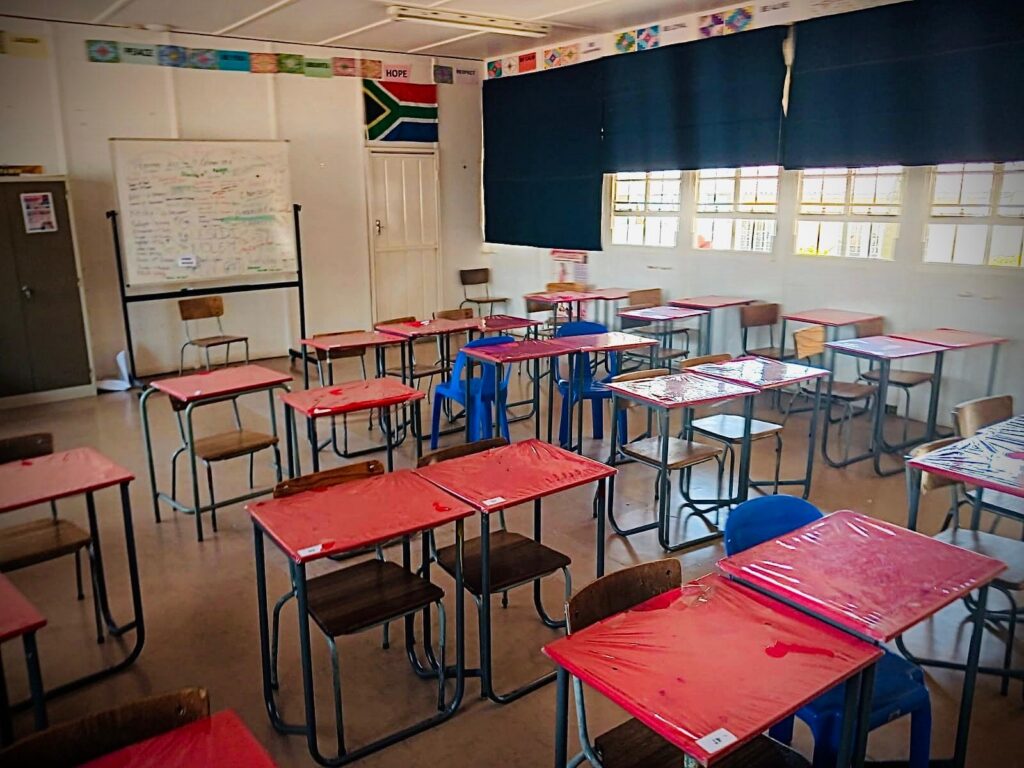
A classroom. By Zebrena Ralph
South Africa’s public education faces a contradiction: thousands of qualified teachers are entering this profession and struggling to find employment, while schools have teaching posts that remain vacant because of budgetary constraints.
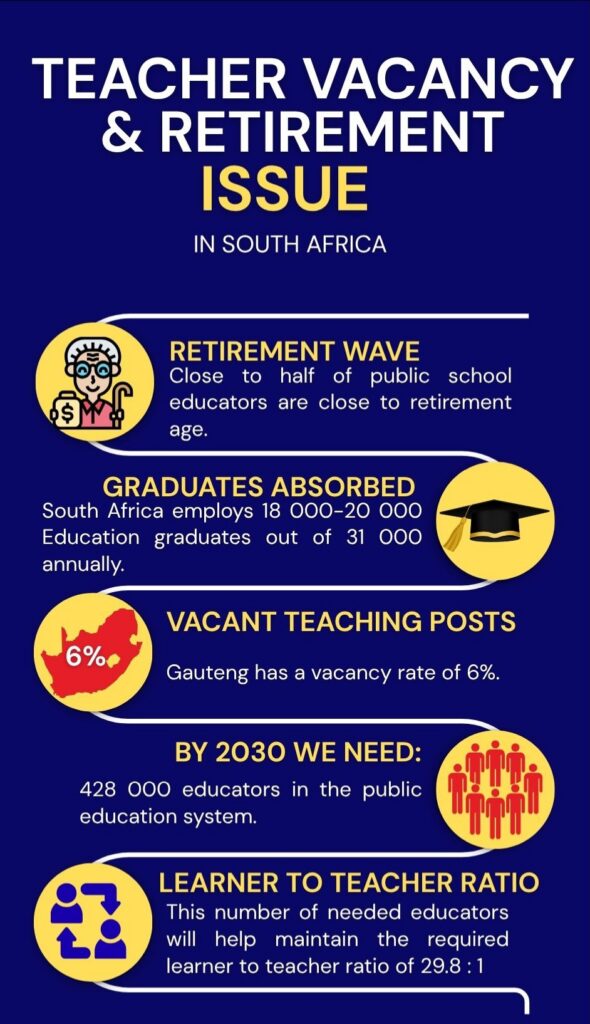
Infographic explaining the education paradox in South Africa. By Zebrena Ralph
In 2023 former Minister of Basic Education, Angie Motshekga, wrote that about 31 000 teachers graduate annually, but only 18 000-20 000 teachers are absorbed into the public-school sector. At the same time, South Africa is approaching a wave of teacher retirements. It is expected that by 2030, close to half of South Africa’s teacher force will be retired. Motshekga said that the employment of teachers needs to rise from 405 000 to approximately 428 000 by 2030 to maintain the learner to teacher ratio which is 29.8 students to one teacher. These figures raise a central question: if qualified teachers are ready to work and the education system needs more educators, why are vacant teacher posts not being filled?
Lukhanyo Vangqa, a spokesperson for the Department of Basic Education, provides an overview for this national issue that public schools in South Africa are facing. Vangqa explains that “employee salaries are paid from equitable shares which comes from the Provincial Treasury. It doesn’t come from the (Department of) Basic Education. So, it’s the provinces that decide how much they want to allocate to their education departments… in terms of teachers and the employment of teachers,” he says.
“This comes after the budget has decreased as part of the country’s austerity measures to reduce the country’s debt, resulting in the budget for education being cut,” Vangqa adds. “Therefore, they need to find savings in their budget and one of the ways they do that is to allow for natural attrition. When teachers retire or resign…they don’t fill those vacancies in order to deal with the budgetary pressures and constraints they have.”
However, Tumi Madika, the Senior Executive Officer from the National Professional Teachers’ Organisation of South Africa (NAPTOSA) in Gauteng, laments how vacant teacher posts impact teachers on the ground. “The issue of unemployment of teachers is of serious nature,” Madika says. “Overcrowding is the order of the day in Gauteng schools… the reason for that is the rise in population. The department cannot keep up with the influx of people coming to Gauteng. The lack of appointment of teachers makes it worse for the issues of overcrowding.
“Issues of safety come into place…You are not able to teach, so teaching and learning is not happening.” Madika adds.
Madika also confirms that retired teachers’ posts are not filled due to budget constraints. “Those employees left by March 31 this year, the ages of 55 and 65. The challenge is that since that time, to date, there is no educator that has been employed in those positions…Those posts have been advertised now (clarified to be July) but they will appoint (teachers) next year January (2027). So, there is a chance that those educators are doubling up on work since March 31 (2026) up until next year.” He states that the government needs to lift the budget cuts and fund education adequately to combat the vacant posts.
A current teacher at King Edward VII School, Jonathan Green, has seen this reality unfold from two perspectives. Green teaches at a quintile five public school, which the government classifies as the least economically disadvantaged schools and are fee-paying schools. “We are very fortunate in the fact that we have more staff available and that means that there is reduced class sizes because there are a greater number of staff to carry the load.”
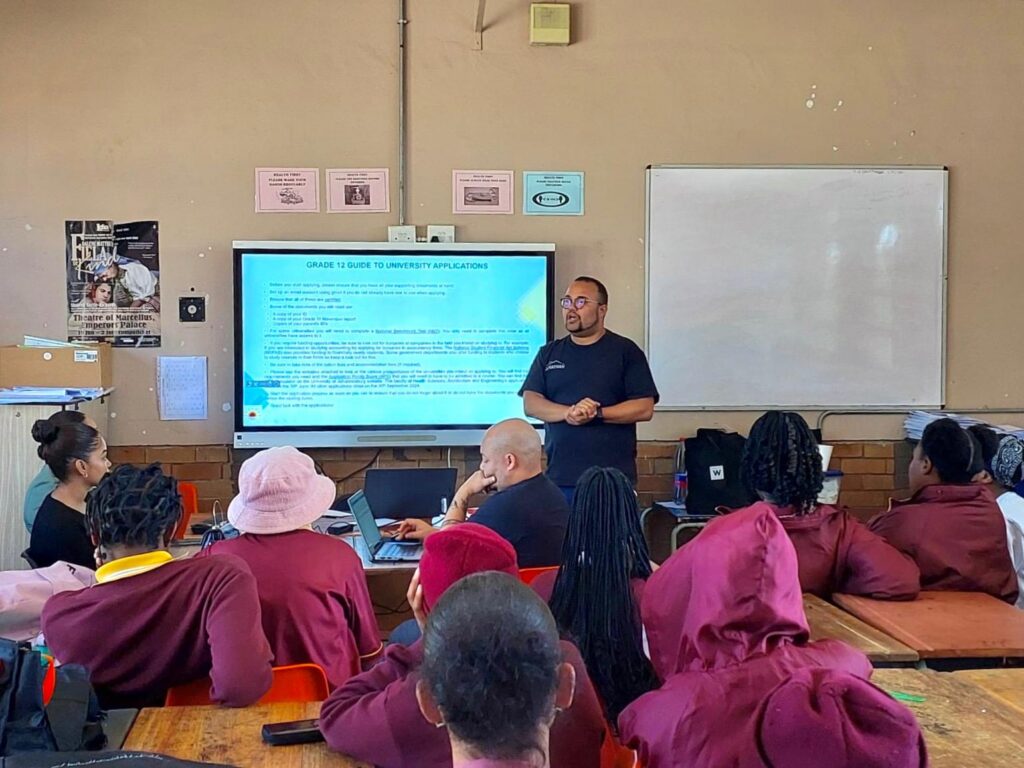
Through his non-profit organisation, Community Developmental Projects, he has held holiday classes at a no-fee paying school, Noordgesig Secondary School, Johannesburg for four years. “I think it is very different. Talk about overcrowding, that is where you see it happen. Talk about lack of resources to a greater extent, that is where you see it happen,” Green says. Apart from the responsibility of preparing for lessons, teaching learners and marking piles of tests, teachers must also deal with administrative work. “You have sympathy for the mountain of admin work, the diagnostics analysis that they (teachers) need to do, the compilation of results, the marking of many more scripts, you know.”
Green teaching at Noordgesig Secondary School. Image by Zebrena Ralph
After 34 years of teaching in six different public schools, Audrey Kleinhans (67) knows this situation well. She confirms that her post was not filled after her retirement. “My post was vacant (when I resigned) and they just took a teacher who was not qualified to replace me,” she says.
A classroom from King Edward The VII School. By Zebrena Ralph
As Nolusu completes her final year of her degree, she has a few concerns for what awaits her after university. “So next year I have to job hunt. So I am worried if I will get a job immediately or if I will have to wait long.
“If I don’t get a job next year, I think I will just come and do my honours because I have already applied,” Nolusu says.
This is a reality that has persisted for years and if budget constraints continue to affect the education sector, the future of South African public schools could be in an even more dire state.
FEATURE IMAGE: A classroom from King Edward The VII School. By Zebrena Ralph
A viral social media claim that foreign nationals make up 98% of Wits staff has been rejected by the university, which says the actual figure is 9%.
Claims that Wits’ has foreign nationals make up 98% of Wits’ staff went viral on social media.
Wits dismissed these claims and said that the correct figure is 9%.
Wits further added that internet users should refrain from spreading information that aims to divide the country.
After trending on social media this past weekend, the University of Witwatersrand has dismissed the viral claims that 98% of its staff are foreign nationals. Wits went to Tik Tok, Twitter and Facebook to dismiss the claims, labelling it “Fake News” and stating that international staff make up 9%.
The list of names that circulated was a screenshot of one page from the Wits academic staff list. The screenshot showed names from a Wits academic staff list but contained no accompanying statistics on the nationality of the university’s staff. The university also warned that the false information could contribute to division within the country. In a response on social media, Wits said, “Please refrain from sharing misinformation which seeks to sow division in our community and our country.”
Wits Vuvuzela contacted the Communications department at the University of Witwatersrand for further comment and verification of the claims. In its response, the university confirmed that international staff account for 9% of its approximately 5500 employees. The department also reiterated its earlier statement that the social media posts are misinformation.
Wits said its objective is to balance the development of South African leadership with the recruitment of international expertise where necessary. “Our objective is therefore neither localisation nor internationalisation in isolation, but a strategically balanced institution that develops South African leadership while drawing on the very best expertise available globally, where necessary” Wits commented.
The claim comes amid renewed debate over the employment of foreign nationals in South Africa, including concerns raised by the March-and-March movement about undocumented migrants and employment.
However, it remains unclear where the 98% figure originated on social media and Wits has called on members of the public to refrain from sharing the claim as well as verifying information before circulating it.
FEATURED IMAGE: The Great Hall at the University of Witwatersrand. Image by Zebrena Ralph
On August, 8 2026, the Wits Sports Council (WSC) along with the All-Residence Council (ARC) hosted the second David Webster Cup since the competition resumed after the Covid-19 pandemic. This year’s tournament had a twist, with Wits residences competing in 12 different sporting codes, in the fight for res bragging rights and the David Webster Cup.
Wits Sports Council adopts Amazing Race format for the annual David Webster Cup.
12 Sporting codes were showcased to Wits students.
This new format allowed for more inclusivity within the Wits sporting community.
The 2026 David Webster Cup was held at the University of the Witwatersrand’s Sturrock Park, where a new ‘Amazing Race’ format was introduced. While the tournament would previously consist of three to four sporting codes, this year it adopted an ‘Amazing Race’ style format, where each residence team could participate in 12 different sporting challenges.
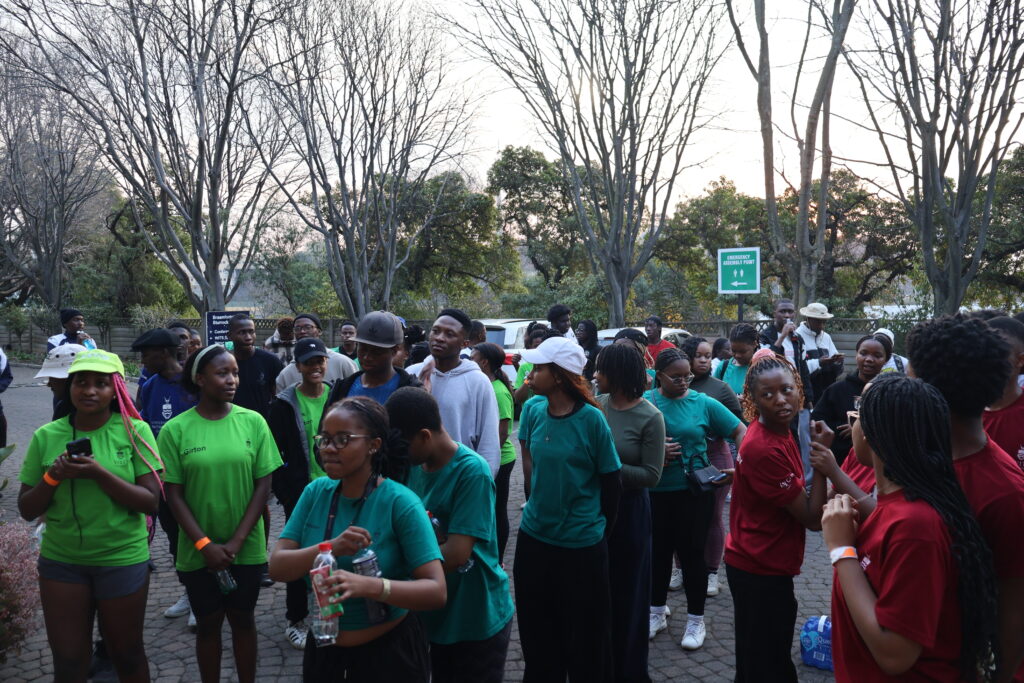
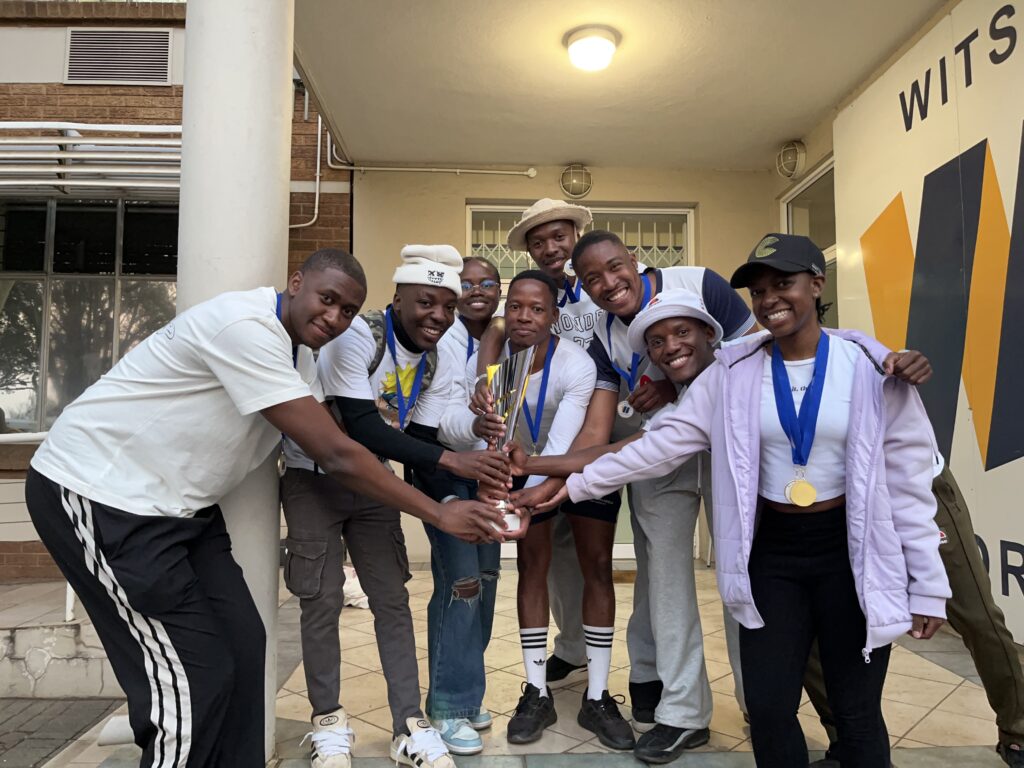
Wits Residences at the 2026 David Webster Cup. By Zebrena Ralph
Every residence had the opportunity to complete a challenge at each sporting code station located around Sturrock Park and the Wits Science Stadium. The residence who collected the most points from all these stations, was crowned David Webster Cup winners, with West Campus Village taking this year’s cup.
West Campus Village being crowned the 2026 David Webster Cup Champions. By Zebrena Ralph
The purpose of this format was to show Wits students that there are more sports than just football, rugby and netball. Twelve other sporting codes were put on display at this year’s Webster Cup such as snow skiing, boxing, yachting, fencing, and tai chi. “A bunch of students came and said that they did not even know snow ski existed on campus,” Lethabo Rabothata, Gender Equity and Transformation Officer, told Wits Vuvuzela. “It’s actually fulfilling to see that.”
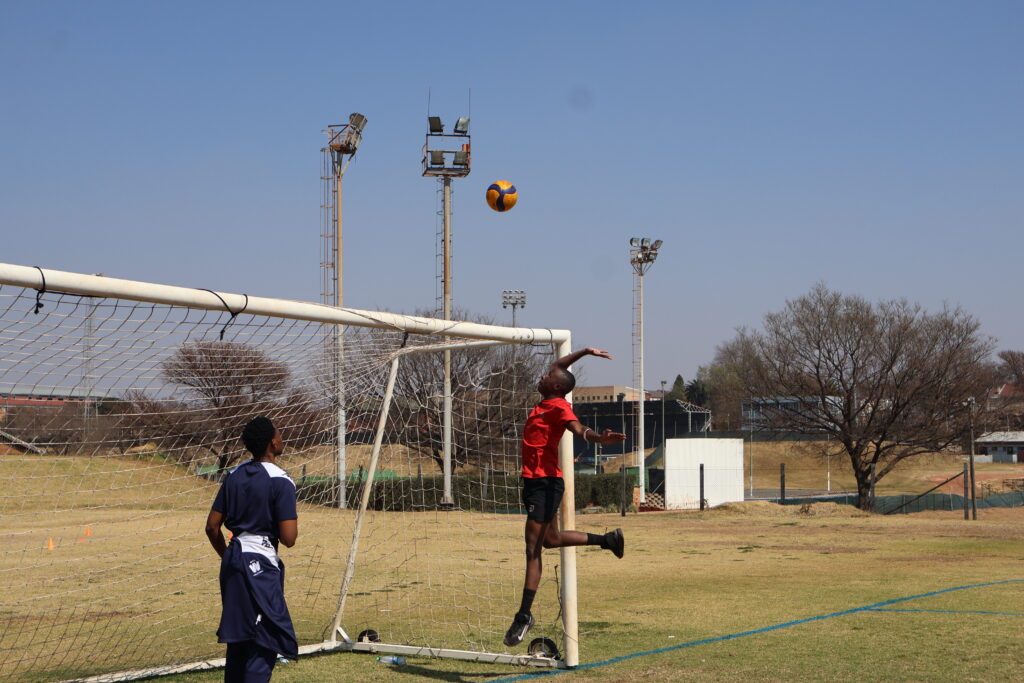
A member from Men’s Res participating in a volleyball challenge. By Zebrena Ralph
The new competition format also aimed to address gender inequality within sports, which existed at previous David Webster Cups. “The real impact that we saw is the (previous) set up of sporting codes presenting us with gender inequalities. It made more sense to do an Amazing Race where everyone is equal and anyone can participate in anything, as opposed to a netball challenge where Men’s Res does not have a team for,” Mamela Nyandeni, Wits Sports Council Chairperson, told Wits Vuvuzela.
Oratile Lesia, the Sports Officer from the All-Residences Council (ARC), said that the ARC played the role of being the bridge between the Wits residences and Wits Sports. The David Webster Cup aimed to foster greater integration between student residence culture and Wits entities such as Wits Sports. “Showcasing this in the David Webster Cup is like merging the two entities together to become one, and to express ourselves beyond our households,” said Lesia.
By showcasing different sporting codes beyond mainstream sports, Azania Jack, a participant from Men’s Res, expressed how as a basketball player he found water polo the most challenging. “It is such a foreign sport to me,” Jack said. Fulufhelo Nengwekgulu from Noswall Hall Residence said that “Mountain climbing was nice, although it was quite difficult, but I enjoyed it as well”.
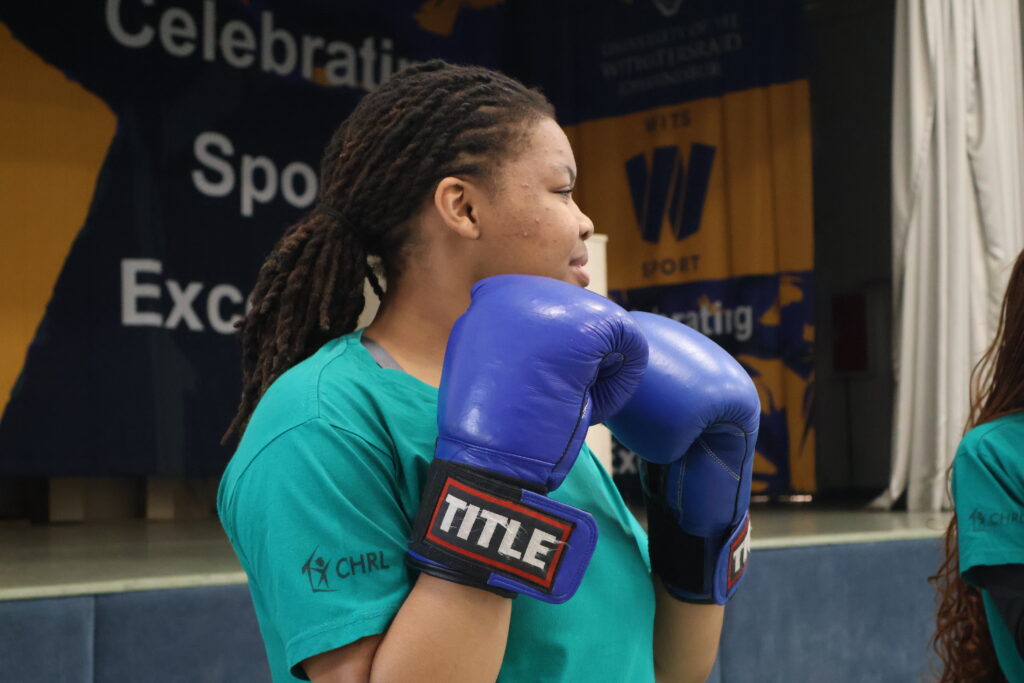
A member from David Webster Hall Residence participating in a boxing challenge. By Zebrena Ralph
Although the David Webster Cup was an overall success, the WSC was faced with the challenge of attendance. While 10 residences were set to compete in the tournament, two withdrew on the morning of the event. Nyandeni expressed that despite this challenge, the ‘Amazing Race’ format allowed adjustments to be made to avoid any major setbacks on the day of the tournament.
FEATURED IMAGE: West Campus Village Residence celebrating. By Zebrena Ralph
Nearly 140 Wits students attended the university’s largest self-defence seminar to date this week, as concerns about gender-based violence and personal safety continue to drive demand for practical self-defence training.
Wits Tang Soo Do, Wits Boxing, Wits Karate and the Gender Equity Office collaborate to host its biggest self-defence seminar yet.
The seminar sees attendance of male participants, highlighting how men can combat gender-based violence.
Calls for Wits to help expand this initiative.
The seminar, organised by Wits Tang Soo Do, Boxing, and Karate, in collaboration with Wits Gender Equity Office (GEO), saw the number of attendees nearly tripling that of 2025.
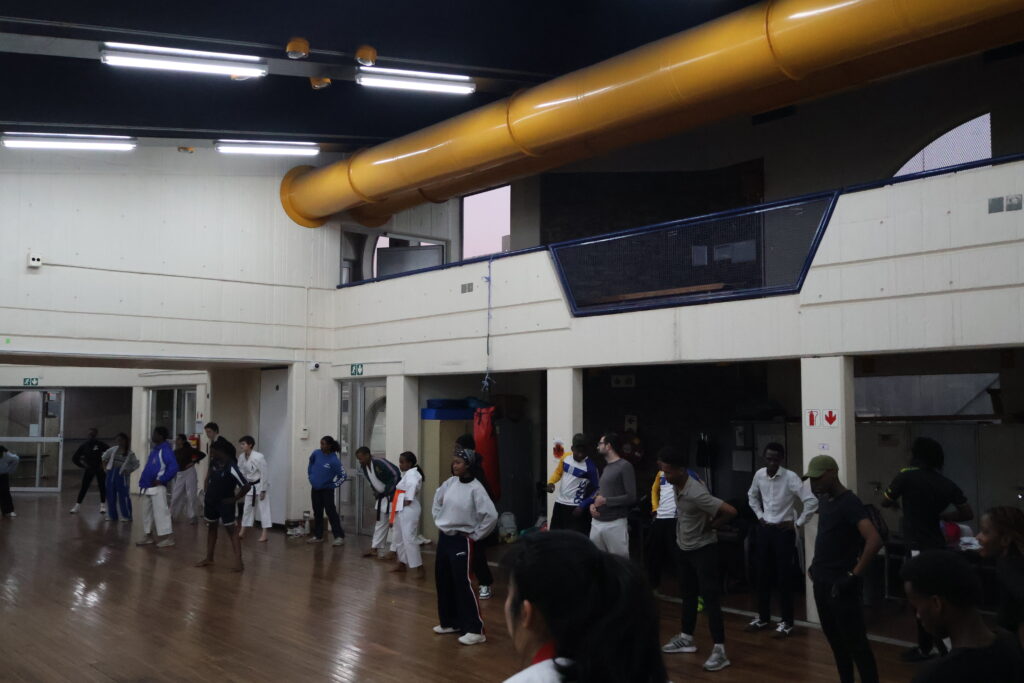
Wits students attending the self-defence seminar. Photo by Zebrena Ralph
The event happened over two days with August 4 reserved for women only, and August 6 for everyone.
39 094 contact crimes were reported between January 2026 and March 2026 according to South African Police Service in Gauteng.
Although 86% of the participants were women, the male participants also found the importance of attending this seminar. “It made me realise how easy it is to protect yourself in a fight and how to actually protect others if you ever in that situation” said participant Ayabonga Ndinga.
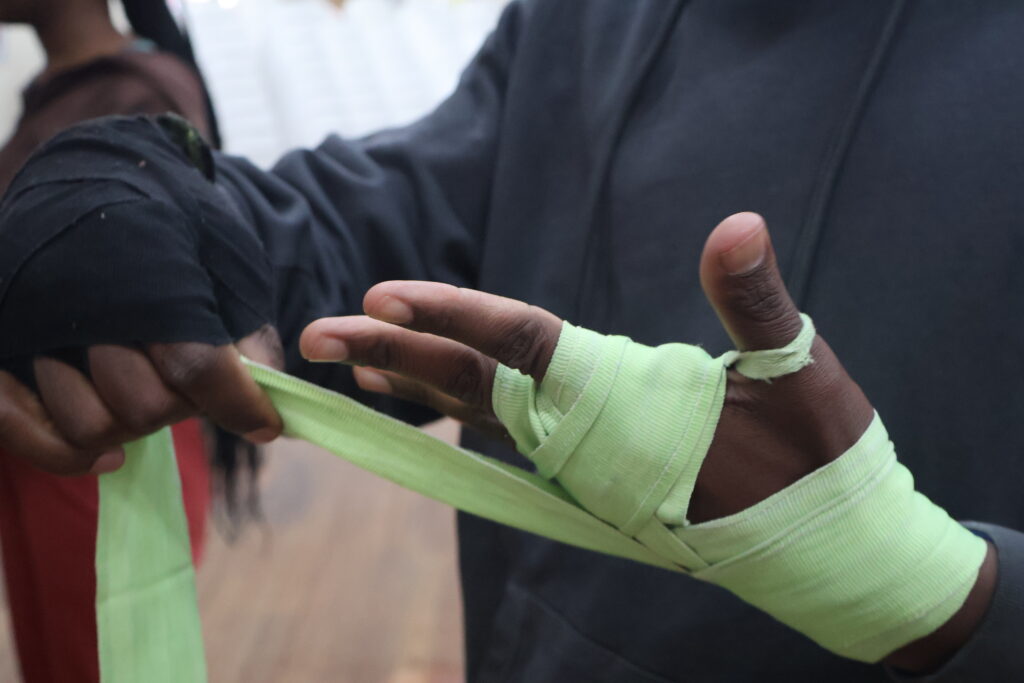
Reamogetse Molapisi, wrapping his hands to get ready to teach boxing related self defence skills. Photo by Zebrena Ralph
As gender-based violence and student safety concerns continue to remain a huge issue for the Wits community and South Africa at large, Lethabo Rabothata, the seminar organiser, saw the need to try and get Wits Tang Soo Do, Boxing and Karate together to exchange ideas on how students can defend themselves and hopefully save lives.
Rabothata highlighted the importance of male participation. “Where I’m from, GBV is crazy…Although, in terms of statistics, women are the most vulnerable in society…some men, when you get assaulted as a guy by a woman, it’s very hard for you to go out and say I was assaulted,” he said.
Recognising that men can also be victims of GBV, while encouraging them to safely intervene when witnessing violence against women, was one of the reasons the combat clubs partnered with the GEO. “If a woman is being assaulted, you need to be able to know what (to do), I can’t just sit and do nothing. I need to be able to step in and help” said Rabothata.
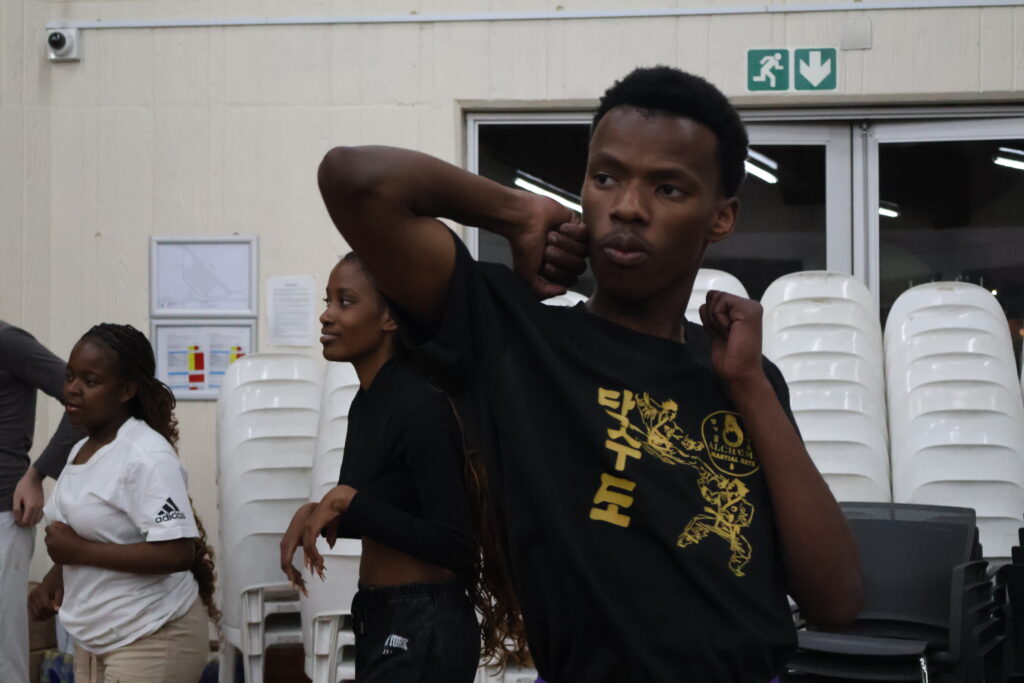
Wits student participating in the self-defence seminar. Photo by Zebrena Ralph
“We are grateful to have such initiatives taken by the Wits Sports in corelation [sic] with the GEO. We hope that it gets to increase every year, but the statistics of needing to defend yourself reduces,” Katlego Motaung, from the GEO, told Wits Vuvuzela.
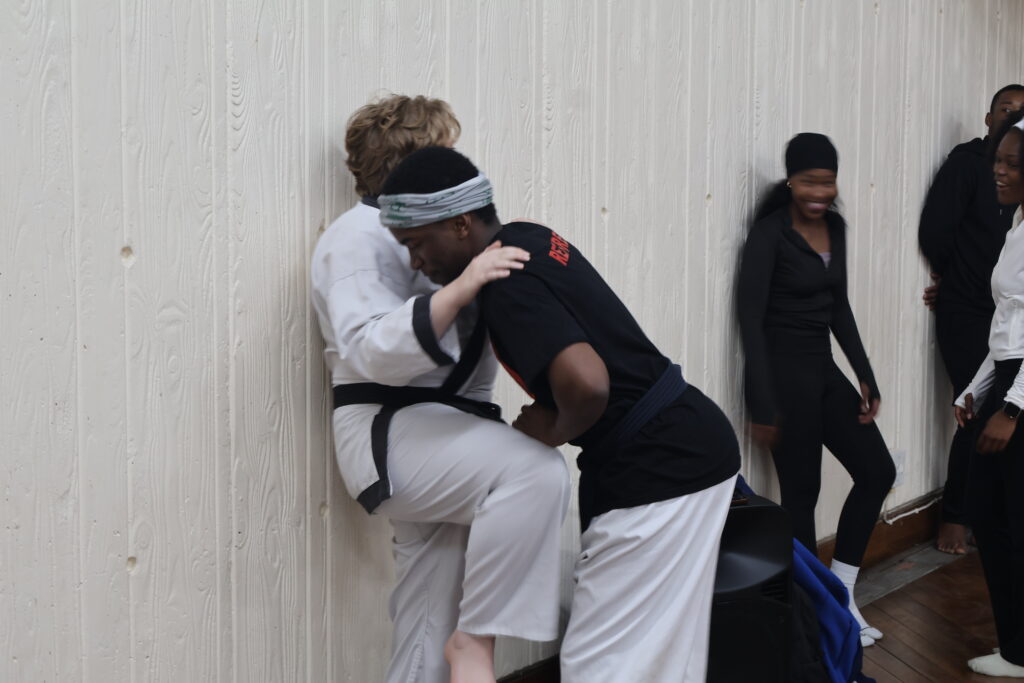
Self-defence instructor demonstrating a self-defence move. By Zebrena Ralph
Rabothata expressed that he hopes that Wits would join this initiative to help expand these self-defence classes to not only students, but staff and outsiders also.
FEATURED IMAGE: Reamogetse Molapisi, Chair of the Wits Boxing Club. Photo by Zebrena Ralph.
Graduates remain the least unemployed, but rising job pressure is keeping more students at university. For many, a degree is no longer the finish line.
Unemployment statistics have risen across all categories.
Graduate unemployment has risen slightly, but graduates are largely unaffected.
But some students are pursuing postgraduate studies as they can’t find jobs.
According to Statistics South Africa’s Quarterly Labour Force Survey over 340 000 more people in South Africa now sit without work. University graduates still have the lowest unemployment rate in South Africa, even though it has picked up by 1.8% in the first quarter of the year
Overall, the graduate unemployment rate is 12.2%. Reflecting the growing pressure of South Africa’s competitive and slow-growing labour market. But graduates remain significantly less likely to be unemployed than people with and without matric certificates.
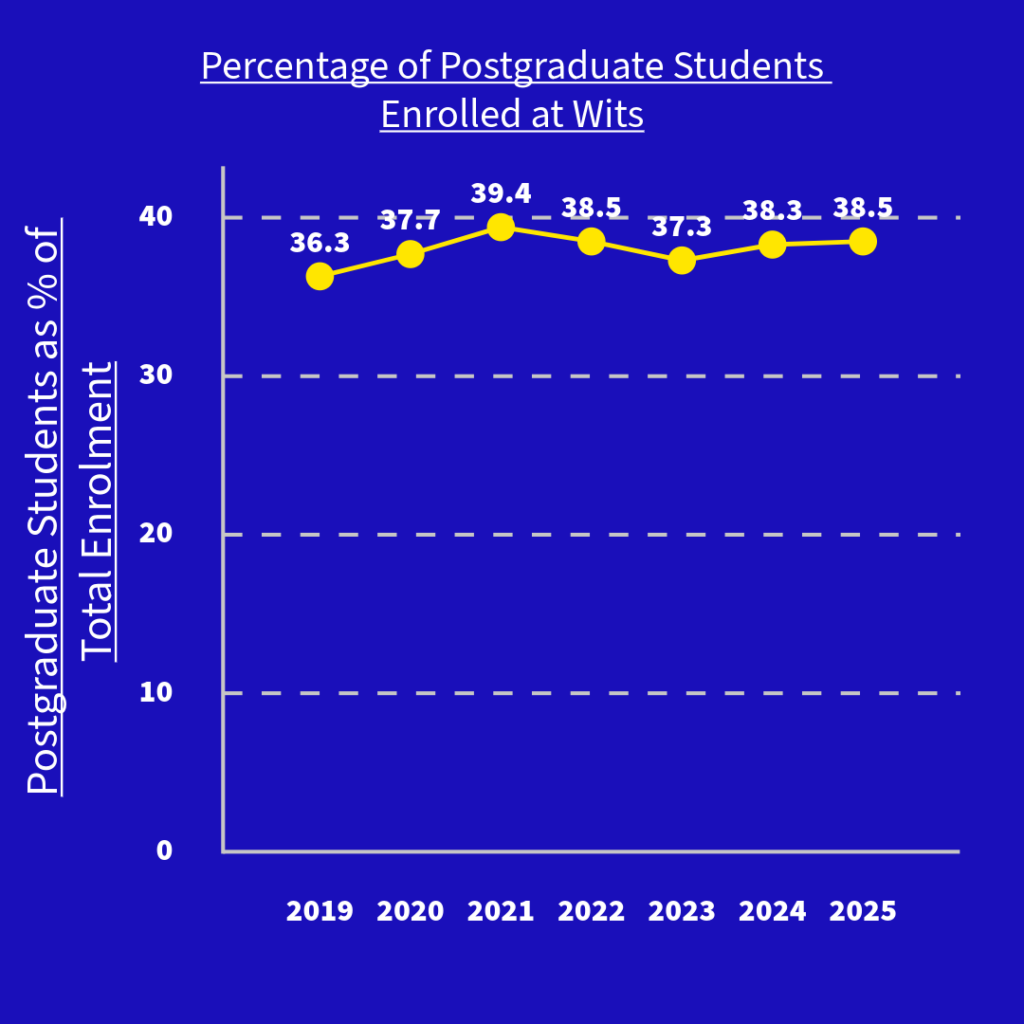
Yet, behind these statistics, another trend has emerged: more students are choosing to stay in university and pursue postgraduate studies. The question is: why?
A graph showing the postgraduate enrolment percentage of the total student enrolment at Wits since 2019. Graphic by Zebrena Ralph
Lindelwe Cili, a team leader for Career Services at Counselling and Careers Development Unit (CCDU), described the link between unemployment and pursuing postgraduate studies as something that does not have a straightforward “yes or no” answer.
She says graduates are not pursuing post graduate studies solely to avoid unemployment. Instead, the decision is shaped by a mix of career requirements, competitiveness in the job market, and individual goals. “Whenever we engage with students, I don’t think we see them using postgrad as a fallback option”, Cili told Wits Vuvuzela.
“One can pursue post-grad to deepen their specialization in the field…and also align with what the industry wants. Also, it depends on the type of degree programme that you are in. If you are in a professional degree, pursuing post-grad would be based on career goals”. This highlights an important nuance: postgraduate studies are often a strategic career move, not a delay tactic.
For some students, furthering their studies is not optional. Honours in Clinical Psychology student, Thabang Ramafoko, said furthering his studies is essential to achieving his career goals. “I want to be a clinical psychologist and that (post graduate studies) is the only way.”
However, the job market still plays a significant role in students’ decisions.
“I furthered my studies because of the job market and because of the degree I done. I did a Bachelor of Arts in Geography and Environmental Studies…You have to further your studies and specialise more so now I am doing my honours in Geography. It increases my chances of employment and also, I just want to be disgustingly educated,” said Honours in Geography student Kamogelo Mokoena.
For some people, the question is no longer whether to study or not, but how much further they need to go.
FEATURED IMAGE: A picture of the Postgraduate Club at the University of Witwatersrand. Image: Zebrena Ralph
Some people still measure degrees based on its employability. Is this a fair standard to use when degrees are not obtained solely to get jobs?
Are Bachelor of Arts (BA) degrees really “useless”? Many people on social media think that it is simply because of the apparent employment challenges BA graduates face. This idea is further portrayed by governments cutting funding for specifically humanities degrees. As seen in the United Kingdom, the University of Hertfordshire scrapped courses such as History, English Literature and Linguistics to name a few, due to a declining demand making the courses no longer financially viable.
The common perception of BA degrees is that, because they are not professional or specialised degrees, they are mostly academic, and unemployment among BA graduates is high. It would be unfair for people to use this criteria to label Bachelor of Arts degrees as “useless”.
According to Statistics South Africa’s Quarterly Labour Force Survey (2025), “possessing a tertiary education, especially a degree, enhances one’s likelihood of securing employment.” The report also shows the more employable sectors for the youth such as Elementary occupations (which require short training) at 25.3%, trade at 24.5%, sales and services at 20.0%, community and social services at 19.8%. This highlights that unemployment is not tied to a specific field of study but is embedded in a country’s economic challenges. The real divide is between graduates and non-graduates in a struggling economy like South Africa’s, but to assume that employment is the only reason degrees are pursued is incorrect.
Graphic showing the top four employable field in South Africa according to Statistics Soth Africa Quarterly Labour Force 2025 report. By: Zebrena Ralph
Professor Paul Ashwin, from Lancaster University, argues that “rather than the employment and salaries of graduates, the central educational purpose of university education is to transform students through their engagement with knowledge”.
Degrees are obtained for different reasons. While some people prepare for specific career paths like healthcare or law, the purpose of higher education goes far beyond employment. A university degree enables knowledge acquisition, critical thinking and personal growth. To label a degree as “useless” because some graduates — including Bachelor of Arts graduates — face unemployment is inaccurate and reveals a deeper misunderstanding of what a university degree is meant to achieve.
BA career paths are unique, hence the stigma. Graduates from specialised fields like Science, Technology, Engineering and Mathematics (STEM) often move into clearly labelled graduate programmes, making these career paths appear neat and measurable. BA graduates, however, rarely follow a linear path. Their broad skills allow them to move into media, marketing, governance, research and corporate roles, often shifting between industries over time. These careers are diverse and non-linear, thus harder to track statistically. Tracey Ashington, a graduate recruiter, explains, that “many jobs are not advertised at all… This is known as the hidden job market.”
BA careers are therefore not nonexistent — they are simply harder to map.
Ironically, employers often complain about graduates lacking the very skills a BA degree develops. According to LinkedIn, adaptability, teamwork, problem-solving and communication skills are seen as core workplace competencies. In an era of automated and artificial intelligence, the ability to interpret information, understand people and think ethically are becoming more valuable.
Perhaps the biggest problem with the ‘useless BA degree’ narrative is that the sole purpose of studying is employment. Reducing tertiary education to a degree being a ticket to getting a job ignores its role in developing thinkers, citizens and problem-solvers, not just employees.
FEATURED IMAGE: Graphic showing the top four employable field in South Africa according to Statistics Soth Africa Quarterly Labour Force 2025 report. By: Zebrena Ralph
The Wits Sports Council (WSC) hosted its third annual sports games event, the WSC Games, on April, 25, 2026. Witsies ditched their usual sporting codes to compete in challenges aimed at building unity.
The Wits Sports Council turned the WSC Games into an Amazing Race-style event to promote unity across sports clubs.
The games encouraged cross-club support and collaborations beyond sport.
Despite some challenges, the turnout was high and the gold team won the 2026 WSC Amazing Race Games.
This year, a new format of the WSC Games was introduced as an Amazing Race styled event, where different Wits sports clubs were grouped into six teams, yellow, gold, silver, purple, orange and blue. Each team consisted of four different sports clubs in order create comradery and unity among different sports instead of allowing each sport to operate in isolation.
Tennis, tai chi and kabujustu yacht, karate, hockey, boxing and mountain climbing, to name a few, are some of the sporting codes who participated in the WSC Amazing Race Games. Each team had to complete different challenges that consisted of learning different sport’s skills for points. “The goal was to get more integration in the Wits sports community —have people interact with each other more,” Tristan Wilkinson, WSC’s safety and maintenance officer, told Wits Vuvuzela.
Naledi Makhetha, Wits Yacht Club member, participating in rock climbing at the 2026 WSC Amazing Race Games. Photo by Zebrena Ralph
The WSC Amazing Race Games emphasised unity among different sporting codes, shifting focus away from division and competition between clubs. “It’s about building partnerships that will help us support each other in everything” said Mamela Nyandeni, the WSC Chair and SRC Sports chair.
Nyandeni explained how the cross-code collaboration at this event can encourage athletes to support each other’s fundraisers and show up for one another at matches. “It’s not always just financial (support). You showing up to a final means a lot”.
Asanda Msomi, participant and Tai Chi and Kobujutsu athlete, expressed how this event allows for possible collaboration outside of the sports field as well. “One of the netball players is a film student and I am from fine arts —we are both in the Arts. Today we got the chance to interact, and I guess now when I see them, I can approach them and possibly collaborate as artists,” Msomi told Wits Vuvuzela.
While the event fostered collaboration and camaraderie among athletes, the WSC faced a few challenges behind the scenes. Initially, 22 of Wits’ sporting codes were supposed to participate, but unfortunately some sporting codes pulled out on the morning of the event due to tournaments and matches. “But the turnout is good. It’s possibly our highest,” Nyandeni told Wits Vuvuzela.
As the finale of the WSC Amazing Race arrived, the final challenge was a relay race with 100 points up for grabs, making it the event’s showstopper. The purple team, which consisted of tang so doo, hockey and snow ski club, won the relay race, but the gold team, made up of the boxing club, took the overall victory and trophy as they were crowned the WSC Games 2026 winner.
The gold team being crowned the WSC Games 2026 winner. Photo by Zebrena Ralph
FEATURED IMAGE: The gold team being crowned the WSC Games 2026 winner. Photo by Zebrena Ralph
Wits students win their second film competition despite facing finance, logistics, and resource challenges.
Three Wit students won the Nikon ZR Filmmaker Challenge 2026.
As part of the competition, their film was premiered in the SK IMAX Cinema in the Mall of Africa.
The trio plans to start a joint film company.
Three Wits film and television students won the 2026 Nikon ZR Filmmaker Challenge for their short film, Threads of a Memory, which was screened as part of the competition at the SK IMAX Cinema in the Mall of Africa on March, 24.
The three, Sesethu Ledwaba, Blessing Tsebe and Hanani Mbam were partly sponsored by Nikon South Africa who provided them with a Nikon ZR camera and three lenses.
Photo of the three winners with film equipment. Photo: Zebrena Ralph
The trio told Wits Vuvuzela that they competed against some renowned filmmakers in a selection process that they saw only the best eight films being premiered at the Ster Kineker IMAX Cinema.
They had the task of outsourcing their own lighting and tripods which they got from the Wits Film and Television Department. On top of this, they funded their own transport, props, and food for their crew by doing side jobs as students, completing production in just three days. Mbam told Wits Vuvuzela that, “luckily for me I had been working at my res from January, so at least that money I was able to make made things a little easier.”
This win comes after the trio won the Italian-South African Short Film Competition in 2025 with their film, The Art of Tricolore.
Speaking to Wits Vuvuzela, Tsebe said, “It shows that we are a winning formula to some point.”
Despite the Nikon ZR Filmmaker Challenge not having a cash prize, the trio won the Nikon ZR camera, which is a high-performance professional camera.
“It’s better than money” said Tsebe who added that they plan to use it to create more of their own films as a joint film company.
FEATURED IMAGE: Photo of the three winners with film equipment. Photo: Zebrena Ralph
In episode six of We Should Be Writing season 7, the team unpacked the evolution of music as a form of expression and protest, through four decades in the South African context. The episode explores the journey of South African music and its consumers from the 80s, 90s, early 2000s and contemporary listeners. From the […]