The Pretoria Correctional Service Museum displays a blood-stained cloth from a flogging and a wooden “whipping triangle” used for corporal punishment.
At the Gallows, 3,500 names are engraved on memorial slabs, including Solomon Mahlangu and the Vulindlela family, executed by the apartheid state.
I thought I was going on a class tour. At Kgoši Mampuru II, I realised I was walking into South Africa’s past.
We visited two museums that tell two sides of the same story. The first was the Pretoria Correctional Service Museum, which shows how the prison system was run. The second was the Gallows Memorial Museum, where 3,500 people were executed. I walked in as a student but I left carrying weight I didn’t expect.
The two museums work together. The Pretoria Correctional Service Museum shows the mechanics of control, how people were fed, clothed, worked, and punished. The Gallows shows the final price of that control, 3,500 lives ended by the state.
We began at the Pretoria Correctional Service Museum. Correctional officer Dimakatso welcomed us and explained that phones and cameras were not allowed inside, and then she guided us through the exhibits. We saw wood carvings and sculptures made by inmates.
The punishment displays were the most difficult part for me. A wooden “whipping triangle” showed where inmates were tied for corporal punishment, and stun belts were used to immobilise them. When I saw a white cloth stained with blood from a flogging, I gasped.
A contraband section held makeshift knives shaped from spoons and dagga pipes, which is why Dimakatso said metal dishes have been replaced with plastic. She added that inmates can study and work, although the pay is little. We ended the tour with a look at a replica of Nelson Mandela’s cell.
At the Gallows, we handed our devices before Mr Kgomo took over. His tone was firm and commanding, stating that we were privileged to be there. He showed us engraved memorial slabs with 3,500 names of the hanged, including political prisoners like Solomon Mahlangu and the Vulindlela family, and I kept asking myself how an entire family could be executed.
The first room we entered was a church beneath the hanging chamber. On execution days, bodies were lowered by 9am for families to view in closed coffins, and relatives were told “he’s no more.” I hate coffins, and my heart raced as I understood how easily dignity was stripped away.
We then climbed the 52 steps to the gallows where prisoners took their last walk. As we ascended past dark images and words on the walls, my heart pounded and I sighed with every step because the weight of what happened there felt physical.
At the top, photographs of the hanged made my eyes fill with tears that didn’t drop, and when I saw the seven ropes in the chamber my heart sank while Mr Kgomo described each stage of the process. I realised that living now is a privilege we take for granted.
We left in silence. Everyone was speechless.
As a journalism student, I cannot separate theory from place anymore. I walked the 52 steps. Visits like this should be compulsory for us, because we cannot report on justice or the law fairly if we do not face the past physically. I arrived curious but I left sad, shaken, and more responsible.
FEATURED IMAGE: A portrait of Khutso Ngwatoana. Photo: Alaistar Russell
Wits Journalism students step inside Kgosi Mampuru II Correctional Centre, confronting the haunting legacy of South Africa’s penal history.
Wits Journalism students visited Kgosi Mampuru II prison and learned about inmate survival, punishment, and daily life behind bars.
They climbed the 52 steps to the gallows, reflecting on the country’s execution history and its human cost.
The gates at Kgosi Mampuru II don’t simply close, they announce an ending. It is a metallic finality that vibrates in your marrow, leaving an unshakable awareness of what it means to be confined, and the fragile privilege of walking free. Exactly at 10:42 am on April 15, 2026, 17 of us from the Wits Journalism programme stepped through that threshold. We traded lecture halls for a space defined by the physics of control. As a student journalist, I am trained to observe, but here, the walls watch you back. An involuntarily warning began to ring in my ears, an indirect message from the architecture itself, “Do not come here.”
Our tour guide, Dimakatso, unveiled a world of “jail language” and survival. She described “two full chickens”, prison slang for the two boiled eggs served with pap at 14: 00 pm which would be your last meal until the next day. She showed us how inmates creatively hollowed Sunlight soap to hide cell phones. In the era of AI, these inmates use primitive ingenuity to stay connected. Sitting on benches crafted by prisoners, I felt a sting of irony, for someone like me, only taught to build cardboard bridges at school, these prisoners learn to build from scratch to survive, and gain skills that might one day free them from that space.
The atmosphere turned clinical and cruel when Dimakatso introduced the “Triangle Step”. She described hot water-soaked wood being bent during a beating, making my body involuntary cringe. My mind flashed to the moment of impact, feeling the sting of a system that once relied on pain as its primary language. Hanging on the triangle step was a bloodstained cloth, an enduring reminder of punishment inflicted on the condemned. I cannot omit this, as it questions what I was never taught in high school. This history was deliberately left out, it sparked questions about justice, pain, and how history is curated.
Next, we moved to the gallows. Mr. Kgomo told us to “fasten our emotional seatbelts”, a fitting warning. We transitioned from the museum of survival to the tomb of execution. I stood before the names on the wall, thinking of Section 11 of the South African Constitution: the right to life. I felt a wave of relief; the 1996 abolition of the death penalty had ended this brutal form of justice. Yet, as we approach April 27, Freedom Day, the irony burns: this day marks our liberation, but these gallows mark how many never lived to see it. Yet, the past is not distant. Between 1902 and 1989, roughly 3,500 people were executed, a grim reminder of state-sanctioned brutality. As I ascended the 52 steps, I imagined faces, some praying, some screaming, others singing hymns, climbing those heavy stairs. By step 52, my chest felt like it was crushed, a tear slipped unnoticed, masking my professionalism.
At the top, the brutality became clinical, detached from emotion. I learned how a prisoner’s BMI (body mass index) was used to select the correct noose, and how a pulse after the fall meant the execution was not complete. We stood where Solomon Mahlangu, whose blood nourished the “tree of freedom”, once stood. As the gates hissed shut behind us, and warnings lingered, I became haunted. The 52 steps symbolise not only punishment but a society still grappling with its past, a past where thousands paid the ultimate price between 1902 and 1989. Is this reflection of the gallows? It is a mirror that confronts the dark architecture of consequence, forcing us to question the true weight of justice and the whispers of history that echo through these steps.
19 : 00 pm, execution time starts. Photo by: Emadul Islam Akash. (Pexels)
We celebrate Freedom Day on April 27, 2026, however, the 52 steps remind us that freedom was counted out in bodies long before it was counted in ballots.
FEATURED IMAGE: Journalism and Media Studies Honours students from Wits University enter Kgosi Mampuru II Management Area. Photo by: Alice Dhlamini.
I should have listened to my intuition when it told me to stay home.
On April 15, 2026, we went on a class trip to Kgosi Mampuru II Prison in Pretoria. The main attractions were the museum and the gallows. The museum was fine. Necessary, even. The Correctional Officer told us about uniforms, rehabilitation methods, and workshops where prisoners learn poultry and woodwork, among other things. She explained the difference between the A-group and the B-group, and how, after six months, social workers and psychologists decide who gets to walk unchained, but supervised, and who gets to work.
She told us dinner is at 14:00. I remember flinching. Dinner at 14:00, then nothing until 08:00 the next morning. I cannot imagine that hunger. But I understood. This is discipline. This is a consequence. From the description, the food sounded unappetising, but when you have lost your freedom, food is grace. The museum was an educational experience.
Then we hiked to the C-Max section; the walk there was long.
At the gate, the other correctional officer, Mr. Kgomo, asked, “Does anyone have physical challenges?” Silence. “Spiritual challenges?” My hand went up before I could stop it. I am spiritually gifted, which means I feel things other people cannot. Energies cling to me. They make me sick. I do not talk about it. People do not understand, and what they do not understand, they demonise. But I could not lie. Not there.
The Gallows, a place where apartheid legalised murder.
Once I stepped over the threshold, it hit me. A weight, sudden and violent, pressed into my chest. My head split with pain. My ears rang. My eyes burned. I knew, instantly, I had made a mistake. That place is not empty. It is crowded. It is full of ancestral rage, betrayal, and grief. I could smell blood, though the floors were scrubbed clean. I could not see them, but I felt them; the men whose fate was already decided. They walked in alive and left in boxes. I could hear the cries of people who died fighting so I could have freedom.
The echoes of ancestors who never got named. Lost souls pacing because no one came to claim them. I felt my stomach turn. I wanted to leave and cry. But I could not. Not there. Not with classmates watching. Not when being gifted is already something people whisper about. So, I swallowed it, and I carried it. The same way those men had to carry their pain.
Days later, and I’m still sick; my spirit has not settled. My body aches in places medicine cannot touch. Death does not scare me. But historical death fuelled by hatred, oppressive laws, and a system that weighed a Black man and found him disposable, scares me.
I found Mr. Kgomo extremely insensitive when he said, “God loves us all,” basically preaching about forgiveness. That to me sounded much like he was justifying the brutality imposed by the apartheid government.
You do not have to understand what it is like to experience a room full of souls pressing against your chest or understand generational trauma freezing up your blood. Just understand that it happened.
They died so I could be free.
FEATURED IMAGE: A portrait of Naledi Maraisane. Photo: Alaistair Russell
An excursion to the Kgosi Mampuru II Correctional Facility to see the gallows was an eye-opening insight into our past.
Wits Journalism 2026 class visited the Gallows museum in Pretoria and met the unexpected
Visiting the gallows was an unsettling yet needed confrontation with our South African history
A journey through the disheartening and silencing reality of the gallows
Visiting this facility was not simply an academic excursion, it was an encounter with a past that still deeply affects our present day. Stepping into an archive of South Africa’s past, which can seem distant. Yet, beneath the silence that lingered around my colleagues was something far heavier, a tension that seemed to wait, like the moment before a floor gives way.
Before the tour, I understood the prison as a historical site tied to South Africa’s complex legal and political history, particularly during apartheid, whereby 3500 executions, including political prisoners, took place. I arrived expecting to observe that history, to engage with it intellectually as part of an academic experience. That illusion collapsed the moment I stood before the gallows. In that instant, history ceased to be abstract instead, it became immediate, intimate, and deeply unsettling. I encountered a space where silence itself carried meaning, where absence spoke as loudly as presence. I began to realise that this was not merely a site of memory, but a confrontation with the unsettling realities of justice, power, and their consequences.
The gallows themselves were stark and unembellished, almost deceptively ordinary. There was no dramatic spectacle, just wood, metal, and the heavy stillness of rooms that seemed to absorb sound. Yet the simplicity of the structure amplified its meaning.
As the guide explained how executions were carried out, the space began to feel suffocating, as though the walls held echoes of final breaths and unspoken words. The chapel, which was ironically no place of comfort. The fifty- two steps leading up to final breaths, the trapdoor right by my feet, silent and unmoving, symbolised a terrifying finality. Standing there, seeing the names and pictures on the walls of the individuals who had occupied that space. Seeing the Vulindlela family, seeing Solomon Mahlangu’s last words plastered above the door, I thought about their fear, their resistance, their humanity. The morgue fridges that stored unappreciated human life.
Critically reflecting on the experience, the gallows emerged as more than a mechanism of execution. They symbolised the authority of a state capable of determining who deserved to live or die. In the context of South Africa’s apartheid history, this power becomes even more troubling. The justice system was not neutral. It was deeply entangled with racial oppression and political control. The gallows thus stand as a reminder of how legal structures can be used to legitimise injustice. They embody a form of institutional violence that dehumanised individuals, reducing them to subjects of punishment rather than recognising their inherent dignity.
Even in a post-apartheid society committed to human rights, the legacy of such spaces lingers, challenging us to reflect on how justice should be defined and practised. Walking away from the prison, I carried with me a profound sense of unease but also a deeper awareness. Some histories are not meant to be comfortable. They are meant to confront us, to unsettle us, and to ensure that we remember the cost of the freedom we celebrate today and to never allow the floor to fall away beneath our humanity again.
FEATURED IMAGE: A portrait of Kamogelo Lesabe. Photo: Alaistair Russell
RELATED STORIES:
Wits Vuvuzela, SLICE: The filtered past: why our history education needs the hard truth, April 2026
Wits Vuvuzela, Walking Through History:Experiencing the Apartheid Museum on Human Rights Day , March 2025
Wits Vuvuzela, REVIEW: Apartheid explored ‘between the cracks , May 2025
As soon as my foot crosses the threshold, I am sucked into the cold, bleak walls of the gallows. Looming before me are my 52 last steps. In a single file, we follow the warden.
49.
50.
51.
With each footfall, the weight in my heart grows heavier. It’s like trudging through water, with my feet being pulled down deeper and deeper. Steadily, we approach that dreaded chamber of death.
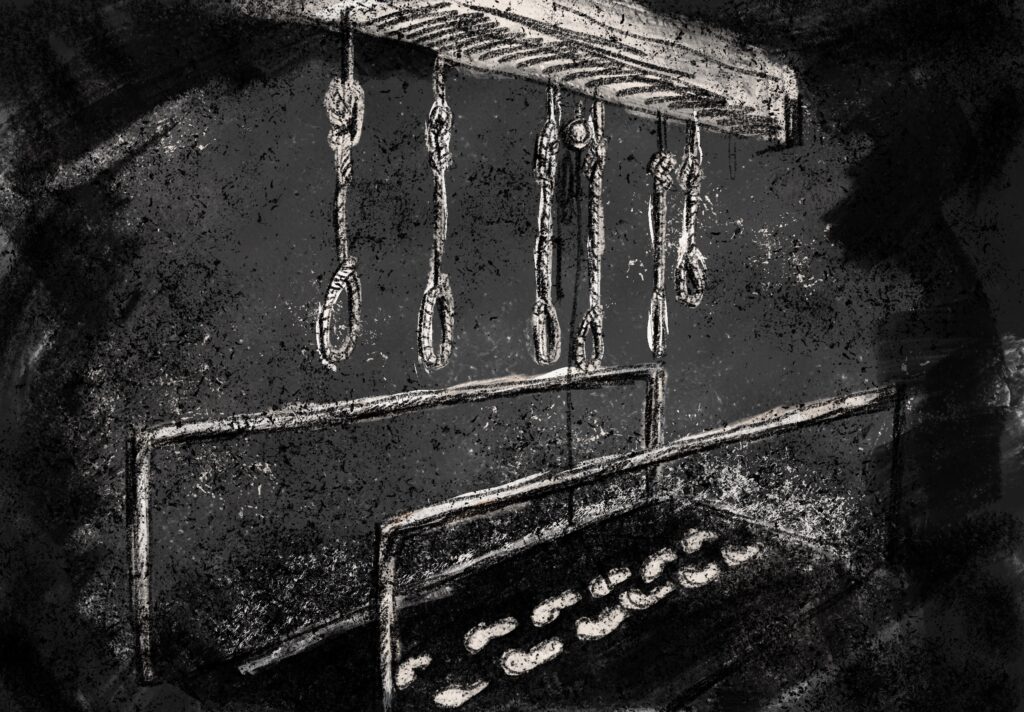
Like a constant buzz of electricity, the air is charged with the crackle of violence. Hanging from the ceiling are nooses, dangling like serpents twisting and curling their vicious tails.
We line up alongside the gallows, necks craned; eyes widened at these troubling ropes. At our feet: a wooden trapdoor which can be opened at the pull of a lever. This rickety platform is the only thing standing between life and death: the final step before the drop.
The clock is ticking. As the warden makes his way across the room, I feel my chest constrict as if the ropes have twisted around my heart. The air is now so thick; my tongue feels like lead and my neck prickles with sweat. Time’s almost up. His hand reaches for the lever.
As we all surround that limp trap door, nobody makes a sound. I can still feel it settling all around me: that cold, deafening silence. Even as we depart from the gallows, it clings to me long after.
Drawing of the gallows in Kgosi Mampuru II prison. By: Jamie Ho.
It has been 32 years since the end of Apartheid, a period where 3 500 people were sentenced to death by the state. In the modern age, it has become concerningly easy to shrug off these injustices as a thing of the past, a forgotten by-gone.
In the gallows of Kgosi Mampuru II prison, however, history is anything but gone. It echoes through the halls, up the stairs, around the hanging rope: a lively, tangible pain that sends a jolt through your bones. It sits heavy in the air: the agony of men marching solemnly to their deaths. That violence bleeds from that pocket of history. It lives in that prison.
The day we visited the gallows, I left with a newfound understanding of the past: that just because it has passed does not mean that it is gone.
The freedom that we have today came at a hefty cost; it was built from bloodied death chambers, scavenged from towers of corpses, hacked from beating hearts that were stuffed in boxes.
It is anything but the past; it is alive, and it weaves itself indefinitely into the fabric of the present, informing the very freedom we have today. It lingers in the triumph of being able to walk freely on an open street. It sits in the warmth and laughter of a community braai. It pumps through the veins of a liberated nation.
Before Solomon Mahlangu was executed he said, “Tell my people that I love them and that they must continue to fight; my blood will nourish the tree that will bear the fruits of freedom.”
As we observe Freedom Day, we must remember the thousands of lives the fruits of our freedom are staked on. We cannot let their memories die in vain. It is our one duty: to honour their sacrifice and let the past mean more than just the past.
FEATURED IMAGE: A portrait of Jamie Ho. Photo: Alaistair Russel
Walking into The Gallows Museum at Kgosi Mampuru II Correctional Centre, the first thing that hits you is not a sound, but the absence of it. We fell into a heavy, suffocating silence. It did not feel right to speak. The atmosphere was tense, sombre, and thick with a history that was never meant to be heard outside these walls. We were not just touring a building; we were retracing the final, mechanical minutes of 3500 lives.
The dehumanisation was in the details. The “procedure” began at 06:50 AM, and by 07:30 AM, it was over, fast and efficient. Life was extinguished with the punctuality of a business transaction. A wave of nausea hit me hearing how seven people were hanged at a time, their bodies later hosed down with a power washer, like equipment in a slaughterhouse, because the state could not be bothered to afford them individual dignity. They were shoved into coffins, and that coffin was shown to families for mere seconds to hide the trauma of the noose and then buried in unmarked graves. They did not just want these men dead; they wanted them erased.
It was a place designed for the mass production of death, a literal “human abattoir.” The ropes had metal rings to ensure the break was instantaneous, a cold, metallic “mercy” in a room that lacked a soul. If a pulse survived the drop, they were simply hoisted back up and hanged again. It was a loop of terror. Our guide explained that some in charge, like warden Christiaan Barnard, openly enjoyed the work because of how well it paid, even believing he would be forgiven because he was “just doing his job.” To keep the killings quiet, they even soundproofed the room to muffle the thunder of the trapdoors hitting the frame.
We climbed the 52 steps in the shadow of painted silhouettes, counting them one by one. I thought of the prisoners who would sing holy songs on their way up, their voices a haunting contrast to the “last request” they were offered at the top. It felt like a final, cruel joke to bark those requests in Afrikaans, a language many did not even understand, moments before they were led into the room where the ropes awaited. It was in this final room, the gallows, that I saw the plaque for a 22-year-old Solomon Mahlangu, barely younger than I am, who once stood on this same trapdoor.
This experience hit me with a force I did not expect. I realise now that we talk about “liberation” as a concept, but we rarely look at the apparatus that tried to crush it. Our democracy is not just built on grand speeches and signed documents; it is built on the silence of these men and the sacrifice of leaders like Solomon Mahlangu, whose words remain painted on these walls: “My blood will nourish the tree that will bear the fruits of freedom.” Standing where the hearse once sat, permanently waiting, I realised that as Freedom Day approaches, I carry the weight of those 52 steps with me.
We can never truly understand our present if we forget the system that tried so hard to wash this history away. I pray that the souls who passed within those walls have finally found the eternal rest and peace that was denied to them in life.
In episode six of We Should Be Writing season 7, the team unpacked the evolution of music as a form of expression and protest, through four decades in the South African context. The episode explores the journey of South African music and its consumers from the 80s, 90s, early 2000s and contemporary listeners. From the […]