Wits University professor who called South Africans lazy and unambitious has left her post.
Professor Srila Roy remains under investigation for alleged racist remarks.
Roy deleted the social media posts, then apologised after backlash.
“South Africans have little ambition, are complacent and have poor work ethic” – these were the choice Wits University’s Head of Sociology, Professor Srila Roy posted on her X (formerly Twitter) account, which has now led to her resignation.
The Department of Sociology confirmed Roy’s resignation from her role as head of department in a statement on February 26.
Following backlash over the post, Roy deleted the post and then posted an apology four days later. In it, she claimed that her tweet was in response to “xenophobic tropes” that arose after the Portfolio Committee on Higher Education raised concerns over the number of foreign nationals working in academic institutions.
Roy said she was sorry for any “hurt” she may have caused and was willing to take full responsibility for her “pushback”.
The South African Sociological Association (SASA) said her remarks were problematic, classist, racist and xenophobic. “Professor Roy’s remarks show disdain for the ethos of the South African higher education sector and the country as a whole,” they added.
In parliament, the Chairperson of the Portfolio Committee on Higher Education and Training, Mr Tebogo Letsie, said: “Professor Roy serves as Head of Sociology at Wits, a field dedicated to understanding social issues such as inequality, gender and development. It is therefore deeply disappointing that someone in such a position could hold and express views that undermine the dignity and potential of the very people our universities exist to serve”.
“South Africans are resilient, hardworking and ambitious, and they continue to strive for a better future despite many challenges.”
The university’s investigation into Roy’s conduct continues.
*Note: Headline updated on February 28, 2026 to provide clarity.
On Monday, February 23, Gauteng Premier Panyaza Lesufi delivered the State of the Province Address (SOPA) at the Nesrec Expo Centre. It is unfortunate that he did not come well prepared to address the electricity issues currently challenging residents in this province.
Yes, the minister of electricity has put an end to nationwide load shedding. However, what are his plans for the ongoing blackouts? The stations are constrained, there are illegal connections, cable theft, the infrastructure is old, we have heard of these reasons and need solutions that will last. Renaming the problem is not solving it. Blackouts are even worse as they are unplanned and last for days on end.
We saw the headlines regarding the recovered R3 million worth of cooper cables. Premier, why did you not give us a detailed strategy on how you plan to prevent this cable theft from happening again? Strong security measures need to be implemented at cable theft hotspots. The people of Gauteng deserve to spend the electricity they pay for without paying extra for generators, solar, gas appliances, data and fast foods.
There were no funds allocated to fixing the old substations and transformers in our province, which are also reasons for the constant trips in electricity supply. Out of the 15 investments he mentioned, from water reservoirs to houses and fast trains, not one investment was allocated to this problem.
City Power in Johannesburg has been screaming “systems constrained due to rising population.” Where are the plans to address this overpopulation within the province as it is one of the major factors affecting our power supply.
The project of turning recyclable waste into energy could really benefit us. As it is currently being done in Bushbuckridge, Mpumalanga, it has proven both profitable and reliable. It would be like killing two birds with one stone as we also struggle with land pollution in Johannesburg.
As we look forward to the upcoming SOPA debates, we expect this shortcoming to be addressed in the house.
The representation and preservation of our continent and our stories matter.
Africa represented in the Wikimedia Foundation board.
Anyone can edit Wikipedia.
South Africans are encouraged to add knowledge on Wikipedia in their language.
Bobby Shabangu, an activist for linguistic diversity on Wikimedia projects, has big plans to grow the platform in South Africa following his 2025 historic appointment as the first African board member of the Wikimedia Foundation.
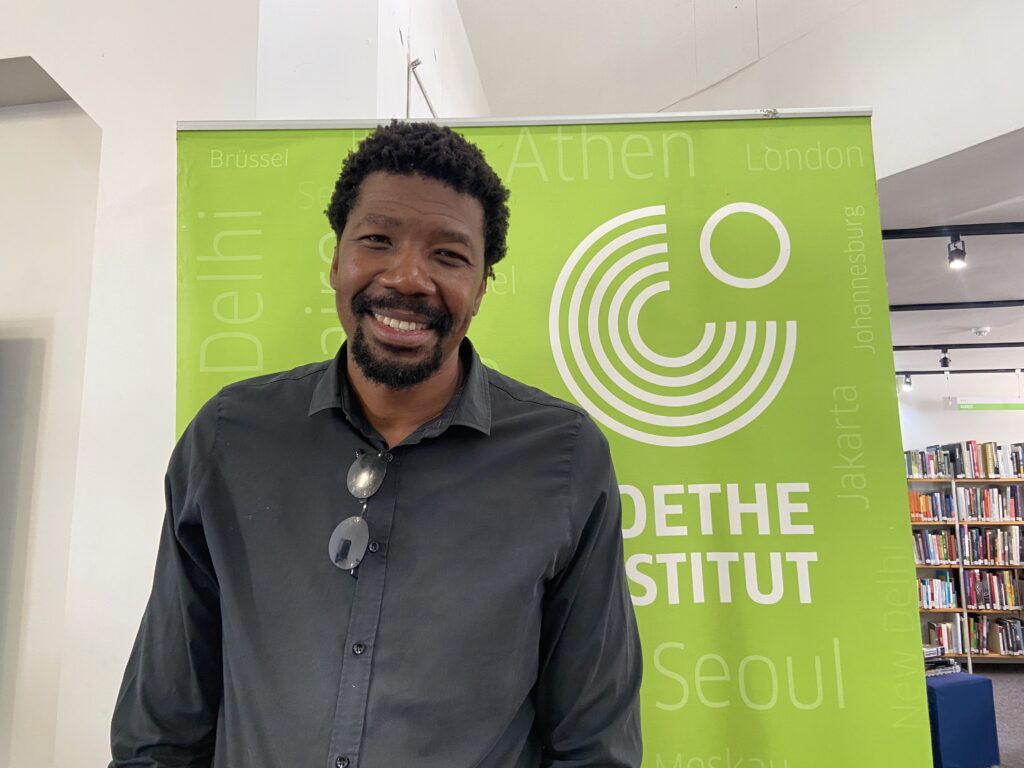
Bobby Shabangu, board member of Wikimedia Foundation. Photo: Lulah Mapiye
Wikimedia is a global, non-profit community for sharing open-content educational resources for free. The Wikimedia Foundation funds Wikipedia.
Shabangu’s plans include strong partnerships with galleries, libraries, archive institutions, and academic institutions across South Africa to grow local language content and improve representation on Wikipedia.
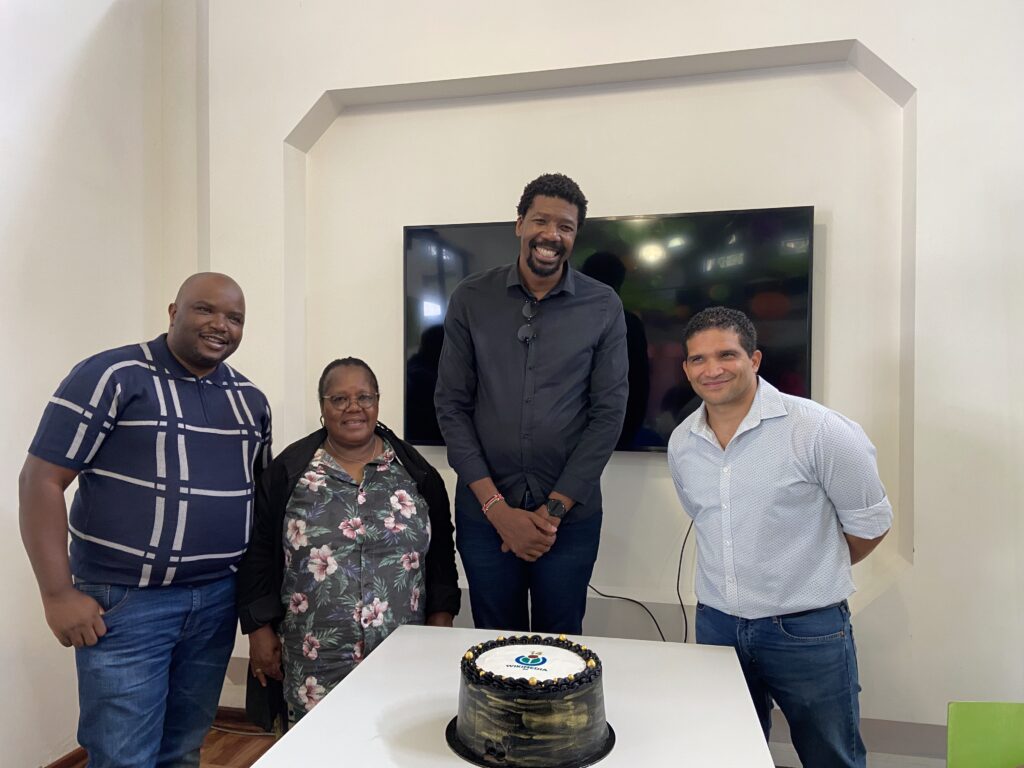
On Saturday, February 21 Wikimedia celebrated 14 years in South Africa. At the celebration, Shabangu expressed his excitement for this appointment as a board member, he said, “I feel fantastic about this and it is important because it will actually bring diversity of thought on the board of trustees.
From left to right: Dumisani Ndubane, Khethiwe Marais, Bobby Shabangu and Herschal Jackson.Photo: Lulah Mapiye
“I know what it is to not have data, to not have network, such things people who aren’t from Africa may not relate and sitting on the board will open doors for more support and inclusion for communities in the Global South.”
Shabangu’s relationship with the organisation dates back to late 2010s when he would use Wikipedia to prepare for prime time shows he was producing for Ligwalagwala FM.
This was when he noticed there were information gaps in African languages on the platform. With less than 10 000 articles published in each of our national languages.
When he discovered the edit button, he aggressively started translating English articles into the five national languages he knew at the time – Siswati, Ndebele, Zulu, Sesotho and Setswana.
Herschal Jackson, Executive director of Wikimedia South Africa, said it is important to be active in our consumption of Wikipedia research. “We are now working on getting more people to contribute to knowledge on Wikipedia in their own language. English is already sitting at over seven million articles. We all need to push together,” he said.
Lwazi Molepo, a biomedical scientist and cultural preservation enthusiast emphasized the importance of editing the platform using an example of Star Wars: A New Hope movie, where the Jawas spoke Zulu and Xhosa yet Wikipedia did not document that.
Claiming that as a result of this omission, other film makers who copied the language spoke gibberish. “We ought to correct incorrectly documented information and add missing information on the platform for the sake of the future generation.”
Everyone is encouraged to edit in information about their tribes and translate already existing English articles into their own mother tongues.
FEATURED IMAGE: Herschal Jackson addressing the audience at the Wikipedia 14th birthday. Photo: Lulah Mapiye
After a month of intermittent blackouts, City Power has upgraded to weekend-long power cuts.
Braamfontein has been experiencing blackouts since Saturday morning.
Residents and businesses bare the consequences of old infrastructure.
City Power restored power on Monday afternoon.
On Saturday morning, Braamfontein residents woke up to another blackout, which led to a morning of cold-water baths, dead batteries, unironed clothes, cold meals and loud generators drowning each other out.
After a month of experiencing weekly unplanned blackouts for a couple of hours per incident, Braamfontein residents did not know that this one was different.
City Power said the outage occurred following a trip from Fordsburg Substation, which affected Braamfontein, Parktown and surrounding areas.
This trip led to three faults on a Braamfontein interconnector cable. As of this morning, two of the three faults have been located, but repairs were underway, said to City Power.
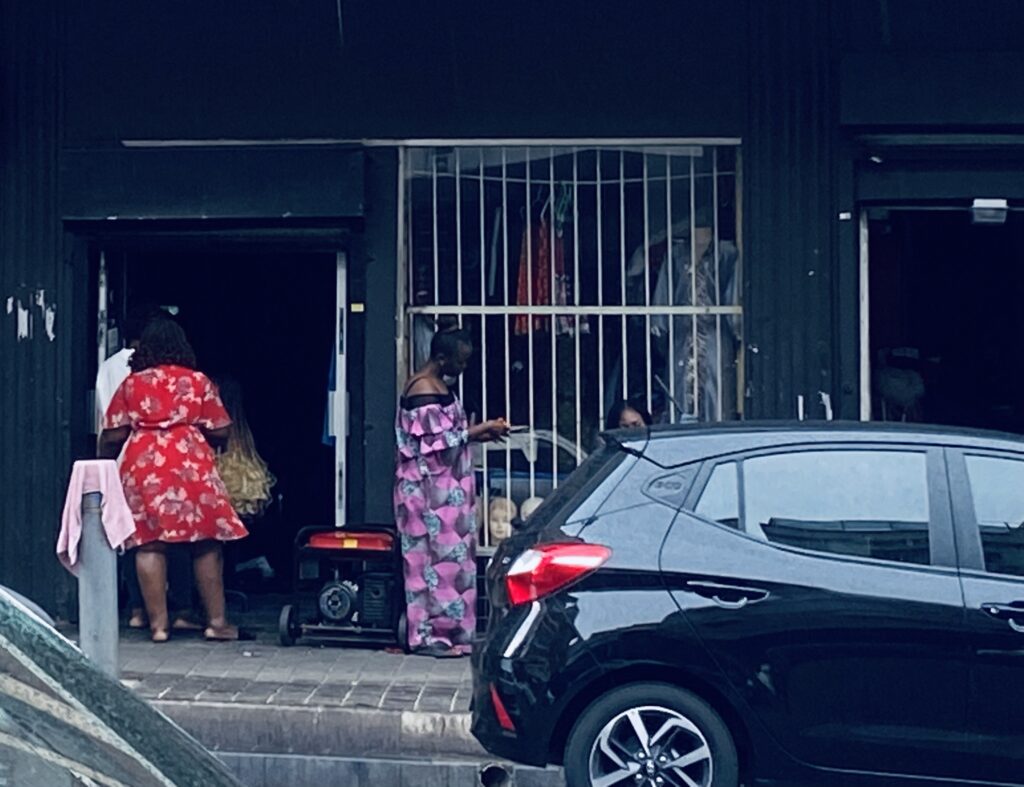
Some businesses have been closed since Saturday morning as they do not have backup power. Hairdressers are operating outside their salons for light.
Hairdressers in Braamfontein attending to their customers outside the salon due to power cuts. Photo: Lulah Mapiye
“I have to do everything in the dark and spend extra money on data since the Wi-Fi is off. City Power needs to start paying us back for the electricity we pay for and don’t have,” said Tebogo Lebeya, resident of Braamfontein.
City Power said that due to existing network faults, customers cannot be backfed from alternative supply points.
They attributed these power faults to cable faults and damage caused by third parties. The disruptions are further linked to ageing infrastructure, illegal connections and sustained overloading of the network.
Sylvester Ayuk, owner of Estee Ay Communications, a printing business in Braamfontein, said: “Our clients are disappointed as we failed to meet deadlines over the past weekend. Our generator was only able to power one printing machine, we only managed to complete a few orders. We are calling upon the management to be quick to restore power next time.”
Amorette Anyang Onya, a nail technician, had to go to another town to charge her nail lamp, which she uses to dry nail polish.
“Having no electricity really slowed down my business. The time I used to go to another town to charge and come back, I could have used treating a customer or two,” she said.
The initial estimated restoration time was 18:00 on Saturday, February 21. The revised date of Monday, February 23 at 12 was unmet, and power was only restored at about 15:30 on the day.
FEATURED IMAGE: Generator powering a salon in Braamfontein due to power cuts. Photo: Lulah Mapiye
Between Statistics South Africa and the president, the country’s employment figures don’t quite add up.
President Cyril Ramaphosa announced on Thursday, February 12, during his delivery of the State of the Nation Address (SONA) in Cape Town that the government has created over 2.5 million job opportunities through the Presidential Employment Stimulus, mainly for young people and women.
The president’s declaration comes as a surprise, because since the inception of the Presidential Employment Stimulus in 2021, unemployment rates for the youth (people aged 15 to 34) have been at their the highest, 44.6% in 2024 and 46.1% in 2025 according to Stats SA. While 31 000 young people got employed in 2025, another 39 000 young people became unemployed. So where exactly are the millions of jobs? Mr President show us the jobs.
Ramaphosa once again promised to create jobs through massive investment in new infrastructure, while upgrading and maintaining the existing infrastructure, and engaging local and international investors to finance this venture.
Last year, the president promised to create jobs through industries of the future, which are green manufacturing, renewable energy, electric vehicles, and the digital economy. This year, he again promised something similar. Is it possible that the president just copied and pasted this section of his speech from his 2025 speech?
Knowing that we have heard this before, what could possibly make us confident that this time things will be different?
The situation is so dire that we had over 600 job seekers queue for 50 positions at a restaurant in Durban last year. Our young people are applying to fake jobs abroad, falling prey to scams. Desperation often trumps due diligence when applying.
Perhaps, this year’s plan could be more promising as confidence is rising among investors, because South Africa is no longer on the grey list and the Rand is currently stronger than the US dollar.
Leaning towards creating jobs within our thriving agricultural sector through the introduction of 10,000 new extension officers to offer support to farmers and improve agriculture is an interesting move, I’ll give him that.
Those are 10,000 new jobs, and they are looking to improve our agriculture sector to be stronger so that we can export more. That includes avocados, maize, livestock, grapes, and wine.
Now we are waiting to see if the budget, which will be tabled on February 25, is in alignment with all the promises and reforms that the president has promised in his SONA.
FEATURED IMAGE: President Cyril Ramaphosa delivers the 2026 State of the Nation Address on February 12, 2026. Photo: Jairus Mmutle / GCIS
Zama Phakathi has proved that absence does not stop the show, while she is in Paris, her curated art exhibition is underway in Johannesburg.
A new exhibition is showing at Museum Africa.
Various art mediums used to tell a story of black struggles.
Art exhibitions are underfunded in South Africa.
Through photographs, sculptures, gouache on paper, achieved footage and an interactive digital map among other mediums, the struggle of black people is made live and felt deep. Art exhibition, Nkosi Sikelel’ iAzania, by Zama Phakathi, prominent entrepreneur and art curator, opened on Saturday, February 7 at Museum Africa, Newtown.
Some of the pieces are loaned from Rossouw Modern Art gallery, Johannesburg Art Gallery, Iziko South African National Gallery amongst others. Phakathi juxtaposes apartheid with democracy using the works of artists such as David Goldblatt (1930-2018), Jürgen Schandeberg (1930-2020), Senzeni Marasela who experienced and documented apartheid and democracy firsthand. Their work stand alongside the works of much younger artists such as Frans Thoba, Sethembile Msezana and Emma Rodseth-Terblanche who only experienced democracy.
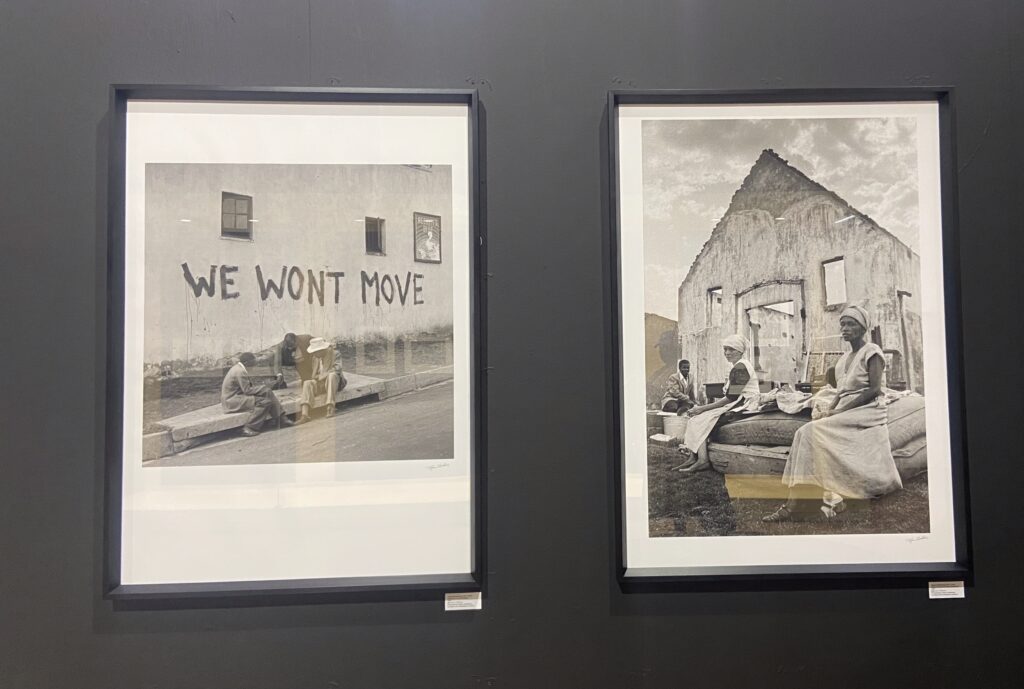
Photographs by Jurgen Schadeberg. Photo: Lulah MapiyeDigital interactive map by Emma Rodseth-Terblanche and Wandile Mthiyane.
Contrasting life then and now, the works zoom into what has changed, what evolved into a different struggle and what remains the same.
Putting together an exhibition in South Africa is a huge challenge due to a lack of funding opportunities said Makgati Molebatsi, art consultant and curator. “Loaning art pieces, ensuring them per their exact value, framing…it all costs a lot of money and for it to run for only three weeks is very unfair,” she said.
Siyabonga Ngwenya, an art enthusiast, attended the opening with her father. She appreciates artists who curate exhibitions like Nkosi Sikelel’ iAzania as she gets to bond and learn from her dad who lived through the apartheid era.
“I like taking my dad to these things, he enjoys going through the pieces with much attention and shares how he remembers things. [Pointing to a train photograph on the wall] like with those trains, he told me they were exactly like that, with black people squeezed together with no breathing room,” she said.
The exhibition runs for three weeks till February 27 and entrance is free.
FEATURED IMAGE: The day Rhodes fell, a photograph by Sethembile Msezane. Photo: Lulah Mapiye
Numbers of illegally owned guns fuelling gun violent crimes are currently outrageous, but there is hope.
The admission of a lack of capacity to tackle organised crime in the Western and Eastern Cape provinces by the Acting Minister of Police, Firoz Cachalia, shook many people.
While their surprise can be credited to many factors, one outstanding reason is that most South Africans are used to being gaslit and have become accustomed to it, as a result fail to recognise the first step in problem solving- acknowledging one exists.
The Democratic Alliance (DA) rejected the minister’s admission, claiming it is an excuse and equates to surrendering the office’s duty to protect its people.
They further pointed the office of the minister has had years to plan against gang crimes, yet underfunding, weak intelligence, and poor prosecution have fuelled gangs to terrorise people and businesses.
The DA and Cachalia are, in fact, in agreement when it comes to the reasons the Department of Police has been failing to end organised crime.
While there are internal problems within the policing system such as: the physical filing system, corruption, police officers not reporting lost or stolen guns- the Minister called for better policing during the eleventh edition of the National Excellence Awards for police officers.
The above needs to work hand in hand with active citizens to lower the rate of organised crime in South Africa.
According to Gideon Joubert of SA Gun Owners Association, there is about three to six million unlicensed firearms in circulation nationally. This contributes to the rising crime levels and makes it difficult to trace perpetrators as the guns either do not have serial numbers, or the serial numbers that are found on the gun belong to some civilian who lost it and did not report.
Last month, Clay Taylor, a gun-free SA researcher, suggested that guns need to be recovered. Lost or stolen guns need to be brought back into the licensing system.
To help with this, citizens are urged to report lost or stolen guns. So far, 22 guns per day are reported missing by civilians and two firearms are reported missing or stolen in the police department per day.
These numbers are not matching the overall numbers of guns circulating across the country in illegal hands. That means there are people – police and citizens – not reporting their lost or stolen guns.
South Africa belongs to all who live in it and all who live in it ought to play a part in keeping it safe and crime free. Report illegal firearms to the South African Police service (SAPS) by calling 08600 10111 or using the MySAPS App.
FEATURED IMAGE: Lulah Mapiye profile image. Photo: Paul Botes
There is so much more to Danya Dev’s album than compliments to beautiful women and a flashy lifestyle, his story is worth listening to closely.
With the recent release of his debut solo album, Danya Dev (Sphelele Dunywa) officially took a hiatus from the Blaq Diamond duo to reintroduce himself. Titled Bayede, a Zulu greeting for a King meaning all hail, the project serves as both a grand entrance and a mission statement.
Across 18 tracks spanning 51 minutes, Danya Dev crafts a sonic world that is remarkably consistent: laid-back, atmospheric, and tailor-made for late-night drives or slow Saturdays.
While some listeners might think the use of typical Afro-pop and Hip-Hop themes, i.e. the allure of beautiful women, female gold-diggers, and flashy lifestyle, was a default genre move, the album is in fact thoughtfully structured as a two-act narrative.
The first act is about the temptation of fame. The journey begins with a man caught in the whirlwind of celebrity. He depicts a reality where his accomplishments and fame act as a magnet for women. On tracks like Uber Eats and Where were you, he highlights the transactional nature of modern romance, where status and ‘’nice things’’ drive attraction.
Danya Devs debut solo album playlist. Photo: Lulah Mapiye
The second act brings the story to a close with a sense of maturity. We see a man who has traded the chaos of the ‘’fast life’’ for the desire to build a home. The lyrics in Ola Sbali (Hi brother inlaw), Abakhongi (lobola negotiators) and 1 million signal a newfound respect for stability and partnership.
While the album features a heavy-hitting roster of guest stars, including Sjava, Kwesta, Cassper Nyovest, Ndu, Mawelele, most are given much time to shine except Sjava who sings for eight seconds in Uber Eats, which is extremely disappointing.
Be that as it may, Bayede does not try to reinvent the wheel, instead, it leans into a singular, steady vibe. It is a cohesive body of work that proves Danya Dev is more than capable of carrying a kingdom on his own.
Vuvu rating: 7/10
FEATURED IMAGE: Danya Devs debut solo album cover. Photo: Danya Devs
Jozi Angels and 22onSloan fund and mentor innovative AI business ideas aimed to solve African problems, founders warned on how not to fumble the bag.
Start-up founders need to be financially literate.
Scaling soon is bad for businesses.
Mentorship and funding available for entrepreneurs with lucrative solutions to African problems.
Wits University is hosting the fourth edition of the Applied Machine Learning Days (AMLD) conference from January 26 to 29 at the Wits Science Stadium and investors are present to advice Artificial Intelligent (AI) powered business founders.
From left to right: Hayet Hammana, Bernadette Bule and Keshni Morar. Photo: Lulah Mapiye
Bernadette Bule, Wits alumni, and Business and Partnerships Manager at 22onSloane, the largest startup campus in Africa, based in Johannesburg, said there is a fundamental skill every founder must have.
“I’ve seen that a lot of founders lack financial literacy, which leads them to desire to scale their businesses way too early. Our programme looks at the stages of our BRL (Business Readiness Level), which is from zero to ten, and determine your business needs as per your BRL level,” she said.
Keshni Morar, Angel Investor at Jozi Angels, agreed. She said a lot of businesses scale prematurely, leading to their downfall. Morar’s core work includes funding and mentoring early-stage South African start-up’s.
“Sometimes they [founders] may not be the right person to scale the business. Understanding fundamentals of business and self-awareness really helps with transferring the power to someone who is more capable of getting the business where it needs to be,” she said.
There were many AI-powered startups at AMLD, from AI models designed to assist doctors with follow-ups, scheduling patients and sending appointment reminders to efforts to end the use of English as a lingua franca through AI-mediated one-on-one conversations amongst African descendants of different languages.
One of the co-founders of Masakhana, a company research and funding company aimed at democratising AI in South Sudan, Lydia Kila Taban said: “We have more than 2,000 spoken languages in Africa, but the technology we use does not understand most of our languages. This results in a lot of people being unable to understand technology as it is not in a language they speak and think in.”
Masakhana is working to solve this problem with the help of researchers, engineers, computer scientists and others passionate about preserving African languages and heritage. This is a perfect example of the type of solutions Jozi Angels is willing to take risk funding.
Bule said with great ideas and the right funding, young people could help put a dent in South Africa’s unemployment problem.
This might be the year the national treasury receives more than two thousand budget tips.
Budget speech to be delivered on February 25, 2026.
Students raise funding, infrastructure, and security concerns.
February 16, 2026, is the closing day to submit tips.
Some university students are eagerly welcoming the Minister of Finance’s call to send budget tips ahead of the second budget speech under the Government of National Unity (GNU), scheduled to be delivered on February 25, 2026.
According to the Parliamentary Monitoring Group, the invitation to send through budget tips began in 1999 under former Finance Minister Trevor Manuel. An effort to get civil society to actively participate in matters of national importance.
Since its inception, citizens’ participation has been limited. In 2023 minister’s office received over 2000 responses. Before and after that, the responses were fewer than a thousand.
Even though the Wits SRC Treasurer General, Somwabo Mhlahlo (22) believes this is one of those things the government does to tick a box, he is determined to contribute to the conversation.
Mhlahlo’s biggest concern is that many students previously funded by the National Student Financial Aid Scheme (NSFAS) are unable to register for the 2026 academic year.
“They have outstanding fees and cannot proceed with their studies because of the NSFAS cap on accommodation, it is the government’s responsibility to settle that debt,” he said. NSFAS currently caps accommodation allowance at R55,000 while residences on campus are currently charging between R55,685- R117,962.
For Sanele Segutya (23), a post-graduate student in Public Management, who spent three weeks in a public hospital in Cape Town due to a leg injury, resource allocation on public health services is most important. To offer services that are almost similar to those offered in private hospitals.
“The fact that I was in a hospital in itself is a privilege. My observations may have been surface level, but the nurses seemed frustrated all the time. At some point they had to discharge patients early because of a shortage of beds,” said Segutya.
Another student who is drafting a tip is eighteen-year-old Tsenolo Dampies, first-year student in Computational and Applied Mathematics. Dampies’ focus is infrastructure and security. “We need more cameras in crime hotspots, and more police stations where people can report crime as we all know that crime is on a rise in South Africa,” he said.
Witsies are using this chance to play a part in building the nation they dream of living in. If you were unaware that you have this power, you are being urged to click on this link, in no more than 300 words, state how you want your government to allocate funds, by no later than Monday February 16, 2026.
FEATURED IMAGE: Image showing South African Rands. Photo: Lulah Mapiye
Booking accommodation is slowly becoming a gamble as trusted sites get flooded with fraudsters.
Students struggle with online registration and travel miles for in-person assistance.
People use Booking.com to defraud customers.
Use of AI consultants blocks customers from getting safe and speedy assistance.
Owam Vinqi, a Wits fourth year student from Port Elizabeth was left without a place to sleep on Thursday, January 15p on Thursday. Vinqi who had spent fifteen hours travelling to Joburg was left stunned after being informed of the non-existence of her booking during check-in at 286 Fox Street, Maboneng.
Vinqi had booked a studio apartment for a two night stay on Booking.com for R810. Money she could barely afford to part with, as her trip was primarily to sort out a registration block due to outstanding fees of R13 000. The last thing Vinqi expected was to fall prey to a scam.
Upon her arrival, a security guard at 286 Fox Street said her booking was invalid, as she had no email with a secret code to present at check-in. The proof of transaction Vinqi had on her banking application was not enough.
“I looked stupid talking to the security. When I tried contacting Sterling [the alleged manager of the apartment] via the Booking.com platform, I received no response.
“I exhausted all my options and finally accepted that I had been scammed,” said Vinqi. She was able to access emergency accommodation in Doornfontein provided by the Wits SRC.
Wits Vuvuzela reached out to Sterling, who refused to disclose his full name and surname, regarding Vingi’s allegations. He denied any knowledge of the booking and explained that Booking.com handles all payments and confirmation letters. He said he only receives his cut days after hosting the guest.
“I do not know if or how she was scammed. If she did not receive a confirmation email, she should take the matter up with Booking.com and they will refund her,” said Sterling.
This incident is one of many global Booking.com scams. In the UK, customers lost a total of £370,000 (ZAR 8 090 645,70) between June 2023 and September 2024 reported The Guardian.
Furthermore, last month, Euronews raised serious concerns regarding the careless nature of Booking.com’s security, specifically its failure to remove fraudulent listings that have become ‘stains’ on the platform’s reputation.
Closer to home, content creator, Ariel Lyndsey, made headlines in December 2025, after she was scammed twice in the Camps Bay area in Cape Town. Despite reporting the first fraudulent listing, she found another deceptive property on the same app, highlighting a dangerous lack of oversight in the platform’s verification process.
Wits Vuvuzela’s efforts to get through to a human consultant at Booking.com were blocked by many AI consultants on calls and Instagram and lastly an international helpline.
Vinqi had exhausted the above options before resorting to opening a fraud case through her bank, and now she is awaiting feedback on the case.
FEATURED IMAGE: Illustration of a student stranded in Maboneng. Photo: Lulah Mapiye
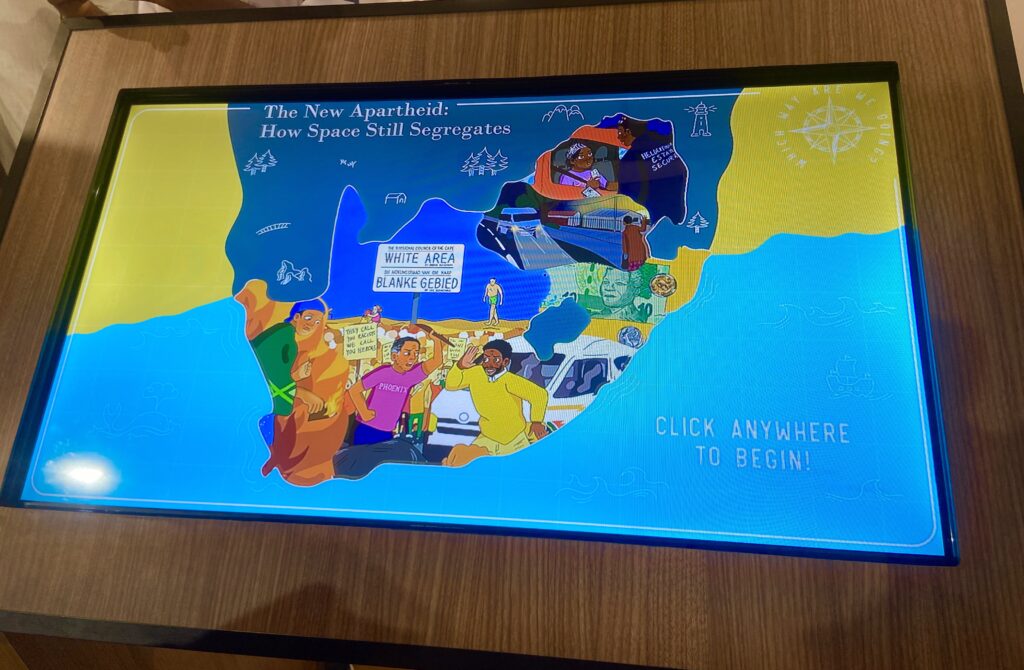
The persistence of unsafe, unregulated minibus taxis in Johannesburg reveals how apartheid’s spatial inequalities continue to shape the failures of South Africa’s transport system.
The majority of Johannesburg residents depend on the informal minibus taxi industry for daily commutes.
Lives of passengers are endangered daily when commuting in unroadworthy minibus taxis, driven by unlicensed drivers, while taxi associations remain inaccessible to passengers.
The minibus taxi industry has the potential to deliver world-class transport; the government and taxi stakeholders need to work together in formulating implementable policies.
Silindelo Sithole, a resident of Alexandra township in Johannesburg, sits with his long legs pressed against one of the two-seaters in the third row from the door in a Siyaya minibus taxi at the MTN taxi rank.
Sithole, 25, holds his breath and silently prays as a visibly drunk man climbs into the driver’s seat. In disbelief, he realises the drunken man will be driving him for the next 20 minutes, from the rank in downtown Johannesburg to Alexandra.
“Taxi people really treat us like trash,” says Sithole, five days later, still visibly shaken.
Minibus taxi drivers in Johannesburg are infamous for breaking traffic rules. Drunk driving, driving without a valid driver’s or vehicle license, skipping red lights, driving on pavements, and overloading taxis. Some of the taxis are poorly maintained and unroadworthy. All these actions compromise the safety of passengers.
The front seat of an old minibus taxi that carries passengers from Braamfontein to Yeoville. Photo: Lulah MapiyeTorn seats, rusted metal and welded metal parts inside a minibus taxi in Johannesburg. Photo: Lulah MapiyeA cello-taped rearview mirror that shows rusted walls inside a minibus taxi queued in Braamfontein. Photo: Lulah Mapiye
Black commuters have faced transport issues since the apartheid era. Apartheid urban planning gave priority to spatial segregation, keeping black South Africans on the outskirts of the city and white people closer to the centre. It had no regard for transport issues that would arise because of said planning. Consequently, black people were forced to rely on public transport, trains and buses, which were neither efficient nor easily accessible.
The lack of accessible transport for black people made way for the introduction of privately owned minibus taxis in townships during the 1970s and early 1980s. Minibus taxis would carry commuters from townships and rural areas to cities for jobs, education, and health facilities.
The unregulated minibus taxi industry was built out of necessity and as a form of resistance to apartheid laws and regulations, which provided limited transport for black people to access non-white areas. Black people became dependent on it for everyday commutes, and due to the apartheid government’s neglect of the industry, it was left to grow massively. Over 70% of South African commuters rely on minibus taxis, according to The National Taxi Alliance (NTA). In some rural or low-income areas, public transport does not even exist, commuters rely solely on minibus taxis.
With the legacy of urban spatial planning still influencing urban use of transport in post-apartheid South Africa, what used to be a race divide is now a class divide. Public transport use has declined, as issues of its inefficiency prevail. This decrease has further fuelled the growth of the privately owned minibus taxi industry. Today with over 3,000 taxis operating in Johannesburg and generating R100-billion annually in the entire country according to the South African National Taxi Council (SANTACO), the industry’s scale belies its informality — a paradox that highlights the state’s failure to regulate one of its most critical urban services.
Thirty-one years after apartheid, the minibus taxi industry still exhibits fierce resistance to regulation and formalisation. It remains a flashpoint of chaos and violence, fuelled by route competition, disputes, assault, and assassinations. During this turbulent power struggle, it is the innocent commuters who bear the brunt of the consequences. In some cases, the assaults are so severe, commuters feel helpless to a point of sacrificing their income, by resigning work or using costly e-hailing services.
A case that illustrates the outcomes of taxi driver’s assaults is that of Nthabiseng Tsunke, a 29-year-old woman hailing from Tshepisong in the West Rand region, who uses a wheelchair. Tsunke claims she resigned from her Information Technology learnership at Bytes Technology, Randburg in 2018 due to lack of assistance boarding taxis during transit.
The Randburg drivers at MTN taxi rank would refuse to help, and constantly nag her with questions regarding the whereabouts of her family members. They would speculate that Tsunke’s family only supports her when it is time for South African Social Security Agency (SASSA) disability grant payouts.
“Each person pays for a seat in a taxi; imagine travelling with someone everywhere I go?” said a frustrated Tsunke. “Also, when I get to work, what would that person be doing?” There are many passengers who feel discriminated and disrespected in taxis. With little to no knowledge of what to do in such situations.
In its current state, the Johannesburg minibus taxi industry does not exhibit characteristics favourable for a world-class African city. Formalising the industry would bring the city closer to world class African standards by ensuring that drivers adhere to road rules and get trained to offer inclusive customer care. Commuters like Sithole and Tsunke would experience safe and inclusive commutes.
Efforts to bring the taxi industry out of the shadows
Through its Taxi Recapitalisation Programme (TRP), the national Department of Transport has been making efforts to move the taxi industry from the informal sector – “the shadows” – to part of the mainstream economy. Since the launch of the programme in October 2006, it has dismally failed to formalise the taxi industry.
This resistance to formalisation and innovation is due to the government’s lack of consultation and collaboration with taxi stakeholders, reported journalist Ivo Vegter in his 2020 report on South Africa’s minibus taxi industry. Santaco rejected the National Land Transport Bill of 2008, which aimed at formalising the taxi industry. The bill also aimed at integrating the taxi industry with the Bus Rapid Transport (BRT) system. The association claimed this bill is part of the government’s plot to strip them of the taxi industry, thus close their businesses.
Recent reports by the department show it has, however, managed to scrap 84,150 old taxis across the country. Despite this achievement, there remain many taxis that operate in questionable conditions in Johannesburg, such as the old Toyota minibus taxis, ‘Siyaya’, which are poorly maintained and only kept on the road to maximise profit.
The government’s failure to scrap all unroadworthy taxis and provide reliable, safe public transport exposes citizens to toxic gases. During one encounter, when I was traveling from Marshalltown to South Hills, the taxi we were in started fuming. The driver parked the taxi by the side road and asked the front-seat passengers to get off. That was because smoke was coming from a part located underneath the front middle space between the driver’s and passenger’s seats.
If it isn’t gas, it’s rainwater coming through the loose part between the taxi door and its frame, says Sithole. The majority of the Siyaya minibus taxis have low suspensions because they are old. While an article from TimesLivedetails the consequences of driving a vehicle with a lowered suspension, another one from Independent Online News (IOL) claims it is illegal. When the Department of Transport scraps these taxis from the road, their actions are met with a lot of backlash.
When unroadworthy and unlicensed vehicles are scrapped off the road or impounded, taxi owners and drivers strike, and commuters are then left to struggle for transport. This highlights how taxi owners prioritise profit over the safety and comfort of residents.
While the scrapping of old minibus taxis is not favourable to some taxi owners, it is essential in ensuring that citizens commute in safe, well-maintained, and roadworthy minibus taxis. An ideal world-class African city should guarantee passengers’ commutes that do not pose a danger to their health.
Cash care measures within the minibus taxi industry
To find out what citizens can do to report rude and drunk drivers, I went to the Faraday Taxi Association (FTA) offices in Yeoville, where I was referred to the headquarters in Rosettenville, South of Johannesburg. The taxis to Rosettenville are located at Faraday taxi rank, an approximate fifteen-minute walk from the Johannesburg CBD. Residents pass abandoned buildings and informal settlements to get to the taxi rank. Alternatively, residents pay R6 for a taxi from Mable Towers, located at 208-212 Jeppe street, to the Faraday taxi rank. The walk there, however long, does become longer and very unsafe when the sun starts going down.
Upon arrival at the association offices, three taxi association branded vehicles are parked outside. Approximately ten men stand, guns on their belts, eating and chatting. I approach a member of the taxi association squad team, who agrees to talk under the condition of anonymity. He shares there are five groups in the FTA. Each number represents specific areas: F1-Faraday, F2-Bree, F3-Kensington, F4-Yeoville branch, and F5-Little Zands.
The squad is stationed at ranks under FTA dailyfrom 5am till 6:30pm. Their main objective is attending to passenger grievances says another man, who wishes not to be named for fear of safety.
He emphasises that minibus taxi commuters need to report lost items and open harassment cases to the squad. “When opening a case, commuters must bring the number plate of a taxi and its travelling time,” he says, because “These details are important when reporting a case as many people do not know the names of the drivers.”
Moreover, not all cases are resolved at the taxi rank, some are taken to the FTA headquarters. Likewise, punishment dependents on the level of offence. Some cases like refusing to give a passenger change warrantees a fine while others like drunk driving result in suspension.
The cash minibus taxi industry of South Africa. Passengers paying their taxi fare. Photo: Lulah Mapiye
From the information shared by the FTA squad member, it is clear all reports are made in person. This is mainly because the FTA does not have a business website. A quick Google search shows only the headquarters’ address. There are no contact details and business hours. A Facebook page, ‘Faraday Taxi Association,’ has 2,700 followers and focuses on selling cars – none of the contact details available online go through.
The FTA’s lack of online presence, as one of the major taxi associations in Johannesburg, reflects the industry’s resistance to formalisation. The industry is stuck with traditional ways of business operation, and these are costly to commuters; they must travel to ranks and association offices to open cases, increasing barriers between the associations and the citizens they claim to serve. The industry lacks good customer care measures, but often resorts to violence to protect its cash.
It is not enough that associations exist, they should be conveniently accessible. Currently, the absence of an active online presence is a technological setback. To achieve a world class African city, the minibus taxi industry needs to offer customer care services, as tabled in the 2020 National taxi lekgotla.
How does South Africa compare?
People from all around the world reside and work in the Johannesburg. Their experiences of Johannesburg’s minibus taxi transport are mostly in comparison with their country’s experiences. Paulin Bitokwela, originally from The Democratic Republic of Congo (DRC) is currently residing South of Johannesburg. He compliments the order that exists within the Joburg taxi ranks, pointing out there is a guaranteed first-come, first-serve policy because of the queueing system.
“In many towns in Congo, people do not queue, people squabble to get into the vehicle. The situation is much better in towns like Lubumbashi, but it really does not compare to the order in Joburg,” he says. Bitokwela aadds that in DRC, whenever residents have a problem with taxis, they complain on television shows and directly to the minister’s office, unlike in South Africa, where minibus taxi complaints are mostly directed to taxi associations.
Tlotlo Oletile, a chemical engineer from Botswana who came to Johannesburg in 2022 as part of her exchange programme with the University of Johannesburg seems to agree with Bitokwela on reporting to the department of transport. She said in a WhatsApp interview what she experienced in Joburg minibus taxis was a huge cultural shock. After unknowingly sitting in the front seat, “People passed their money to me and I was supposed to count the money and give people change,” says Oletile, laughing at the recollection of her experience. “I was so surprised because in Gaborone every taxi has a conductor who counts.”
I was so surprised because in Gaborone every taxi has a conductor who counts.
Oletile also points out the advantage that comes with calling out your stop; in Johannesburg you just say “short left” and the taxi stops, while in Gaborone there are designated bus stops which are 200-400m apart. Bitokwela’s compliment of the Johannesburg’s taxi industry’s queueing system and Oletile’s appreciation of the taxi drivers stopping anywhere are testament to the potential Johannesburg taxi industry has to offer world-class African city treatment to its customers.
To fulfil this potential, South Africa should consult with other African countries that have an improved minibus taxi system. The government conducted investigations with various BRT systems such as Ecuador and ColombiaBrisbane, Australia to develop Rea Vaya — a fast, safe, and affordable bus system. These consultations proved vital in the production of a transit system that would play a key role in realising the vision to turn Johannesburg into a world-class African city. The same can be done to improve our minibus taxi industry, such as consulting with countries that have a formalised minibus taxi industry like Botswana.
Vegter, a journalist who worked on a minibus taxi report recommends the government should consult local minibus taxi associations stakeholders when drawing up policies. “These policies should abolish anti-competition behaviours, unsafe vehicles, overloading, and reckless driving. Which would promote competition and improve customer experiences for taxi passengers,” he writes
FEATURED IMAGE: The cash minibus taxi industry of South Africa. Passengers paying their taxi fare. Photo: Lulah Mapiye
Since her announcement as the Democratic Alliance’s mayoral candidate for Johannesburg, Helen Zille has dominated national headlines. In this bonus episode of We Should Be Writing podcast, hosts Lulah Mapiye and Bonolo Mokonoto dissect a media meet-and-greet with the mayoral hopeful. From her extensive political résumé to her controversial public utterance, we examine why the Democratic Alliance has chosen Hellen Zille as their candidate for the 2027 local mayoral elections. Additionally, […]