Lesotho’s frozen Maluti Mountains is home to Club Maluti – a rustic, analogue sanctuary where generations of Witsies have found lifelong bonds and adventure on its slopes.
Founded in 1968, Club Maluti remains the cradle of African snow sports.
A nearly 60-year partnership with Wits Snow Ski Club turns the remote mountain cabin into an iconic student rite of passage.
The hand-built, member-run lodge offers an analogue escape where phone screens give way to fireside traditions.
Up at 3,200 metres in the Maluti Mountains, where sub-zero air bites your cheeks and river gorges freeze into solid glass, sits a rustic timber lodge. Its living heartbeat the generations of snow-seekers that visit during the colder months. Tucked away in Lesotho, ten minutes down the pass from Afriski, Club Maluti (Club M) is a place where city stress dies on the switchbacks and generations of Witsies have found a second home.
Stepping through the timber door of Club Maluti after the 5-hour drive up from Johannesburg, the first thing that hits is not the cold; it is the immediate warmth of woodsmoke, room-wide laughter, and decades of lived history. Shedding my heavy winter coat as the sound of music hums through the room, I realise I haven’t just entered a cabin; I’ve stepped into a living time capsule and close-knit community.
How a crazy idea built a legacy
Sitting near the fireplace listening to older members share stories over cold beers, the roots of the place come into sharp focus. The story began in the mid-1960s with Syd Chaplin, who ran pony treks in the region before establishing Oxbow Lodge near the Malibamat’so River. Looking to draw winter crowds to the frozen highlands, Chaplin connected with Phillip Lloyde, a ski enthusiast, alongside Joburg-based friends Brian de la Harpe and Stan Flemming.
The four friends saw the snowy Maluti peaks as an ideal and natural playground for winter sports. Driven by a shared love for skiing and working through official channels, they secured permission from King Moshoeshoe II of Lesotho. They signed a 100-year lease on the land, under the strict condition that no one could profit from the club, before officially forming Club Maluti. What followed in 1967 was endless weekend work parties where members hauled timber up unpaved tracks; they completed the original A-frame in April 1968.
When their initial slope proved too sunny, local mine manager Keith Whitelock pointed them ten kilometres east to the Mahlasela Bowl, a cold, shaded natural amphitheatre. It proved to be the finest natural slope in Lesotho, establishing the cradle of African snow sports. Throughout the 1970s and 80s, South African families crossed the border to escape city life, skiing, ice-skating on frozen gorges, and dancing on lodge tables late into the night.
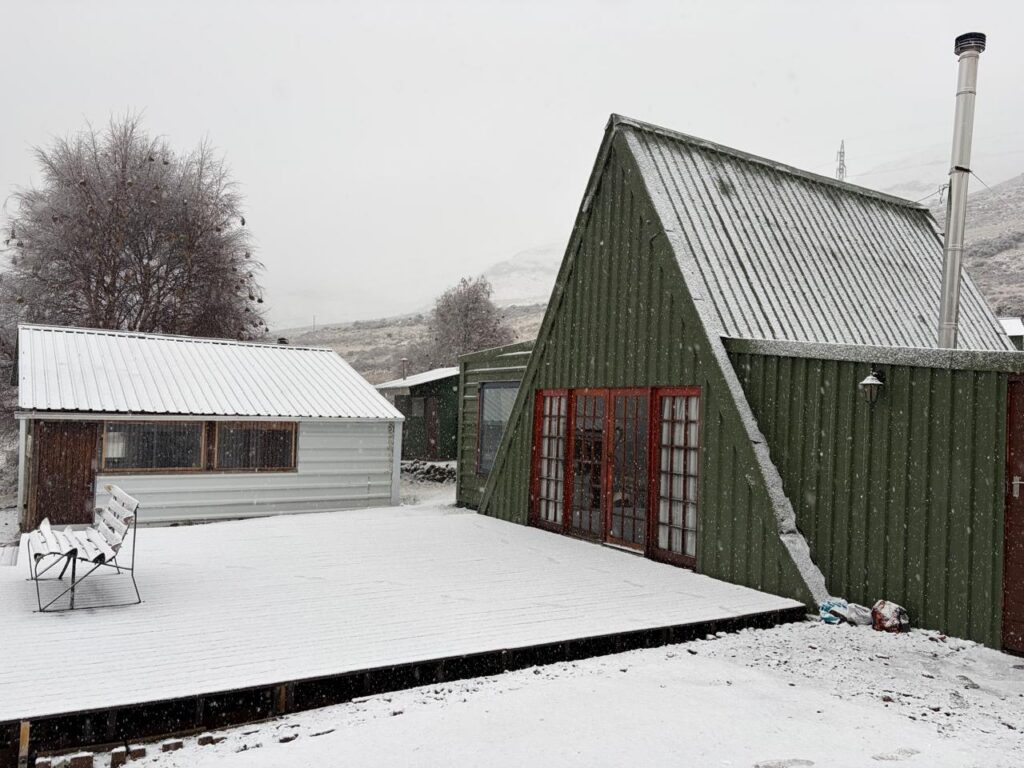
Original A-frame building during winter. Photo by: Daniella Ripamonti
When campus met the mountain
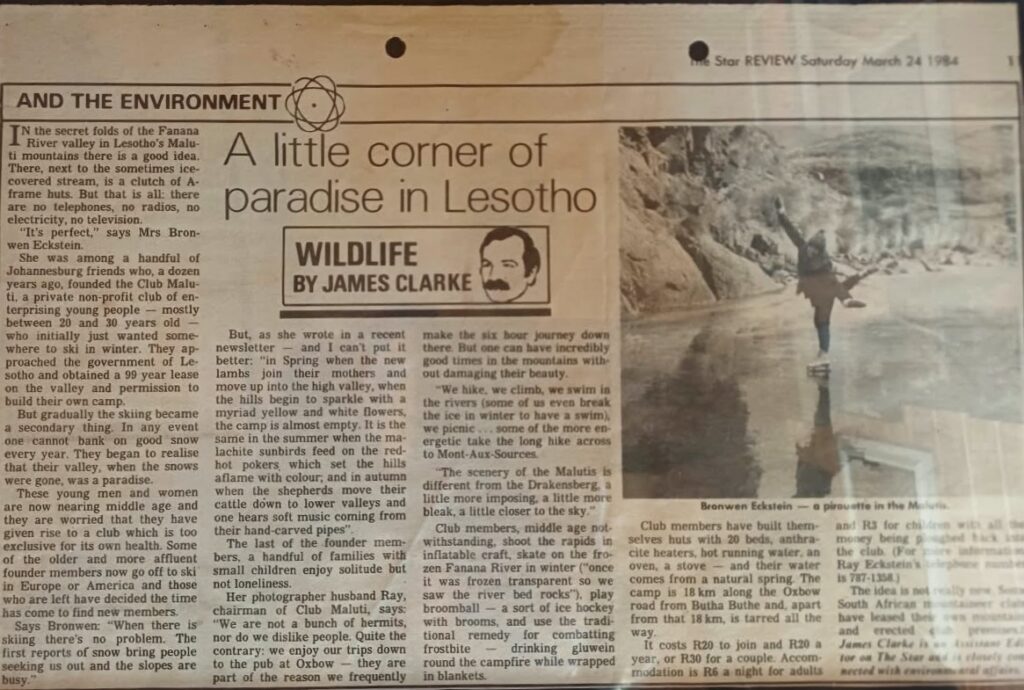
Walking through the cabin, I quickly notice how deeply Wits University is woven into the floorboards. In 1984, Wits student Ivan van Eck saw a newspaper photo of someone ice-skating in Lesotho. Entranced, van Eck drove up to investigate, fell in love with the place, and founded the Wits Snow Ski Club (WSSC) to bring campus along.
Van Eck eventually took over ski rentals and set up makeshift rope tows at the club in 1991. However, his push to create commercial ski packages directly violated the King’s non-profit mandate, famously leading to his deportation by Lesotho border officials in 1992 for operating a business without a hotel licence.
Meanwhile, through the late 1980s and 90s, Club M member Ernesto Casserino conducted feasibility and environmental studies with the Lesotho government. His work laid the groundwork for fellow members Graham Joyce, Oliver Schwankhart, and Peter Pyper to partner with Wessel Bosman and open Afriski resort in 2000.
Through changing resort developments and shifting border regulations over the decades, the bond between WSSC and Club M remained untouched, creating a bridge between varsity life and the peaks of Lesotho. Former Club M Chairman Mehow Granicki explained that this pipeline is what makes the club unique: “If you get involved with Wits Ski Club, you’re always welcome to continue [as a full member] at Club Maluti after you finish your studies. Your varsity mates become your winter mates.”
Archive newspaper article from 1984 that made Evan van Eck go to Lesotho and later establish the Wits Snow Ski Club.
The shift to boardsand living walls
Standing in front of photo archives from the 80s and 90s, I watched the club’s visual story unfold on its lounge walls. The black-and-white photos of the 70s, the bright clothes of the 80s, and the rise of snowboarding on the continent in the 90s.
“The students are a great litmus test,” Granicki noted. “They come like every generation with their music, quirks, and ideologies. The club absorbs, welcomes, and adapts. We had electro, now it’s drum & bass. We charged camera batteries, now cell phones, but it’s still the same sound system, and it’s still the same generator.”
When snowboarding exploded internationally in the late 80s, students brought back overseas VHS tapes, cut a window into an A-frame wall, mounted a monitor, and looped snowboard videos. Student energy brought freeride trick culture, vibrant gear, and fresh music to the slopes.
Today, almost every member snowboards. The communal shed is packed with shared boards and boots, keeping snow sports accessible for students. Down at Afriski, supportive members help newcomers set up their gear and carve their first turns.
The rituals that build a family
Experiencing the lodge firsthand reveals how much care keeps it running. Completely member-run, the property features the main A-frame lounge, the timber B-frame bunkhouse, and the Park Home sleeping quarters kept warm by anthracite stoves.
Every couch and timber beam represents collective effort. As Granicki reflected: “Each building had an era, a crew, a mission.” From wrap-around seating to the wood-fired hot tub steaming under sub-zero skies, everything was hand-built during voluntary off-season work parties. At the heart of daily life are Basotho hosts Maskok and Ntja Sepatla. Living on site, Maskok lights the fires before dawn while Ntja maintains the generator and water systems.
Access remains strictly word-of-mouth through member referrals. Every trip kicks off with Friday night introductions around the fire, where guests share their names, trip count, and a claim to fame before receiving a mandatory weekend nickname.
“That drive and weekend in the mountains bonds you in such a healthy way,” Granicki explained. “By maintaining rituals, we maintain culture across generations.”
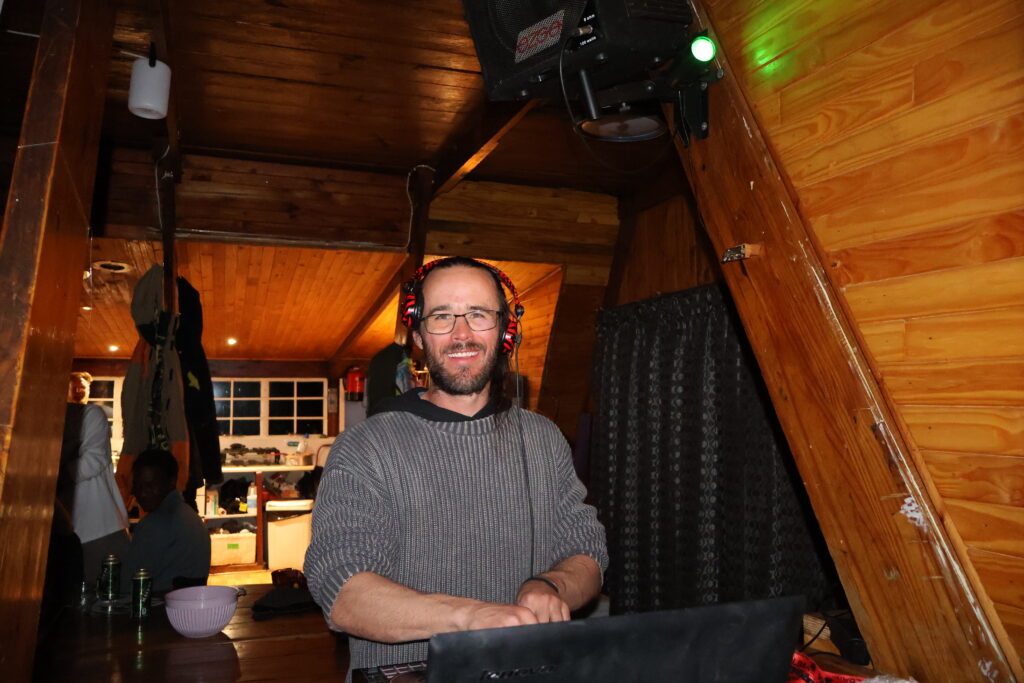
Jason Roberts DJing in A-Frame. Photo by: Daniella Ripamonti
The soul of Club M
For Vishaylin Mahadeo, who joined WSSC in 2011, the lodge became his anchor: “It’s home to me; it’s my family, my safe space. When going through a difficult time, my first thought is, ‘let’s go to the mountain.’ I have snowboarded everywhere in the world, and this mountain is still so special to me. My university experience was created through Ski Club; I even extended my degree just because I loved it so much!”
Granicki, who first visited as a matric student, feels that same pull: “Club M is home to misfits, geniuses, daredevils, and lost souls [who are] funny, beautiful, and live for the moment… My favourite personal memory is meeting my wife up there. Our adventure began from loving winter and the outdoors.”
In a world driven by screens, Club M remains fiercely analogue.
“It represents freedom, exploration, and self-discovery. You’re in the middle of two mountains, under stars, in a cabin when it’s snowing. My hope is that it remains a time capsule that forces you to be more of yourself, having fun, being human. Here’s to the snow!”
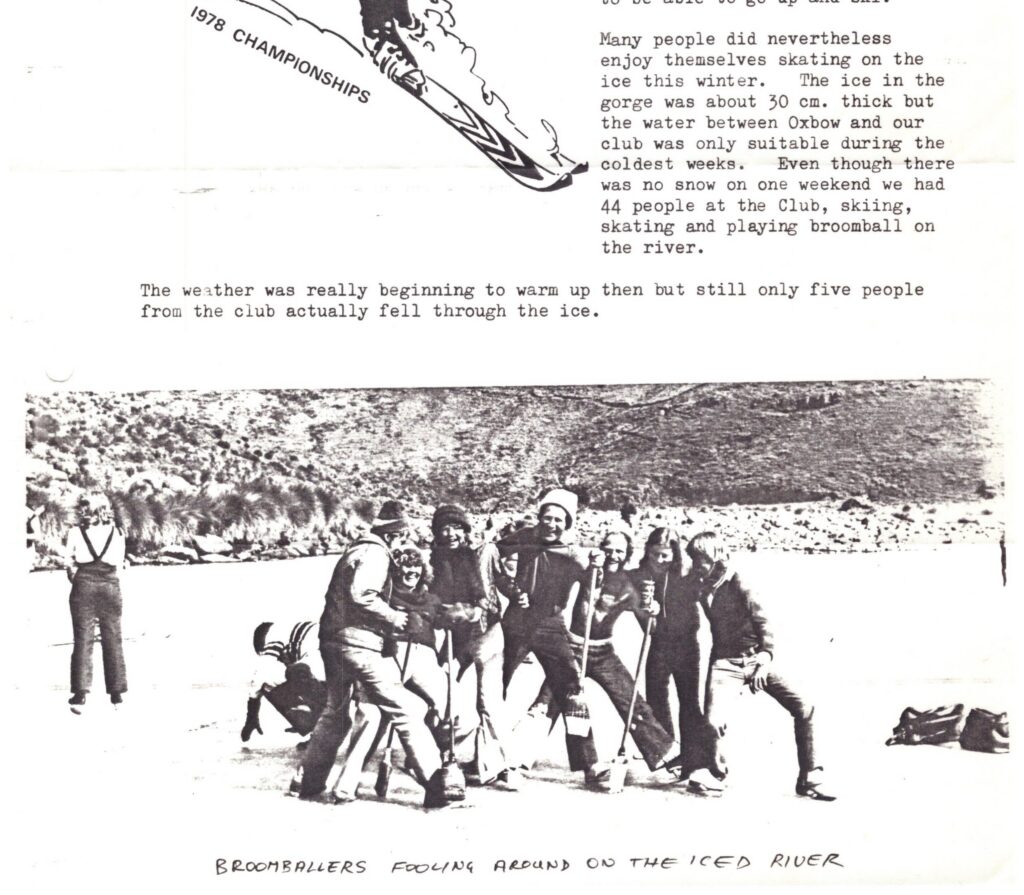
Archive newspaper from 1978 showing members broom balling on the iced river.
FEATURED IMAGE: Photo of Club M members at Afriski. Photo by: Daniella Ripamonti
Seven months after her precautionary suspension, former Wits Sociology Head of Department Professor Srila Roy faces an internal university disciplinary hearing set for September 15
Former Sociology Head of Department Professor Srila Roy will appear before a formal Wits disciplinary hearing on September 15, 2026.
Head of the School of Social Sciences, Professor Lorena Núñez Carrasco, confirmed that internal proceedings remain ongoing and an outcome will take time.
Roy remains under institutional restrictions that prevent her from speaking publicly or publishing material regarding the ongoing case.
Former Head of Sociology Department Professor Srila Roy will face an internal university disciplinary hearing on September 15, 2026, seven months after her precautionary suspension.
Professor Srila Roy. Photo: The University of the Witwatersrand
The hearing date was confirmed by Head of the School of Social Sciences, Professor Lorena Núñez Carrasco, in response to written enquiries about Roy’s employment status and the progress of internal proceedings.
While questions surrounding Roy’s permanent standing at Wits have circulated since her suspension in February, the university confirmed that internal processes have not yet concluded.
“The disciplinary process has not concluded, the hearing will in fact only be held on the 15th of September, [and] even then, the final resolution will take some time,” Núñez Carrasco stated in an email response.
She added that until the matter is officially resolved, Roy is restricted from making public statements or publishing material concerning the case.
Roy was placed on precautionary suspension in February 2026 following public backlash over remarks posted on social media regarding South African work ethic amidst parliamentary discussions on foreign academics in higher education.
The post drew swift condemnation from student leadership, the South African Sociological Association (SASA), and members of parliament. Roy subsequently resigned as Head of Department, leading to formal university disciplinary procedures.
Although Parliament’s Portfolio Committee on Higher Education previously called for her dismissal, Wits University maintained that any institutional outcome would depend strictly on the completion of its formal internal processes.
With the hearing scheduled for mid-September, the final determination on Roy’s future academic standing at Wits remains pending.
FEATURED IMAGE: Graphic showing silhouette of a woman by a calendar marking September 15 2026. Designed by: Daniella Ripamonti
Former Auditor-General Terence Nombembe takes the chair at Wits Council, bringing a legacy of accountability to the university’s top governing structure.
Terence Nombembe, a key figure in South Africa’s fight against state capture, was appointed Chairperson of the Wits Council on 6 May 2026.
Nombembe has been a member of the Council since 2021, providing him with years of insight into the university’s complex financial and policy landscape.
SRC Deputy President Sibusiso Ngele expressed hope that Nombembe’s history with student leadership will lead to a positive future for the university.
The University of the Witwatersrand (Wits) has officially appointed former Auditor-General and Zondo Commission investigator Terence Nombembe as the Chairperson of the Wits Council. The move, announced on 6 May 2026, brings a world-renowned expert in accountability to the university’s highest governing body.
A legacy of oversight
Nombembe is no stranger to high-stakes governance. Before his election to the Chair this month, he served as a member of the Wits Council for five years, starting in 2021. His professional pedigree is rooted in transparency; he served as South Africa’s Auditor-General from 2006 to 2013 and later as the Head of Investigations for the Zondo Commission into State Capture.
Beyond his public office, Nombembe has held influential roles as the CEO of the South African Institute of Chartered Accountants (SAICA) and served on the board of the WWF South Africa. His career has been defined by a zero-tolerance approach to financial mismanagement, a background that Sibusiso Ngele, Deputy President of the Wits SRC, considers a vital asset.
“He is very familiar with Wits’ proceedings and the Council in general,” Ngele said. “That background is very important for the institution’s future.”
While the appointment of an “integrity expert” carries significant weight, Ngele was careful to define the boundaries of the Council’s power. He noted that while the Council approves major policy, financial rules, and documentation, the day-to-day management of the university remains the responsibility of the Vice-Chancellor.
Ngele noted that Nombembe’s role is primarily one of oversight rather than executive action, emphasising that the entire Council structure, not just the Chair, is responsible for implementing the university’s approvals. “As much as he is [the] Chair, it’s not very executive decisions that he has [to make]; it’s the whole structure that’s responsible for that implementation,” Ngele explained.
Addressing sensitive issues
When asked if Nombembe’s history of holding institutions accountable would change how management interacts with student leadership on sensitive topics, such as campus infrastructure, Ngele admitted the answer is not simple.
“It would be very difficult to answer that question,” Ngele stated. However, he remained hopeful that Nombembe’s track record would lead to a more collaborative environment. “Given his history with the SRC, I think we can really hope for a great future ahead for Wits,” Ngele concluded.
Waiting for the full picture
At the time of publication, other top members of the SRC executive, including President Gilbert Nchabeleng and Treasurer General Sonwabo Mhlahlo, had not yet commented regarding their specific expectations for Nombembe’s term.
As Nombembe settles into the chair, the student body will be watching to see how his high-level expertise in accountability translates into the tangible student experience on the ground.
FEATURED IMAGE: Picture of the Great Hall at the University of Witwatersrand. Photo: Daniella Ripamonti
Wits University reclaims African narratives through the South African premiere of Kancícà at the Digital Dome, proving 8K innovation is a powerful tool for cultural memory and heritage.
The Wits Anglo American Digital Dome is pivoting from its traditional scientific roots to become a hub for African mythology and storytelling.
Kancícà utilises high-end gaming engines and 360-degree 8K animation, positioning Wits at the global forefront of immersive digital production.
The project serves as a “portal” for students to explore the future of work, AI, and African leadership within the global digital ecosystem.
The interior of the Anglo American Digital Dome. Photo: Supplied
While the Johannesburg Planetarium officially completed its R90-million transformation into the Wits Anglo American Digital Dome in November 2024, a recent premiere suggests the facility is entering a new era of cultural significance.
On 8 May, the Dome hosted the South African premiere of Kancícà, an immersive experience that moves beyond traditional astronomy to signal a turning point for how the continent tells its own stories. The launch positions Wits as a leading hub for cutting-edge digital experiences rather than a mere consumer of Western technology.
Dr Moumita Aich, instrumental in the Dome’s research integration, notes that 8K full-dome technology allows for a “shared emotional experience,” emphasising that this technology creates new forms of public engagement while preserving heritage.
“The scale and detail make African histories and traditions feel alive and immediate,” says Aich. “In this way, the Dome becomes more than a scientific space: it becomes a place for cultural memory and reimagining African narratives through immersive storytelling.”
Festival director Alby Michaels explains that Kancícà focuses on creating work “by Africans, for Africans, and especially through an African lens”. The production uniquely utilised Unreal Engine, a high-end gaming engine, to render 2D and 3D animation for the full-dome experience. “It opens up the doors for more experimentation… so that we can become the leaders in our own narratives,” Michaels says.
For Wits students, Michaels sees the Dome as a laboratory for the “future of work”. “I’m hoping an engagement like this will open a little door, even a portal, for imagining the future in a better way for all of us,” he told Wits Vuvuzela.
Audience members from outside of Wits, Constant Volschenk and Bongiwe Ndulula, highlight the immersive nature of the dome, which relies on a 35-degree viewing angle in reclining seats. “The main scenes are in front of you, and the surrounding is the background of the scene,” says Volschenk. Ndulula was particularly moved by a spiritual scene involving a boat in a storm, noting that the 360-degree view offers a vital shift in perspective.
Following its premiere, the programme is now open to the public at the Wits Anglo American Digital Dome from 25 April to August 2026. As Aich suggests, if you have not yet watched this wonderful show, it is a necessary gateway into the future of African digital heritage.
FEATURED IMAGE: Exterior picture of the Anglo American Digital Dome. Photo: Daniella Ripamonti
As a fashion design graduate, I view the Met Gala with a more demanding eye than the average spectator. I look for textile innovation and historical literacy. When the 2026 theme was announced as “Costume Art,” I was ecstatic. It was a call to treat the human form as a canvas.
This theme offered a limitless playground, yet the evening proved to be a game of hits and misses. While some evolved the silhouette, others simply slapped a painting onto fabric. True “Costume Art” requires transformation, and only a handful truly understood the assignment.
However, one cannot discuss the artistry on the steps without acknowledging the tension on the streets. The evening’s opulence faced heavy scrutiny as Jeff Bezos served as honorary chair. The record-breaking $42 million (R701.87 million) proceeds drew criticism, with protesters outside highlighting the disparity between the gala’s excess and Amazon’s labour controversies. This corporate undertone, marked by the notable absences of stars like Bella Hadid, Zendaya and New York’s mayor, Zohran Mamdani, left the event feeling more like a private billionaire function than a cultural zeitgeist.
So I followed with that unease at the back of my mind, but with my eye and pen poised.
The ‘almost’gallery: honourable mentions
These looks were undeniably stunning and technically brilliant, but they missed my top spots because they felt a bit too ‘safe’, or in one case, incomplete, compared to the architectural risks taken by my favourites.
Laura Harrier (Di Petsa): A masterclass in ‘wet look’ draping that turned her into a Greek marble statue, though the silhouette felt familiar.
Kendall Jenner (Gap Studio): A sophisticated take on the Winged Victory of Samothrace. Had she worn her monumental wings on the carpet rather than just in the museum photos, she would have secured the win.
As stunning as those classic references were, a few attendees truly understood the assignment, transforming the body into a living canvas in ways that felt entirely new.
The masterpieces: when fashion becomes art
Emma Chamberlain set the bar in custom Casey Cadwallader for Mugler. Drawing from Van Gogh’s impasto techniques, the gown utilised hand-painted resin and moulded silk to capture the tactile texture of a canvas come to life. She didn’t just wear art; she embodied the medium of painting itself.
Yu-Chi Lyra Kuo provided a moment of monochromatic brilliance, channelling the Winged Victory through Jean Paul Gaultier’s architectural pleating. The atelier transformed soft fabric into chiselled marble, celebrating the artisan’s ability to turn textile into stone.
Sabine Getty offered a haunting metaphor for the decay of art. The Ashi Studio bodice featured surrealist hands that seemed to sculpt her form, while the shredded silk skirt appeared to unravel like an ancient, deteriorating canvas. It was a masterclass in using deconstructivism to tell a story of loss.
Anok Yai, in Balenciaga, delivered the night’s most profound transformation, coating her skin in bronze pigment to embody the ‘Blac Madonna’. While others wore art-inspired gowns, Yai used her skin as the medium. It was a powerful reminder that fashion can re-contextualise the human body as a sacred object.
However, the brilliance of these living masterpieces only made the night’s failures more glaring.
The unfinished canvases
Simone Ashley’s Stella McCartney gown felt pedestrian. The body-chain aesthetic lacked innovation and failed to engage with the theme’s sculptural possibilities. Similarly, Kim Kardashian prioritised her signature cinched branding over thematic exploration. Her Allen Jones collaboration felt more like high-budget cosplay than the “Living Sculpture” it aimed to be.
The evening’s most egregious oversight came from Deborah Roberts, who arrived in a Christopher John Rogers gown she had already debuted at the 2022 New York City Ballet. For an event centred on innovation, re-wearing a years-old socialite gown felt dismissive of the Met’s prestige.
Finally, Zoë Kravitz in Saint Laurent was a masterclass in the mundane. A basic black lace gown offers zero artistic provocation in this context. For a designer, the lack of innovation is jarring; it wasn’t “bad” fashion, it was absence of a vision.
Ultimately, the 2026 Met Gala proved that when you give designers the world as their canvas, the results are polarising. We saw the heights of technical brilliance, where fabric was manipulated to look like marble or wet oil paint, and we saw the lows of creative stagnation, where ‘basic’ was the order of the day.
As a journalist and a designer, I believe the Met Gala should be the one night where ‘wearability’ is the last thing on anyone’s mind. We want to be challenged; we want to see the boundaries of the human form pushed until they break. This year showed us that while anyone can wear a dress, very few can truly embody a masterpiece.
For those who dared to treat their bodies as a canvas, the result was nothing short of legendary. For the rest? There’s always next year’s exhibition.
Vuvu rating: 6.9/10
FEATURED IMAGE: Rough fashion illustration, edited by AI. Graphic by: Daniella Ripamonti
In the high-octane world of South African Fashion Week, a runway is usually a transition, a place where models move from point A to point B to showcase a garment. But for House of Olé, the Spring/Summer 2026 showcase transformed the runway into a breathing, multidisciplinary studio. It was a bold statement of ‘The Comeback,’ signalling that after a strategic hiatus from the runway, the brand’s return was about more than just clothes; it was about a new philosophy of survival.
The show was a sensory assault in the best way possible. Before a single look walked, the stage was set with the ‘invisible’ architects of beauty. A makeup artist stood at the start of the ramp, applying live finishing touches to models as they sat, before embarking on their walk. In the centre, a visual artist stood with a brush in hand, painting onto the suits as they passed.
The result was a ‘Human Art Gallery.’ Models did not just walk; they performed. Some lounged on velvet sofas positioned along the runway, remaining still as statues, inviting guests to observe the textile and the tailoring as they would a masterpiece in a gallery. This was not just a fashion show; it was an immersive performance piece, underscored by the raw vocals of a live singer that echoed through the Hyde Park studio.
Photo of the Runway from the House of Olé at SAFW SS2026. Photo by: Daniella Ripamonti
“They really have lived up to the anticipation”, noted guest and choreographer Nomza Monake. “I’ve seen Olé’s work before, but today just took it to another level. I loved how they fused the arts together. It was not just a fashion show, but a fashion show with a difference… I’m just so sold.”
Behind this theatricality lies the sharp business mind of Ole Ledimo, the designer and founder of House of Olé. Ledimo is acutely aware that the industry he returned to is different from the one he left. “When times are tough, it forces us creatives to dig even deeper,” Ledimo explained backstage. His response to the economic squeeze during his time away from the runway was to embrace a radical variety, mixing high-end, hand-painted couture with accessible ready-to-wear to maintain and win new clients.
When asked about the defining piece of the night, Ledimo pointed to a garment aptly titled “Collaboration.” It served as the anchor for his vision of the season. “It’s something I feel like as artists and human beings we need to do often,” he said. “Coming together, I think that’s what made the collection amazing, bringing the guys that have been my friends, working together for many years, from backstage into the actual show.”
The collection itself challenged the rigid boundaries of the “modern gentleman.” Ledimo’s suits, architectural, bold, and defiant, were worn by models of all shapes and heights, pushing back against the stereotypes of how men “should” dress. “The colour pink doesn’t define your masculinity. It’s a colour,” Ledimo asserted, defending the need for self-expression. “Sometimes it’s people’s opinions that hold us back.”
House of Olé Spring/Summer 2026 collection lineup for SAFW 2026. Photo by: Daniella Ripamonti
As the final model took their seat on the runway sofa and the live singer’s last note faded, the message was clear: Ole Ledimo has moved House of Olé beyond the stitch. By bringing the “behind-the-scenes” directly onto the ramp, he proved that the future of South African luxury is not just about the clothes; it is about the collective power of the artists who bring them to life.
Vuvu Rating: 9/10
FEATURED IMAGE: Photo of a model surrounded by art pieces on the runway for the House of Olé, SAFW SS2026. Photo by: Daniella Ripamonti
Walking into The Gallows Museum at Kgosi Mampuru II Correctional Centre, the first thing that hits you is not a sound, but the absence of it. We fell into a heavy, suffocating silence. It did not feel right to speak. The atmosphere was tense, sombre, and thick with a history that was never meant to be heard outside these walls. We were not just touring a building; we were retracing the final, mechanical minutes of 3500 lives.
The dehumanisation was in the details. The “procedure” began at 06:50 AM, and by 07:30 AM, it was over, fast and efficient. Life was extinguished with the punctuality of a business transaction. A wave of nausea hit me hearing how seven people were hanged at a time, their bodies later hosed down with a power washer, like equipment in a slaughterhouse, because the state could not be bothered to afford them individual dignity. They were shoved into coffins, and that coffin was shown to families for mere seconds to hide the trauma of the noose and then buried in unmarked graves. They did not just want these men dead; they wanted them erased.
It was a place designed for the mass production of death, a literal “human abattoir.” The ropes had metal rings to ensure the break was instantaneous, a cold, metallic “mercy” in a room that lacked a soul. If a pulse survived the drop, they were simply hoisted back up and hanged again. It was a loop of terror. Our guide explained that some in charge, like warden Christiaan Barnard, openly enjoyed the work because of how well it paid, even believing he would be forgiven because he was “just doing his job.” To keep the killings quiet, they even soundproofed the room to muffle the thunder of the trapdoors hitting the frame.
We climbed the 52 steps in the shadow of painted silhouettes, counting them one by one. I thought of the prisoners who would sing holy songs on their way up, their voices a haunting contrast to the “last request” they were offered at the top. It felt like a final, cruel joke to bark those requests in Afrikaans, a language many did not even understand, moments before they were led into the room where the ropes awaited. It was in this final room, the gallows, that I saw the plaque for a 22-year-old Solomon Mahlangu, barely younger than I am, who once stood on this same trapdoor.
This experience hit me with a force I did not expect. I realise now that we talk about “liberation” as a concept, but we rarely look at the apparatus that tried to crush it. Our democracy is not just built on grand speeches and signed documents; it is built on the silence of these men and the sacrifice of leaders like Solomon Mahlangu, whose words remain painted on these walls: “My blood will nourish the tree that will bear the fruits of freedom.” Standing where the hearse once sat, permanently waiting, I realised that as Freedom Day approaches, I carry the weight of those 52 steps with me.
We can never truly understand our present if we forget the system that tried so hard to wash this history away. I pray that the souls who passed within those walls have finally found the eternal rest and peace that was denied to them in life.
From pre-colonial wars to the mechanics of state execution, students are demanding a more nuanced history. It is time to stop sanitising the past and walk the 52 steps.
The Department of Basic Education is currently reconsidering how we teach our past, a move that comes not a moment too soon. In a recent series of conversations at the University of the Witswatersrand (Wits), students expressed a clear hunger for a history that goes beyond the “standard” narrative.
Joy Cain, a first-year Biomedical Sciences student, noted a lack of perspective on the white experience during Apartheid, while Shane Yurar, a first-year Film and Television student, suggested the curriculum should expand to include pre-colonial history, specifically the tribal wars of leaders such as King Shaka. Others, like Aluta Manale, an international relations honours student, pointed toward the migration stories from Congo. Or as Tinashe Morena, a second-year psychology student, said, the need to study the Black authors and struggle writers who defined an era.
The underlying message from these students is clear: they feel their history has been “filtered.”
As I stood in the Kgosi Mampuru II Gallows last week, Wednesday, 15 April, I realised just how thick that filter is. While students are asking for more diverse stories, there is a physical site of memory in Tshwane that remains almost absent from our national consciousness. The Gallows is a “human abattoir”, a place where 3,500 lives were ended with clinical, industrial efficiency.
My mentors cautioned that the Gallows might be too ‘deep’ or too ‘sore’ a topic to bring up in a casual vox pop, and they are right. It is a heavy, sombre reality. But that is exactly why it needs to be taught. By shielding students from the ‘scary parts’ of our history, we are not protecting them; we are leaving them with an incomplete understanding of how we got here.
We learn about the “In Detention” poem in English class, but we do not walk the 52 steps in History. We talk about the triumph of 1994, but we do not look at the white telephone that never rang for those awaiting a pardon.
If the Department of Basic Education wants to truly localise our curriculum, they must include the sites that prove Apartheid was not just a set of laws, but a factory of dehumanisation. To truly appreciate the “Freedom” we celebrate on April 27th, we must stop sugarcoating the past. We must look at the darkness of the Gallows to understand the value of the light we live in today.
Drawing of a noose that represents the Gallows, in South Africa. Graphics: Daniella Ripamonti
FEATURED IMAGE: Drawing of a noose that represents the Gallows, in South Africa. Graphics: Daniella Ripamonti
Wits students react to the Zara x John Galliano collab. In a cost-of-living crisis, is the designer label still a status symbol or just overpriced plastic?
Global high-fashion icon John Galliano signs a historic two-year creative partnership with Zara.
Wits students are divided; some chase the ‘status’ of the label, while others slam the ‘tacky’ dilution of luxury.
The rise of high-quality ‘dupes’ and fast fashion collabs is blurring the line between prestige and plastic.
Luxury used to be defined by exclusivity, the rustle of silk, the weight of hand-stitched leather, and a price tag that felt like a gatekeeper. But as Vogue reports about the unexpected two-year partnership between the legendary John Galliano and fast-fashion giant Zara, the golden gates of high fashion have swung wide open. Wits students may be far away from the fashion high streets of Milan or Paris, but they had something to say about the reported collaboration.
The collaboration, set to debut in September 2026, marks the return of Galliano (the former Dior creative director known for theatrical couture) to the mass market.
For Lindani Dweba, a final-year BA student majoring in Politics and HR, the allure is simple: the name. “I would buy for the name,” Dweba admits. When faced with the choice between a R1,800 designer-labelled polyester jacket and a R200 thrifted wool coat, he leans toward the label. “Preferably the label. But luxury is becoming cheapened because of alternatives making the same thing.”
However, not everyone is buying the hype. For Caleb Boroto, a first-year Film and TV student, the collaboration feels “tacky.” Boroto argues that someone of Galliano’s regard partnering with a fast-fashion brand strips away the luxury feel entirely. “Gun to my head, I’d pick the R200 wool jacket,” says Boroto. “I’d prefer to be sustainable and choose something that lasts, like wool or cotton.”
The Reality of Aspiration: Lindani Dweba, a final year student, wears Nike P-6000s (R2,399), which serve as an attainable alternative to luxury items like the Gucci Rhyton sneaker (R21,700). Photo: Daniella Ripamonti
Katlego Hlahla, a third-year Actuarial Science student, echoes this scepticism, noting that luxury prices often feel “unnecessarily inflated” for the quality provided. As Zara’s prices creep up, the lines between ‘high street’ and ‘high end’ are blurred.
The psychology of the label remains a powerful force, even when the quality is questionable. Sephaku Tshoshi and Kirsten Pudi, both fourth-year Accounting Science students, admit they would choose a designer name over a thrifted bargain any day. “I wouldn’t get the same bag without the name, even if the quality was the same,” said one of the students, gesturing to her Ted Baker tote. They noted that the rise of high-quality “dupes” has made luxury more accessible, but also less significant. “People are buying fakes now, even people with money. You can’t tell the difference anymore.”
Psychology Honours students Daiyaan Kahan and Jake Fourie said that “accessibility cheapens the value, but people still buy it for the status symbol.” Fourie, however, sees the positive side, “If it’s more accessible, it’s overall good. More people representing a brand is good for the brand’s expansion” he stated
As the Zara x Galliano collection prepares to hit shelves, the Wits campus remains a tug-of-war between the desire for status and the demand for authenticity. In an era where ‘luxury’ can be bought at the mall in a plastic bag, real luxury might just be the ability to tell the difference.
FEATURED IMAGE: Reframing the Aesthetic: By pairing a sporty PUMA track jacket with tailored pinstripe trousers and formal loafers, Demitri Michaud, a postgraduate student, demonstrates a ‘high-low’ styling approach that mirrors global trends of deconstructed luxury. Photo: Daniella Ripamonti
Thrifting may be trendy, but for many students, it is simply the cheapest way to afford fashion.
Economic necessity and “instant gratification” drive some Wits students to second-hand shopping.
The Matrix’s Zaza Clothing reports its busiest year yet as students ditch retail for quality and affordability.
Hidden online fees and poor garment quality are making global fast-fashion giants less appealing to local youth.
In the heart of Braamfontein, the ‘thrift flip’ is more than just a curated style; it is a survival strategy. As South Africa faces a cost-of-living crisis, students are increasingly searching for the perfect R50 vintage shirt. This shift has turned a trendy pastime into a financial necessity.
While discussions about second-hand shopping often highlight ‘slow fashion’ and sustainability, the reality in hubs like Melville and Braam tells a different story. For many of The University of the Witwatersrand (Wits) students, thrifting isn’t about saving the planet; it is about saving their bank balance.
On the top floor of the Matrix, the energy at Zaza Clothing is a testament to this shift. Since opening in March 2023, owner Ali Monama says business has grown every year, but 2026 is by far the busiest he has seen.
“I chose the Matrix because fashion starts with the youth,” Monama says. He notes that while sustainability is a plus, the economy is the real driver. “Thrifting is critical for the economy right now. People prefer it because modern retail clothes don’t last, whereas vintage leather and denim are pure quality,” he adds.
The price tags at Zaza Clothing offer a stark alternative to the mall, ranging from R20 earrings to R600 Doc Marten boots. The prices are what appeal to students like Thulani Bikili, a second-year civil engineering student. Bikili thrifts twice a month specifically because of the cost-of-living crisis. “Retail stores are just overpriced,” he says.
For some, the appeal is a mix of budget and “instant gratification.” First-year electrical engineering students, Siyamthanda Mazwan and Naomi Makangume, argue that while sustainability is a “secondary perk,” the real win is finding unique items that allow them to avoid “following the crowd.”
Picture of students browsing through a clothes rack at Zaza Clothing. Photo: Daniella Ripamonti
The duo also highlighted the growing frustration with online giants like Shein. Between unpredictable shipping times and hidden customs fees, they’ve started questioning the true cost of “cheap” online hauls. “Is it really cheaper if I’m paying for all these other hidden fees?” They ask. “With thrifting, you get what you buy then and there. You can actually try it on to see if it fits.”
As financial pressures continue to reshape student life, the shift toward second-hand clothing reveals a generation that is becoming increasingly resourceful. Whether it’s to find a one-of-a-kind vintage piece or simply to survive the month, the students at Wits are proving that in the struggle between ethical spending and economic reality, the price tag, and the quality, is winning every time.
FEATURED IMAGE: Picture of sunglasses and ties taken at Zaza Clothing store in The Matrix. Photo: Daniella Ripamonti
In episode six of We Should Be Writing season 7, the team unpacked the evolution of music as a form of expression and protest, through four decades in the South African context. The episode explores the journey of South African music and its consumers from the 80s, 90s, early 2000s and contemporary listeners. From the […]