On Monday, February 23, Gauteng Premier Panyaza Lesufi delivered the State of the Province Address (SOPA) at the Nesrec Expo Centre. It is unfortunate that he did not come well prepared to address the electricity issues currently challenging residents in this province.
Yes, the minister of electricity has put an end to nationwide load shedding. However, what are his plans for the ongoing blackouts? The stations are constrained, there are illegal connections, cable theft, the infrastructure is old, we have heard of these reasons and need solutions that will last. Renaming the problem is not solving it. Blackouts are even worse as they are unplanned and last for days on end.
We saw the headlines regarding the recovered R3 million worth of cooper cables. Premier, why did you not give us a detailed strategy on how you plan to prevent this cable theft from happening again? Strong security measures need to be implemented at cable theft hotspots. The people of Gauteng deserve to spend the electricity they pay for without paying extra for generators, solar, gas appliances, data and fast foods.
There were no funds allocated to fixing the old substations and transformers in our province, which are also reasons for the constant trips in electricity supply. Out of the 15 investments he mentioned, from water reservoirs to houses and fast trains, not one investment was allocated to this problem.
City Power in Johannesburg has been screaming “systems constrained due to rising population.” Where are the plans to address this overpopulation within the province as it is one of the major factors affecting our power supply.
The project of turning recyclable waste into energy could really benefit us. As it is currently being done in Bushbuckridge, Mpumalanga, it has proven both profitable and reliable. It would be like killing two birds with one stone as we also struggle with land pollution in Johannesburg.
As we look forward to the upcoming SOPA debates, we expect this shortcoming to be addressed in the house.
The pressure of the beauty maintenance day is piling up and emptying the pockets of many.
There was a time when “beauty maintenance” meant styling your hair and maybe getting it trimmed before school picture day. That was all that was required of you. Now? The expectations for women in particular feel endless – lashes, nails, hair, waxing, eyebrow shaping, facials, wig installs – the list just keeps growing. What used to be simple personal grooming has evolved into a full-time job, that requires a whole day off.
Let me be clear: personal grooming is important. Looking after yourself can boost your confidence, self- esteem, improve hygiene, and contribute to your overall self-care. There is nothing wrong with wanting to feel put together. However, somewhere along the way, beauty maintenance stopped being about feeling good and started feeling like a requirement.
Hair being braded. Photo: Bonolo Mokonoto
A full “maintenance day” for me can easily cost up to R1500. That’s a significant amount of money to spend. Between work, transport, and everyday expenses, budgeting for lashes and nails every few weeks isn’t always realistic. Social media and societal pressures can make beauty maintenance feel necessary.
Nails being cured under a UVA light. Photo: Bonolo Mokonoto
Braamfontein and Johannesburg CBD has a huge selection of beauty salons and maintenance spots. On almost every corner there are nails, brows, or hair services on offer. The options are endless, but unfortunately, the quality isn’t always guaranteed. Many students have experienced rushed appointments, unprofessional service, or results that don’t match the price paid.
The bigger issue, though, is the societal pressure attached to it all. When i walk into a lecture hall and the majority of people have their nails done and frontals installed, it makes me feel like I do not fit in. There is this unspoken expectation that to be “put together,” you must have your lashes done, nails fresh, edges laid, and brows perfectly shaped. And for young women, especially myself, navigating identity and confidence, that pressure can weigh heavy.
A wig getting prepared to get installed. Photo: Bonolo Mokonoto
I think beauty regiments should be about self-expression, self-care and evoke joy. They should make you happy, not anxious about keeping up with the trends. It should feel like self-love, not a compulsory checklist, added onto your budget.
So, before you book your next appointment, do it because you genuinely love how it makes you feel, not because it’s trending.
FEATURED IMAGE: Hair being braded. Photo: Bonolo Mokonoto
An ode to Motown is for the lovers of classic nostalgic music and is a must-see performance.
On February 22, I attended An Ode to Motown, a production staged in celebration of Black History Month, at Joburg Theatre. What unfolded was more than a tribute concert; it was a vibrant, high-energy homage to one of the most influential musical movements to emerge from 20th-century America.
Motown, founded in Detroit in 1959, became the heartbeat of Black American music, introducing the world to artists who would shape pop, soul and R&B for generations. The show paid tribute to this rich history, revisiting classics that still resonate across continents.
There was not an empty seat in sight.
From the opening notes, the audience was transported into a world of polished harmonies, synchronised choreography and timeless storytelling.
The singing was exceptional, powerful yet controlled, capturing the emotional depth that defines Motown. The performers, Liesl Penniken, Lerato Mvelase, Tamara Dey, Hlengiwe Pearl, and Anele Precious Mthethwa, moved effortlessly through beloved hits.
An ode to Motown show image. Photo: Supplied/B Sharp entertainment
Hits such as “Mr. Postman,” “Ain’t No Mountain High Enough,” and “I’m Coming Out,” each song greeted with cheers and nostalgic excitement. The inclusion of “Cruisin”, “Call Tyrone,” and “Water Runs Dry,” along with two soulful renditions of songs by Erykah Badu, broadened the tribute to include neo-soul influences that echo Motown’s legacy.
Quotations from songs by Smokey Robinson added a poetic thread, reminding us of the lyrical genius that defined the era.
Visually, the production was stunning. The performers dazzled in gorgeous, extravagant gowns that shimmered beneath the stage lights. The intricate choreography was both elegant and dynamic, matching the vibrancy of the live band. The theatre itself seemed to pulse with the vibrations of an enthusiastic crowd, their energy feeding the performers on stage.
Yet the show also raises an interesting question: what relevance does Motown’s history hold for South Africa? In some ways, staging this tribute here is like hosting a concert in the United States commemorating the artists of Sophiatown. It is a celebration of a distinctly American Black cultural movement, performed for lovers of classic American music and for those who admire the monumental Black artists who emerged from that era. At the same time, it highlights the global reach of Black music and its power to connect polarizing histories.
Ultimately, An Ode to Motown was a joyful, nostalgic, and beautifully executed celebration. One that proves Motown’s rhythm still moves audiences, no matter where they are in the world.
Vuvu rating 9.5/ 10
FEATURED IMAGE: An ode to Motown, performance on February 22 at the Joburg theatre. Photo: Bonolo Mokonoto
After a month of intermittent blackouts, City Power has upgraded to weekend-long power cuts.
Braamfontein has been experiencing blackouts since Saturday morning.
Residents and businesses bare the consequences of old infrastructure.
City Power restored power on Monday afternoon.
On Saturday morning, Braamfontein residents woke up to another blackout, which led to a morning of cold-water baths, dead batteries, unironed clothes, cold meals and loud generators drowning each other out.
After a month of experiencing weekly unplanned blackouts for a couple of hours per incident, Braamfontein residents did not know that this one was different.
City Power said the outage occurred following a trip from Fordsburg Substation, which affected Braamfontein, Parktown and surrounding areas.
This trip led to three faults on a Braamfontein interconnector cable. As of this morning, two of the three faults have been located, but repairs were underway, said to City Power.
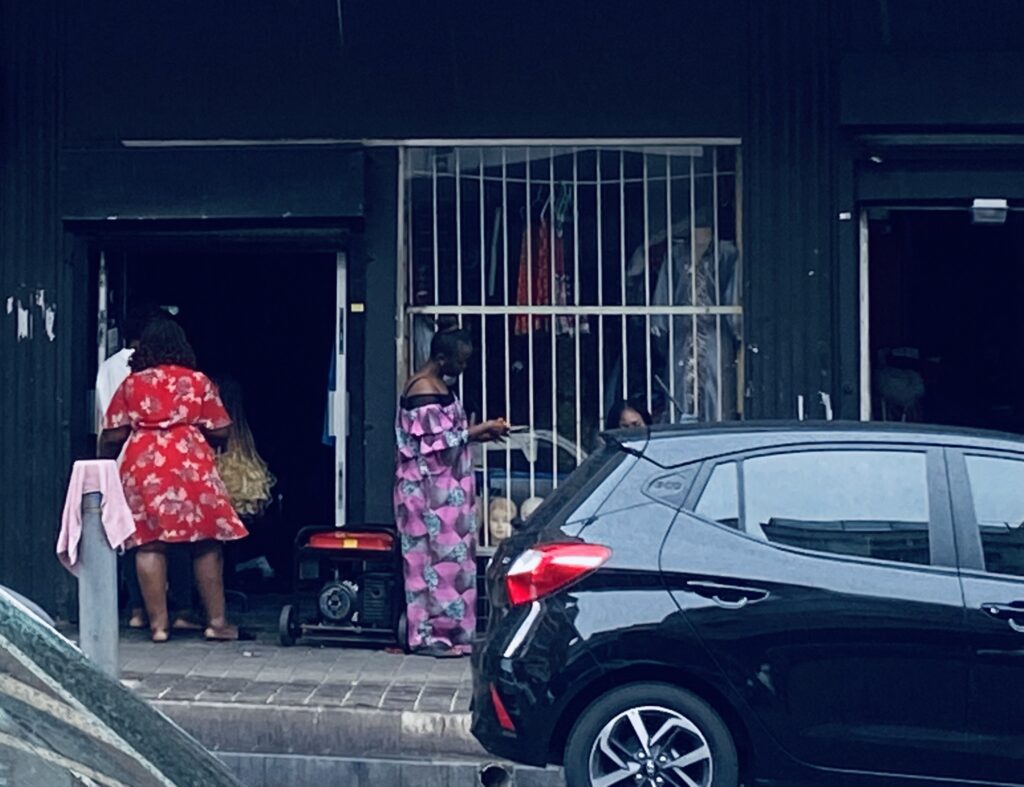
Some businesses have been closed since Saturday morning as they do not have backup power. Hairdressers are operating outside their salons for light.
Hairdressers in Braamfontein attending to their customers outside the salon due to power cuts. Photo: Lulah Mapiye
“I have to do everything in the dark and spend extra money on data since the Wi-Fi is off. City Power needs to start paying us back for the electricity we pay for and don’t have,” said Tebogo Lebeya, resident of Braamfontein.
City Power said that due to existing network faults, customers cannot be backfed from alternative supply points.
They attributed these power faults to cable faults and damage caused by third parties. The disruptions are further linked to ageing infrastructure, illegal connections and sustained overloading of the network.
Sylvester Ayuk, owner of Estee Ay Communications, a printing business in Braamfontein, said: “Our clients are disappointed as we failed to meet deadlines over the past weekend. Our generator was only able to power one printing machine, we only managed to complete a few orders. We are calling upon the management to be quick to restore power next time.”
Amorette Anyang Onya, a nail technician, had to go to another town to charge her nail lamp, which she uses to dry nail polish.
“Having no electricity really slowed down my business. The time I used to go to another town to charge and come back, I could have used treating a customer or two,” she said.
The initial estimated restoration time was 18:00 on Saturday, February 21. The revised date of Monday, February 23 at 12 was unmet, and power was only restored at about 15:30 on the day.
FEATURED IMAGE: Generator powering a salon in Braamfontein due to power cuts. Photo: Lulah Mapiye
Johannesburg’s water crisis is heavily restricting the daily lives of citizens.
For the past month, the City of Johannesburg has been struggling with a water crisis that has exposed serious cracks within local governance and infrastructure. What started off as a short outage has now spiralled out of control.
Residents have been frustrated by the lack of water services across Johannesburg the city. From Melville, Westdene, Parktown west and Emmarentia, some residents have gone more than 20 days without water.
Johannesburg can not claim to be a world- class African city, while its residents are standing in queues at water tanks for over three weeks. This lack of service delivery is inhumane. Water is a basic need, and the municipality needs to ensure at that this service is delivered to all residents efficiently.
Volunteers in Melville have organised communal water tanks with strict limits per household simply to ensure survival. For elderly residents and families with small children, the daily act of securing water has become exhausting.
Frustration has spilt onto the streets as peaceful protests are being carried out. Protests have erupted in Melville. Residents are angry at the lack of urgency shown by the government. All the while, some are missing school, work, being put through unhygienic conditions and emotional stress.
City officials point to ageing infrastructure, pressure management systems, maintenance backlogs and lack of coordination with Rand Water as part of the problem. The Government has announced intervention plans and committees aimed at stabilising the water supply. But for residents living day to day without running water, these long-term strategies offer little immediate relief.
The lack of planning and leadership is now being highlighted as residents are being impacted. The city of Johannesburg must move pass crisis management and implement sustainable and reliable service delivery.
When taps begin to run dry, this is an indication that governance has failed and South African citizens have to now pay the price.
FEATURED IMAGE: Two plastic containers of water, half empty. Photo: Bonolo Mokonoto
South Africa is again debating the name changes of provinces and towns.
Over the past month, there has been nationwide debate over the name changes of various towns and provinces. This puts into question South Africa’s history and if we should preserve the current names as a reminder or change them to honour our heritage.
Name changes carry real and expensive costs. The updating of maps, road signs, business branding and tourism material require funding and resources that could be used elsewhere. The country has a multitude of more pressing issues – such as a high unemployment rate, and water and electricity shortages- changing the names of provinces and towns shouldn’t be the top priority for the current economic climate of South Africa.
The Eastern Cape’s is currently undergoing a massive transformation on this front. Gayton McKenzie , the Minister of Sports, Arts and Culture, approved 21 geographical name changes, including renaming East London to KuGompo and Graaff-Reinet to Robert Sobukwe Town. This has been in line with public consultations and recommendations made from the South African Geographical Names Council.
The name changes are yet to be confirmed as it is the department’s ongoing commitment to ensure that the names highlight the country’s diverse heritage and history. Most residents in Eastern Cape are against the name changes highlighting that the towns historical identity and heritage should remain, as this keeps history intact.
Other residents argue that the changes are long overdue, as the original names are reminiscent of our history and it is important to keep reminders around, so that people do not forget. The renaming project can be viewed as a form of decolonialisation and reclaiming our history and instilling pride over the South African landscape.
King Misuzulu kaZwelithini recently reignited the debate by calling for the removal of “Natal”, from the provincial name “KwaZulu-Natal”, he argues that before colonial efforts the area was simply called KwaZulu. The Zulu king is pleading with politicians to broaden the public debate about these historical boarders as they have been shaped by colonial authorities.
The African National Congress (ANC) has responded cautiously, particularly around the proposals to rename KwaZulu-Natal, stressing that it has not yet adopted an official position on the matter. The party emphasised that any provincial name changes must follow proper constitutional and legal processes.
As the debate continues, we need to critically ask ourselves what impact the name changes will have on the community, whether positive or negative, it will be the residents that deal with the massive changes, and their opinion is of high importance.
FEATURED IMAGE: Geographical name changes debate. Graphic by: Bonolo Mokonoto
Four seasons in, Bridgerton struggles with originality, yet it feels as genuine than ever.
Dearest gentle reader, in this highly anticipated new season of one of Netflix’s most-watched series, Bridgerton season four, part one, is not quite what we expected.
This season focuses on the notorious playboy Benedict Bridgerton’s love story and his quest to find life partner. He meets a lady named Sophie at a masquerade ball and makes it his mission to find her after she leaves the ball in a hurry. This season uses the Cinderella trope, but instead of a glass slipper, Sophie leaves behind a glove. This story line makes the story predictable, as many audience members are very familiar with this trope, it lacks originality.
A very interesting aspect of this new season is that we get an inside look into the servants’ quarters. We are offered a behind-the-scenes glimpse of how the lives of the rich and royal are kept in-order by those who are rarely noticed in these spaces. It is reminiscent of renowned period drama, Downton Abbey.
Through this shift in perspective, the series highlights the invisible labour that sustains the grandeur of high society. Lady Whistledown makes a point of exposing and sharing the stories of these workers, further emphasising their importance in society.
A carriage driver remarks on the behaviour within the ton, stating, “It’s thrilling for them, chaos for us.” This line emphasizes the immense labour servants must perform to maintain the magnificence or grandeur of the balls and social events hosted during the debutante season.
Throughout the Bridgerton series, Benedict has been depicted as sexually fluid, which makes his search for a wife this season feel out of left field and somewhat out of character.
It would have been more compelling to watch him seek companionship with both men and women, ensuring that the character development establishing him as pansexual in previous seasons, did not go to waste.
The chemistry between Benedict and Sophie is undeniable. This is the first season where the main couple get to know each other in a friendly manner, and this was entertaining to watch.
The playfulness and gentle ease they have with each other is refreshing, from the conflict we initially see with the previous main couples in the series.
Despite the predictability and missteps on Benedict’s character development, Bridgerton season four succeeds in feeling emotionally sincere.
This may not be the most original chapter in the Bridgerton storyline, but it proves that familiarity, when written well, can still be engaging.
Vuvu rating: 7.5/ 10
FEATURED IMAGE: Bridgerton season 4 review. Photo: Netflix
Jozi Angels and 22onSloan fund and mentor innovative AI business ideas aimed to solve African problems, founders warned on how not to fumble the bag.
Start-up founders need to be financially literate.
Scaling soon is bad for businesses.
Mentorship and funding available for entrepreneurs with lucrative solutions to African problems.
Wits University is hosting the fourth edition of the Applied Machine Learning Days (AMLD) conference from January 26 to 29 at the Wits Science Stadium and investors are present to advice Artificial Intelligent (AI) powered business founders.
From left to right: Hayet Hammana, Bernadette Bule and Keshni Morar. Photo: Lulah Mapiye
Bernadette Bule, Wits alumni, and Business and Partnerships Manager at 22onSloane, the largest startup campus in Africa, based in Johannesburg, said there is a fundamental skill every founder must have.
“I’ve seen that a lot of founders lack financial literacy, which leads them to desire to scale their businesses way too early. Our programme looks at the stages of our BRL (Business Readiness Level), which is from zero to ten, and determine your business needs as per your BRL level,” she said.
Keshni Morar, Angel Investor at Jozi Angels, agreed. She said a lot of businesses scale prematurely, leading to their downfall. Morar’s core work includes funding and mentoring early-stage South African start-up’s.
“Sometimes they [founders] may not be the right person to scale the business. Understanding fundamentals of business and self-awareness really helps with transferring the power to someone who is more capable of getting the business where it needs to be,” she said.
There were many AI-powered startups at AMLD, from AI models designed to assist doctors with follow-ups, scheduling patients and sending appointment reminders to efforts to end the use of English as a lingua franca through AI-mediated one-on-one conversations amongst African descendants of different languages.
One of the co-founders of Masakhana, a company research and funding company aimed at democratising AI in South Sudan, Lydia Kila Taban said: “We have more than 2,000 spoken languages in Africa, but the technology we use does not understand most of our languages. This results in a lot of people being unable to understand technology as it is not in a language they speak and think in.”
Masakhana is working to solve this problem with the help of researchers, engineers, computer scientists and others passionate about preserving African languages and heritage. This is a perfect example of the type of solutions Jozi Angels is willing to take risk funding.
Bule said with great ideas and the right funding, young people could help put a dent in South Africa’s unemployment problem.
This might be the year the national treasury receives more than two thousand budget tips.
Budget speech to be delivered on February 25, 2026.
Students raise funding, infrastructure, and security concerns.
February 16, 2026, is the closing day to submit tips.
Some university students are eagerly welcoming the Minister of Finance’s call to send budget tips ahead of the second budget speech under the Government of National Unity (GNU), scheduled to be delivered on February 25, 2026.
According to the Parliamentary Monitoring Group, the invitation to send through budget tips began in 1999 under former Finance Minister Trevor Manuel. An effort to get civil society to actively participate in matters of national importance.
Since its inception, citizens’ participation has been limited. In 2023 minister’s office received over 2000 responses. Before and after that, the responses were fewer than a thousand.
Even though the Wits SRC Treasurer General, Somwabo Mhlahlo (22) believes this is one of those things the government does to tick a box, he is determined to contribute to the conversation.
Mhlahlo’s biggest concern is that many students previously funded by the National Student Financial Aid Scheme (NSFAS) are unable to register for the 2026 academic year.
“They have outstanding fees and cannot proceed with their studies because of the NSFAS cap on accommodation, it is the government’s responsibility to settle that debt,” he said. NSFAS currently caps accommodation allowance at R55,000 while residences on campus are currently charging between R55,685- R117,962.
For Sanele Segutya (23), a post-graduate student in Public Management, who spent three weeks in a public hospital in Cape Town due to a leg injury, resource allocation on public health services is most important. To offer services that are almost similar to those offered in private hospitals.
“The fact that I was in a hospital in itself is a privilege. My observations may have been surface level, but the nurses seemed frustrated all the time. At some point they had to discharge patients early because of a shortage of beds,” said Segutya.
Another student who is drafting a tip is eighteen-year-old Tsenolo Dampies, first-year student in Computational and Applied Mathematics. Dampies’ focus is infrastructure and security. “We need more cameras in crime hotspots, and more police stations where people can report crime as we all know that crime is on a rise in South Africa,” he said.
Witsies are using this chance to play a part in building the nation they dream of living in. If you were unaware that you have this power, you are being urged to click on this link, in no more than 300 words, state how you want your government to allocate funds, by no later than Monday February 16, 2026.
FEATURED IMAGE: Image showing South African Rands. Photo: Lulah Mapiye
Booking accommodation is slowly becoming a gamble as trusted sites get flooded with fraudsters.
Students struggle with online registration and travel miles for in-person assistance.
People use Booking.com to defraud customers.
Use of AI consultants blocks customers from getting safe and speedy assistance.
Owam Vinqi, a Wits fourth year student from Port Elizabeth was left without a place to sleep on Thursday, January 15p on Thursday. Vinqi who had spent fifteen hours travelling to Joburg was left stunned after being informed of the non-existence of her booking during check-in at 286 Fox Street, Maboneng.
Vinqi had booked a studio apartment for a two night stay on Booking.com for R810. Money she could barely afford to part with, as her trip was primarily to sort out a registration block due to outstanding fees of R13 000. The last thing Vinqi expected was to fall prey to a scam.
Upon her arrival, a security guard at 286 Fox Street said her booking was invalid, as she had no email with a secret code to present at check-in. The proof of transaction Vinqi had on her banking application was not enough.
“I looked stupid talking to the security. When I tried contacting Sterling [the alleged manager of the apartment] via the Booking.com platform, I received no response.
“I exhausted all my options and finally accepted that I had been scammed,” said Vinqi. She was able to access emergency accommodation in Doornfontein provided by the Wits SRC.
Wits Vuvuzela reached out to Sterling, who refused to disclose his full name and surname, regarding Vingi’s allegations. He denied any knowledge of the booking and explained that Booking.com handles all payments and confirmation letters. He said he only receives his cut days after hosting the guest.
“I do not know if or how she was scammed. If she did not receive a confirmation email, she should take the matter up with Booking.com and they will refund her,” said Sterling.
This incident is one of many global Booking.com scams. In the UK, customers lost a total of £370,000 (ZAR 8 090 645,70) between June 2023 and September 2024 reported The Guardian.
Furthermore, last month, Euronews raised serious concerns regarding the careless nature of Booking.com’s security, specifically its failure to remove fraudulent listings that have become ‘stains’ on the platform’s reputation.
Closer to home, content creator, Ariel Lyndsey, made headlines in December 2025, after she was scammed twice in the Camps Bay area in Cape Town. Despite reporting the first fraudulent listing, she found another deceptive property on the same app, highlighting a dangerous lack of oversight in the platform’s verification process.
Wits Vuvuzela’s efforts to get through to a human consultant at Booking.com were blocked by many AI consultants on calls and Instagram and lastly an international helpline.
Vinqi had exhausted the above options before resorting to opening a fraud case through her bank, and now she is awaiting feedback on the case.
FEATURED IMAGE: Illustration of a student stranded in Maboneng. Photo: Lulah Mapiye
Being a first-year can conjure up a rollercoaster of emotions, and navigating it can turn survival into belonging.
The moment my parents’ car disappeared down the road outside my residence four years ago, reality hit me. Standing there in a new place, surrounded by unfamiliar faces and unpacked boxes, I felt a knot in my stomach and my chest tightened with anxiety. It was bittersweet watching them leave, I felt a mixture of both excitement and fear settling in all at once. As shy as I was, I knew this was an opportunity of a lifetime.
Around me, students laughed as their parents helped them carry boxes upstairs, rooms and corridors buzzed with conversation, and new friendships seemed to form effortlessly. I knew no one. I kept questioning if I truly belonged here. I did not realise then, what I know now, which is that almost everyone around me was feeling the exact same way I did. Even in my loneliness, I promised myself that I would make the most out of this experience.
Walking onto the Wits University campus for the first time can be both exciting and terrifying. Your first year at Wits represents a sense of freedom and possibility, but also pressure and uncertainty, this marks the beginning of a journey that will test you in ways you never expected.
Wits is more than just attending lectures and keeping up with submission deadlines. Outside of classes you will quickly come to realise that this university has so much more to offer. Whether you are grabbing something to munch on at the Matrix, sitting on the Lawns with your new formed friends, or doing the occasional people-watching on the Great Hall steps, these spaces become the heart of student life on main campus.
The fountain separating the Great Hall from the Library Lawns, it brings a relaxing white noise during stressful days. Photo: Bonolo MokonotoThe Matrix, located on east campus. This is a busy student center, with food vendors, banks and the Campus Bookshop. Photo: Bonolo MokonotoThe Main campus bus stop. This is where you will catch the Wits bus that takes you to the other wits campuses and residences. On the same road is AMIC Deck which is the bridge that connects east and west campus. Photo: Bonolo Mokonoto
Hundreds of events are hosted by various clubs and societies and pop- up performances are frequent; this is to remind you that Wits is a community, as much as an academic space. Ensure that you get involved as it will help make campus feel less stressful and more like home.
Speaking of stress, the change from high school to university is drastic and this can be overwhelming. No one is here to remind you of deadlines or check if you are keeping up academically, it is important that you take agency over your own life. First year is not about being perfect, it is about learning how to manage your time efficiently to avoid unnecessary stress later on.
Making friends can be tricky, campus is constantly busy and it is easy to feel alone in the crowd, as was I upon arrival. People might seem like they have it together, but they are silently navigating the confusion and anxiety just as you are. Do not be afraid to talk to the person sitting next to you in a lecture or ask questions in tutorials, you would be surprised how many people feel exactly the way you do.
Zesti Lemonz on west campus, this eatery provides light meal takeaways for students on the go and provides an outdoor seating area to mingle with friends. Photo: Bonolo MokonotoJimmy’s, located on west campus with a corresponding location at the Matrix. Photo: Bonolo MokonotoThe Wits Anglo American Digital Dome is a 360° immersive digital facility on east campus. It provides a state- of -the art venue showcasing science, arts and culture. Photo: Bonolo Mokonto
As the year continues, it is important to know where you can seek out help. Wits offers academic development units such as the Wits Writing Centre, tutors, and libraries that are there to support you. Make use of these facilities early on, there is no shame in seeking help.
Recreational sports facility located on west campus, this is where you can bond with other sports lovers and engage in the ever therapeutic team sport. Photo: Bonolo MokonotoOutdoor gym on west campus close to Barnato Hall Residence. Photo: Bonolo MokonotoA deeply hidden dam and water feature located on west campus next to Barnato. This is known to the seasoned witsies as a secret getaway from the constantly hectic wits campus. Photo: Bonolo MokonotoAlumni House on the lower end of west campus, it houses Olives and Plates a restaurant on campus for all to enjoy. Photo: Bonolo Mokonoto
First year will test you, you might fail a test, or question whether you belong or not. Do not give up, keep showing up and take it one day at a time.
Oh and remember, once a Witsie always a Witsie!
FEATURED IMAGE: The Great Hall at Wits University. Photo: Bonolo Mokonoto
The Vanderbijlpark scholar transport accident exposes how reckless driving and weak enforcement continue to cost lives on South Africa’s roads.
On Monday, January 19, a scholar transport minibus was involved in a devastating collision in Vanderbijlpark, situated south of Johannesburg. The tragic accident resulted in fourteen fatalities, sending shockwaves through Gauteng and the country at large.
As investigations continue, the 22-year-old driver appeared before the Vanderbijlpark Magistate’s Court, where the case took a drastic turn as he abandoned bail and additional charges were added. The National Prosecuting Authority confirmed on Thursday, January 22, that the driver, Ayanda Dludla, now faces 14 counts of murder, upgraded from the initial charges of culpable homicide. Other charges include three counts of attempted murder, one count of driving without a valid permit and one count of operating an unlicensed vehicle.
Initial reports and video footage point to reckless driving during peak traffic. Too often, scholar transports operate in a grey area where unroadworthy vehicles, missing permits and unqualified drivers are treated as a miner issue, rather than a life-threatening risk for the lives of people on the road.
The tragedy that unfolded in Vanderbijlpark is not just a heartbreaking reminder of how dangerous our roads have become; it is an indication of the disappointing system that has repeatedly failed to protect even its most vulnerable users. For years, communities and road safety advocates have warned about reckless driving and weak enforcement from road officials.
The Department of Transport’s recent push to verify scholar transport operators, to ensure proper registration and the possession of valid documentation, is crucial. This raises an uncomfortable question: why did it take the loss of fourteen young lives for this urgency? Road stops after such a tragedy are not enough, enforcement must be consistent and uncompromising, not just reactive.
Scholar transport drivers are entrusted with young lives, and that responsibility needs discipline, patience and respect for the rules of the road. Reckless overtaking, speeding and a complete disregard for traffic laws are acts of negligence with inevitably devastating consequences.
Parents and community members should be empowered to play a role and verifying whether a scholar vehicle is properly registered, checking operating permits, and refusing to use services that cannot prove the above should be normalised. Communities should feel supported and not intimidated or discouraged when reporting unsafe drivers.
The way forward requires more than apologies and condolences. It demands stricter enforcement, routine vehicle inspections and serious consequences. The Vanderbijlpark tragedy must mark a turning point for South Africans. Our children deserve to travel safely to and from school, anything else is a failure we can no longer accept.
Investigations into the accident are ongoing and the case has been postponed to March 5, 2026.
FEATURED IMAGE: Bonolo Mokonoto profile image. Photo: Paul Botes
In episode six of We Should Be Writing season 7, the team unpacked the evolution of music as a form of expression and protest, through four decades in the South African context. The episode explores the journey of South African music and its consumers from the 80s, 90s, early 2000s and contemporary listeners. From the […]