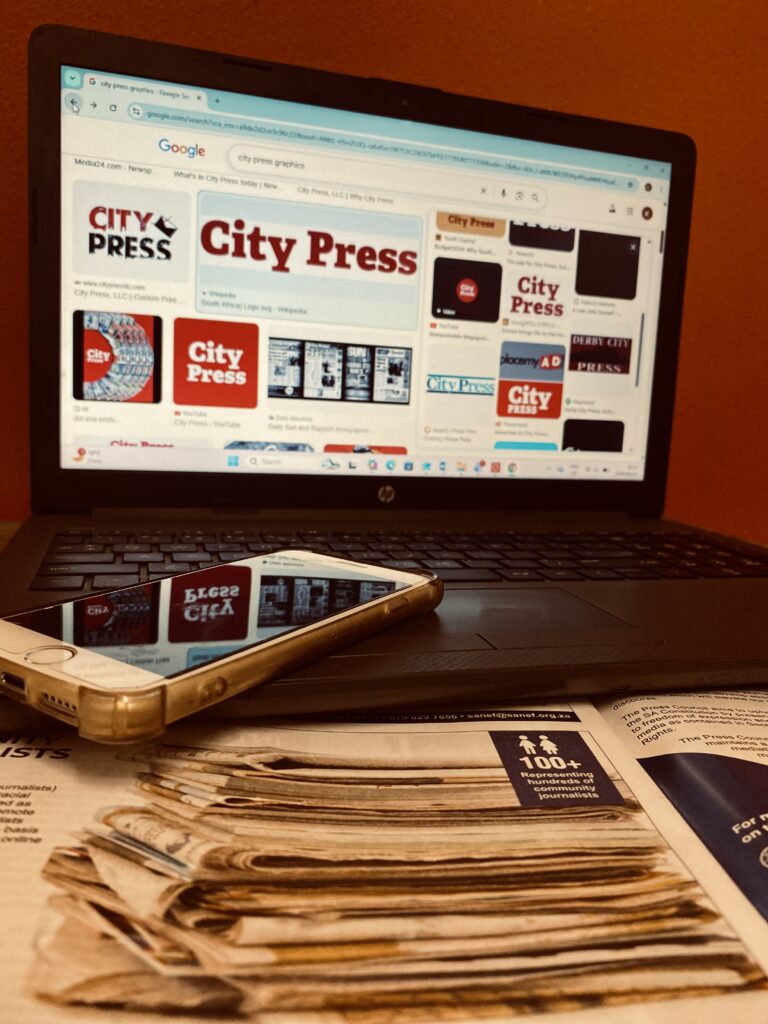
The closure of City Press feels symbolic for journalism students growing up in the digital era.
The closure of City Press reflects the decline of traditional print journalism.
Journalism students are preparing for an industry increasingly dominated by digital media.
Despite the shift of digital journalism, newspapers still represent an important part of journalism culture.
As a journalism student, I always imagined my future inside a busy newsroom. Pictured reporters rushing to meet deadlines, newspapers stacked on desks and the sound of keyboards filling the room as stories came together before print. Growing up, newspapers felt permanent. They felt important. The closure of City Press in addition to several other titles shut down by Media24, felt like a violent wake up from a beautiful dream. One never gets used to that.
When news of the newspaper’s closure broke, it felt bigger than the loss of a publication. It felt like the end of a version of journalism many students like me had hoped to become part of one day.
Growing up, I witnessed the slow decline of print newspapers as more people turned to digital media for news. As journalism students we already publish stories online and use websites during practicals, so digital journalism already feels normal to us. However, the closure of City Press still felt significant because it marked the end of one of South Africa’s last major print newspapers.
Most people now consume news through their phones before it ever riches print. Social Media updates appear faster and are easier to access, which explains why fewer people still buy newspapers. Although digital newspapers have become the norm, newspapers still carried a sense of tradition that made the closure of City Press feel Symbolic.
Even though many journalism students are already preparing for digital media spaces, the closure of City Press still feels emotional because newspapers were once seen as the centre of journalism. Watching another print title disappear makes the shift from print to digital feel more final.
Despite this uncertainty, the closure of City Press also reminded me why journalism still matters. Even if newspapers disappear, people will always need stories that inform, expose and reflect society honestly. Journalism may no longer look the same as it once did, but its responsibility remains important.
The closure felt personal because it represented more than the loss of a newspaper. It represented change and uncertainty. Still, while many aspiring journalists continue studying, writing and preparing themselves to tell stories in whatever form journalism takes next they are faced with this uncertainty.
The newsroom may be changing before we even enter it, but the passion to tell meaningful stories remains.
Print in the magazine, phone and laptop: City Press visuals, Photo: Khutso Ngwatoana
FEATURE IMAGE: Print in the magazine, phone and laptop: City Press visuals, Photo: Khutso Ngwatoana
While digital news thrives online, a devoted newspaper vendor from KZN remains a steadfast presence at a Wits bustling intersection, hoping to convince young and old to grab print copies.
In the centre of Johannesburg, at the busy intersection of Yale and Empire Road near Wits University, Phumzile Msani ,stands as a symbol of a bygone era.
Phumzile Msani engaging with a potential client at the intersection of Yale and Empire Road. Photo: Rivaldo Jantjies
As a devoted newspaper vendor, despite the drastic change in the print media landscape, Msani has continued to sell printed news for more than thirty years.
Hailing from KwaZulu-Natal, Msani stepped out of her comfort zone to seek employment in Johannesburg. Without fully completing her education, she could not secure a formal job, leading her to sell newspapers. The money she earned was sent back home to support her extended family. The 57-year-old and her family still rely on the ever dwindling income from her daily hustle.
From Monday to Friday, between 9am and 5pm, she sells newspapers on the busy intersection. Her selection includes The Star, The Citizen, Business Day, and Mail and Guardian.
The latest quarterly figures from the Audit Bureau of Circulations of South Africa (ABC) show a further decline in circulation figures. The Star, which used to be one of Msani’s bestsellers has seen a 35% decrease in circulation in the last year alone, less than 6000 paid copies in circulation weekly.
However, Msani’s commitment goes beyond her sales of newspapers, she is a familiar face and voice to regular passersby, making sure to greet passersby with a welcoming grin and willingness to chat.
Msani said the Covid-19 pandemic severely hurt her sales. Despite more individuals using online news sources, sales have not returned to their pre-lockdown level. She told Wits Vuvuzela, “before Covid-19, I used to sell 90 copies every single day, now I only sell up to nine copies a day.”
Price increases have also played a role in decreased sales. For instance, City Press, which was priced at R20 in December 2019, now stands at R29, while Beeld, which was R12.50, has risen to R18.50. Similarly, Die Burger has seen an increase from R13.60 to R16, and Daily Sun’s price has more than doubled from R4.20 to R8 during the same period.
Msani is a monument to the lasting value of print media in an age when digital news is taking over the world. Her devotion, and steady presence beg the question of whether print and digital journalism can coexist, or will screen convenience eventually make the sound of newspapers rustling obsolete?
FEATURED IMAGE: Selection of newspapers that Phumzile Msani sells. Photo: Rivaldo Jantjies
COVERING THE BIG NEWS: Business Day editor Songezo Zibi. Photo: Dinesh Balliah.
This year’s Menell Media Exchange conference played host to much needed debates and commentary about the future of the media industry.
The conference, which took place in Sandton, Johannesburg this Friday and Saturday, was not short on humour as delegates and speakers confronted the prickly issues of the future of the media industry and sustainability in the digital age. The second day kicked off with a comedy roast of South African media by the Late Night News (LNN) team of Loyiso Gola and Kagiso Lediga.
The duo took a stab at almost everyone in a media roast, including controversial media veteran Allister Sparks, to news organisations like the Sunday Times and the Mail&Guardian to radio host Redi Thlabi.
Celebrated radio personality John Perlman of KayaFM joined media strategist Shaka Sisulu, commentator Palesa Morudu and Business Day editor Songezo Zibi on the first panel that focused on how South African media covered the big stories of the day. These included the coverage of xenophobic violence in South Africa along with Nkandla. Perlman offered advice to journalists struggling with coverage of big stories which can be chaotic: “We need to be comfortable with confusion and not being right,” he said.
Sisulu was critical of what he referred to as a predetermined narrative in the media and added that the South African story needs to be told in a more diversified way.
While Zibi received much applause for his contribution to the panel discussion.
#MMX15@SongezoZibi asks an important question on xenophobia, What would the story have been if BEE included other African nationals?
Wits University had a strong presence on the second day of the conference. Wits Journalism’s Ashfaaq Carim and Dinesh Balliah formed part of the panel discussion on new ways of storytelling. TV lecturer Indra de Lanerolle presented a short talk on the 10 things you need to know about South Africa’s digital space.
Andrew Phelps from the New York Times highlighted the challenges when faced with breaking news in the digital world. “No one remembers who was right first but everyone remembers when you were first and wrong.” He said that journalists need to choose accuracy over speed when working with online stories.
The conference wrapped up on a positive and optimistic note although the uncertainty around the future of journalism and in particularly, sustainability, will linger long after.
Long time journalist and public commentator Allister Sparks (82) found himself at the centre of a social media storm when he declared Apartheid architect Hendrick Verwoerd was a ‘smart politician’. Wits Vuvuzela spoke to Sparks at the Menell Media Exchange conference in Sandton about the state of journalism in South Africa and the shifts in the political landscape.
VETERAN JOURNALIST: Allister Sparks remains vocal about dying newspapers, the ‘gimmicks’ of the EFF, and the ‘unbalanced’ Baleka Mbete. Photo: Dinesh Balliah
What stood out for you at this year’s conference and is there anything you expect to hear?
I was particularly taken by yesterday’s session by Catherine Kennedy (of the South African History Archive). I didn’t go to the branding, maybe I missed something there, I guess I feel it’s a bit too late for me to brand myself at my age (laughs). For me Catherine was the highlight. Particularly John Perlman and Songezo Zibi, I thought there were wise thoughts that came out of them.
On parliament in South Africa today …
Parliament has been a very refined and remote place, now it’s in the public eye and I think that’s good. [However] it will have to take a grip on itself, and it needs a better speaker than we have at the moment, because it can easily become a laughing stock, it can really damage its reputation.
On the EFF and their disruption in Parliament, and Baleka Mbete …
I do think the EFF (Economic Freedom Fighters), has brought something, but it’s got to be very carefully monitored by a much better speaker than we’ve got. I think Max Sisulu would have managed it, Max was a very good speaker and Frene Ginwala likewise, not a partisan speaker who’s the chairman of a party, and her lack of balance shows so glaringly, nobody takes her seriously.
I think the red garments [of the EFF] was a gimmick, I guess once you’ve got them it’s very hard to get rid of them, I don’t think it has any impact anymore, it had an impact in the beginning. The gimmicks need to be limited, but they can only be limited by the speaker, and that’s got to be by persuasion, not by bringing in the police. She (Mbete) needs to call in the whips and say ‘How do we deal with this?’
I think a lot of it [parliament] is archaic language and it’s a bit absurd; it’s meant to preserve a tradition, but at the same time its got to give way to the modern world and the modern South Africa where not everybody shares the British tradition. There has to be some kind of control in the transformation of parliament and only a really wise, strong, and influential speaker can do that.
On Business Day editor Songezo Zibi …
I think he’s a very thoughtful young man and I think he has some very important insights … he’s a real asset to the media. He’s a young man and he’s a very important addition to our galaxies of editors, he’s thoughtful and cares about the media. John Perlman has been around for a long time, but this is a newcomer really [Zibi] out of a different profession, and he has a great career ahead of him.
On newspapers in the new digital age …
I think two kinds of newspapers papers are going to survive in the new digital age: One is the local paper, the small town paper and the other is the serious paper. I think the popular press is going to die, and we have an awful lot of popular press here and its days are numbered.
There’s got to be one black newspaper that’s going to emerge as a serious one, [maybe] it is the Sowetan, City Press is getting there but it’s only a Sunday paper.
Since her announcement as the Democratic Alliance’s mayoral candidate for Johannesburg, Helen Zille has dominated national headlines. In this bonus episode of We Should Be Writing podcast, hosts Lulah Mapiye and Bonolo Mokonoto dissect a media meet-and-greet with the mayoral hopeful. From her extensive political résumé to her controversial public utterance, we examine why the Democratic Alliance has chosen Hellen Zille as their candidate for the 2027 local mayoral elections. Additionally, […]