Diabetes health education could help Wits students make informed choices about food and their health.
Wits students need more diabetes education to make informed health choices.
Limited healthy food options make it difficult for students to eat well on campus.
Health professionals are urging students to make healthier lifestyle choices.
For many students at the University of the Witwatersrand, deciding what to eat between lectures depends on two things – what is affordable and what is quick to eat. However, with diabetes becoming a growing health concern in South Africa, health professional Sister Lebohang Ngubeni, from the Shout IT Out Campaign, says students also need to understand how their everyday lifestyle choices can affect their health.
Students regularly eat cheap, convenient foods such as bunny chow, slap chips, fried foods and sugary snacks, while also getting little or no exercise. In the long run, these habits can lead to weight gain and also increase the risk of developing type 2 diabetes, a condition that occurs when blood sugar levels are too high, among other health problems.
TimesLive news recently reported on diabetes becoming South Africa’s leading cause of death. Dr Siyamak Saleh, who was commenting on the news report in a TikTok video, said, “HIV is a much easier condition to manage compared to diabetes! We need more health education.” It’s very important to know your blood sugar levels to help identify risks early on.
According to the National Institute of Diabetes and Digestive and Kidney Diseases, diabetes is a condition where there is too much glucose, or sugar, in the blood. The body gets glucose from the food we eat, and insulin helps the body use that glucose for energy. With type 2 diabetes, the body can become resistant to insulin, which causes glucose to build up in the blood.
The latest mortality data from Statistics South Africa shows that diabetes mellitus was responsible for 27 692 deaths in 2023, making it the country’s leading cause of natural death.
Wits students have several takeaway options, including Sausage Saloon, Chinese Lantern, and Kara Nicca’s. Sima Boyisa, a first-year Wits student, said she struggles to find healthier options on campus.
“There’s never healthy food. If I don’t eat burger, a wrap or chips at the Main Dining Hall, which are affordable, there’s nothing [else] I can opt for,” said Boyisa.
While the food outlets offer students affordable and convenient meals, Boyisa experience highlights a question at the heart of the issue, which is: do Wits students have enough affordable, healthy food options on Campus?
According to Sister Lebohang, “students should be aware of lifestyle factors such as obesity, smoking and lack of exercise because it can increase their risk of diabetes”. She advised students with a limited budget to prioritise vegetables, which they can buy at Food Lover’s Eatery in Braamfontein, drink more water and avoid fizzy drinks.
Students who are concerned and need information about diabetes, testing or management support can visit the Wits Campus Health and Wellness Centre. The main clinic is located on the lower ground floor of the Student Union Building, below the Matrix, on Braamfontein Campus East. Students on the Parktown Education Campus side can visit the satellite clinic at Highfield Accommodation House, on the ground floor.
FEATURED IMAGE: Wits students queue for affordable takeaway meals at Chinese Lantern. Photo: Alice Dhlamini.
University of the Witwatersrand (Wits) Women’s Rugby showed early-season resilience and unity despite a 27-0 opening defeat to Zondi Women’s Rugby club on Saturday.
Wits Women’s Rugby opened their 2026 league season with a 27-0 defeat to Zondi Women’s Rugby Club at Wits Rugby Stadium.
Despite the loss, Wits showed resilience, strong defensive organisation, and growing team unity throughout the match.
The match reflected the continued growth of the Wits Women’s Rugby programme since its establishment in 2019.
The Wits Women’s Rugby team opened their league season at Wits Rugby Stadium on Saturday May 9, 2026, producing a spirited performance against a physically dominant Zondi side in a match that tested both their structure and resolve.
From kick-off at 13:20, Wits showed intensity at the breakdown, organised defensive sets, and confidence in possession despite sustained early pressure from the visitors. Zondi controlled the territory for much of the first half, scoring their first try midway through after winning a turnover inside Wits’ 22. Wits responded with improved defensive organisation and stronger carries, matching Zondi’s physicality in several exchanges. Zondi added another try just before half-time to take a 10-0 lead into the break, but the Wits team continued to contest every phase with discipline and commitment.
Their strongest moments came in defense, where disciplined communication and collective organisation reflected the side’s growing cohesion. Even during difficult phases of play, players responded to the coach’s instructions, quickly regrouping after errors and maintaining their defensive structure under pressure.
Pinned deep in their own half on several occasions, Wits absorbed repeated phases of pressure through committed tackling and strong on-field communication. The forward pack showed determination in the scrums, while ball carriers consistently worked hard to gain metres in contact despite Zondi’s physical dominance.
Wits Women’s Rugby forwards contest possession during a scrum against Zondi in their opening league fixture at Wits Rugby Stadium on Saturday. Photo: Alice Dhlamini
The second half brought renewed energy from the home side. Substitutions lifted the tempo, defensive organisation improved, and Wits showed greater confidence in building play. A yellow card during a crucial stage shifted momentum further in Zondi’s favour, but Wits still maintained their intensity and rate throughout.
Even as the scoreline widened, the home side continued fighting until the final whistle, earning respect from supporters and coaches alike for their commitment.
Captain Nikitha Dlabane, a final-year biomedical sciences student, said the performance reflected the growing unity developing within a relatively inexperienced Wits side, explaining that despite the pressure of the occasion, the players “stayed together as a team” and continuously encouraged one another throughout the match. She added that the side drew confidence from strong scrummaging, effective carries, and organised defensive folding, although she acknowledged that there is still room for improvement as the squad continues to develop.
“This game was tough because a lot of our girls are very new,” she said, “but we stayed together as a team. We encouraged each other all the way, and I feel like that is what makes the team.”
Dlabane also highlighted the technical aspects that gave Wits confidence during the match.
Head coach Winsdon Grootboom praised his side’s “never-say-dying attitude” despite the defeat, highlighting the determination shown by a squad that included “six or seven women” making their first rugby appearance. Although he admitted that “pressure creates mistakes” at crucial stages of the match, Grootboom said he was encouraged by the way the players “fought until the end” and continued trying to execute the structures and patterns they had worked on in training.
The Wits Women’s Rugby team warm up ahead of their season opener against Zondi Women’s Rugby Club at Wits Rugby Stadium on May 9, 2026. Photo: Alice Dhlamini
Wits player Mamokgopane Tsotetsi, a second-year industrial engineering student, said preparation played an important role in helping the team remain composed ahead of the fixture, with the squad focusing on “scrums, structures, lineouts, and all the basics” during training. She added that constant communication and encouragement on the field helped the side maintain its intensity during difficult passages of play.
Beyond the result, the fixture reflected the growing visibility of women’s rugby at Wits, with supporters highlighting the significance of women’s presence in a traditionally male-dominated sport. Second-year Bachelor of Arts student in South African Sign Language and political studies, Tshimangadzo Sigoba, described it as “refreshing seeing women taking up space in rugby,” while supporter One Segano noted that women’s rugby is gaining greater exposure and media attention on campus.
The crowd responded loudly throughout the afternoon, particularly after Zondi’s opening try, as tension built with Wits searching for opportunities to break through defensively. A Wits injury late in the match added further intensity to an already physical encounter, while the home side’s number one forward stood out with powerful ball carries and strong work around contact areas.
While the scoreboard may not have favoured Wits, the match stood as a testament to the team’s rapid progress and the rising profile of women’s rugby at the university since its establishment in 2019. As the season unfolds, the Wits Women’s Rugby team looks set to continue inspiring players and supporters alike with their unwavering determination.
A graphic highlighting Wits Women’s Rugby’s season opener against Zondi Women’s Rugby Club reflects the team’s resilience, unity, and determination despite a challenging start to the season. Graphic: Emmanuel Molebatsi
FEATURED IMAGE: Wits Women’s Rugby players chase down a Zondi ball carrier during their league opener at Wits Rugby Stadium on May 9, 2026. Despite a 27-0 defeat, Wits showed defensive resilience and growing cohesion throughout the match. Photo: Alice Dhlamini
At Wits, decolonisation remains incomplete as English dominance continues to limit true multilingual inclusion in learning and assessment.
In 2015, during the #FeesMustFall movement, South African universities were forced into a reckoning that extends beyond protest and policy reform. At the University of the Witwatersrand, this moment led to a language policy that introduced English, isiZulu, Sesotho, and South African Sign Language (SASL) into its academic framework. Yet, as Wits advances through its 2023 Strategic Framework, a plan guiding the university’s goals around transformation, inclusion, research, and global competitiveness, though a contradiction remains: the institution speaks of decolonising knowledge while leaving the language of learning largely unchanged.
Decolonisation without linguistic transformation is incomplete. A curriculum may diversify its content but if access to knowledge remains dependent on English, exclusion is not removed but relocated into the medium of instruction. This dynamic can be understood through what Miranda Fricker terms epistemic injustice, which is a condition in which certain forms of knowledge are undervalued because of the language in which they are expressed. In this context, students are not excluded from knowing, but from having their knowledge fully recognised unless it is articulated in English.
As Steve Biko warned, “the most potent weapon in the hands of the oppressor is the mind of the oppressed”, a condition sustained not only through content, but through the very language in which knowledge is delivered and recognised. His insistence that education must cultivate critical consciousness rather than reproduce subordination sharpens this argument: when students are compelled to translate their intellectual lives into English to be legible, the system does not liberate thought; it disciplines it.
This is not abstract. In lecture halls across Wits, language shapes how students learn and are assessed. In science and health sciences courses, students encounter, process, and are tested on complex ideas in English, even when understanding often begins in other languages during peer discussion. Learning in familiar languages can improve comprehension, participation, and confidence, reduce cognitive load and also allow students to engage more fully with complex material.
In engineering tutorials, students switch to isiZulu or Sesotho in order to unpack difficult concepts, only for that cognitive work to disappear in formal assessment, where only English counts. In Sociolinguistics, this is understood as code-switching, a skilled practice rather than a deficiency. What appears as hesitation is, in reality, intellectual labour: students are learning disciplinary content while translating it across linguistic systems; a demand not equally placed on all. They are not struggling with content; they are performing unpaid intellectual labour to make that content legible within a single dominant language.
Wits visibly acknowledges four languages on campus signage, raising questions about the absence of South Africa’s other official languages in learning and assessment. Photo: Alice Dhlamini.
This extends beyond technical disciplines and reflects a broader experience across faculties where language shapes who can fully access knowledge.
As third-year industrial engineering student Tshedza Tsiololi explains, “some engineering terms, such as dynamic system or torque, do not translate easily into everyday language… This makes learning time-consuming, especially in the absence of accessible translation tools”. This translation process carries material consequences. When comprehension is delayed, so too is performance, affecting assessment outcomes, time to completion, and the cost of education. Language barriers are therefore not only pedagogical concerns but structural inefficiencies.
The result is not a lack of understanding but a delay in it. Students carry an invisible cognitive burden, constantly translating their thinking. Language cannot be treated as a secondary issue in curriculum reform.
Language shapes how knowledge is accessed, processed, and recognised. When a medical student must translate reasoning to communicate with a patient, or an engineering student is assessed in a language that can flatten thinking processes, language becomes a gatekeeping mechanism. Yet the persistence of English is often justified through its role in global academia. While not unfounded, this argument is incomplete. Countries such as Germany, Japan, and South Korea demonstrate that strong language production can occur in national languages alongside English. Multilingualism is not a barrier to global relevance but a source of intellectual flexibility.
Wits’ current approach reflects both progress and limitations. As noted by the Head of African Languages, Dr Soyiso Khetoa, “the university’s focus on English, South African Sign Language, isiZulu, and Sesotho is informed by demographic research”. Institutional efforts, such as language-learning applications, support isiZulu acquisition. However, this raises a deeper question: what happens to students whose linguistic identities fall outside these dominant categories?
A comparative perspective complicates this further. In Tanzania, the adoption of Swahili under Julius Nyerere aimed to democratise education and strengthen national identity. This model significantly expanded access and participation at foundational levels, enabling students to learn in a familiar linguistic context. While access improved at foundational levels, challenges emerged in higher education, including limited technical terminology. This illustrates that linguistic transformation is both possible and complex, requiring sustained commitment rather than selective implementation.
Accommodation based on geographic prevalence may be efficient, but it is not neutral. It creates new margins. Students who speak other African Languages remain excluded, not because their languages lack value, but because they fall outside institutional feasibility. In this way, multilingualism risks becoming selective rather than transformative. South Africa’s own history offers parallels. Institutions such as Stellenbosch University and the University of Pretoria have shown that full academic systems can be developed in Afrikaans, raising the question of why similar levels of investment have not been extended to African languages in a democratic context, while also revealing how language can function as both inclusion and exclusion.
Bert van Pinxteren argues that expanding the language of learning is expensive and complex. “Developing academic terminology in African languages, training staff, and redesigning assessments require time and resources”, he notes. These challenges are real, but difficulty is not a justification for permanence. Technology tools, from translation software to AI-assisted terminology development, are reshaping what is feasible. The limitation is increasingly institutional: whether universities are willing to invest in systems that reflect their students’ realities.
When African languages are used informally for explanation but excluded from formal assessment, universities reinforce a hierarchy where legitimacy remains tied to English. Inclusion becomes conditional.
Restricted-access signage at Wits mirrors ongoing debates around who is fully recognised within the university’s linguistic and academic spaces. Photo: Alice Dhlamini.
The 2015 policy was a meaningful step, but without implementation, it risks becoming symbolic. If students must translate their intellectual lives into one dominant language to be recognised, decolonisation remains incomplete. The issue is the distinction between symbolic and material transformation: policy signals intent, but assessment determines whose knowledge is legitimised.
A serious commitment to transformation does not require abandoning English. It requires building multilingual academic systems where English is one of several legitimate languages of learning. This could include bilingual modules, expanded language support, and discipline-specific terminology across a broader range of African languages.
And perhaps the most uncomfortable question is this: must students once again protest to be heard? The 2015 moment demonstrated that institutional change often follows student pressure. If language remains a barrier, it raises concerns about whether dialogue alone is sufficient.
Decolonisation, if it is to mean anything, must be a dialogue, not only between institution and student, but between languages themselves. The question is not whether English will remain at Wits; it will. The question is whether students will continue to think in multiple languages but be recognised in only one language. Until students can be recognised in the languages in which they think, decolonisation remains a translation exercise, not a transformation. More fundamentally, it is whether Wits is willing to move from being a university that is merely in Africa to one that is truly of Africa.
FEATURED IMAGE: A student points toward an emergency assembly point at Wits, symbolising urgent questions around language, access, and transformation in higher education. Photo: Alice Dhlamini.
Wits Journalism students step inside Kgosi Mampuru II Correctional Centre, confronting the haunting legacy of South Africa’s penal history.
Wits Journalism students visited Kgosi Mampuru II prison and learned about inmate survival, punishment, and daily life behind bars.
They climbed the 52 steps to the gallows, reflecting on the country’s execution history and its human cost.
The gates at Kgosi Mampuru II don’t simply close, they announce an ending. It is a metallic finality that vibrates in your marrow, leaving an unshakable awareness of what it means to be confined, and the fragile privilege of walking free. Exactly at 10:42 am on April 15, 2026, 17 of us from the Wits Journalism programme stepped through that threshold. We traded lecture halls for a space defined by the physics of control. As a student journalist, I am trained to observe, but here, the walls watch you back. An involuntarily warning began to ring in my ears, an indirect message from the architecture itself, “Do not come here.”
Our tour guide, Dimakatso, unveiled a world of “jail language” and survival. She described “two full chickens”, prison slang for the two boiled eggs served with pap at 14: 00 pm which would be your last meal until the next day. She showed us how inmates creatively hollowed Sunlight soap to hide cell phones. In the era of AI, these inmates use primitive ingenuity to stay connected. Sitting on benches crafted by prisoners, I felt a sting of irony, for someone like me, only taught to build cardboard bridges at school, these prisoners learn to build from scratch to survive, and gain skills that might one day free them from that space.
The atmosphere turned clinical and cruel when Dimakatso introduced the “Triangle Step”. She described hot water-soaked wood being bent during a beating, making my body involuntary cringe. My mind flashed to the moment of impact, feeling the sting of a system that once relied on pain as its primary language. Hanging on the triangle step was a bloodstained cloth, an enduring reminder of punishment inflicted on the condemned. I cannot omit this, as it questions what I was never taught in high school. This history was deliberately left out, it sparked questions about justice, pain, and how history is curated.
Next, we moved to the gallows. Mr. Kgomo told us to “fasten our emotional seatbelts”, a fitting warning. We transitioned from the museum of survival to the tomb of execution. I stood before the names on the wall, thinking of Section 11 of the South African Constitution: the right to life. I felt a wave of relief; the 1996 abolition of the death penalty had ended this brutal form of justice. Yet, as we approach April 27, Freedom Day, the irony burns: this day marks our liberation, but these gallows mark how many never lived to see it. Yet, the past is not distant. Between 1902 and 1989, roughly 3,500 people were executed, a grim reminder of state-sanctioned brutality. As I ascended the 52 steps, I imagined faces, some praying, some screaming, others singing hymns, climbing those heavy stairs. By step 52, my chest felt like it was crushed, a tear slipped unnoticed, masking my professionalism.
At the top, the brutality became clinical, detached from emotion. I learned how a prisoner’s BMI (body mass index) was used to select the correct noose, and how a pulse after the fall meant the execution was not complete. We stood where Solomon Mahlangu, whose blood nourished the “tree of freedom”, once stood. As the gates hissed shut behind us, and warnings lingered, I became haunted. The 52 steps symbolise not only punishment but a society still grappling with its past, a past where thousands paid the ultimate price between 1902 and 1989. Is this reflection of the gallows? It is a mirror that confronts the dark architecture of consequence, forcing us to question the true weight of justice and the whispers of history that echo through these steps.
19 : 00 pm, execution time starts. Photo by: Emadul Islam Akash. (Pexels)
We celebrate Freedom Day on April 27, 2026, however, the 52 steps remind us that freedom was counted out in bodies long before it was counted in ballots.
FEATURED IMAGE: Journalism and Media Studies Honours students from Wits University enter Kgosi Mampuru II Management Area. Photo by: Alice Dhlamini.
Power outages at Wits’ International House disrupt postgraduate students’ study routines and raise safety concerns amid aging infrastructure and poor communication.
Recurring power outages at International House since March 2026.
Residents face interrupted study routines and safety risks, particularly at night when corridors are left in darkness.
Limited communication from management and delays in forming a House Commitee or upgrading infrastructure have left residents uncertain and frustrated.
Persistent power disruptions at Wits’ International House residence are straining the building’s infrastructure and backup systems, compelling postgraduate students to relocate late at night to continue studying.
The outages began in early March 2026, with some residents reporting disruptions occurring two to three times a week. During these periods, the residence relies on a generator shared with Sunnyside Hall, limiting available backup power and leaving sections of the building without electricity.
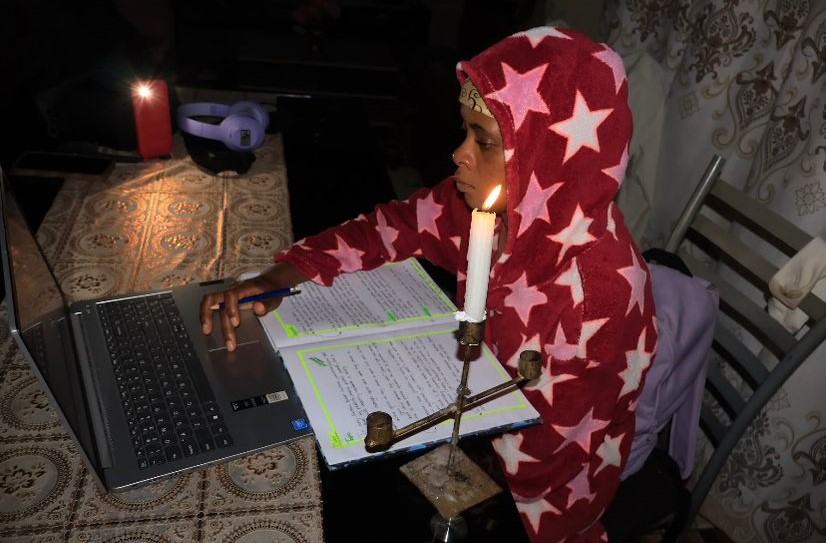
Students say the impact extends beyond inconvenience. Darkened corridors and shared spaces have forced some residents to either remain in unsafe conditions or move across campus late at night to access functional study areas.
Postgraduate resident Ireen Masemula, who is pursuing a BEd honours in language education, described the disruptions as exhausting and unsettling. “The lights go out at around 8 p.m. sometimes, and I only return from the library around 1 a.m.,” she said. “It’s not safe, especially as a young woman. I have to go to the library to work, and I struggle to study in such an environment.”
Studying by candlelight during outages at Wits’ International House. Photo by: Alice Dhlamini.
According to Tyson Mnisi, a security officer at International House, the outages are not solely linked to external power-supply issues. He explained that a combination of external disruptions and internal electrical faults contributes to recurring failures.
“Sometimes it’s just a minor cut, but often it’s an internal load,” Mnisi said, adding that high-wattage appliances such as microwaves and heaters place significant strain on the system. “You’ll have students making popcorn in their rooms, and suddenly the whole circuit trips. The infrastructure is just not built to accommodate such levels of demand.”
Tshiamo Modise, an undergraduate student and a student employee in the residence’s maintenance team, said communication gaps have intensified the situation. During a recent incident involving multiple generator failures, she used her own airtime to contact management after the building’s Wi-Fi and telephones went down.
“I reached out to management for answers, yet I was met with silence and no formal explanation”, Modise said, noting that outages have also resulted in spoilt food and unsafe conditions in shared kitchen spaces.
Residents say the recurring disruptions point to deeper structural concerns within the residence, as temporary fixes have not addressed the underlying causes.
Shanon Smit, a handyman at the residence, suggested that establishing a formal House Committee could strengthen communication between residents and maintenance teams, particularly in reporting faulty appliances before they place additional strain on the system.
Despite these suggestions, students say little has changed, leaving them to adjust their routines individually while managing ongoing disruptions.
Attempts to obtain comment from residence manager Bhekizizwe Nkosi were unsuccessful at the time of publication.
For now, International House residents remain caught between different explanations and ongoing infrastructure pressures, with no clear timeline for lasting improvements.
Residents say that without urgent infrastructure upgrades, the ongoing outages will continue to compromise both the safety and basic living conditions within the residence.
FEATURED IMAGE: International House Residence. Photo by: Alice Dhlamini.
Rising fuel costs are forcing Wits students to choose between paying for their daily commute and basic essentials like meals and data
The recent fuel hikes have increased taxi fares by R6 per trip, costing students an extra R240 monthly.
Daily commuters are walking long distances to save fare money, resulting in late arrivals and lost study time.
Two weeks after South Africa’s fuel increase, some Wits University students who commute daily say rising transport costs are already affecting their ability to attend lectures, manage time, and meet basic living expenses.
According to Bloomberg, petrol is currently around R 23 per litre, following recent increases in global oil prices and local fuel adjustments.
While the increase in fuel prices continues to place pressure on household budgets, its impact has now extended directly into the public transport costs.
The National Taxi Alliance (NTA) confirmed that taxi fares have already increased by R6 per trip. For daily commuters, this translates into an estimated additional R12 per day for a return trip, about R60 per week, and roughly R240 per month.
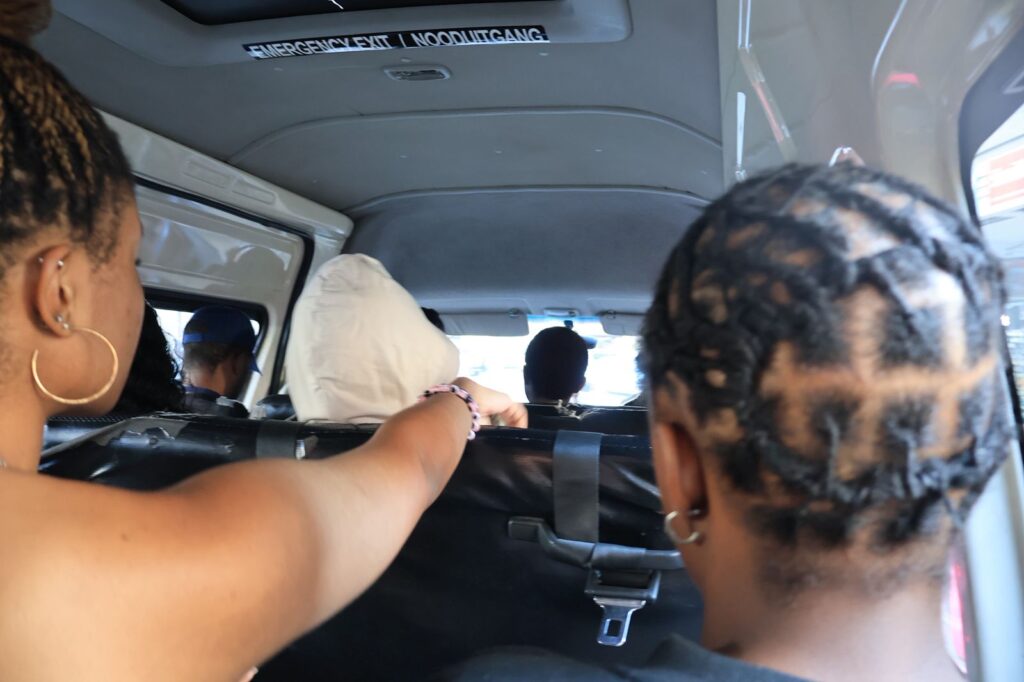
A Wits student passing their taxi fare to the front of the vehicle. Photo: Alice Dhlamini
For students who rely on taxis from the surrounding areas, the increase has turned daily travel into a financial strain.
“I live off campus in Benoni, and I have to travel every day to get to class,” says Afrika Mbangiso, an honours in Psychology student.
“From Wanderers Taxi Rank in Johannesburg, I have to walk the rest of the way to Wits just to save money for lunch or sometimes, for my trip back home,” Mbangiso adds.
It has also affected her punctuality and workload. “I am sometimes late for class, meaning it’s more work that I must catch up on later”, she adds. For students like her, longer commutes and additional walking reduce time for rest, studying, and academic preparation.
Nontobeko Zulu, a Postgraduate Certificate in Education (PGCE) student, argues that the increase has forced what she calls a “displacement of funds”. “For many of us, these aren’t just transport fares, they represent a radical displacement of funds,” Zulu says.
FEATURE IMAGE: A picture of a passenger passing forward taxi fare, which has increased by R6 per trip due to petrol hitting R23 per litre. Photo: Alice Dhlamini
Since her announcement as the Democratic Alliance’s mayoral candidate for Johannesburg, Helen Zille has dominated national headlines. In this bonus episode of We Should Be Writing podcast, hosts Lulah Mapiye and Bonolo Mokonoto dissect a media meet-and-greet with the mayoral hopeful. From her extensive political résumé to her controversial public utterance, we examine why the Democratic Alliance has chosen Hellen Zille as their candidate for the 2027 local mayoral elections. Additionally, […]