by Anazi Zote | Jul 18, 2014 | News

Nearly 500 delegates were hosted by Wits University for the 14th congress of the Pan-African Archeological Association this week. Photo: Anazi Zote.
It’s been over 60 years since the Pan African Archeological Association and Related Studies (PAA) lost its bid to come to South Africa for its second congress. In 1948, the nationalist government withdrew its support for the congress and delegates made their way to Algiers in 1951.
This week, Wits University, initially intended as the 1951 venue, hosted PAA members from all corners of the continent at the 14th installation of their congress.
One of the conference organisers, Dr Karim Sadar, who lectures archaeology at Wits University, said the conference was a landmark event.
Sadar explained that the apartheid government did not want to associate with other African countries because it believed in racial segregation.
President of the association, Benjamin Smith, a former Wits professor, described the congress as the biggest gathering of PAA members so far with almost 500 participants: “We have delegates coming from across Africa and this is the largest Pan African congress we have ever held,” he said.
Delegates were treated to oral and poster presentations around the theme: ‘African Archeology without frontiers.”
Speaking at the opening of the congress on Monday this week, deputy director general in the Department of Science and Technology, Professor Yonah Seleti praised the work of the PAA and its members.
“The work that you do contributes not only to the scientific knowledge around origins, but also contributes to our social cohesion and cultural identity, and much more, it carves a path to modernity which is Africa, Seleti said.
by Anazi Zote | Jul 6, 2014 | News
 A public lecture addressing the sharp increase in the number of sudden deaths among young people was held at the Wits Medical School last week.
Presented by Professor Dimitri Constantinou, Director of the Fifa Medical Centre Of Excellence, the lecture focused on sudden death among athletes and argued that most of these deaths were caused by cardiovascular disease.
Constantinou said the media has a significant role to play in educating people about cardiovascular disease especially when it involves prominent footballers.
Instead of informing people, he said, the media tends to sensationalise these deaths and misses the opportunity to raise awareness about the risks of cardiovascular disease in young people.
According to Constantinou, anyone at risk of cardiovascular disease is at a high risk of having a heart attack if they exercise.
In these cases, high-risk persons, especially professional athletes, need to be closely and regularly monitored.
Constantinou recommends that anyone who is engaging in any form of exercise should go for regular heart wellness screenings.
by Anazi Zote | May 28, 2014 | News
UPDATE: MAY 29, 2014, 10:21am
Rhodes University has released another statement confirming that a Rhodes student currently in hospital for ingesting petrol, is under investigation by South African Police Services (SAPS) as a possible link to a fire that damaged the Steve Biko student union building on Tuesday.
The university is offering counselling to all students in the same residence as the hospitalised student following the incidents.
UPDATE: MAY 28, 16:48 pm.
Rhodes University has released a statement confirming that the man who was involved in an incident at a fuel station early yesterday morning, is a student at the University.
The third year student, currently at Livingstone Hospital in Port Elizabeth has been joined by his family. The university has said that “an initial internal investigation has revealed that the hospitalisation of the student may be linked to the fire which started at the Rhodes Pool Club (the Purple Horse) in the Steve Biko Building on Tuesday (27 May 2014) morning.” The university has not confirmed the link though, and neither has the South African Police Services.
ORIGINAL STORY: PUBLISHED MAY 28, 2014 at 16:21pm
If this storify does not load automatically, please click here.
https://storify.com/WitsVuvuzela/rhodes-fire-at-steve-biko-1
by Anazi Zote | May 16, 2014 | News

Elliot Tshomela, security guard at Bridgeview, stands by the gate entrance to let residents inside. Photo: Anazi Zote
Increasing crime near Bridgeview apartments on Juta street has affected several students at Wits University and left many afraid many of walking home at night.
Natasha Tendai, 2nd year BSc, said she does not go anywhere at night because she is scared. “I only come home late when I have a test and even then I ask the university security to escort me,” she said.
She said it is a frustrating situation because she cannot work in the library late at night and must cut her study time. “Even if you want to work in the library at night you think twice.”
Simba Munyaradzi, 2nd year BCom, said he got mugged last month on his way back home. He was held at gun point as he approached Bridgeview.
Armed robbery
“That was my first and last time getting mugged,” Munyaradzi said. He now makes sure that he’s home before 7pm.
[pullquote]“Even if there were more security guards on Juta street, it may not make any difference because they are not armed.”[/pullquote]
Munyaradzi said he felt “numb” and “shocked” after his robbery. He believes there should be a security guard patrolling the street.
However, even if there were more security guards on Juta street, it may not make any difference because they are not armed.
“We see it, we know it is wrong but what can we do? This person is carrying a gun and you don’t have anything so what are you going to do?” said Danisa Nkala, a security guard at Bridgeview.
“When you go into the situation trying to save the person getting attacked you put your life in danger because you have no way of protecting yourself,” he said.
Nkala told Wits Vuvuzela that criminals get away with crime because they are quick. Since the robbers are armed students do not scream or call for help because they fear getting shot.
Plan of action
David Rebelo, acting head of security at Bridgeview, said he was looking to work more closely with the South African Police Service (SAPS) to protect students. He said the building security did include armed guards. However, these armed guards are not on the premises and the on-duty guard–who is not armed–must press the panic button to call them.
“We are looking at having a meeting with the security guards of the building to put plans in place,” Rebelo said.
He said they were looking at installing another panic button that would alert police when an armed robbery was happening. He also hopes to install cameras facing the street opposite the complex for security to see students exit the building.
RELATED ARTICLES:
by Anazi Zote | May 10, 2014 | Featured 1, News

BANNED DRIVER: Nymhardt Black (48) sits in the car with his wife Debbie Black (40) after voting and wait to speak to an IEC member to lodge their complaint. Photo: Luke Matthews
By: Palesa Tshandu and Anazi Zote
A tow-truck driver was fired from his job yesterday when his employer would not allow him to miss work to vote in yesterday’s general elections.
Nymhardt Black (48) who was an employee at A1 Assist in Industria, North Roodeport said he lost his job because he took off from work to cast his vote.
According to Black, his former employer told him to “come park your truck because you’re fired”. Black responded by saying, “We can’t get fired because we want to vote.”
The frustrated former employee lodged a complaint with the Independent Election Commission (IEC) in the hopes of arguing for his right to participate in the elections.
The employer, who is a manager at the tow-trucking company refused to give Wits Vuvuzela comment on the matter.
Black, who is the sole bread winner in his family of four, does not regret losing his job in exchange for exercising his right to vote but said, “My wife is not happy that I got fired.”
He says the decision for leaving his job is also related to the working conditions at the company. His lack of regret for losing his job is also related to the bad working conditions at the company. He only earned R1300 per week, which amounted to R5200 per month while working the whole day, every day.
He does not wish to return to his former job but is currently looking for a new one.
RELATED POSTS:
by Anazi Zote | May 7, 2014 | News
Camels, jumping castles and free falafels were all part of the unusual 66th Israel Independence Day celebrations at Wits yesterday.
But while some Witsies crossed the library lawns on the back of a camel, the Wits Palestinian Solidarity Committee (PSC) held a film screening to protest the celebrations.
The film based on the life of “terrorist” fighter Leila Khaled was used as a means of showing the desperation of the Palestinian people who are fighting for their independence.
While the film was being screened, some members of the Wits PSC protested on the library lawns alongside the South African Union of Jewish Students (SAUJUS) who celebrated Israel’s independence.
Several protesters said Israel had blood on its hands because the state was created “through the blood of Palestinians.”
Members of the Wits PSC insisted that while the film focused on violent means of protest, the PSC itself believed in a non-violent approach to the dispute between the two nations. Aaliyah Mohammed, a member of the PSC, says the committee fights by calling for sanctions and boycotts on Israeli academic, cultural and sport activities.
Another committee member, Muhammed Ismail Bulbulia added: “Until the very end, I would fight for what I believe in provided I’m justified in fighting for it.”
Both the protest and the celebrations were conducted next to each other but no incidents were reported.
by Anazi Zote | May 6, 2014 | Sport
Wits Hockey lost 4-2 to the University of Cape Town (UCT) in their last match of the Varsity Hockey Tournament at home last night.

PUTTING IN HIS ALL: Barry Morisse dribbles forward from his own half in a spirited performance which saw his team lose to UCT. Photo: Luca Kotton
Within two minutes of the first chukka, the UCT team managed to score their first goal. Supporters from Wits were not too thrilled with the early celebrations but their team still had lots to prove for the remainder of the game.
Wits were awarded two penalty corners and failed to convert either, while UCT took advantage and scored two goals in the first chukka from their penalty corners.
The visitors from the coast were not as dominant in the second chukka but they still managed to score another goal in the remaining minutes of the chukka putting them in the lead with a strong 4-1 score against the locals.
In the last few minutes of the game Wits was in charge and was able to score a goal with seven minutes remaining till the final whistle blew, they failed to score anymore goals and the score finished 4-2 in favour of UCT.
The man of the match award went to UCT’s Andy Winter, and the saver of the day was Wits’s Cole Zondagh, his third time during the tournament.
We just didn’t stand up and take responsibility in our roles.
Wits hockey coach, Mark Sanders spoke to Wits Vuvuzela after UCT scored from three of their set pieces, “We discussed all their set pieces we knew exactly what was happening … we just didn’t stand up and take responsibility in our roles.”
Sanders admits that the upcoming hockey tournament in Bloemfontein next week will be difficult. “It’s going to be a hard challenge but we can definitely work hard to get there, we got two big games that we have to salvage something out of but we can do it if we put our minds to it, if luck goes our way a little bit we can get there.”
by Anazi Zote | May 1, 2014 | News

Thabang Molefi promotes her book ‘Dollars to Soweto’ to business minded Wits students. Photo: Anazi Zote
It is not easy being a young entrepreneur in South Africa but Thabang Molefi kept swimming even while her business was sinking.
Molefi shared the challenges of her journey from humble beginnings in Soweto to the United States of America as she promoted her recently published book at the Wits Business Society (WBS) yesterday.
Dollars to Soweto chronicles Molefi’s rise to business success and is a manual for any young entrepeneur who feels discouraged by the difficulties of starting a business. “I used to walk to and back from school every day while I watched my class mates drive home and it helped me prepare for the challenges I would face in the future,” she writes.
Molefi is now grateful for the many times she had to struggle in order to make it. There’s a time when she had to move back in with her mom because the money she earned on American cruise ships ran out on her first attempt to open a healthcare centre. “I had to go back and live at home and drive my mother’s car”.
She went from running a truck company, to property management and now owns a company called Roots Healthcare Centre in Soweto. She regrets leaving the business she was most passionate about (Roots Healthcare Centre) for other businesses that she was convinced would make her quick money.
She told members of the WBS: “don’t leave the business you’re trying to grow in and don’t grow too fast.” She admits she felt pressure from other entrepreneurs who were doing much better than she was which made her deviate from her core business.
However, the many challenges she faced in opening her business did not stop her from pursuing her goals but it made her more cautious about her decisions and priorities. “Your priorities must be right in business because people start with the things they should start with last,” she said.
She advised students who wanted to become entrepreneurs to make sure they market their business well and run the business without relying on credit.
by Anazi Zote | Apr 25, 2014 | News

WORLD DOMINATION: Small parties of the Collective Democracy conglomerate, are gearing up for a “radical change” in government that is accountable and transparent, come May 7. Pictured from left are Mkhuleko Hlengwa (IFP), Forouk Kassim (Cope) and Bantu Holomisa (UDM) Photo: Nqobile Dludla
By Anazi Zote and Lameez Omarjee
A ‘quality over quantity’ government was the unanimous call of the three political parties represented at the Great Debate (#witsdebate) held last night on the Wits education campus in Parktown.
Bantu Holomisa, of the United Democratic Movement (UDM) and a member of parliament (MP), Farouk Cassim, Congress of the people (COPE), and Mkhuleko Hlengwa of the Inkatha Freedom Party (IFP) participated in the third debate which focused on the viability of small parties as opposition to the African National Congress (ANC) and the larger opposition party, the Democratic Alliance (DA).
Quality over quantity
“[It is] not about numbers, [but rather] about quality that counts in the politics of a (our) country… Look at the numbers of big parties, they can’t even deal with their corrupt president,” said Holomisa.
In the same voice, defending their party size, Cassim, of the still relatively new COPE party, said: “We may be small in size, but not in vigour and voice. In vigour and voice we are powerful, the country hears us”.
“Whether we get the numbers or not, the IFP is here to serve … the populist agenda, which the main party is relying on, is going to be broken,” added Hlengwa.
Cassim told Wits Vuvuzela, “Mass parties world-wide are going to be extinct, they are going to be of no value because the trend of the future will be smaller parties … acting as conglomerates.”
Ethical governance
Hlengwa emphasised that opposition parties did not exist simply to oppose but to constructively create progress. He told Wits Vuvuzela that “if you criticise for the sake of criticising, then there will be no progress”.
All three parties echoed the sentiment of having an accountable and transparent government for the benefit of all South Africans. “In the past five years, there has been a lack of accountability and responsibility,” said Hlengwa.
[pullquote]“This is no longer a democracy, it is a demo-crazy”[/pullquote]
Holomisa warned South Africans not to follow the footsteps of a corrupt government because it will collapse. Small parties have a role to play in ensuring that there is no corrupt governance. “If we are quiet and we don’t expose these things, then we will be like other countries in the continent,” said Holomisa.
He also blamed the lack of votes for small parties on the misuse of government resources by the African National Congress (ANC), which relies heavily on the South African Broadcasting Corporation (SABC) to be its [the ANC’s] mouthpiece. “
This is no longer a democracy, it is a demo-crazy,” he said. The final installation of the Wits Great Debate happens next week Thursday and speakers are still to be announced.
RELATED ARTICLES
by Anazi Zote | Apr 17, 2014 | Featured 1
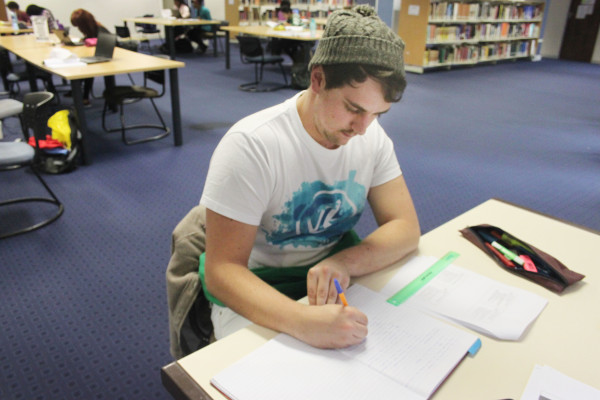
- Ross Bruce a 3rd year students studying a BSc in Psychology studies hard for his test. Photo: Wits Vuvuzela
Fifty-six percent of American students consider homework a primary source of stress, according to a survey conducted recently at Stanford University.
Researchers examined perceptions about homework, student well-being and behavioural engagement in a sample of over 4 000 students.
The study showed that 43% viewed tests as a primary stressor, while 33% felt there was a lot of pressure to get good grades.
Approached by Wits Vuvuzela, Wits students said they had a similar experience. Khomotso Mashala, 2nd year Mining Engineering, said the number of assignments placed her under so much stress that she had failed a test. “Like what’s the point of putting in so many hours of studying when you are going to fail?”
No time for hobbies
The research also found it was hard for students to balance their lives between homework, extra-curricular activities and social time. Mashala agreed. “You know it’s been hectic. I don’t even know what my hobby is any more.”
Some students felt they had to choose homework over developing other talents or skills. Nonhlanhla Mavimbe, 2nd year Mining Engineering, said: “Like I’m actually sitting here on this bench thinking about deregistering because, like, it’s so hard. I want my life back.”
Overall, the research showed that too much homework was actually counter-productive in attempts to increase student performance in university.
The experience of Wits students is similar. Third year psychology student, Jessica du Plooy, said she was too overwhelmed by the workload to achieve well. “If there’s too much to do, I do nothing. If I’m not going to finish, then why should I bother? It’s so depressing.”
Although Wits students felt strongly about their workload, the Stanford researchers noted there were limitations to the findings since some students saw the research as an opportunity to complain about their individual workloads.
Gillian Mooney, a Wits researcher in teaching and learning in tertiary education, said the amount of stress depended on the different abilities of each student and the subjects they studied.
“It boils down to what you have to do to get a degree qualification, which has its requirements.” It was a very complex issue that would need to be discussed in more than just one line, she said. The workload was there to prepare students for their future jobs.
by Anazi Zote | Apr 15, 2014 | News

The bad conditions in the parking officers’ change rooms has been left unattended for a long time. Photo: Anazi Zote
Parking officers at Wits University have complained about the condition of their change room facilities since the renovation of Origins Centre. They were moved out on a temporary basis while the building was under construction but were promised they would return.
They have been filing several requests and suggestions for buildings they could occupy whilst they wait for their new change rooms but these suggestions have been ignored. Parking officers are starting to lose patience after receiving endless promises from the Property and Infrastructure Management Division (PIMD) on West Campus.
Other structures within Campus Control, such as security guards have received response to their request for new change room facilities. No one has been able to explain why the security guards are prioritised instead of the parking officers.
[pullquote]“The building is caving in and water is seeping through it. Sihlala nama kati apha (We sit with wild cats here)” [/pullquote]
There is no electricity, the toilet facilities do not work as there is no running water and the drains are blocked. “This is not justice, we can’t change and drink our tea in these conditions,” a parking officer said. Inside the building there are parking signs stacked on the damp carpet and in the corner of rooms.
“The building is caving in and water is seeping through it. Sihlala nama kati apha (We sit with wild cats here),” another parking officer said.
Several requests have been sent to the deputy director of PIMD, Rias Adams, but have been not been attended to.
Adams acknowledged that he received these requests and said the parking officers would be located given rooms in the new science building which is currently being built on West Campus. This building is due for completion by the end of this year.
While this renovation continues parking officers are left with no option but to stay in the building. Adams said, “The university struggles with space and priority is given to education requests.”
He also told Wits Vuvuzela there are structures in place and if the parking officers had any complaints they would have to direct them to the head of Campus Control, Robert Kemp. He said the requests he received from the parking office were sent to the director of campus development and planning, Emannuel Prinsloo. Prinsloo was unable to comment on the matter.
Robert Kemp, the head of campus control, says the change room facilities for parking officers was going to be allocated near the new Maths building but this was allocated to contractors instead.
While renovations of the science block are taking place, he said, “going forward we look at temporary space near the squash courts on West Campus.”
In the long-term he hopes to secure adequate space through the space allocation office.
by Anazi Zote | Mar 28, 2014 | News
Unlike Europe where most universities have formal structures to support pregnant students, South African universities are yet to implement such structures. Even then, supervisors at Wits have still found ways in which to assist pregnant students.
Mahnaaz Abdulla, 22, a marketing honours student at Wits was unable to continue as a full-time student after she fell pregnant.
Although she managed to complete all her courses in the first semester last year, she gave birth in June and was unable to sit for her mid-term exams. “My research and exams had to be carried on to this year,” said Abdulla.
However, she says Wits showed tremendous support and “assisted me by letting me switch to part-time.”
Professor Alex van den Heever, Chair of Social Security Systems Administration and Management Studies at Wits says countries like Sweden have structures in place to support pregnant students so they can finish their education and believes a similar system would work well in South Africa.
[pullquote align=”right”]“It is extremely difficult as a new mother to make that choice and to have an infrastructure that will allow such a return.”[/pullquote]
Alex van den Heever, who has done research on income protection for pregnant women, says there are ways to structurally shape education institutions for pregnant students and mothers such as building crèche facilities on campus.
Van den Heever’s research looks at extending social grants to pregnant women above the age of 18 years. “Students who are pregnant are not supported in education easily,” van den Heever says. He added that increasing the age at which grants are given would stabilise the economy since it would enable pregnant students complete their studies instead of dropping out.
In Abdulla’s case, Basie Jordaan, the honours co-ordinator in her department, helped by sorting the paperwork quickly. “Basie used to email me all the time so that I was in touch with my research,” Abdulla says.
Pregnant students encouraged to finish
The Registrar for Health Sciences, Sandra Benn, encourages students who fall pregnant to come back and complete their degrees. Students often grapple with the difficult decision to either have an abortion or keep the baby, she says.
“It is extremely difficult as a new mother to make that choice and to have an infrastructure that will allow such a return. Either way a student is encouraged to finish,” Benn says.Marike Bosman, Registrar of Management and Law, says it is hard to distinguish when students de-register from their degrees as a result of pregnancy. “They will either say it is a wrong choice of study or for personal reasons. We will not know why they really cancelled.”

- Professor Alex van den Heever carries out research in extending social grants to pregnant women above 18 years old. Image: Wits Vuvuzela.
The Student Advisor for the Faculty of Health Sciences, Reverie Kuschke says “a student who is pregnant is referred to the Office of Student Support (OSS) for assistance. Each situation is treated individually and the student is permitted to take a ‘leave of absence’ (LOA) rather than de-register.”
In the case of a shorter LOA, the time period would be negotiated between the assistant Dean of Student Support, the relevant department and the student.
There are various counselling facilities on campus that offer support to students who are struggling with personal issues. Toinette Bradley, head of therapy in the Counselling and Careers Development Unit (CCDU) says the therapy they give helps to empower the student not instruct them. “We do not give advice, as this is not what therapy is about.”
Bradley says the counselling involves exploring how the student feels, helps them support their decision and allows them to use the therapeutic space.
Fortunately, Abdulla has the support of her husband and family. “In the evening he sits with her [the baby] for about an hour and a half so that I may get homework and studying done,” Abdulla told Wits Vuvuzela.
Although she is married, Abdulla admits that her pregnancy was not planned. She now looks forward to completing her degree and spending time with her family.


