Beyond the polished grids and aesthetically pleasing feeds, Witsies are using social media on their own terms, transforming videos into value and posts into powerful tools to build a lasting digital presence.
On any given day around the Great Hall or the Matrix, you will see them. Students carrying heavy school bags, holding a coffee from Xpresso in one hand, and using the other to set up a tripod. Some are filming a quick “outfit of the day” at West Campus, while others record a “spend the day with me” vlog on their walk between lectures. Behind these quick videos, many Wits students are running real digital businesses right alongside their degrees. Across South Africa, the digital landscape is no longer just a virtual space: it has evolved into what Siphokazi Vuso describes in Forbes Africa as a strategic jobs engine.
Yet beneath polished Instagram feeds and viral TikTok clips lies a reality of late-night admin, delayed invoices, and the emotional weight of putting oneself into the world. For three Witsies Kungawo Gwayi, Praise Ngubeni and Amahle-Imvelo Jaxa, building a digital presence is not simply about chasing views. It is about discipline, courage, and transforming content creation into something impactful and valuable for their audience.
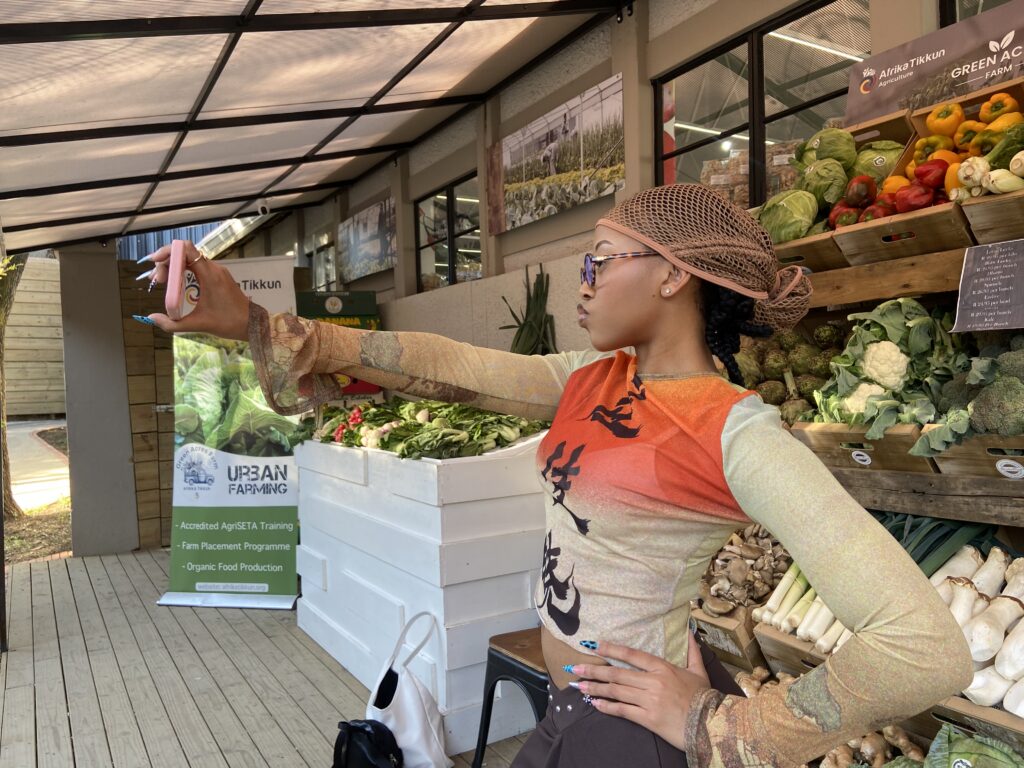
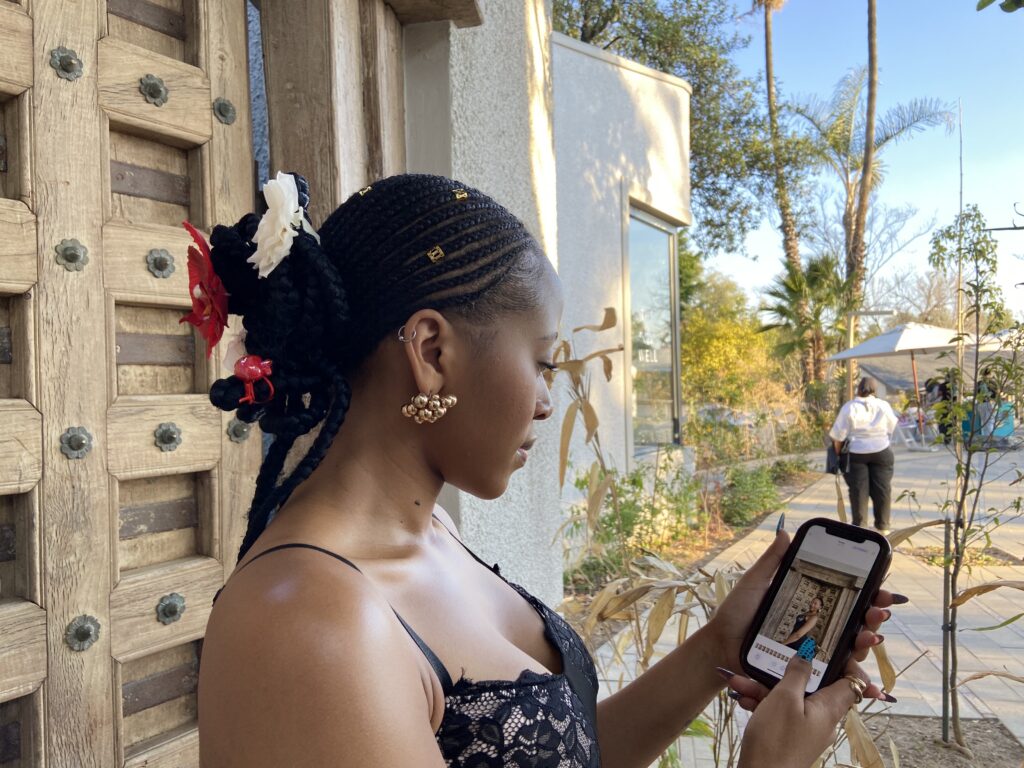
Every creative journey starts with a personal spark. For Gwayi, who holds an honours degree in theatre and performance, self-expression has always been central. “I started with fashion content because putting together an outfit felt natural,” Gwayi explains. As she grows, she has opened herself up to other spheres from skincare, perfumes and banking so she can be marketable across various brands.
An image of Kungawo taking pictures for her instagram page. Photo by: Rearabilwe Tsebela
An image of Kungawo going through her pictures. Photo by: Rearabilwe Tsebela
For Ngubeni, a third-year accounting student from Ermelo, Mpumlanga, content creation grew from a quiet desire to step outside familiar boundaries. “Being a boy from a small town with a simple culture really makes one feel boxed in. Intrinsically, I am an explorer, a leader and an opportunist,” Ngubeni explains. His entry point was through fitness. “People would enquire with me about their training, diets and just general life advice. I realized I could leverage all of this not only to better my life, but to inspire and motivate those around me”.
Praise shares a look into his workout session. Video: Courtesy of @praise_ye
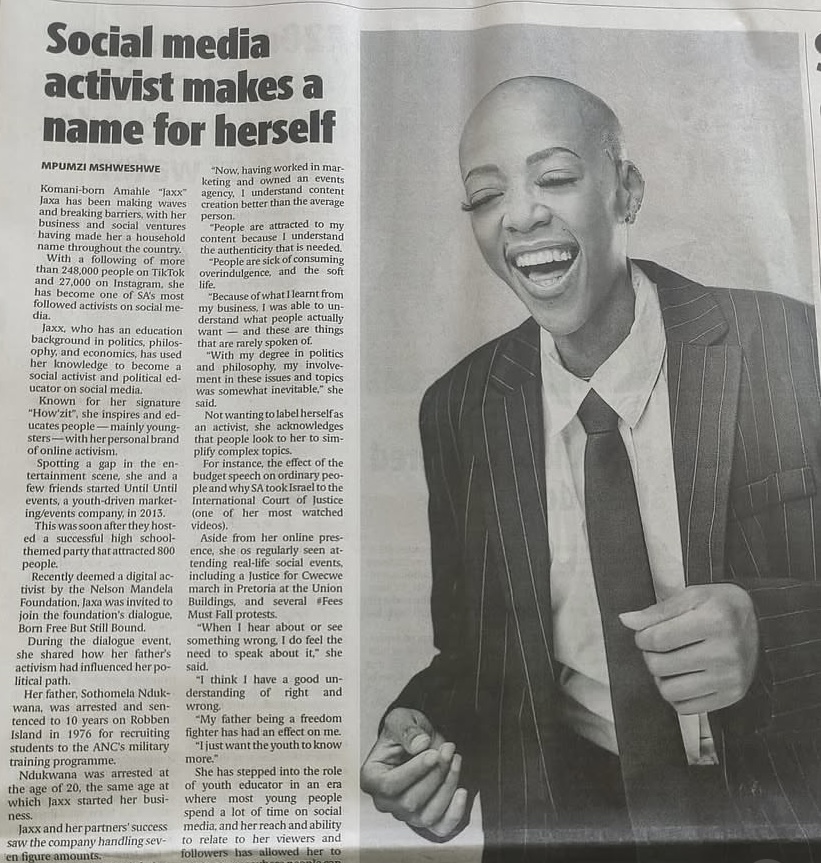
Jaxa, an international relations honours graduate, was raised on news and politics by a single mother and political father turned serial entrepreneur. “Every Sunday my mom and I read the paper together”, Jaxa reflects. “Without that nurturing, I wouldn’t have the keen interest I have in current affairs and politics.” When her video on South Africa’s peacekeeping went viral, it confirmed her path. “I have created content since social media existed, it was an easy transition.”
An image of content creator Amahle Jaxa featured in a print profile by the Daily Dispatch. Photo: Courtesy of @jaxxofalltrades_sa / Daily Dispatch
The soft glow of a screen often hides the physical and mental endurance requires to sustain a digital footprint alongside university deadlines.
Ngubeni relies on careful time management to balance his degree with his creative drive. “My weeks are always planned in advance. I wake up early Monday through to Saturday and I know midday is for classes and gym, and then in the evenings I fight to get in the last solid block of studying.” He speaks openly about the weight it carries. “Burnout becomes life at some point, and I just learn to be patient enough to let it build my capacity”.
For Gwayi, the final year of her degree demanded profound emotional strength. “I had to balance work, academics and grief since I had lost my very close friend,” she recalls. “Listing my priorities and ticking off as I go definitely helped me show up as best as I can.
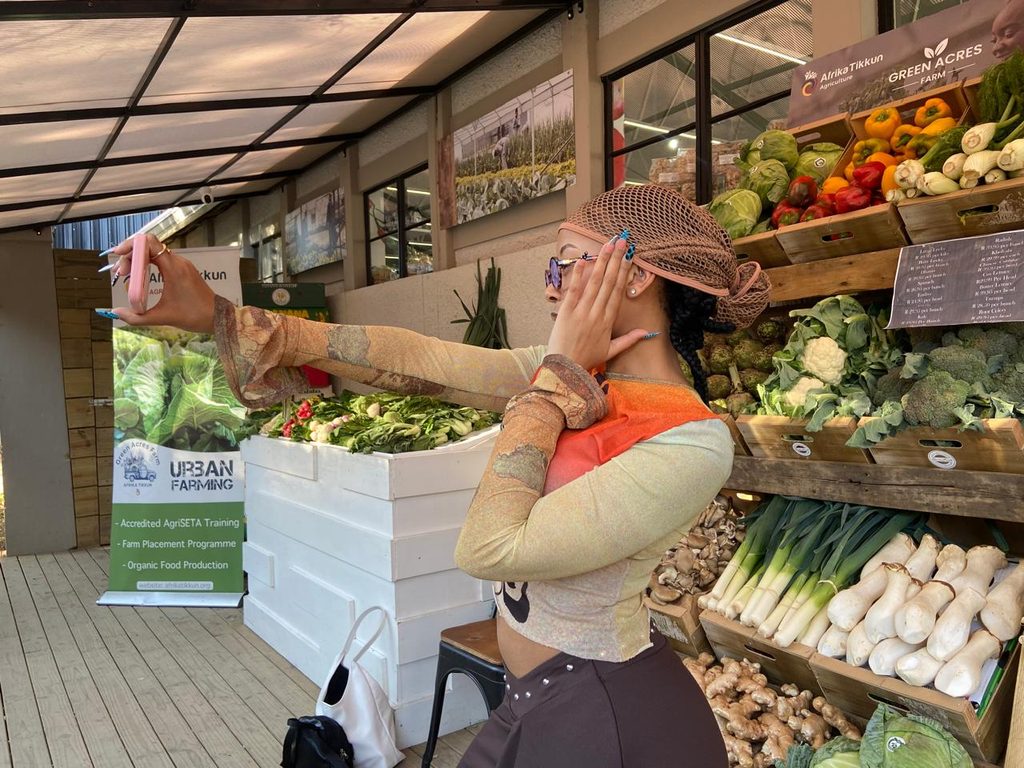
Beyond tight schedules, both creators acknowledge the vulnerability that comes with visibility. Gwayi notes, “It is not normal to have parts of your life always at people’s disposal even when you are a private person, digital content creation is a performance of self.” Jaxa echoes this feeling, adding: “From an emotional perspective, you expose yourself to strangers, from a mental perspective, it’s gruelling. It’s about posting consistently and sometimes even when you do not want to.”
A picture of Kungawo taking pictures for her Instagram page. Photo by: Rearabilwe Tsebela
Digital platforms open up genuine opportunities across the continent, but navigating industry structures requires patience and adaptability.
Learning the professional side of the media landscape was a formative process for each creator. Ngubeni’s first project came after sharing organic content for a major retail group, which led to a paid opportunity between R4 000 and R6 000. He has since poured his earnings back into tools like an iPad to support his workflow. “The one thing people miss is that this is a business, not a hobby that happened to pay,” Ngubeni notes. “Behind the videos, there are invoices, rate cards, vendor registration forms and pricing decisions.”
Jaxa recalls her first paid campaign in 2020 earning R3000 for a DIY clothing brand shoot in her apartment and credits a major campaign with Steers for boosting her confidence and giving her a crash course in set professionalism.
Both Jaxa and Gwayi highlight managing long payment cycles often taking 30 to 90 days as one of the steepest learning curves for creators. Jaxa advises hiring an accountant as soon as possible to manage cash flow.
Despite the quiet sacrifices behind the scenes, all three creators are building careers to be proud of.
“I would tell them to start now,” Gwayi encourages fellow students. “The more you think about it, the less productive you are being. Allow yourself to be seen trying.
Ngubeni shares a similar sentiment: “Do it scared, do it unsure, do it. Second half: learn to manage your time extremely well and plan your content intentionally.”
For Jaxa, remaining grounded in one’s voice is everything. “Stay true to yourself; authenticity goes such a long way and that’s what your audience wants,” she says. “It is also one of the most fulfilling things I have ever done. I have an autonomy over my life that many people are not afforded, and I will always be grateful.”
Watching Gwayi, Ngubeni and Jaxa navigate their paths, it becomes clear that student content creation is about far more than trends or viral moments. It is about brave young people deciding that their stories, their perspectives and their futures belong firmly in their own hands. As they balance long nights of studying with the courage to be seen, they remind us that building a life of purpose does not happen overnight, it is created draft by draft and, post by post.
FEATURED IMAGE: A image of three Witsies buildinding a digital presence as content creators. Photos: Top: Rearabilwe Tsebela, Bottom Left:@praise_ye, Bottom Right:@jaxxofalltrades_sa, Collage: Rearabilwe Tsebela
As students trade pen and paper for digital devices, research reveals that screen notes might be hurting memory, focus and learning.
A brain study reveals that handwriting activates deep neutral networks essential for memory and focus.
Typing relies on simple, repetitive key presses that cause students to forget key details.
Picking up a pen this September will help students actively engage with content to improve academic performance.
While many view a handwritten letter as a lost art, science shows that giving up pen and paper comes at a steep cognitive cost. September 1, marks World Letter Writing Day, an annual event meant to encourage people to put down their digital devices and write by hand.
A 2024 brain study from the Norwegian University of Science and Technology proves that handwriting fundamentally changes how the brain learns. Researchers attached 256 sensors to university students to track their brain waves while they wrote with a pen versus typing on a keyboard.
The results showed that writing by hand activated widespread interconnected networks across the brain, particularly in areas responsible for memory formation and encoding new information. Shaping each letter requires careful visual and physical control, movement that stimulates deep brain connectivity and improves memory, spelling accuracy and attention.
By contrast, typing involves simple, repetitive finger presses on identical keys, engaging far fewer brain circuits. Students who type notes process information shallowly and forget key details quickly.
Lerato Seohatse, a senior consultant at the Wits Reading and Writing Centre, explains that writing functions as an active thinking process rather than a mere final product.
“At the Wits Reading and Writing Centre we work with the idea that writing is thinking,” Seohatse said. “Handwriting plays a big role in cleaning out ideas. It slows down the writing process and therefore, the cognitive processes involved in writing”.
Seohatse notes that starting with physical tools allow students to map out concepts freely without the pressure of perfection. “One might start with a mind map, which is so much easier to construct through handwriting. At this stage, the topic is explored freely without pressure. Good writing often starts with a pen on paper,” he added.
On campus, students confirm the visual and mental benefits of sticking to traditional pen and paper.
Keletso Molapo, a first-year BSc electrical engineering student relies on handwriting his school notes to retain information. “When I handwrite, I am able to store information easily. The more I hand write is the more information I am able to obtain,” he said.
Lethabo Mofokeng, a third-year bachelor of arts student double majoring in media and African languages, shares that “I think I performed better academically when I wrote my notes by hand. The main reason is that handwriting made me actively engage with information, I could summarize difficult concepts, underline important words and create my own structure instead of simply typing everything from a lecture or textbook,” Mofokeng said.
While digital devices offer speed, neuroscience and some student experiences suggest that picking up a pen this September might be the best revision tool for Witsies.
FEATURED IMAGE: A visual prompt asking if pen-to-paper writing is now reserved for formal signatures rather than everyday note-taking. Graphic: Rearabilwe Tsebela
On International Left Handers Day, students share the everyday struggles of navigating a space built almost entirely for the right-handed majority.
Thursday, August 13, marks International Left Handers Day, an annual event meant to highlight the daily challenges faced by left-handed people living in a space built predominantly for right-handers.
A pie chart graphic illustrating the gap between left-handed and right-handed people. Photo: Rearabilwe Tsebela
Handism is prevalent even though 10% of the global population is left-handed. From lecture halls to basic household items, almost everything is designed for the right-handed majority.
For many lefties, this bias starts at home from a very young age. In many families left-handed children are trained to use their right hand for writing or eating.
Using right-handed tools every day might seem like a small issue to most, but it leads to physical discomfort and a slower working speed.
At Wits University, students share how these design barriers shape their daily lives.
Enhle Luthuli, a fourth-year postgraduate diploma in specialized accounting student, said, “I was never aware that they were actually left-handed scissors, which I acquired once and made my life easier as I could see where I was actually cutting”. Writing also presents physical challenges. “I have become so picky with the type of pens I write with because if the pen is a gel pen, my hand may smudge on what I had just written resulting in my work looking untidy,” she added. In lecture halls Luthuli makes it a point to sit on the far left side to avoid bumping arms with right-handed peers.
Katlego Modiba, a third-year accounting science student, noted that specific everyday objects still create challenging moments. “You feel demoralized when you encounter a situation that forces you to change your hands,” Modiba said. He explained that everyday tasks like using a tin opener or shifting gears while driving can be tricky because as a left-handed driver using their stronger arm can damage the car when too aggressive. In high school, Modiba even had to give up softball because all the available sports gloves were made for right-handed players.
Compounding these struggles is the reality that left-handed items like specialty scissors and sports equipment often cost more than the standard right-handed ones. Because schools and sports teams rarely buy these pricier options, left-handed people often do not know they exist, leaving them with no choice but to adapt or pay the price out of their own pockets.
A graphic defining “handism” as an unintentional design oversight that fails to account for 10% of the population. Photo: Rearabilwe Tsebela
Yet, despite having an official date on the calendar. International Left Handers Day usually passes without most left-handed people knowing it exists, let alone celebrating it.
This raises an important question: is International Left Handers Day really meant for left-handed people or is it a necessary wake up call for a right-hand dominated society? Behind every smudged notebook, awkward seating choice and missed opportunity lies a quiet daily effort to adapt. A little empathy and more inclusive design can ensure that no one feels left out in a world that so easily forgets them.
FEATURED IMAGE:A graphic highlighting the purpose of International Left-Handers Day. Photo: Rearabilwe Tsebela
How a stagnant job market turned South Africa’s postgraduate programmes into an emergency waiting room for unemployed graduates.
Towards the end of every academic period, a quiet panic settles amongst final year students. You hear it in the conversations on campus and the endless scrolling on LinkedIn: the realisation that a degree is no longer a ticket into the workforce. Faced with a stagnant economy, thousands of us make the same calculation: do we risk entering a brutal job market, or do we register for an honours degree?
Let us be real. For a lot of us, staying in university for another 12 months is not driven by academic ambition or a sudden passion for a postgraduate thesis. It is a survival strategy.
Higher education is becoming a social safety net. Packing your bags and going home to a township or rural area without a job carries a crushing social stigma. After our families made heavy financial sacrifices to support us through our undergraduate qualifications, returning empty handed can sometimes feel like failure.
Enrolling in an honours programme provides a respectable cover story. It buys us another 12 months of the ‘student identity’, preserves our dignity with the family back home and allows time to keep frantically sending out CVs while quietly stalling the reality of a job market that has no room for us.
The numbers behind this decision show just how much the economic landscape has changed compared to when our older siblings were graduating. Looking back at the period between 2008 and 2010, South Africa was navigating the aftermath of a global financial crisis. According to Statistics South Africa, the average national unemployment rate in 2008 stood at 22.9% while youth unemployment for those aged 15 to 34 sat around 32.7%. During that period, figures from the higher education department showed that public universities produced roughly 127 000 graduates in 2007. Back then, an honours degree was predominantly viewed as a traditional specialisation route or an entry point into academia.
A graphic illustration comparing South Africa’s national and youth unemployment rates between 2008 and 2026. By: Rearabilwe Tsebela
Today, the numbers are terrifying. Statistics South Africa’s first quarter labour figures place our national unemployment rate at 32.7% while youth unemployment for those aged 15 to 34 has reached 45.8%. For the youngest job seekers aged 15 to 24, the unemployment rate sits above 60,9%. At the same time, university output has grown by roughly three-quarters, with public universities now pumping over 220 000 graduates annually into a stagnant economy.
Having a tertiary qualification still gives us a slight edge compared to the national average, but when thousands of new graduates flood the market every year and entry-level jobs now require extensive experience while paying peanuts, that advantage disappears fast. As a result, postgraduate programmes below master’s level have absorbed thousands of us who are simply using academia as an emergency shelter.
So, we stall further. We take on additional debt, live on two-minute noodles and risk academic burnout for another year just to keep a respectable title while hiding from national unemployment statistics.
It is time for universities and policymakers to look at the booming postgraduate enrolments and ask the tough questions.
Are institutions really cultivating a new generation of brilliant scholars, or are they just temporarily hiding unemployed graduates for another academic year? Until the South African economy can create jobs, the honours degree will remain less of an academic launchpad and more of an emergency holding pen.
FEATURED IMAGE: A graphic illustration showcasing the post-graduation anxiety of choosing between an uncertain job market and studying further. Photo: Rearabilwe Tsebela
R520-million partnership between Universities South Africa and Services SETA intended to be a lifeline for the missing middle has been met with administrative silence as Wits University leaves students in the dark.
Wits University received R20 million of a R520 million national bursary allocation.
Both USAf and the university financial aid have declined to clarify how the funds will be distributed.
Eligible self-funded students lack information on how to access the aid despite the high-profile announcement.
A partnership between Universities South Africa (USAf) and Services SETA launched an ambitious R520 million bursary fund on 30 April 2026 aimed at funding 5 200 students up to R100 000 a year for three years, but details of how Wits students can access the institution’s allocated R20 million remain unavailable with university authorities refusing to divulge any information.
The R520 million was distributed equally across 26 public universities in South Africa, with each institution receiving R20 million to support up to 200 beneficiaries.
An infographic illustrating the USAf and Servies SETA partnership. Graphic by: Rearabilwe Tsebela
In a press statement, USAf stated that the bursary fund is open to first-time applicants who are South African citizens enrolled at a public university, with funding capped at R100 000 per year. USAf CEO Dr Phethiwe Matutu, linked the fund to the missing middle gap students whose household income exceeds the R350 000 NSFAS threshold, but who still face financial pressure. However, the missing middle at Wits University are finding that information is strictly private.
“I have a concern that we are singling out specific funding”, stated Amanda Kort, a representative of the Wits financial aid office. “This is an internal administrative process, and I do not believe that we should provide the information nor the interview.”
This wall of silence is mirrored at the national level. Gcina Nhleko, USAf manager for corporate communications and media inquiries, deferred responsibility to the campus. “We do not allocate funds to students as USAf, but universities do,” Nhleko said. “We have been requested to follow the university protocols, please liaise with your financial aid bureau.”
Ntsako Mngomezulu, a bachelor of science student majoring in geology and applied geology, who is a self-funded missing middle student, has not found any information on where to apply for the R100 000 bursary. She noted that while the funding would “unburden her the cap does not adjust to inflation in Johannesburg.”
Lethabo Leputu, a bachelor of arts in film and television student, echoes the information gap. “It is my first time hearing about this,” she said when asked about the bursary. Leputu is partially funded by the National Film and Video Foundation which covers her tuition, but she must still find money for accommodation: placing her squarely in the missing middle. While acknowledging the R100 000 would not cover everything, she sees real value in what it could cover. “I would really appreciate my residence fees being covered. That would alleviate the stress and anxiety that comes with seeing your fee statement,” she said.
The lack of transparency raises questions about accountability, especially as Services SETA acting CEO Sibusio Dhladla noted the organisation is currently under administration due to “governance failures.”
Services SETA had not responded to requests for comment by the time of publication. For now, the R20 million earmarked for Wits remains a ghost in the system, leaving the students it was meant to support without a clear path to access the promised relief.
FEATURED IMAGE: Wits students protest against fee increase in 2016. Gap funding came as a solution from government to help students whose household income is less than R600 000. Photo: Wits Vuvuzela/File
Every Wednesday at any Roco Mama’s near you, students are signing waivers, sweating through ten burning wings and calling it a good time. But this is not really about the food.
Every Wednesday, something unusual happens at Roco Mama’s branches across the country. Students pull up in groups, sign a legal waiver and willingly eat ten of the hottest wings on the menu in under 10 minutes for a chance to win a cap and a free meal worth R200. Most of them lose. Almost none of them regret it.
The challenge has quietly become a student ritual, Witsies are showing up in numbers. Waiter Jimmy Khumalo stated that “Yona iWits iya si supporta” which translates to Wits really supports us.
The rules are simple. Ten hot wings, a side of fries and a 500ml sprite. Finish everything in ten minutes and the meal is on the house. Tap out and you are R200 lighter. Before any of that, you sign a waiver. Rosebank branch manager Giovanni Bernicchi is straightforward about why “We won’t be liable for anything that happens to the person, that is why we have a contract in place, which remains valid for up to one year” he stated.
What draws students in? Bernicchi says it is a combination. “Students are coming for both the content and the experience. Because it only happens once a year, they want see how it is and experience something that is hot” he added.
But spend any time watching a table attempt the challenge, and one thing becomes immediately clear. Nobody is doing this alone, even when they came alone. Strangers lean across tables offering advice. Friends count down together. Someone who already tapped out becomes the loudest cheerleader for the person still going.
There is a camaraderie that heat seems to manufacture, there is a shared suffering in it that makes strangers feel closer, more quickly than most situations would. On the Wednesday I visited, three separate groups of student friends were there to take on the challenge. Though different in race and background, they had the same energy. The restaurant for those few minutes felt less like a dining space, and more like a locker room before a big sports game.
A group of friends bow their heads and join hands in prayer over plates of spicy hot wings and fries at RocoMamas. Photo: Rearabilwe Tsebela
This sense of solidarity may also explain a quieter phenomenon at these tables: the placebo effect. In this context, the placebo effect refers to the way a person’s belief that they can get through the heat, reinforced by the encouragement of those around them, makes the experience more bearable that it would be alone. The pain does not disappear, but the brain works with the body rather than against it. When a stranger tells you, “you have got this” and your friends suffering right alongside you, community becomes the painkiller.
Oratilwe Mabizela, who completed the challenge, speaks to exactly this. “I love challenging myself and I hate quitting’’, he said. Mabizela grew up eating spicy food and wanted to test his limits and set out to become the first person to complete the challenge at the Loftus Park branch. On whether he would do it again? He replied “Oh no! The challenge itself is not that bad, the aftermath is, when the food has to go out”, he said.
Tshidi Thabethe did not complete the challenge however does not frame it as a loss. “I paid for the experience more than the food. It was fun, intense and definitely something different”, she said. Thabethe came after seeing the buzz online, curious to find out if the challenge lived up to the hype. It did. Her TikTok video of the attempt has since reached 1.1 million views turning one Wednesday into viral content long after the heat has worn off.
Students are willing to risk R200 not for the food and not just for the content but for a story they get to tell together. Win or lose, they walk away with something no meal alone could offer: the memory of having gone through something hard, with other people and coming out the other side laughing.
The edge Witsies try and conquer is not always academic. Sometimes it is sitting across the table from a friend suffering through the same fire and realising you are not alone. Ten wings. 10 minutes. Community.
The challenge is available every Wednesday at Roco Mama’s, so wherever you are in the city, there is a table and a waiver waiting to be signed.
FEATURED IMAGE:The outdoor seating area of RocoMamas Rosebank, featuring wooden picnic-style benches and warm lighting under a modern black frame. Photo: Rearabilwe Tsebela
We used to protect our most intimate moments: grief, prayer and quiet joy within the four walls of our homes. Now, we trade them for likes. As the line between experiencing and performing life vanishes, we must ask: If everything is for sale online, does anything remain sacred?
A camera is always ready, lingering in the background to record even the smallest moments. In the age of the non-stop vlog, the boundaries of human experience are dissolving. Social media has not just given us a platform, it has turned our very existence into a product. We are no longer living our lives: we are curating them for an invisible audience that does not actually care.
William Shakespeare once wrote that “all the world’s a stage”, suggesting that we are all merely players acting out our roles. Centuries later. Sociologist Ervin Goffman expanded on this, arguing that in our social interactions, we are constantly “performing” to manage how others see us. Goffman believed we had a “front stage” for the public and a “backstage” where we could finally be ourselves. However, the digital age has effectively abolished the backstage.
Look at your feed. You will see funerals livestreamed, hospital beds used as backdrops and personal breakdowns filmed through a beauty filter. We see random acts of kindness where the camera is clearly set up before the help is even offered. In these moments, the experience itself becomes secondary. The grief is not about loss: it is about engagement. Kindness is not about the person in need: it is about the creator’s brand.
Even the sanctuary is no longer safe. Instead of lifting both hands to praise the Lord, many are now holding up a phone to take content. We see congregants capturing the choir or the sermon for their stories instead of being present in the moment. This raises a chilling question: Are we still experiencing life, or are just performing it? How is one supposed to be fully immersed in worship when they are preoccupied with the right camera angle?
A packed auditorium during a contemporary church service, featuring integrated live-streaming and digital displays. Photo: Rearabilwe Tsebela
This shift is fueled by a hungry algorithm.
Research from the University of Malta in 2025 found that the “TraumaTok” trend encourages young people to turn their private grief into public confessional narratives. This specific trend is exactly what is destroying the sacred and private nature of our lives. When we see life through a lens, we stop being participants and start being directors. We wait for the right lighting before we cry: we pause the conversation to ensure the aesthetic is correct.
This is the death of the sacred. Something is sacred precisely because is it not for public consumption. Its value lies in its privacy, the fact that it belongs only to the people in the room.
Critics will argue that social media connects us and in some ways it does. But there is a massive difference between connection and performance.
True connection happens in the unrecorded silence between two people. When we broadcast those silences, we strip them of their power. When everything becomes content, nothing feels special anymore. We are feeding a hungry algorithm with the bits of our souls that should have been kept for ourselves.
It is time to draw a hard line in the digital sand. Not every moment needs a caption. Not every heartbreak needs a story update. Not every sunset needs a filter. Some things should remain unseen, not because they lack value, but because they hold too much of it to ever be liked. In reclaiming our privacy, we might just rediscover the quiet, unrecorded beauty of being alive.
FEATURED IMAGE: A professional camera rig stands ready on a sidewalk in Braamfontein. Photo: Rearabilwe Tsebela
What began as a study group is now a campus staple with 200+ orders. Built on brotherhood and faith, Panache is redefining luxury for the Wits community.
On any given day at Wits University, students cross the Library Lawns wearing hoodies and streetwear that stand out in the crowd. Among the sea of fast fashion, certain pieces carry a specific look that has become a staple of the Braamfontein and Wits community aesthetic. This presence belongs to Panache.
But long before it became a growing local brand, it started with something far simpler: friendship. For students Tshepang Rafutho, third-year accounting science, Kevin Radebe, BComHons in insurance and risk management, Thokozani Matyolo, honours in economic science and Tshiamo Ntlemo, third-year accounting science, Panache was never the original plan.
Their story began in lecture halls and shared study groups, where mutual friends brought them together. What started as an academic collaboration evolved into a friendship rooted in shared interests, ambitions and goals.
The brotherhood remains the brand’s anchor. While many student startups buckle under the pressure of balancing business and academics, the four credit their stability to a shared faith.
Rafutho explains, “At the core of it all, Christ has become the foundation of our friendship. That’s our anchor, the rock on which we stand.” It shapes how we move, how we treat each other and how we handle both challenges and success”. This stability allows them to hold each other accountable and push for growth without the work ever feeling personal.
The idea for Panache grew out of a gap they observed in student life. Matyolo said, “There was not much that reflected accessible luxury for students. We felt like students were not given the opportunity to experience quality and an elevated style that still felt accessible”.
Their first release, the “Princess Diana” hoodie defined the brand’s aesthetic. The design features a high contrast black and white portrait of the late Princess in a tiara, set against heavy black fabric with a minimalist ‘P’ embroidered on the sleeve. The turning point arrived when the founders realised the brand was resonating beyond their own social circles, the order list began to feature names they did not recognise. “I would say it was when people not close to us, people who did not have any obligation to support us were buying the hoodies despite not being familiar with the brand” said Matyolo.
Picture of a black Panache hoodie featuring a graphic print of Princess Diana, laid out on a white garden table. Photo: Rearabilwe Tsebela
We officially decided to go for it when we saw the genuine excitement around our very first drop. Before we had even officially positioned Panache as a brand, people were already treating it like one,” said Rafutho. Since its inception in May 2024, Panache has fulfilled over 200 orders, expanding its reach well beyond its initial circle of supporters. For the founders, seeing students wearing their pieces is the ultimate validation. As Ntlemo puts it, “Like ba believe’a mo rena!” (They believe in us).
“The support is a constant reminder to stay consistent and intentional, because every garment worn carries the Panache name and reflects what the brand stands for” said Ntlemo”
However, the vision for Panache stretches far beyond campus. The team is already building Friends of Panache, a creative ecosystem where ideas, can be brought to life through projects and collaboration. “Our goal is to become the bridge for young creatives who have the talent but lack access to opportunities that allow them to build strong portfolios,” said Radebe.
For instance, a student photographer can transition from taking casual photos to leading a professional clothing photoshoot using Panache apparel, while a model can use Panache’s garments to build solid work needed to reach “bigger stages” like mainstream magazines.
For Rafutho, Radebe, Matyolo and Ntlemo, the message to their peers is clear, you don’t have to wait until you have made it with intention. Whether through a garment or a creative collaboration, Panache is about owning your journey in real time.
FEATURED IMAGE:Picture of the four founders of Panache leaning in against a bright sky, capturing the spirit of collaboration and brotherhood behind the brand. Photo: Rearabilwe Tsebela
Since her announcement as the Democratic Alliance’s mayoral candidate for Johannesburg, Helen Zille has dominated national headlines. In this bonus episode of We Should Be Writing podcast, hosts Lulah Mapiye and Bonolo Mokonoto dissect a media meet-and-greet with the mayoral hopeful. From her extensive political résumé to her controversial public utterance, we examine why the Democratic Alliance has chosen Hellen Zille as their candidate for the 2027 local mayoral elections. Additionally, […]