A creative powerhouse whose legacy is defined by life experiences, grit, passion and purpose.
Malcolm Purkey is famously known as a multifaceted genius. A playwright, director, actor, lecturer and an experienced Dean of AFDA Johannesburg. From humble beginnings, Purkey carved his own path in theatre and education rooted at Wits University.
Born in 1951, Yeoville, Johannesburg, Purkey spent his life moving around the city. His parents came from Britain; his father Harold Purkey was a jazz pianist and his mother, Kay Purkey was a hardworking singer. It is no surprise, then, that Purkey inherited all the artistic talent from both his parents.
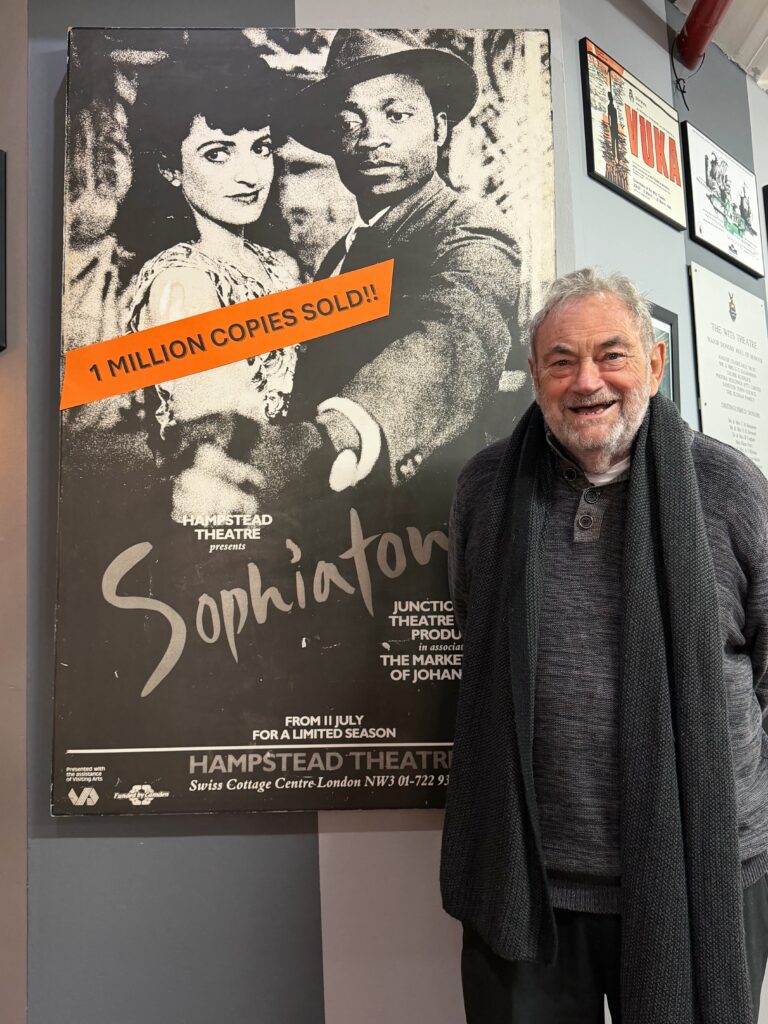
A photo of Malcolm Purkey standing next to Sophiatown board. Photo: Sikelelekile Pahlana
Purkey is a true Witsie, he started at Wits in 1970 and studied English, Sesotho and Ancient Greek. He initially dropped out because he had failed his undergraduate modules and found his way back to Wits, completing English One. Afterwards, he left school and worked in a theatre for six months, which marked the beginning of his theatre career. He left South Africa to go to Britain, and realised Britain was not home, in fact he came to the conclusion that: “I am neither African nor European, I am both.”
His return to Wits to complete his honours in English, built a box theatre in the Matrix alongside an architect and he also built The Nunnery theatre.
As Purkey spoke to Wits Vuvuzela, a vivid recollection of being taught the absurdist play, Waiting for Godot by Samuel Beckett by former English lecturer, Hilary Semple. A seminal moment for him.
“I’m an absurdist. Oh my God. There is no God. Oh, my God what am I supposed to do? So, what I did is I wrote [sic] an answer. Where the two characters who are looking, waiting for Godot, they finally get to heaven, and they find out that the realisation of a dream is hopelessly inadequate. The journey is all…That was the play I wrote, and it got professors saying nice things about it,” he shared.
The play in question was Sequel to Jeso (1971), which was one of his first plays shown at Wits, in the Great Hall.
Decades on, Purkey’s imprint in theatre continues to be felt the resurgence of the play Sophiatown (1986), which was recently on show at the Wits Theatre. Sophiatown has successfully sold one million copies of the play text published by Wits University Press and Macmillan Publishers which happens to also be a part of the current grade 11 first additional language curriculum.
Purkey believes that drama, as both a subject and medium, is a powerful tool. “Drama teaches you a whole lot of power, language, talking and being in the world.” He first learned just how powerful when he co-founded the Junction Avenue Theatre Company in 1976 and later joined forces with Workshop 71 to form a non-racial theatre group that could shed a light on the injustice of the Apartheid regime.
A guiding principle for the company was “history from below.” It “was the idea that we have to reveal the hidden history that the apartheid state wanted hidden, such as the destruction of Doornfontein, the destruction of Sophiatown, the ANC in exile,” he shared.
His first award followed shortly after in 1978, when Purkey won best director of the year for the play Travesties.
Through his work and life experience Purkey has been able to not only achieve much but also live up to his sense of purpose, which is: “To use theatre to communicate wonderful, contradictory, and telling ideas that reveal part of our worlds to ourselves and part of ourselves to ourselves that otherwise remain hidden”.
FEATURED IMAGE: A photo of Malcolm Purkey. Photo by: Sikelelekile Pahlana
The play Sophiatown balances the tragedy of displacement and forced removals with the joys of human connection, jazz, singing and dancing.
It is Saturday, April 11, 2026, and the theatre kid in me is geeking throughout the entire experience of witnessing the revival of Sophiatown on stage. A legacy, a history so rich, words cannot begin to describe the greatness embodied through the characters, the storytelling and the finer details that reflected the true intentionality in honouring and remembering Sophiatown.
Upon arrival, I was excited and deeply curious about what the play Sophiatown would actually be about. The audience sat in the lounge area of the Wits Theatre, anticipating the journey we were about to embark for the next two hours. Chatter and joy filled the lobby as we patiently waited for the show to start.
Boy, were we in for a true treat! Drum rolls and a groovy jazz tune is how we were introduced to Sophiatown, a fitting opening for a place known for its sonically rich cultural heritage and legacy. One of the main characters, Jack, took us back in time. It is the 1950s: typewriter on the desk, a bookshelf in the background, blue lights and the interior of a warm family home, await the rest of the characters.
Jack, an aspiring journalist, resurrects the legacy of Drum magazine by calling out names of the 1950 Drum legends such as: Can Themba, Lewis Nkosi, Bloke Modisane, and Todd Matshikiza, he highlights how they paved the way for African storytelling in Sophiatown at that point in time. Soon after, the rest of the characters join in on a chorus and soothes our ears with a sweet melody, the peanut gallery begins to cheer, and we have officially taken off.
The play is truly nothing short of amazing, and it importantly showcases how Sophiatown can never be solely understood through a singular lens or a singular story. It is culturally rich, consisting of diverse people, multiple races and different lived experiences. We are taken through a story of history, as the play reflects the severity of living under the apartheid regime which pushed for racial segregation and alienation. As one of the main characters Mingas says, “Sophiatown is not just about clubs and jazz, it is about war.”
The play explores the plight of BantuEducation, and the complexities of interracial relationships as we see through the arrival of a white Jewish girl, Ruth Golden, who is originally from Yeoville. She finds herself in Sophiatown after seeing an advertisement in the Drum magazine for the “diamond lady, number 17.”
Ruth’s presence at 65 Gerty Street in Sophiatown reflects the different living conditions between the white people and black people. Ruth is forced to adapt to life in Sophiatown, in a smaller house where everyone shares rooms, it enhances the complex relational dynamics between characters such as Lulu and Princess, Mingas, Jack and Fafi and the mother who all occupy the home.
Above all else, the play highlights the brutality of forced removals in Sophiatown with reference to the Native Resettlement Act of 1954. The apartheid regime used to remove black people from their homes, through bulldozing houses and destroying the infrastructure. The wound of displacement is so deeply felt by the audience as the characters are forcefully moved to Meadowlands.
Actors of Sophiatown play on stage. Photo by: Sikelelekile Pahlana
The play effectively and harmoniously balances light-heartedness through humour, singing and dancing with the seriousness of how violent the apartheid regime was.
The play asks to be remembered, embraced, and treated as a real point in time because it was and forever will be. We are urged into carrying the memory of Sophiatown with us and be conscious enough to ensure we never forget the pain, the joy and the collective fight it took for us to taste freedom, not idealistically yet in reality – to feel the things, the legends of those times always hoped to one day be a witness to.
I spoke to the writer, Malcolm Purkey, who said the play Sophiatown was created 40 years ago, in 1986 and it still stands today, a true testimony to its importance and relevance. When I asked him what he wanted people to take away from the play, he said, “If we found the right way, we could live together with respect. The gap of poverty and inequality is still there, and the war is not over,” Sophiatown reminds us of our common humanity and truly reflects the times, with dignity.
We are reminded, as Don Mattera once articulated, “Memory is a weapon!” Our history, South African history awaits you on the stage, it is worthwhile to go check it out and experience it for yourself. The play runs from April 11 to May 8, 2026. You will laugh, you may shed a tear, yet you will not regret it.
Vuvu Rating: 10/10.
FEATURED IMAGE: Picture of stage during Sophiatown play. Photo by: Sikelelekile Pahlana
After creating an award nominated play, six former Witsies, interwoven by the threads of their theatrical dreams, unite to start their own theatre company.
The curtains may have closed on the final run of the show Seeing Other People at the Theatre on the Square, Sandton, on Saturday, 22 July, but for the creators, it marks just the opening act of an exciting new journey.
After creating a three-time Naledi Theatre award-nominated play former Witsies Hira Lodhi, Martin Grendele, Naledi Modipa, Sasha Karlin, Hlumie Moloi and James Netherlands have started a theatre company named “Top Comedy”.
The group said founded the company for two reasons. Firstly, they thoroughly enjoy working together and share an undeniable performance chemistry and rapport. Secondly, creating this company provides them with a valuable support system.
“The theatre industry can be quite competitive, working together means we have each other to lean on for support in regards to creating work together,” said the group in a combined statement.
The idea of starting the company had been on the group’s mind since their days at the Wits theatre department, but they admitted that it “always seemed so out of reach.“. However, after the success they experienced with their play Seeing Other People starting the company felt like the right move.
The group wanted to make it clear that they are a theatre company, not a production company. “The major difference being that we don’t produce other theatre or works, except our own. We simply collaborate creatively to make a work of theatre [and to] generate online content.”
(From left to right) James Netherlands, Martin Grendele, Sasha Karlin, Hlumie Moloi, Hira Lodhi, Naledi Modipa posing for a “fun” photo after a performance of their award nominated show Seeing Other People at Theatre on the Square. Photo: Terri-Ann Brouwers
Commenting on the roles each member fulfils, they said that the roles change depending on the project they are working on and what each member wants to take on.
“For example, Hira Lodhi [was the] director, designer and producer of “Seeing Other People” while Martin Grendele [was the] producer and performer.”
The team says that their long-term goals are simply “To keep working. To keep creating”.
The future of the company looks bright as they are currently working on new theatrical and digital projects.
FEATURED IMAGE: The six Witsies who started Top Comedy after the final run of their award nominated show, Seeing Other People, at Theatre on the Square. Photo: Terri-Ann Brouwers
A new theatre culture is being created at The Market Theatre. A culture that goes beyond the boundaries of the spoken word by using a collection of languages, performances and emotions.
Vumani Oedipus is a collaborative effort between the Wits Theatre and The Market Theatre in Johannesburg. The play is a reworking of the classic Greek tragedy Oedipus Rex into an African rendition. Directed by Wits School of Arts (WSOA) lecturer Dr Samuel Ravengai, the majority of the cast and crew are Wits students with two students from The Market Laboratory Drama School also included.
POWER HUNGRY: Edipha (Lucky Ndlovu) kneels in front of three of the seven imbongis and Jocasta (Nomfundo Shezi) during the performance of Vumani Oedipus at The Market Theatre. Photo: Samantha Camara
Friday night’s performance was nothing short of energetic and focused making it difficult to choose a single stand-out moment. Each action was met with an equal reaction that made the story flow effortlessly and the hour fly by quicker than one would have hoped.
Lucky Ndlovu (Edipha) and Nomfundo Shezi (Jocasta) are the striking lead pair whose interactions captivate the audience throughout the performance.
The theatre was filled with a diverse group of audience members who laughed, gasped and sympathised with the characters.
The play is performed in about 60 percent English and the remainder in a variety of Nguni languages such as isiZulu, Seswati, isiXhosa and Ndebele. Despite the variety of languages used in the play and the intentional abscence of subtitles or interpretation, it is simple to follow even if you only understand one of the languages used.
The performance relies far more on emotion and physical performance than the spoken word. The facial expressions from perfomers such as Sibusiso Mkhize (Kiliyoni) were more than enough to follow what is happening.
TRAGEDY: From front, Edipha (Lucky Ndlovu) is helped up by the court attendant (Sandile Mazibuko) while Kiliyoni (Sibusiso Mkize) watches during the performance of Vumani Oedipus at The Market Theatre. Photo: Samantha Camara
Although the story of Edipha was one of prophesised tragedy and the audience left the theatre feeling heart sore for the characters, there were a number of light-hearted moments. Fumani Moeketsi (Thilesi The Sangoma) was responsible for many of these moments with her witty retorts and fiesty attitude.
The performance flowed perfectly from beginning to end and it was a pleasure to watch young talent perform with such passion, energy and professionalism.
Vumani Oedipus is showing at The Market Theatre’s Barney Simon Theatre until Sunday, October 11.
Since her announcement as the Democratic Alliance’s mayoral candidate for Johannesburg, Helen Zille has dominated national headlines. In this bonus episode of We Should Be Writing podcast, hosts Lulah Mapiye and Bonolo Mokonoto dissect a media meet-and-greet with the mayoral hopeful. From her extensive political résumé to her controversial public utterance, we examine why the Democratic Alliance has chosen Hellen Zille as their candidate for the 2027 local mayoral elections. Additionally, […]