Wits students react to the Zara x John Galliano collab. In a cost-of-living crisis, is the designer label still a status symbol or just overpriced plastic?
Global high-fashion icon John Galliano signs a historic two-year creative partnership with Zara.
Wits students are divided; some chase the ‘status’ of the label, while others slam the ‘tacky’ dilution of luxury.
The rise of high-quality ‘dupes’ and fast fashion collabs is blurring the line between prestige and plastic.
Luxury used to be defined by exclusivity, the rustle of silk, the weight of hand-stitched leather, and a price tag that felt like a gatekeeper. But as Vogue reports about the unexpected two-year partnership between the legendary John Galliano and fast-fashion giant Zara, the golden gates of high fashion have swung wide open. Wits students may be far away from the fashion high streets of Milan or Paris, but they had something to say about the reported collaboration.
The collaboration, set to debut in September 2026, marks the return of Galliano (the former Dior creative director known for theatrical couture) to the mass market.
For Lindani Dweba, a final-year BA student majoring in Politics and HR, the allure is simple: the name. “I would buy for the name,” Dweba admits. When faced with the choice between a R1,800 designer-labelled polyester jacket and a R200 thrifted wool coat, he leans toward the label. “Preferably the label. But luxury is becoming cheapened because of alternatives making the same thing.”
However, not everyone is buying the hype. For Caleb Boroto, a first-year Film and TV student, the collaboration feels “tacky.” Boroto argues that someone of Galliano’s regard partnering with a fast-fashion brand strips away the luxury feel entirely. “Gun to my head, I’d pick the R200 wool jacket,” says Boroto. “I’d prefer to be sustainable and choose something that lasts, like wool or cotton.”
The Reality of Aspiration: Lindani Dweba, a final year student, wears Nike P-6000s (R2,399), which serve as an attainable alternative to luxury items like the Gucci Rhyton sneaker (R21,700). Photo: Daniella Ripamonti
Katlego Hlahla, a third-year Actuarial Science student, echoes this scepticism, noting that luxury prices often feel “unnecessarily inflated” for the quality provided. As Zara’s prices creep up, the lines between ‘high street’ and ‘high end’ are blurred.
The psychology of the label remains a powerful force, even when the quality is questionable. Sephaku Tshoshi and Kirsten Pudi, both fourth-year Accounting Science students, admit they would choose a designer name over a thrifted bargain any day. “I wouldn’t get the same bag without the name, even if the quality was the same,” said one of the students, gesturing to her Ted Baker tote. They noted that the rise of high-quality “dupes” has made luxury more accessible, but also less significant. “People are buying fakes now, even people with money. You can’t tell the difference anymore.”
Psychology Honours students Daiyaan Kahan and Jake Fourie said that “accessibility cheapens the value, but people still buy it for the status symbol.” Fourie, however, sees the positive side, “If it’s more accessible, it’s overall good. More people representing a brand is good for the brand’s expansion” he stated
As the Zara x Galliano collection prepares to hit shelves, the Wits campus remains a tug-of-war between the desire for status and the demand for authenticity. In an era where ‘luxury’ can be bought at the mall in a plastic bag, real luxury might just be the ability to tell the difference.
FEATURED IMAGE: Reframing the Aesthetic: By pairing a sporty PUMA track jacket with tailored pinstripe trousers and formal loafers, Demitri Michaud, a postgraduate student, demonstrates a ‘high-low’ styling approach that mirrors global trends of deconstructed luxury. Photo: Daniella Ripamonti
Thrifting may be trendy, but for many students, it is simply the cheapest way to afford fashion.
Economic necessity and “instant gratification” drive some Wits students to second-hand shopping.
The Matrix’s Zaza Clothing reports its busiest year yet as students ditch retail for quality and affordability.
Hidden online fees and poor garment quality are making global fast-fashion giants less appealing to local youth.
In the heart of Braamfontein, the ‘thrift flip’ is more than just a curated style; it is a survival strategy. As South Africa faces a cost-of-living crisis, students are increasingly searching for the perfect R50 vintage shirt. This shift has turned a trendy pastime into a financial necessity.
While discussions about second-hand shopping often highlight ‘slow fashion’ and sustainability, the reality in hubs like Melville and Braam tells a different story. For many of The University of the Witwatersrand (Wits) students, thrifting isn’t about saving the planet; it is about saving their bank balance.
On the top floor of the Matrix, the energy at Zaza Clothing is a testament to this shift. Since opening in March 2023, owner Ali Monama says business has grown every year, but 2026 is by far the busiest he has seen.
“I chose the Matrix because fashion starts with the youth,” Monama says. He notes that while sustainability is a plus, the economy is the real driver. “Thrifting is critical for the economy right now. People prefer it because modern retail clothes don’t last, whereas vintage leather and denim are pure quality,” he adds.
The price tags at Zaza Clothing offer a stark alternative to the mall, ranging from R20 earrings to R600 Doc Marten boots. The prices are what appeal to students like Thulani Bikili, a second-year civil engineering student. Bikili thrifts twice a month specifically because of the cost-of-living crisis. “Retail stores are just overpriced,” he says.
For some, the appeal is a mix of budget and “instant gratification.” First-year electrical engineering students, Siyamthanda Mazwan and Naomi Makangume, argue that while sustainability is a “secondary perk,” the real win is finding unique items that allow them to avoid “following the crowd.”
Picture of students browsing through a clothes rack at Zaza Clothing. Photo: Daniella Ripamonti
The duo also highlighted the growing frustration with online giants like Shein. Between unpredictable shipping times and hidden customs fees, they’ve started questioning the true cost of “cheap” online hauls. “Is it really cheaper if I’m paying for all these other hidden fees?” They ask. “With thrifting, you get what you buy then and there. You can actually try it on to see if it fits.”
As financial pressures continue to reshape student life, the shift toward second-hand clothing reveals a generation that is becoming increasingly resourceful. Whether it’s to find a one-of-a-kind vintage piece or simply to survive the month, the students at Wits are proving that in the struggle between ethical spending and economic reality, the price tag, and the quality, is winning every time.
FEATURED IMAGE: Picture of sunglasses and ties taken at Zaza Clothing store in The Matrix. Photo: Daniella Ripamonti
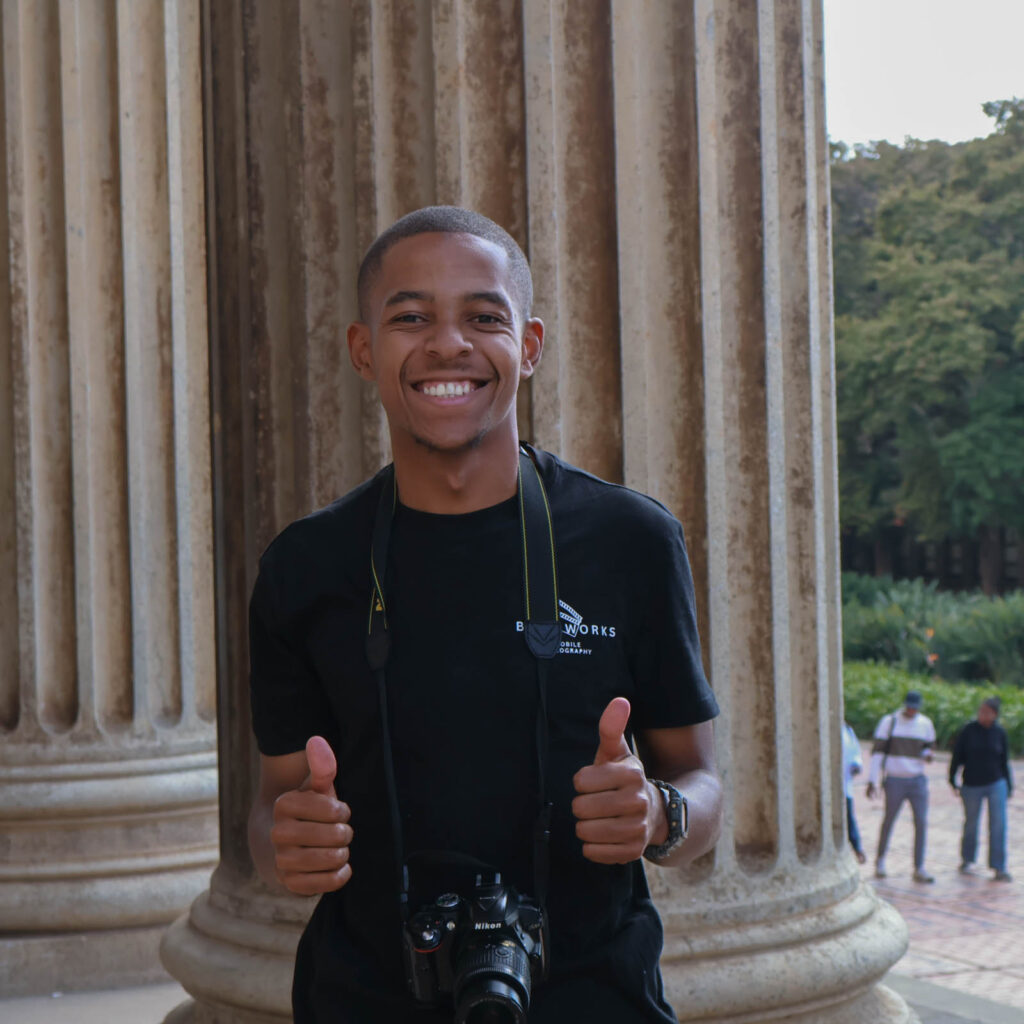
Student photographers at Wits University raise concerns over being denied the opportunity to work during graduation season after missing an accreditation deadline they claim was not clearly communicated.
Student photographers were denied access to graduation due to a permit system.
Many missed the deadline because communication was unclear.
Students are calling for better communication and inclusion in future.
Over the past two weeks, Wits University Campus has been filled with celebrations as graduates marked a significant milestone. For many, taking photos at iconic locations such as the Great Hall has become a tradition. However, this year, some students were forced to make alternative arrangements after unaccredited photographers were denied access.
The university introduced a system requiring photographers to obtain permits to operate during the graduation period. A limited number of registered photographers were allowed to work in designated outdoor public areas, while Campus Protection Services (CPS) removed those without permits.
According to the Examination and Graduation Office (EGO), the application process was posted on the university website ahead of the graduation period. Officials say that the system aims to manage the high volume of people on campus and ensure safety during the ceremonies.
However, several student photographers say they were unaware of the process until it was too late.
A student photographer with they camera around they neck by the Great Hall. Photo: Sanele Sithole
Bakithi Mntungwa, a Bachelor of Education Honours student, said he only learned about the permit requirement shortly before graduations began.
“I only found out about the permit a few days before the first day of graduation, when I was already booked to take photos. By then, the application had already closed around February,” he said.
Other students echoed similar frustrations.
Thabo Mthembu, a Mining Engineering student, said while he understands the reasoning behind the rule, he believes student photographers should have been prioritised.
“I understand the need for regulation, but I had hoped student photographers would be given priority,” Mthembu said.
Mthembu also described difficulties accessing campus with his equipment, despite being a registered student, saying he was denied entry by security.
Students argue that communication could have been improved through official university channels such as email or social media platforms. They pointed to previous opportunities, such as photography competitions, which were widely advertised to students.
“When the applications closed, I was still dealing with registration and financial issues. Checking the website was the last thing on my mind,” Mntungwa added.
While acknowledging the importance of safety and organisation during graduation, both photographers believe that clearer communication and greater inclusion of student creatives could have prevented missed opportunities.
As graduation season has ended, students are calling for more transparent processes and better access in the future so that student photographers are not only present on campus, but part of capturing its most important moments.
Questions were sent to the EGO for comment, specifically regarding concerns raised by student photographers, but no response was received by the time of publication.
FEATURED IMAGE: A student photographer by the Great Hall taking a picture of the landscape. Photo: Sanele Sithole
Urban settlements such as townships are being created in rural areas which has raised concerns over ownership and the role of municipal authority.
Urban settlements formed on the outskirts of cities are far cheaper for the average South African.
Public infrastructure and basic services are provided through privatized services and investments.
Community chiefs are granted more authority and jurisdiction over these urban settlements compared to the municipalities that govern them.
South Africa’s cities were never designed equally. Under Apartheid, millions of black South Africans were pushed to the outskirts of cities through policies such as the Group Areas Act, which enforced racial segregation and forced removals.
Decades later, the spacial legacy lives on as those policies continue to shape where people live.
The New South Institute (NIS) hosted a dialogue on March 11, 2026, with the emergence of urban settlements beyond conventional planning systems, specifically on land governed by traditional authorities, on the agenda.
In a research paper, Professor Andries du Toit, NIS affiliate researcher and his team argue that these “settlements should be recognized as a distinct South African urban form, an auto-constructed suburbia, under informal institutions.”
The houses built in these areas, like KwaMhlanga (Mpumalanga), Dassenhoek (eThekwini), Hammanskraal (Tshwane) and Kabokweni (Mbombela region), receive public infrastructure and services. These include roads, water and electricity, which are provided by private companies and/or private arrangements instead of their designated municipality.
“There is a limited investment in social and community infrastructure particularly in the form of churches – people who live in these areas are going to have to travel and spend a lot of time traveling to access education and various other social opportunities and services,” said Dr. Andrew Charman, NIS affiliate researcher.
The New South Institute (NIS) dialogue on working paper, Urban Settlements on Traditional Authority Land: Four case studies. From left to right: Dr. Andrew Charman, Prof. Andries du Toit, Dr. Gaynor Paradza and Prof. Mfaniseni Sihlongonyane. Photo: Bonolo Mokonoto
The residents of these settlements are not given property with prospects of receiving a title deed, they are given a permission to occupy from the chief of the land. “It is not a deed of sale, you haven’t bought the land, you essentially paid the traditional authority for the service of allocation,” said du Toit.
Dr. Gaynor Paradza from the Public Affairs Research Institute (PARI) said, “At most a municipality owns like 12 percent of the land in its jurisdiction and sometimes as little as two percent – as a municipality [they] don’t even have a say on what is going on.” The chief of the land is able to make authoritative decisions granted that they have the support and consent of the community.
The New South Institute (NIS) dialogue on working paper, Urban Settlements on Traditional Authority Land: Four case studies. From left to right: Prof. Andries du Toit, Dr. Gaynor Paradza and Prof. Mfaniseni Sihlongonyane. Photo: Bonolo Mokonoto
“The bottom line is that chiefs make decisions about land allocation, meaning that they are involved in town planning,” said Professor Mfaniseni Sihlongonyane head of the school of Architecture and Planning at wits university. “Maybe there are multiple visions of what cities should be especially in the African context,” he said.
As housing costs rise in central urban areas, many find themselves settling on land that is governed by traditional leaders on the outskirts of cities, as it is more affordable. But the flipside is that they aren’t catered for by the municipality they fall under.
FEATURED ARTICLES: The New South Institute (NIS) dialogue on working paper, Urban Settlements on Traditional Authority Land: Four case studies. From left to right: Dr. Gaynor Paradza, Prof. Mfaniseni Sihlongonyane and Dr. Ngaka Mosiane. Photo: Bonolo Mokonoto.
The war in the Middle East deeply impacts the lives of people across the globe and South Africa is no exception.
Millions of people woke up to the breaking news on their screens, that the United States of America and the State of Israel, launched airstrikes targeted at Iran’s military bases and nuclear-related-infrastructure, on February 28, 2026. The prospects of a war started brewing after negotiations between the U.S and Iran in early February hit a dead end.
Iran’s Supreme Leader Ayatollah Ali Khamenei was killed by attacks from Israel and the U.S, and the current death toll in Iran currently surpasses 1, 000. Iran has responded by launching missiles and drones towards Israel and targeting U.S military bases across the Middle East. The countries affected by the attacks from Iran include Saudi Arabia, United Arab Emirates and Kuwait.
But it was the confirmed closure of the Strait of Hormuz on March 2, that had an immediate global impact . According to Reuters, Iranian officials announced that the shipping corridor will be closed and any ship that attempts to pass through will be attacked.
Approximately 20% of the world’s oil supply passes through the Strait of Hormuz, which means global oil prices, inflation, food and petrol prices are likely to increase significantly in the short term.
South Africa imports oil in large quantities, most of its crude oil supply coming from Nigeria and Saudi Arabia. This means that citizens will experience higher petrol prices and businesses will experience delayed goods from abroad. The impact was felt instantly as the minister of Mineral and Petroleum Gwede Mantashe announced an increase in fuel prices effective from March 4, as a result of the current international factors. The price of petrol increased by 20c and diesel by 65c, residents still await further changes as the war continues.
Behind the geopolitical strategies and missile attacks we watch from a distance are thousands of people whose lives have now been forever altered. Families are watching their homes and communities destroyed and those far removed from the shockwaves deal with rising costs and uncertainty.
As the situation unfolds, we are confronted with the fact that war is never limited to the countries fighting it, its impact is felt by everyone. We all mourn and feel the pain of those directly impacted.
Until the day global leaders choose dialogue and peace over destruction and violence, it will be us, ordinary citizens who continue to pay the price for their negligent and violent behaviour.
FEATURED IMAGE: Graphic depicting the joint allies the United States of America and the State of Israel, above Iran. Graphic by: Bonolo Mokonoto
After months of volunteer clean-ups and security upgrades, the heritage site welcomed visitors to the revived space.
The Braamfontein Cemetery wants locals to use the premises for educational and research purposes.
The cemetery has increased its safety measures around the area, as many visitors felt unsafe due to unsecured perimeters.
Visitors can ask for a security escort when venturing deeper onto the property.
The Braamfontein cemetery is regarded as one of the most historically significant places in Johannesburg, but some residents do not feel comfortable visiting due to safety concerns and negative experiences.
The cemetery reopened its gates on February 22, 2026 with increased security for grieving families and rebranded as a public heritage site open for walking tours and educational visits.
Volunteers cleaning up at the Braamfontein Cemetery. Photo: Bonolo Mokonoto
“Just walk, enjoy the space, enjoy the beauty of the architecture of the cemetery”, said Antoinette Morgan, from Friends of Johannesburg Cemeteries (FOJC), a group under the Johannesburg Heritage Foundation (JHF).
“This cemetery has a lot of the old Rand pioneers – the early people who came to establish their life in Johannesburg”, said Morgan. The cemetery is home to many historical figures, such as “David Draper, who was the geologist who first had mass water production pumped up to the highfeld” and “of course Enoch Sontonga” she added.
The architecture at the cemetery beautifully captures its era. Nicola Noble from FOJC working with JHF, said: “The design of the crematorium almost hides its purpose, it is in the shape of – a neo- Romanesque chapel – it resembles a church.”
The crematorium at the Braamfontein Cemetery, with four furnaces. Photo: Bonolo Mokonoto
Morgan said, “A lot of the perimeter fencing was missing on both sides, so people would just walk across the cemetery at will.”
“With a lot of work with Johannesburg City Parks and Zoo, we managed to get them to secure the perimeter fencing on both sides – it is still palisade but it is more secure”, she states that there are guards at each gate and roaming guards throughout the cemetery.
When people want to go deeper into the cemetery for research and feel uncomfortable, they can now ask a guard to guide them through.
Johannesburg City Parks and Zoo did not respond to requests for comment at the time of publication.
FEATURED IMAGE: Graves taken at the Braamfontein Cemetery. Photo: Bonolo Mokonoto
On Monday, February 23, Gauteng Premier Panyaza Lesufi delivered the State of the Province Address (SOPA) at the Nesrec Expo Centre. It is unfortunate that he did not come well prepared to address the electricity issues currently challenging residents in this province.
Yes, the minister of electricity has put an end to nationwide load shedding. However, what are his plans for the ongoing blackouts? The stations are constrained, there are illegal connections, cable theft, the infrastructure is old, we have heard of these reasons and need solutions that will last. Renaming the problem is not solving it. Blackouts are even worse as they are unplanned and last for days on end.
We saw the headlines regarding the recovered R3 million worth of cooper cables. Premier, why did you not give us a detailed strategy on how you plan to prevent this cable theft from happening again? Strong security measures need to be implemented at cable theft hotspots. The people of Gauteng deserve to spend the electricity they pay for without paying extra for generators, solar, gas appliances, data and fast foods.
There were no funds allocated to fixing the old substations and transformers in our province, which are also reasons for the constant trips in electricity supply. Out of the 15 investments he mentioned, from water reservoirs to houses and fast trains, not one investment was allocated to this problem.
City Power in Johannesburg has been screaming “systems constrained due to rising population.” Where are the plans to address this overpopulation within the province as it is one of the major factors affecting our power supply.
The project of turning recyclable waste into energy could really benefit us. As it is currently being done in Bushbuckridge, Mpumalanga, it has proven both profitable and reliable. It would be like killing two birds with one stone as we also struggle with land pollution in Johannesburg.
As we look forward to the upcoming SOPA debates, we expect this shortcoming to be addressed in the house.
The pressure of the beauty maintenance day is piling up and emptying the pockets of many.
There was a time when “beauty maintenance” meant styling your hair and maybe getting it trimmed before school picture day. That was all that was required of you. Now? The expectations for women in particular feel endless – lashes, nails, hair, waxing, eyebrow shaping, facials, wig installs – the list just keeps growing. What used to be simple personal grooming has evolved into a full-time job, that requires a whole day off.
Let me be clear: personal grooming is important. Looking after yourself can boost your confidence, self- esteem, improve hygiene, and contribute to your overall self-care. There is nothing wrong with wanting to feel put together. However, somewhere along the way, beauty maintenance stopped being about feeling good and started feeling like a requirement.
Hair being braded. Photo: Bonolo Mokonoto
A full “maintenance day” for me can easily cost up to R1500. That’s a significant amount of money to spend. Between work, transport, and everyday expenses, budgeting for lashes and nails every few weeks isn’t always realistic. Social media and societal pressures can make beauty maintenance feel necessary.
Nails being cured under a UVA light. Photo: Bonolo Mokonoto
Braamfontein and Johannesburg CBD has a huge selection of beauty salons and maintenance spots. On almost every corner there are nails, brows, or hair services on offer. The options are endless, but unfortunately, the quality isn’t always guaranteed. Many students have experienced rushed appointments, unprofessional service, or results that don’t match the price paid.
The bigger issue, though, is the societal pressure attached to it all. When i walk into a lecture hall and the majority of people have their nails done and frontals installed, it makes me feel like I do not fit in. There is this unspoken expectation that to be “put together,” you must have your lashes done, nails fresh, edges laid, and brows perfectly shaped. And for young women, especially myself, navigating identity and confidence, that pressure can weigh heavy.
A wig getting prepared to get installed. Photo: Bonolo Mokonoto
I think beauty regiments should be about self-expression, self-care and evoke joy. They should make you happy, not anxious about keeping up with the trends. It should feel like self-love, not a compulsory checklist, added onto your budget.
So, before you book your next appointment, do it because you genuinely love how it makes you feel, not because it’s trending.
FEATURED IMAGE: Hair being braded. Photo: Bonolo Mokonoto
An ode to Motown is for the lovers of classic nostalgic music and is a must-see performance.
On February 22, I attended An Ode to Motown, a production staged in celebration of Black History Month, at Joburg Theatre. What unfolded was more than a tribute concert; it was a vibrant, high-energy homage to one of the most influential musical movements to emerge from 20th-century America.
Motown, founded in Detroit in 1959, became the heartbeat of Black American music, introducing the world to artists who would shape pop, soul and R&B for generations. The show paid tribute to this rich history, revisiting classics that still resonate across continents.
There was not an empty seat in sight.
From the opening notes, the audience was transported into a world of polished harmonies, synchronised choreography and timeless storytelling.
The singing was exceptional, powerful yet controlled, capturing the emotional depth that defines Motown. The performers, Liesl Penniken, Lerato Mvelase, Tamara Dey, Hlengiwe Pearl, and Anele Precious Mthethwa, moved effortlessly through beloved hits.
An ode to Motown show image. Photo: Supplied/B Sharp entertainment
Hits such as “Mr. Postman,” “Ain’t No Mountain High Enough,” and “I’m Coming Out,” each song greeted with cheers and nostalgic excitement. The inclusion of “Cruisin”, “Call Tyrone,” and “Water Runs Dry,” along with two soulful renditions of songs by Erykah Badu, broadened the tribute to include neo-soul influences that echo Motown’s legacy.
Quotations from songs by Smokey Robinson added a poetic thread, reminding us of the lyrical genius that defined the era.
Visually, the production was stunning. The performers dazzled in gorgeous, extravagant gowns that shimmered beneath the stage lights. The intricate choreography was both elegant and dynamic, matching the vibrancy of the live band. The theatre itself seemed to pulse with the vibrations of an enthusiastic crowd, their energy feeding the performers on stage.
Yet the show also raises an interesting question: what relevance does Motown’s history hold for South Africa? In some ways, staging this tribute here is like hosting a concert in the United States commemorating the artists of Sophiatown. It is a celebration of a distinctly American Black cultural movement, performed for lovers of classic American music and for those who admire the monumental Black artists who emerged from that era. At the same time, it highlights the global reach of Black music and its power to connect polarizing histories.
Ultimately, An Ode to Motown was a joyful, nostalgic, and beautifully executed celebration. One that proves Motown’s rhythm still moves audiences, no matter where they are in the world.
Vuvu rating 9.5/ 10
FEATURED IMAGE: An ode to Motown, performance on February 22 at the Joburg theatre. Photo: Bonolo Mokonoto
After a month of intermittent blackouts, City Power has upgraded to weekend-long power cuts.
Braamfontein has been experiencing blackouts since Saturday morning.
Residents and businesses bare the consequences of old infrastructure.
City Power restored power on Monday afternoon.
On Saturday morning, Braamfontein residents woke up to another blackout, which led to a morning of cold-water baths, dead batteries, unironed clothes, cold meals and loud generators drowning each other out.
After a month of experiencing weekly unplanned blackouts for a couple of hours per incident, Braamfontein residents did not know that this one was different.
City Power said the outage occurred following a trip from Fordsburg Substation, which affected Braamfontein, Parktown and surrounding areas.
This trip led to three faults on a Braamfontein interconnector cable. As of this morning, two of the three faults have been located, but repairs were underway, said to City Power.
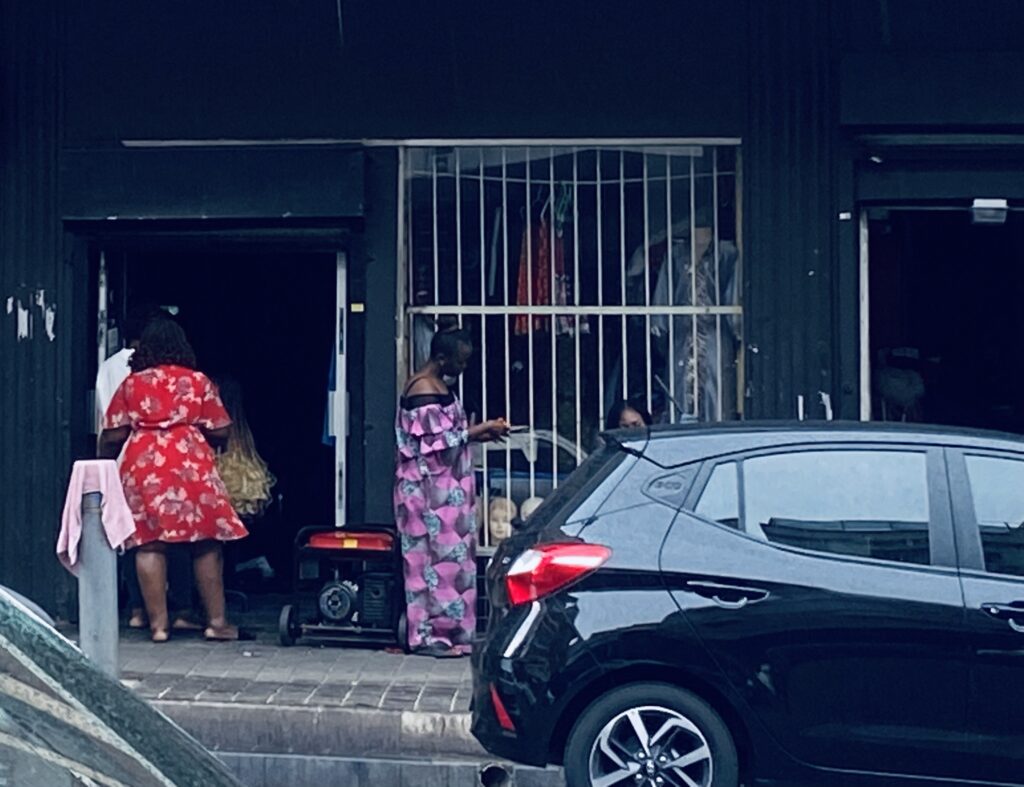
Some businesses have been closed since Saturday morning as they do not have backup power. Hairdressers are operating outside their salons for light.
Hairdressers in Braamfontein attending to their customers outside the salon due to power cuts. Photo: Lulah Mapiye
“I have to do everything in the dark and spend extra money on data since the Wi-Fi is off. City Power needs to start paying us back for the electricity we pay for and don’t have,” said Tebogo Lebeya, resident of Braamfontein.
City Power said that due to existing network faults, customers cannot be backfed from alternative supply points.
They attributed these power faults to cable faults and damage caused by third parties. The disruptions are further linked to ageing infrastructure, illegal connections and sustained overloading of the network.
Sylvester Ayuk, owner of Estee Ay Communications, a printing business in Braamfontein, said: “Our clients are disappointed as we failed to meet deadlines over the past weekend. Our generator was only able to power one printing machine, we only managed to complete a few orders. We are calling upon the management to be quick to restore power next time.”
Amorette Anyang Onya, a nail technician, had to go to another town to charge her nail lamp, which she uses to dry nail polish.
“Having no electricity really slowed down my business. The time I used to go to another town to charge and come back, I could have used treating a customer or two,” she said.
The initial estimated restoration time was 18:00 on Saturday, February 21. The revised date of Monday, February 23 at 12 was unmet, and power was only restored at about 15:30 on the day.
FEATURED IMAGE: Generator powering a salon in Braamfontein due to power cuts. Photo: Lulah Mapiye
Johannesburg’s water crisis is heavily restricting the daily lives of citizens.
For the past month, the City of Johannesburg has been struggling with a water crisis that has exposed serious cracks within local governance and infrastructure. What started off as a short outage has now spiralled out of control.
Residents have been frustrated by the lack of water services across Johannesburg the city. From Melville, Westdene, Parktown west and Emmarentia, some residents have gone more than 20 days without water.
Johannesburg can not claim to be a world- class African city, while its residents are standing in queues at water tanks for over three weeks. This lack of service delivery is inhumane. Water is a basic need, and the municipality needs to ensure at that this service is delivered to all residents efficiently.
Volunteers in Melville have organised communal water tanks with strict limits per household simply to ensure survival. For elderly residents and families with small children, the daily act of securing water has become exhausting.
Frustration has spilt onto the streets as peaceful protests are being carried out. Protests have erupted in Melville. Residents are angry at the lack of urgency shown by the government. All the while, some are missing school, work, being put through unhygienic conditions and emotional stress.
City officials point to ageing infrastructure, pressure management systems, maintenance backlogs and lack of coordination with Rand Water as part of the problem. The Government has announced intervention plans and committees aimed at stabilising the water supply. But for residents living day to day without running water, these long-term strategies offer little immediate relief.
The lack of planning and leadership is now being highlighted as residents are being impacted. The city of Johannesburg must move pass crisis management and implement sustainable and reliable service delivery.
When taps begin to run dry, this is an indication that governance has failed and South African citizens have to now pay the price.
FEATURED IMAGE: Two plastic containers of water, half empty. Photo: Bonolo Mokonoto
South Africa is again debating the name changes of provinces and towns.
Over the past month, there has been nationwide debate over the name changes of various towns and provinces. This puts into question South Africa’s history and if we should preserve the current names as a reminder or change them to honour our heritage.
Name changes carry real and expensive costs. The updating of maps, road signs, business branding and tourism material require funding and resources that could be used elsewhere. The country has a multitude of more pressing issues – such as a high unemployment rate, and water and electricity shortages- changing the names of provinces and towns shouldn’t be the top priority for the current economic climate of South Africa.
The Eastern Cape’s is currently undergoing a massive transformation on this front. Gayton McKenzie , the Minister of Sports, Arts and Culture, approved 21 geographical name changes, including renaming East London to KuGompo and Graaff-Reinet to Robert Sobukwe Town. This has been in line with public consultations and recommendations made from the South African Geographical Names Council.
The name changes are yet to be confirmed as it is the department’s ongoing commitment to ensure that the names highlight the country’s diverse heritage and history. Most residents in Eastern Cape are against the name changes highlighting that the towns historical identity and heritage should remain, as this keeps history intact.
Other residents argue that the changes are long overdue, as the original names are reminiscent of our history and it is important to keep reminders around, so that people do not forget. The renaming project can be viewed as a form of decolonialisation and reclaiming our history and instilling pride over the South African landscape.
King Misuzulu kaZwelithini recently reignited the debate by calling for the removal of “Natal”, from the provincial name “KwaZulu-Natal”, he argues that before colonial efforts the area was simply called KwaZulu. The Zulu king is pleading with politicians to broaden the public debate about these historical boarders as they have been shaped by colonial authorities.
The African National Congress (ANC) has responded cautiously, particularly around the proposals to rename KwaZulu-Natal, stressing that it has not yet adopted an official position on the matter. The party emphasised that any provincial name changes must follow proper constitutional and legal processes.
As the debate continues, we need to critically ask ourselves what impact the name changes will have on the community, whether positive or negative, it will be the residents that deal with the massive changes, and their opinion is of high importance.
FEATURED IMAGE: Geographical name changes debate. Graphic by: Bonolo Mokonoto
Since her announcement as the Democratic Alliance’s mayoral candidate for Johannesburg, Helen Zille has dominated national headlines. In this bonus episode of We Should Be Writing podcast, hosts Lulah Mapiye and Bonolo Mokonoto dissect a media meet-and-greet with the mayoral hopeful. From her extensive political résumé to her controversial public utterance, we examine why the Democratic Alliance has chosen Hellen Zille as their candidate for the 2027 local mayoral elections. Additionally, […]