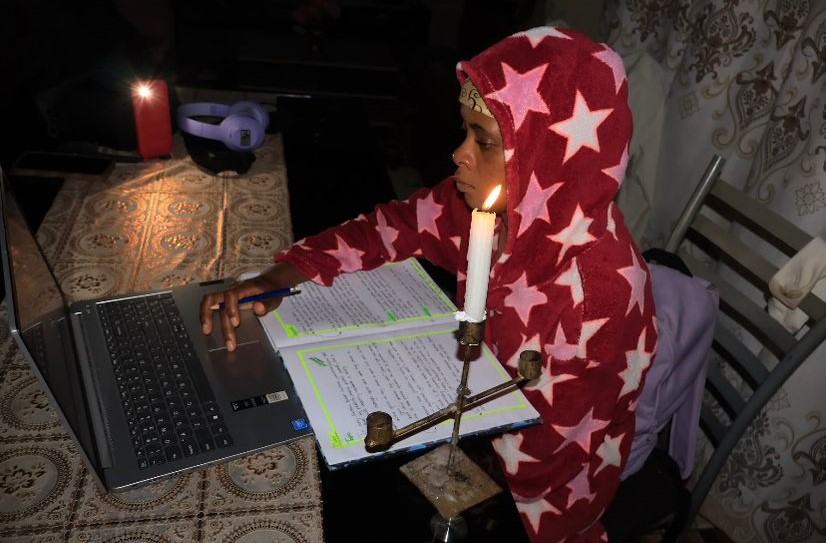
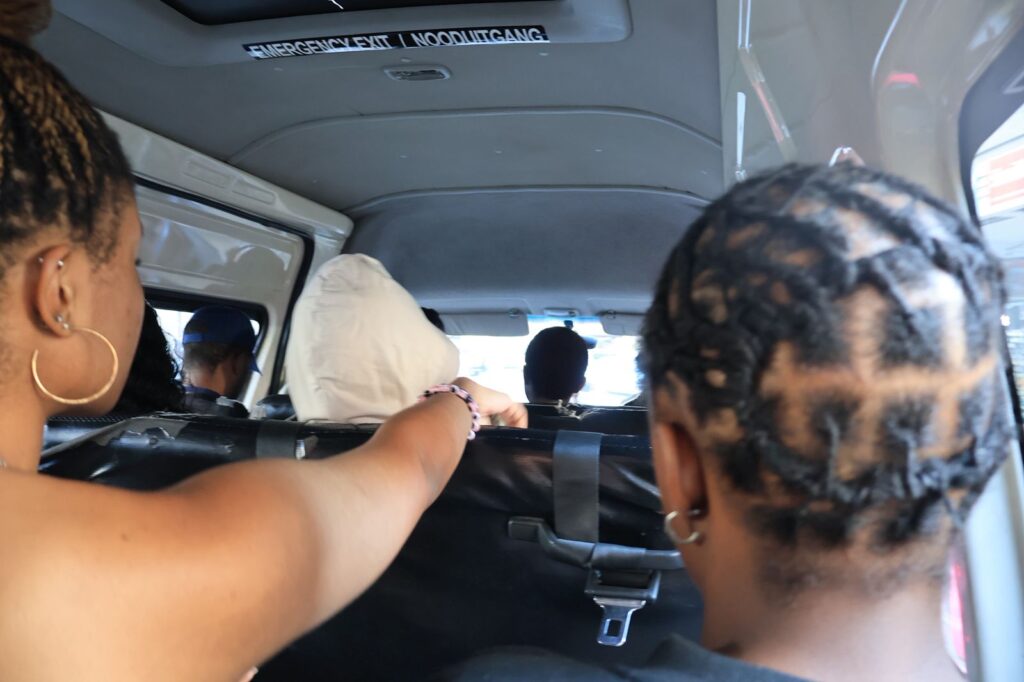
Johannesburg’s water crisis is heavily restricting the daily lives of citizens.
For the past month, the City of Johannesburg has been struggling with a water crisis that has exposed serious cracks within local governance and infrastructure. What started off as a short outage has now spiralled out of control.
Residents have been frustrated by the lack of water services across Johannesburg the city. From Melville, Westdene, Parktown west and Emmarentia, some residents have gone more than 20 days without water.
Johannesburg can not claim to be a world- class African city, while its residents are standing in queues at water tanks for over three weeks. This lack of service delivery is inhumane. Water is a basic need, and the municipality needs to ensure at that this service is delivered to all residents efficiently.
Volunteers in Melville have organised communal water tanks with strict limits per household simply to ensure survival. For elderly residents and families with small children, the daily act of securing water has become exhausting.
Frustration has spilt onto the streets as peaceful protests are being carried out. Protests have erupted in Melville. Residents are angry at the lack of urgency shown by the government. All the while, some are missing school, work, being put through unhygienic conditions and emotional stress.
City officials point to ageing infrastructure, pressure management systems, maintenance backlogs and lack of coordination with Rand Water as part of the problem. The Government has announced intervention plans and committees aimed at stabilising the water supply. But for residents living day to day without running water, these long-term strategies offer little immediate relief.
The lack of planning and leadership is now being highlighted as residents are being impacted. The city of Johannesburg must move pass crisis management and implement sustainable and reliable service delivery.
When taps begin to run dry, this is an indication that governance has failed and South African citizens have to now pay the price.
FEATURED IMAGE: Two plastic containers of water, half empty. Photo: Bonolo Mokonoto
The increase in the minimum wage amount is not as impactful as the minister of labour and employment would suggest.
The minimum wage amount has increased to R30, 23 per hour from R28, 79 per hour.
The new minimum wage is still not enough to sustain South Africans.
Millions still struggle to cater to their basic needs.
The minimum wage amount is set to increase to R30,23 per hour, from R28,23 per hour as of March 1, 2026. South Africans are beyond frustrated by this small change.
“The income is basically the same, given that the economy is also changing. [The government] increasing the minimum wage doesn’t change the fact that things are also getting more expensive. If, lets say, they were increasing the wages, but the economy’s status was still the same at least [there] would be a bit of a change, compared to right now,” said Rose Mongwe, a third-year bachelor of education student.
The minimal increase, means Mongwe, whose mother is a domestic worker will not get an allowance increase this year. She uses what her mom can give her for toiletries and other personal needs. “It is not [as much] as I would want it to be but then it kind of helps here and there and sustains me when I’m unable to get some money for myself,” she said.
Muhammed Siyad the Regional Investment Growth Manager for Southern Gauteng at Absa said, “At the rate at which inflation is climbing, this increase of the minimum wage amount per hour I don’t feel it would affect any households in a positive sense, the reason for that is everything else is getting more expensive, its making it harder for people to manage based on the current salaries.”
Neo Bapela honours in bachelor of education said, “I feel like the [minimum wages amount] is very little, but also it goes according to peoples’ responsibilities, I might think that the money is enough for me, because I don’t have kids, I don’t have other responsibilities.”
The increase of the minimum wage amount does not keep up with the rising cost of living. Many households continue to stretch out their money, the increase of R1,44 offers little to no relief.
FEATURED IMAGE: Cash and coins. Photo: Bonolo Mokonoto
South Africa is again debating the name changes of provinces and towns.
Over the past month, there has been nationwide debate over the name changes of various towns and provinces. This puts into question South Africa’s history and if we should preserve the current names as a reminder or change them to honour our heritage.
Name changes carry real and expensive costs. The updating of maps, road signs, business branding and tourism material require funding and resources that could be used elsewhere. The country has a multitude of more pressing issues – such as a high unemployment rate, and water and electricity shortages- changing the names of provinces and towns shouldn’t be the top priority for the current economic climate of South Africa.
The Eastern Cape’s is currently undergoing a massive transformation on this front. Gayton McKenzie , the Minister of Sports, Arts and Culture, approved 21 geographical name changes, including renaming East London to KuGompo and Graaff-Reinet to Robert Sobukwe Town. This has been in line with public consultations and recommendations made from the South African Geographical Names Council.
The name changes are yet to be confirmed as it is the department’s ongoing commitment to ensure that the names highlight the country’s diverse heritage and history. Most residents in Eastern Cape are against the name changes highlighting that the towns historical identity and heritage should remain, as this keeps history intact.
Other residents argue that the changes are long overdue, as the original names are reminiscent of our history and it is important to keep reminders around, so that people do not forget. The renaming project can be viewed as a form of decolonialisation and reclaiming our history and instilling pride over the South African landscape.
King Misuzulu kaZwelithini recently reignited the debate by calling for the removal of “Natal”, from the provincial name “KwaZulu-Natal”, he argues that before colonial efforts the area was simply called KwaZulu. The Zulu king is pleading with politicians to broaden the public debate about these historical boarders as they have been shaped by colonial authorities.
The African National Congress (ANC) has responded cautiously, particularly around the proposals to rename KwaZulu-Natal, stressing that it has not yet adopted an official position on the matter. The party emphasised that any provincial name changes must follow proper constitutional and legal processes.
As the debate continues, we need to critically ask ourselves what impact the name changes will have on the community, whether positive or negative, it will be the residents that deal with the massive changes, and their opinion is of high importance.
FEATURED IMAGE: Geographical name changes debate. Graphic by: Bonolo Mokonoto
This might be the year the national treasury receives more than two thousand budget tips.
Budget speech to be delivered on February 25, 2026.
Students raise funding, infrastructure, and security concerns.
February 16, 2026, is the closing day to submit tips.
Some university students are eagerly welcoming the Minister of Finance’s call to send budget tips ahead of the second budget speech under the Government of National Unity (GNU), scheduled to be delivered on February 25, 2026.
According to the Parliamentary Monitoring Group, the invitation to send through budget tips began in 1999 under former Finance Minister Trevor Manuel. An effort to get civil society to actively participate in matters of national importance.
Since its inception, citizens’ participation has been limited. In 2023 minister’s office received over 2000 responses. Before and after that, the responses were fewer than a thousand.
Even though the Wits SRC Treasurer General, Somwabo Mhlahlo (22) believes this is one of those things the government does to tick a box, he is determined to contribute to the conversation.
Mhlahlo’s biggest concern is that many students previously funded by the National Student Financial Aid Scheme (NSFAS) are unable to register for the 2026 academic year.
“They have outstanding fees and cannot proceed with their studies because of the NSFAS cap on accommodation, it is the government’s responsibility to settle that debt,” he said. NSFAS currently caps accommodation allowance at R55,000 while residences on campus are currently charging between R55,685- R117,962.
For Sanele Segutya (23), a post-graduate student in Public Management, who spent three weeks in a public hospital in Cape Town due to a leg injury, resource allocation on public health services is most important. To offer services that are almost similar to those offered in private hospitals.
“The fact that I was in a hospital in itself is a privilege. My observations may have been surface level, but the nurses seemed frustrated all the time. At some point they had to discharge patients early because of a shortage of beds,” said Segutya.
Another student who is drafting a tip is eighteen-year-old Tsenolo Dampies, first-year student in Computational and Applied Mathematics. Dampies’ focus is infrastructure and security. “We need more cameras in crime hotspots, and more police stations where people can report crime as we all know that crime is on a rise in South Africa,” he said.
Witsies are using this chance to play a part in building the nation they dream of living in. If you were unaware that you have this power, you are being urged to click on this link, in no more than 300 words, state how you want your government to allocate funds, by no later than Monday February 16, 2026.
FEATURED IMAGE: Image showing South African Rands. Photo: Lulah Mapiye
Being a first-year can conjure up a rollercoaster of emotions, and navigating it can turn survival into belonging.
The moment my parents’ car disappeared down the road outside my residence four years ago, reality hit me. Standing there in a new place, surrounded by unfamiliar faces and unpacked boxes, I felt a knot in my stomach and my chest tightened with anxiety. It was bittersweet watching them leave, I felt a mixture of both excitement and fear settling in all at once. As shy as I was, I knew this was an opportunity of a lifetime.
Around me, students laughed as their parents helped them carry boxes upstairs, rooms and corridors buzzed with conversation, and new friendships seemed to form effortlessly. I knew no one. I kept questioning if I truly belonged here. I did not realise then, what I know now, which is that almost everyone around me was feeling the exact same way I did. Even in my loneliness, I promised myself that I would make the most out of this experience.
Walking onto the Wits University campus for the first time can be both exciting and terrifying. Your first year at Wits represents a sense of freedom and possibility, but also pressure and uncertainty, this marks the beginning of a journey that will test you in ways you never expected.
Wits is more than just attending lectures and keeping up with submission deadlines. Outside of classes you will quickly come to realise that this university has so much more to offer. Whether you are grabbing something to munch on at the Matrix, sitting on the Lawns with your new formed friends, or doing the occasional people-watching on the Great Hall steps, these spaces become the heart of student life on main campus.
The fountain separating the Great Hall from the Library Lawns, it brings a relaxing white noise during stressful days. Photo: Bonolo MokonotoThe Matrix, located on east campus. This is a busy student center, with food vendors, banks and the Campus Bookshop. Photo: Bonolo MokonotoThe Main campus bus stop. This is where you will catch the Wits bus that takes you to the other wits campuses and residences. On the same road is AMIC Deck which is the bridge that connects east and west campus. Photo: Bonolo Mokonoto
Hundreds of events are hosted by various clubs and societies and pop- up performances are frequent; this is to remind you that Wits is a community, as much as an academic space. Ensure that you get involved as it will help make campus feel less stressful and more like home.
Speaking of stress, the change from high school to university is drastic and this can be overwhelming. No one is here to remind you of deadlines or check if you are keeping up academically, it is important that you take agency over your own life. First year is not about being perfect, it is about learning how to manage your time efficiently to avoid unnecessary stress later on.
Making friends can be tricky, campus is constantly busy and it is easy to feel alone in the crowd, as was I upon arrival. People might seem like they have it together, but they are silently navigating the confusion and anxiety just as you are. Do not be afraid to talk to the person sitting next to you in a lecture or ask questions in tutorials, you would be surprised how many people feel exactly the way you do.
Zesti Lemonz on west campus, this eatery provides light meal takeaways for students on the go and provides an outdoor seating area to mingle with friends. Photo: Bonolo MokonotoJimmy’s, located on west campus with a corresponding location at the Matrix. Photo: Bonolo MokonotoThe Wits Anglo American Digital Dome is a 360° immersive digital facility on east campus. It provides a state- of -the art venue showcasing science, arts and culture. Photo: Bonolo Mokonto
As the year continues, it is important to know where you can seek out help. Wits offers academic development units such as the Wits Writing Centre, tutors, and libraries that are there to support you. Make use of these facilities early on, there is no shame in seeking help.
Recreational sports facility located on west campus, this is where you can bond with other sports lovers and engage in the ever therapeutic team sport. Photo: Bonolo MokonotoOutdoor gym on west campus close to Barnato Hall Residence. Photo: Bonolo MokonotoA deeply hidden dam and water feature located on west campus next to Barnato. This is known to the seasoned witsies as a secret getaway from the constantly hectic wits campus. Photo: Bonolo MokonotoAlumni House on the lower end of west campus, it houses Olives and Plates a restaurant on campus for all to enjoy. Photo: Bonolo Mokonoto
First year will test you, you might fail a test, or question whether you belong or not. Do not give up, keep showing up and take it one day at a time.
Oh and remember, once a Witsie always a Witsie!
FEATURED IMAGE: The Great Hall at Wits University. Photo: Bonolo Mokonoto
The Vanderbijlpark scholar transport accident exposes how reckless driving and weak enforcement continue to cost lives on South Africa’s roads.
On Monday, January 19, a scholar transport minibus was involved in a devastating collision in Vanderbijlpark, situated south of Johannesburg. The tragic accident resulted in fourteen fatalities, sending shockwaves through Gauteng and the country at large.
As investigations continue, the 22-year-old driver appeared before the Vanderbijlpark Magistate’s Court, where the case took a drastic turn as he abandoned bail and additional charges were added. The National Prosecuting Authority confirmed on Thursday, January 22, that the driver, Ayanda Dludla, now faces 14 counts of murder, upgraded from the initial charges of culpable homicide. Other charges include three counts of attempted murder, one count of driving without a valid permit and one count of operating an unlicensed vehicle.
Initial reports and video footage point to reckless driving during peak traffic. Too often, scholar transports operate in a grey area where unroadworthy vehicles, missing permits and unqualified drivers are treated as a miner issue, rather than a life-threatening risk for the lives of people on the road.
The tragedy that unfolded in Vanderbijlpark is not just a heartbreaking reminder of how dangerous our roads have become; it is an indication of the disappointing system that has repeatedly failed to protect even its most vulnerable users. For years, communities and road safety advocates have warned about reckless driving and weak enforcement from road officials.
The Department of Transport’s recent push to verify scholar transport operators, to ensure proper registration and the possession of valid documentation, is crucial. This raises an uncomfortable question: why did it take the loss of fourteen young lives for this urgency? Road stops after such a tragedy are not enough, enforcement must be consistent and uncompromising, not just reactive.
Scholar transport drivers are entrusted with young lives, and that responsibility needs discipline, patience and respect for the rules of the road. Reckless overtaking, speeding and a complete disregard for traffic laws are acts of negligence with inevitably devastating consequences.
Parents and community members should be empowered to play a role and verifying whether a scholar vehicle is properly registered, checking operating permits, and refusing to use services that cannot prove the above should be normalised. Communities should feel supported and not intimidated or discouraged when reporting unsafe drivers.
The way forward requires more than apologies and condolences. It demands stricter enforcement, routine vehicle inspections and serious consequences. The Vanderbijlpark tragedy must mark a turning point for South Africans. Our children deserve to travel safely to and from school, anything else is a failure we can no longer accept.
Investigations into the accident are ongoing and the case has been postponed to March 5, 2026.
FEATURED IMAGE: Bonolo Mokonoto profile image. Photo: Paul Botes
Two years after the Usindiso building fire, inner-City residents still wait for answers from the city of Johannesburg.
Darkness, green-water puddles and the stench of blocked sewage welcome you as you walk through the streets of Doornfontein, in the inner city of Johannesburg. A part of the City of Gold that has now turned into the city of filth. Yet Mother Nature continues to do what she does best: the Jacaranda trees bloom, their purple flowers desperately trying to make the streets of Angle Road pleasing to the eye.
Two years ago, thick smoke engulfed the city’s sky and wails of loss filled the air as 77 people died when the Usindiso building caught fire. One would have thought that this tragedy would prompt the city council to act, make buildings safe and secure. But that’s just a wild dream for the residents of the Linatex Building.
Doornfontein’s decaying buildings stand along 27 Angle road, where crumbling infrastructure shapes daily life. Photo: Likho Mbuka
Yet amid the decay, small acts of resilience persist. Men sit on plastic chairs beside the road, passing around quarts of beer. A few metres ahead, women join them, laughing in low tones as taxis idle nearby. Beyond the parked cars, the Linatex Building rises like a scar, paint peeled away, windows replaced with plywood, entrance dark and damp. Water pools at the doorway, spilling from a broken pipe inside.
This is where 52 families call home. Inside, life continues despite the city’s absence.
Walk down Angle Road today and you’ll see the skeleton of what Doornfontein once was. The Linatex Building, with its art deco bones and high ceilings, still hints at the suburb’s industrial glory; when it was Johannesburg’s first residential neighbourhood, alive with the clatter of factories and the hum of workers streaming to and from the mines.
Through much of the 20th century, these narrow streets buzzed with purpose. Workshops spilled oil onto pavements. Warehouses stored goods bound for the gold economy. Workers lived in tight quarters above the factories, their children playing in alleyways that smelled of diesel and ambition.
But when apartheid ended, capital moved north. The money followed Sandton’s glass towers and manicured business parks, leaving Doornfontein’s buildings to rot. First went the machinery. Then the workers. Then the owners. Roofs began to leak. Drains clogged with debris no one came to clear. Damp crept up the walls, turning them black with mould.
Doornfontein’s decline
By the early 2000s, families had arrived: displaced workers, migrants, people seeking shelter close to schools and taxi routes. They moved into the hollow shells of Linatex, of Walpert Motors on Janie Street, of a dozen other abandoned buildings. They paid rent to whoever claimed to be in charge.
The City of Johannesburg has a name for these places: “hijacked buildings.” Properties abandoned by owners, now occupied and managed informally. The city says syndicates control some of them, extracting illegal rent from desperate tenants.
But the Socio-Economic Rights Institute (SERI) calls it something else: survival. The argue that the term “hijacked” criminalises people who occupy these spaces not out of greed, but out of having nowhere else to go.
According to SERI, many residents pay rent often to informal caretakers, and take on repairs themselves, patching leaks and unclogging drains that the City ignores.
“People occupy these buildings because they have nowhere else to go,” said SERI’s Osmond Mngomezulu. “The City’s failure to provide safe, affordable housing forces them to choose between homelessness and hazard.”
The narrative of mass hijacking is repeated by city officials and in the media. The facts tell a different story.
In September 2025, the Commission of Inquiry into the Usindiso Building fire released findings that shattered that assumption.
The evidence found by the Commission does not support the idea that criminal syndicates have “taken over” inner-city buildings. Only 5,74% of properties showed alleged rent collection by non-owners. Instead, the Commission pointed to poverty and a critical shortage of affordable housing as the root causes driving people into unsafe buildings.
“Bad buildings or unsafe buildings are routinely described as hijacked,” the report noted with undertones suggesting that the occupiers are the hijackers.
The Commission went further: it discouraged the City of Johannesburg and political office bearers from using the word “hijacked” at all. The term, they said, is pejorative, it criminalises the poor for surviving.
Yet the label persists. And so does the city’s neglect.
Plastic waste and a cooking drum fire stand outside Linatex. Photo: Likho Mbuka
Surviving Linatex
Outside the Linatex Building, Fredah Motshwane stands at the entrance, surrounded by plastic crates stacked like a makeshift barrier against the street. She is the first person I meet that morning; she waves me over and guides me through the damp corridor, her flip-flops slapping against the wet concrete.
“We moved here on 1 June 2014, after the fire burned the third floor of the Moth Building near Park Station,” she says, her voice calm but steady. She gestures toward the darkened stairwell behind her.
“I have kids, but they don’t stay with me anymore. After Usindiso, I sent them home. I was scared.”
Motshwane doesn’t pay rent. She survives on occasional domestic work and small handouts. “The City says this place is hijacked, but it’s the same City that brought us here,” she adds, folding her arms across her chest.
She pauses, listening to the sound of water dripping somewhere deep inside the building. “Since then, no one has come back. The roof leaks, the toilets are blocked, and we fetch water outside. Still, this is home.”
Inside, the building tells its own story. On the first floor, a single light bulb flickers over a narrow passage. Electrical wires snake along the ceiling, patched together with tape and rope. The walls sweat from moisture, paint peel in long strips. The air smells faintly of burning paraffin and mildew.
At the corner, a small room glows with warm light. Inside, David Thabethe stands behind a wooden counter no bigger than a school desk in his tuckshop.
“This is how I survive,” he says, handing a loaf of bread to a young woman clutching coins. Packets of chips hang on nails on the wall.
“Even when the water stops or the lights go, we still try. The city forgot about us. But we still plan,” he adds.
Further down the corridor, the smell of damp grows stronger. Vusumuzi Dwyili appears from a doorway, gesturing at a broken pipe leaking onto the floor. “That light?” He points at the flickering bulb. “We fixed it ourselves. When something breaks, we fix it. The city hasn’t been here for years.”
His one-room home, barely big enough for a bed and a cupboard, has no windows. The door doesn’t close properly, and a curtain serves as his only privacy.
Life in the cracks of a world-class City
Johannesburg brands itself as a “world-class African city.” Billboards promise innovation, investment, glass towers reaching for the sky. Yet for residents of Doornfontein, that slogan feels like a cruel joke.
The city’s own records list over 600 “bad buildings” in the inner city, structures deemed unsafe or illegally occupied. Linatex is one of them. In a 2024 media statement, the City’s Human Settlements Department confirmed that the building is used for “temporary emergency accommodation” and is “under assessment.” Repairs to plumbing, wiring, and waterproofing were promised. Plans to remove “illegal occupants” were mentioned.
No public timelines have been released. Two years after Usindiso. Two years of waiting.
Nearby, at Walpert Motors and Lalanathi, the story is the same. Both are privately owned, and the city insists the owners are responsible for maintenance under municipal by-laws. The City’s “bad buildings strategy,” managed by the Office of the Chief Operating Officer, promises to “improve safety and ensure lawful occupancy through assessments, partnerships with owners, and gradual relocation of residents.”
But SERI researchers say this language masks something simpler: systemic neglect. “It’s easier to call people illegal than to confront the housing crisis,” Mngomezulu says. “The City’s constitutional duty is to provide safe, alternative accommodation before eviction. Yet it seldom does so.”
The numbers tell their own story
The Usindiso Commission of Inquiry, convened after the 2023 fire, found that up to 188 buildings in the inner city lacked basic fire-safety compliance. 65% had no working extinguishers. 80% had exposed electrical wiring or blocked emergency exits. Many had no provision of basic services, no water, no electricity, no sanitation, no refuse removal.
The Commission’s recommendations were clear: provide basic services to bad buildings immediately. Invest in infrastructure. Adopt a coherent plan to address homelessness, including a recalibrated Inner City Housing Implementation Plan (ICHIP).
Sizwe Pamla, spokesperson for the Gauteng Premier, confirms that the report has been received.
“The city manager is responsible for ensuring compliance with the Occupational Health and Safety Act,” he says. “The Department of Employment and Labour holds broader enforcement responsibilities.”
The report’s release, he adds, will be finalised once “an opening in the Premier’s schedule” allows.
For residents like Motshwane, the delay feels like an afterthought.
“They talk about safety, but we’re still here in danger,” she says.
Each building tells the same story: survival without state support. At Walpert Motors, now home to forty families, Thobile Zondo sweeps the cracked concrete floor of her one-room space. A thin curtain separates her sleeping area from her cooking corner. Sunlight filters through gaps in the boarded windows.
“We’ve been asking for toilets, for windows, for repairs, but nothing,” she says, leaning her broom against the wall.
She pauses, watching a neighbour carry a bucket of water past her door. “But we clean together. We make this place liveable.”
Their stories expose the contradiction at the heart of Johannesburg’s urban narrative: a city chasing investment and luxury developments while criminalising its poor for surviving. For yearning for basic rights. For wanting dignified living conditions.
From decay to defiance: the spirit of Doornfontein
Just across the road from Linatex, at 32 Van Beek Street, laughter spills from Skateistan, a skateboarding and education centre built between warehouses. Inside, children zip across ramps, their helmets flashing under fluorescent lights. Upstairs, others sit on desks, bent over homework.
Educator Enos Rankwe, once an engineering student, mentors dozens of children daily.
Skating gives young people a sense of freedom and purpose in a city that often forgets them. Photo: Likho Mbuka
“We give them a place to dream,” he says, watching a girl land her first kickflip. “After school, they come here for food, lessons, and skating. We teach kindness, not just tricks.”
For many of these children, some from Linatex and Walpert, Skateistan is the only space where childhood feels safe.
“Here, they’re free,” Rankwe says. “Even for an hour, they forget what’s waiting at home.”
Dr. Yvette Esprey, a clinical psychologist at Wits University, calls this “social cohesion in motion.”
“Shared, creative spaces like Skateistan rebuild trust and agency in environments shaped by trauma,” she said. “They’re a counterbalance to neglect.”
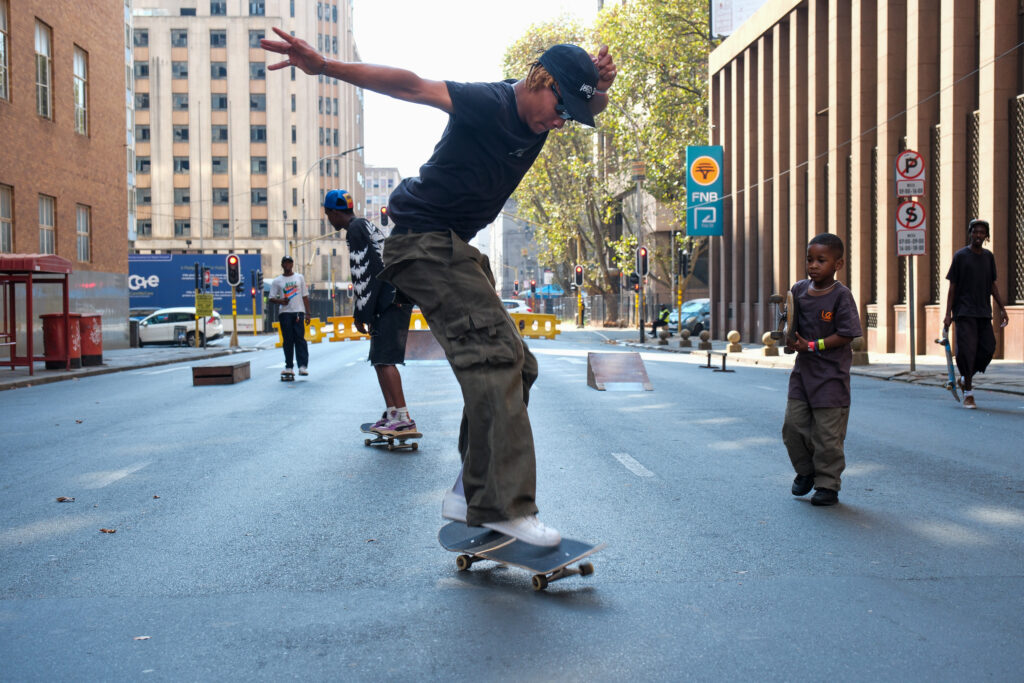
Crispyboards’ inner-city skatepark gives skaters like Slayde and Zev a space of freedom and movement. Photo: Likho Mbuka
Yet the contrast is stark. The city’s Joburg 2040 Growth and Development Strategy (GDS) envision a “world-class African city” built on innovation, inclusivity, and resilience. Ten years have passed since former mayor of Johannesburg, Parks Tau’s address promising to turn “challenges into opportunities.”
The inner city reflects something else: systemic inertia.
SERI estimates that over 20,000 people live in “bad buildings” across the inner city, including migrants, women-led households, workers earning below the minimum wage. Despite commitments to refurbish or relocate residents, the city’s Special Projects Unit has not released a public progress report since 2022.
Edward Molopi from SERI is blunt: “The city’s approach frames inner-city poverty as criminality rather than a housing crisis. People are forced into these conditions because they’ve been excluded from formal housing markets. Instead of support, they face raids, evictions, and stigma.”
Tomorrows city, today’s neglect
As the afternoon light fades, the children at Skateistan roll past the decaying walls of Linatex. Their laughter echoes down the street, bright, defiant, alive.
In Doornfontein, survival is not passive. It’s an act of protest. From Fredah’s determination to keep her children safe, to Thobile’s daily cleaning of a floor that isn’t hers, to Enos’s skateboarding lessons, each story reveals a city sustained not by policy, but by people.
For all the city’s promises of being “world-class,” perhaps Johannesburg’s real greatness lies elsewhere: in the resilience of its poorest residents. In their refusal to give up on a place that has already given up on them.
Crispyboards’ inner-city skatepark gives skaters like Slayde and Zev a space of freedom and movement. Photo: Likho Mbuka
FEATURED IMAGE: Johannesburg’s inner city is notorious for decay and danger, yet its young skaters carve out pockets of freedom in the midst of it. Photo: Likho Mbuka
Behind Johannesburg’s title as a world-class African city lies Wits and UJ transforming the city into Africa’s intellectual powerhouse.
Every lab, start-up and innovation hub is part of Johannesburg’s knowledge.
Together, the University of the Witwatersrand (Wits)and the University of Johannesburg(UJ) represent both prestige and purpose. One drives global excellence, the other ensures progress is inclusive and grounded in local realities.
University expertise is embedded in municipal development, bridging knowledge with real-world governance.
As “Joburgers” would say in Setswana: “Joburg ke country,” meaning Johannesburg is a country. A city that feels like a nation itself, whose name echoes with the roar of commerce. For over a century, its identity has been forged in the deep-level gold mines beneath its tall buildings. It is South Africa’s economic and commercial epicentre, a city built on tangible assets. But the gold of the 21st century isn’t dug from the ground, it is cultivated in lecture halls, coded in digital hubs and debated in policy forums. Today, Johannesburg’s claim as a world-class African city is redefined not only by its physical infrastructure, but by a formidable concentration of intellectual capital.
Image of Wits University standing tall in Jorissen Street. Photo: Abena Mahlahlane
Walking through Braamfontein, the heartbeat of Johannesburg feels close to the surface. The streets are alive with the sound of taxis hooting, car guards filling the area at parking lots, and groups of students in Wits hoodies spilling onto Jorissen Street, cracking jokes and bursting into laughter. Wits University is at the centre of it all, its sandstone buildings rising between the city’s noise and ambition[Ed1] .
Barely five kilometres from inner-city Braamfontein away is the suburb of Auckland Park, where the University of Johannesburg (UJ) beats with its own rhythm. The atmosphere shifts from inner-city street buzz to a campus alive with experimentation. Young innovators huddle as they test prototypes and plan start-ups.
More than just neighbours, the universities are the twin engines of a thriving knowledge economy, providing a growing density of research, innovation and talent. Their combined influence transforms the city into a knowledge economy, where ideas are currency, and innovation is the infrastructure.
Pillars of a knowledge city
Unlike some African cities which dominated by a single major university, Wits and UJ complement each other rather than compete. While Wits University delivers globally benchmarked research, UJ leads in socially embedded innovation. This unique dynamic is validated by the world’s most respected university ranking systems.
Wits University is ranked number 267 in the world, and second in Africa, according to the 2025 QS World University Rankings. Long celebrated for its groundbreaking research, and alumni who’ve shaped South Africa’s story, Wits continues to hold its own among the world’s best.
“From my point of view, rankings are important because institutions want to do well, it is what people see first. We participate in rankings where research is a major component, because that is the hallmark of a good university,” said Wits Deputy Vice-Chancellor, Professor Lynn Morris.
Together, Wits and UJ form the intellectual backbone of Johannesburg. Universities whose ideas don’t stay trapped in ivory towers but spill into the city streets, innovation hubs and communities.
The deep science engine: Wits
Founded in 1922, Wits University is Johannesburg’s oldest and arguably most prestigious university. A beacon of deep research and frontier science. With over 380 NRF-rated researchers, its labs have birthed discoveries from mining engineering to quantum computing.
Wits Quantum Initiative, the first of its kind in Africa, positions the university at the cutting edge of subatomic physics and computational research. During the COVID-19 pandemic, Wits scientists collaborated across disciplines, from epidemiology to data analytics, demonstrating the university’s capacity for rapid, high-impact innovation.
Under its Wits 2033 strategic plan, the university aims to cement its identity as a research-intensive, globally engaged African leader. The plan envisions Wits as a bridge between Global South and North, a hub for scientific collaboration that also speaks to local realities.
Innovation with social purpose: UJ
While Wits chases the stars of scientific prestige, the University of Johannesburg grounds innovation in human impact. UJ’s philosophy is clear: research must solve problems.
Its Strategic Plan 2035, “Reimagining the Future. Realising Possibility” aligns the university’s goals with the UN’s Sustainable Development Agenda. The result is an institution where inclusivity and integrity are baked into the research DNA. With research productivity of 2.35 accredited output units per scholar (double the national average). UJ turns efficiency into impact.
This academic prowess is not confined to campus grounds. Both universities have built powerful, dedicated innovation hubs that act as direct channels for executing economic and social policy, turning abstract knowledge into jobs, businesses and solutions.
Wits and the digital heartbeat of the inner city
Built on the site of a former print works, Tshimologong Digital Innovation Precinct buzzes with coders, designers and start-ups. It’s not just a space, it’s a policy instrument, part of Johannesburg’s broader urban regeneration strategy. With its name meaning “new beginnings” in Setswana, the precinct operates on three pillars: Digital Skills Development, Incubation & Acceleration, and Market Access. Tshimologong is Wits’s engine for commercializing digital innovation.
I visited the precinct late one afternoon and was immediately greeted by a cheerful administrator, who called for executive assistant Kgaugelo Modiba to assist me. “Don’t be nervous,” Modiba reassured me, as I prepared to interview the initiative’s CEO Mark Harris.
A few people sat nearby in the café area, eyes hooked on laptops, making the most of the precinct’s quiet hum and free Wi-Fi. It was exactly how Prof. Morris described it, “you should visit the precinct, it is a rather refreshing space where everyone is welcome. You can grab coffee and enjoy perks of free Wi-Fi.”
Kgaugelo led me down a corridor into a boardroom flooded with natural light. Tshimologong CEO Mark Harris greeted me with a glass of water and an easy smile. It seems conversations for the people at the precinct come easily. “So what kind of journalist are you going to be? The good kind or the bad one,” Harris laughed.
I asked Harris why Tshimologong had been placed in the heart of Braamfontein, and his answer echoed the vision of the late Professor Barry Dwolatzky (founder of Tshimologong), which was that young people hold the creativity, energy and reason to build a new South Africa. Braamfontein was chosen because its streets are alive with students and young creators.
“The vision was to spot people like yourself who are educated and ambitious, create space for them to become entrepreneurs,” said Harris.
The precinct was never meant to sit safely inside the university walls, but to stand open to all youth, educated, self-taught and anyone with the will to innovate and build.
Tshimologong’s Digital Skills Academy is a crucial accelerator, taking high-potential youth and equipping them with job-ready skills in Artificial Intelligence, Machine Learning and the Internet of Things; the core competencies of the Fourth Industrial Revolution (4IR).
This isn’t just for the sake of training, the precinct works with corporate partners on Enterprise Supplier Development (ESD) programs. These aim to secure employment through its network, creating a direct pipeline from the classrooms to the economy.
“From what I’ve seen of the youngsters who come here, these are people who want to make an impact. Our trainers are just as committed, they are determined to empower future entrepreneurs. The youth are showing up positively, they are hungry for change, and they want to help South Africa grow. We often hear the negative stories about crime and violence, but I refuse to only see that side. There is so much potential here, and I believe in them,” said Harris.
As the discussion continued to unfold, it moved beyond Braamfontein’s physical space to the culture it nurtures. Harris’s belief in the potential of young people seem to find its proof just outside the boardroom walls.
This spirit is best captured by the Fak’ugesi African Digital Innovation Festival, hosted at Tshimologong every year. This festival turns Braamfontein into a pulsing circuit of creativity. The 2025 edition, themed #PowerSurge, called on Africa’s digital creators to “take control on the grid”, blending ancestral intelligence with artificial intelligence.
The Fak’ugesi festival turns Braamfontein into a living circuit of art, technology and collaboration, celebrating Africa’s creative power in the digital age. Photo: Abena Mahlahlane
Walking through the entrance felt like stepping into an animated scene. Walls alive with colour, music weaving between exhibition stands and a soft buzz of conversation rising from every corner. A row of Virtual Reality headsets lined one side of the room, where groups of young people tested immersive worlds. Up the staircase were two small rooms that had been turned into gaming rooms, complete with PS5 and Xbox consoles that drew clusters of gamers competing in friendly matches.
Panels of speakers shared stories of small start-up creators and local digital enterprises. Every corner felt like a classroom and playground combined, a space where learning, creativity and collaboration merged.
“When I curated #PowerSurge I looked at what is currently happening in the African digital continent, we saw last year in 2024, about 65 billion Rands worth of investments that went into start-up, technology and creative sectors,” said the director of Fak’ugesi festival, Alby Michaels. “This year we wanted to showcase what is next in the African continent. We have been creating this beautiful content for our creators for years, but I think now it was all about owning up agencies, standing together and moving forward with purpose.”
Through such initiatives, Johannesburg asserts itself not merely as a consumer of global tech, but as a producer of digital culture and creativity, solidifying its reputation as a continental innovation capital.
“Creators are doing amazing stuff, we are not just consumers of the digital space we are actually critics of those spaces,” said Michaels.
Ideas move faster than light, a panel of artists, technologists and innovators reimagining what it means to create in the digital age. Photo: Abena Mahlahlane
CALSTEAM: UJ’s Future-of-Learning Lab
UJ’s Centre for Advanced Learning Technologies in Science, Technology, Engineering, Arts and Mathematics (CALSTEAM) redefines how the next generation learns.
Instead of chalk and paper, lessons unfold through virtual and augmented reality (VR/AR), tools designed to make abstract science visible and alive. “VR allows students to step inside the science,” explained Professor Mafor Penn, who leads research at the centre. “Concepts like molecules, cells and sound waves suddenly become visible, something you can interact with rather than just imagine.”
Concepts like molecules, cells and sound waves suddenly become visible, something you can interact with rather than just imagine.
CALSTEAM evolved from UJ’s former VARSTEME hub, broadening its focus to include the arts and entrepreneurship. Its mission is not only to enhance teaching but to cultivate educators who are also innovators. Teachers who can create, adapt and apply technology to suit local contexts.
For many South African schools where resources remain scarce, CALSTEAM is deliberate about accessibility. Many of its tools are designed for affordability, ensuring that immersive learning is not limited to well-resourced schools. “We don’t want to widen the gap between those who have and those who don’t,” said Penn. “That’s why we work with scalable, low-cost technologies that can be used anywhere, even in under-resourced classrooms.”
The centre’s pioneering project, Culturally Anchored Virtual and Augmented Reality Simulations (CAVARS), takes this philosophy further by merging indigenous knowledge systems with science education. In one simulation, African drumming demonstrates sound waves, turning cultural practice into scientific inquiry. “Science should never feel foreign,” Penn added. “When learners see their heritage reflected in what they study, it becomes meaningful and memorable.”
Through coding clubs, immersive learning workshops, and postgraduate programmes in Educational Technology, CALSTEAM envisions a future where learning is not confined to textbooks but expands into virtual space, interactive, inclusive, and distinctly African.
Hardwiring Academia into the city’s DNA
Gauteng City-Region Observatory (GCRO) offices at Wits. Photo: Abena Mahlahlane
A true world-class city does not just produce knowledge, it governs through it. The Gauteng City-Region Observatory (GCRO) is the institutional glue that connects Wits, UJ and the Gauteng Provincial Government. This is not a case of academia simply advising from the sidelines, it is a deep, structural partnership.
“The GCRO is an important research unit that provides data to the provincial government to help them understand and know where to place their resources, to know what interventions to look at, plan and think about the health of the city. “Wits and UJ also plays part and contribute to providing evidence and the data needed”, said Prof. Morris.
Binding the partnership together is the Quality of Life Survey, a mirror reflecting how Johannesburg’s residents navigate the promises and pressures of city life. From employment and housing to public transport and social cohesion. The survey provides policymakers and researchers with a shared lens on how people actually experience the city. “Our work has to have both the rigorous foundation and approach of academics, but be structured in a way that could be useful to policy makers. So, questions are tailored to what problems we see in Johannesburg region and how they could be academically rigorous to answering those questions,” said GCRO researcher, Jason Bell. “Wits and UJ are historic centres of debate, discussion, knowledge generation. They play an active role in the ecosystem of policy identification.”
The road ahead
Both institutions have formalized their future through long-term strategies, Wits 2033 and UJ 2035, each mapping a decade of sustained excellence.
Wits aims to strengthen its position as the leading research university in the Global South, while UJ envisions itself as the model of inclusive innovation. Their combined trajectories ensure that Johannesburg’s intellectual ecosystem remains globally competitive and locally transformative. If executed, these roadmaps could make Johannesburg the continental capital of knowledge innovation, leading Africa into the Fourth Industrial Revolution (4IR).
“People want to see more than just the research, they want to see that the research is actually deployed. Whether it is a new of doing things, a new product or a new device, something tangible, an improved process,” said Morris.
The city that thinks
In small, ordinary moments, a lecture’s spark, a student’s first breakthrough, a start-up’s first pitch, Johannesburg’s new gold is being mined.
Through innovation hubs that drive economic growth and educational equity, and a unique governance model that embeds their expertise into the very fabric of the city, these two universities are doing more than just educating students. They are actively building a more resilient, prosperous, and innovative Johannesburg—a true world-class African city for the 21st century.
FEATURED IMAGE: A collage of Johannesburg’s academic icons, representing the city’s transformation into a world-class hub of knowledge. Photo: Abena Mahlahlane
Scientology’s presence in Joburg is dubiously significant, what does this reveal about the city of gold?
Thank you for loving me
when I still tasted
of heartache and war.”
- ‘Happily Ever After’ by Nakita Gill in, Fierce Fairytales, & Other Stories to Stir Your Soul
The heartache and war of apartheid South Africa ended in 1994, yet, in that time, scars forgot to form, and opened wounds were left bleeding.
Poverty, joblessness, homelessness, displacement, neglect, disparity – these are all part of the picture of Joburg City.
In a metropolis with over six-million people, living in Joburg can be lonely, whether it’s the high life in Sandton or down-and-out in Hillbrow, even the widest of smiles can mask the pain of lost hope. Of being incomplete. Making community ever more important.
There are those who share a way of thinking, others who believe in the same god, some who share stories through music and poetry, and many who hold politics as their armour. All uniting with a feeling of belonging.
But what happens in a city like Johannesburg? A city with the collective trauma left by apartheid, a city where people are gasping for air as the tide gets higher? What happens when the curious case of Scientology makes its way into the city.
Scientology: the religion Tom Cruise made famous…or infamous
In life, at one point or another, it is only natural to wonder what your purpose is, where you are going, and who you truly are. These are questions you may ask yourself, your parents, someone you trust. These are also the questions that Scientology claims to answer.
In his book, Scientology: A New Slant on Life, L. Ron Hubbard, the founder of the movement, described the religion as “the science of knowing how to know answers,” explaining that, “a Scientologist is a specialist in spiritual and human affairs,” believing in the spirit’s connection to all things around it, including itself.
Are they really? Photo: Ekta Seebran.
Going to the chapel and we’re…not going to pray, because Scientologists don’t do that. Photo: Ekta Seebran.
Happily, immortalised in stone. Photo: Ekta Seebran.
The religion takes its lead from established faiths that are practiced all around the world, these include Christianity, Hinduism, and Buddhism, among others. Through these, it promises to guide practitioners toward attaining the goal of survival and immortality through repairing the negative parts of one’s life. In this effort, Scientologists practice a combination of mental and spiritual improvement counselling, including auditing and advanced training, which apply the principles and goals of the religion.
At the top of a hill in Kyalami, Johannesburg, rests the advanced training centre of Africa. Here, people from all over the world can do counselling and complete their training courses in the fortified castle.
Unbeknown to some, Scientology has come to gain a significant following in South Africa, with the Church of Scientology in Johannesburg being established in 1957, in Hillbrow, and later being moved to Kensington, which is where it can be found today.
Some may wonder why Scientology became so incredible, and notoriously, renowned. Is Tom Cruise’s celebrity to blame, did he promote the need for the religion, or is there truly merit in its practice?
Counselling your way to ‘you complete me’
Jade Lopes is a fourth-generation South African Scientologist and volunteers as a “Sea Org”. Sea Orgs work seven days a week, and are considered the most devoted Scientologists, dedicating their life to the religion by symbolically signing a billion-year contract.
“I think I did my first course when I was about five years old. I did a course called ‘Learning How to Learn’, and it was amazing because it gave me the ability to study from a young age. And then there was really a point in my life where I started receiving counselling, and this was probably at the age of 19 or 20,” muses Lopes.
…and cancel it! Photo: Ekta Seebran.
“During the counselling, probably on session 20 or something like that, I realised that I felt happier, like, stably happy, you know? It wasn’t like I had my session and then two hours later I’m back to being sad again or whatever it was. When I realised that I was more in control of myself, that was when I was like, okay, Scientology is it for me,” she affirms.
This counselling ,which Jade expressed such appreciation for, is known as auditing, and uses the practice of ‘Dianetics’.
Defined by L. Ron Hubbard, dianetics is “what the soul is doing to the body,” believing that our minds hold images of past experiences of pain or distress, called engrams, which manifests negatively on a person’s physical and mental health. Dianetics works to “clear” the mind of these engrams through reliving the experience in auditing sessions and letting them go, all in an effort to get rid of the reactive mind – responsible for emotional reactions – and bring the logical mind forward.
“Honestly, Scientology saved me”, says Sandile Hlayisi, the chairperson for the “Volunteer Ministers in South Africa” programme.
“If I hadn’t found Scientology when I did, I’d either be a very miserable lawyer or I’d be dead in a ditch somewhere,” Hlayisi considers, explaining that growing up in Soshanguve, north of Pretoria, he had a typical township childhood, which wasn’t easy, and that during his second year at UNISA, studying law, a friend of his called him.
Sandile describes the conversation as such;
“Remember all those questions you used to ask as a kid? On life, the meaning of life, the universe, all these questions you had in school?”, the friend inquired.
“Yeah,” Sandile agreed.
“I think I found a place that might be able to help you find the answers.”
With the promise of help, guidance, answers to live a better life, why wouldn’t you join Scientology?
Likewise, Kiran Dhiman, a Scientologist all the way from India, now living in Johannesburg, shared her story with Wits Vuvuzela. Dhiman said that she joined the religion because she was, “struggling in life,” explaining that it helped her to communicate with people and tackle her problems effectively.
The Scientology network, which holds a collection of media pertaining to Scientology, their teachings and practices, shares similar stories in their series titled, “Meet a Scientologist.”
Stories of people needing help and finding solace in the religion’s offering of counselling through auditing, and life skills through training courses. Hopeful stories, aspirational stories. In a city with a history of trauma still endured today, it offers a fertile ground to plant such seeds of hope.
You want the truth?
William Gumede, associate professor at Wits University, explained in an article written from a keynote he gave in 2022, that the challenge in rebuilding South Africa stems from the damage created in the wake of apartheid.
Gumede illustrates that development efforts such as building a democracy and growing entrepreneurship become stunted and replaced by broken communities, families, and an inability to engage thoughtfully in relationships, in the economy, in the workplace, and so on.
What the oppressors leave, Gumede explains, are human casualties who feel as if “the self has no foundation” any longer.
And here enters Scientology.
As I drive from Wits University down toward Kennsington, fear fills my stomach, and adrenaline reaches my heart. The religion is shrouded in controversy, “It’s a cult!” is the over-arching narrative. All I could think was, “I elected to spend the next four weeks inside a cult.” My sense of self-preservation must’ve escaped me when I wasn’t looking.
Upon entering the illustrious church of Scientology I was handed a questionnaire to fill out: name… age… what struck your interest in Scientology?
The question that stood out the most, however, asked what area in life I needed help with, giving options ranging from school or work to family or relationships. From there I learnt that the church offers courses, both free and paid, which promise to help you improve your life.
For Dhiman, Hlayisi, and Lopes this proved to be true. Encouraging all to not only engage in counselling and further training, but to join the religion as volunteers.
Through community work, human rights initiatives, and education programmes, Scientology in Johannesburg demonstrates its goal to “make the world a safe and peaceful place,” gushed Kiran.
One of these initiatives is known as the “Volunteer Minister” a free programme that comprises of online courses. According to the official Kyalami Castle Scientology website, “Volunteer Ministers are dedicated to assisting others not only in life saving situation, but also by helping individuals overcome difficulties in their daily lives.”
Dhiman further enthuses that South Africa has the highest number of trained volunteer ministers and leaders in the world, with 40 000 active workers.
In 2022, Scientology Volunteer Ministers were recognised for the humanitarian work they did during the COVID-19 pandemic. Among the work the ministers were applauded for, the group’s initiative to sanitise over 70 000 buildings stood out, this was recognised by the city, and the Johannesburg Metro Police Department. The group was presented with an award made of a bronzed pair of JMPD standard issue boots, for their efforts.
Beyond this are initiatives including, “The truth about drugs” programme, which is an education-based programme, as described by both Sandile and Kiran, which seeks to teach people about drugs in hopes that they will make more informed decisions regarding their consumption or experimentation when confronted with narcotics. From mental health initiatives and human rights to education in life improvement and spiritual enlightenment, Scientology promotes itself. It is difficult though to ignore the controversy held over the religion, and subsequently makes one consider the implications of such work.
But can you handle the truth?
Controversies and allegations against Scientology have dominated the narrative around the religion, painting the group as a money-hungry, exploitative, cult. Reconciling the evident humanitarian image of the church with the darkness of its portrait is conflicting, but one that cannot be dismissed.
In 2014 the church was taken to the Johannesburg High Court by two of its former members, Ernest and Gaye Corbett. The Corbetts claimed that the church failed to repay at R5,8-million loan, and were demanding a full repayment with interest, amounting to R16-million. Allegations against the church included secretive internal financial dealings, separating families, and unfair policies within the religion.
Earlier this year, the church was put on blast again for unfair labour practices and exploitation of workers at its rehab facility in Rustenburg, Narconon Africa. The case is still being investigated.
One of the earliest grievances against the church, was its use of ‘Dianetics’ as counselling, with the American Psychological Association and the American Medical Association dismissing Hubbard’s work as pseudoscientific, soon after the release of his book, Dianetics: The Science of the Mind.
This fact prompts the question: with the impact apartheid South Africa left, does the perceived harm of Scientology’s presence in the city of gold indicate an exploitable vulnerability in Joburg?
One suspenseful morning, I took my third trip to the Johannesburg Church of Scientology. At 12:45pm sharp I participated in the church’s offering of one free dianetics session.
My auditor first briefly explained the process, asked if I was comfortable, and then asked me a series of questions including my parents’, grandparents’, aunts’, uncles’, brothers’, and sisters’, names, ages, and quality of relationship. Though I answered the latter, I declined giving any names. An effort in exercising caution.
The hour encompassed me closing my eyes and being told to find my earliest memory of pain. From there, I verbally relived the memory, working to recall as much detail as possible, and once I did, I was told to let it go.
Now, doubtful and curious about the practice of auditing, I spoke to counselling psychologist and psychotherapy researcher, Kerry Gordon, who explained, “what’s important in psychotherapy is that there has to be a relationship of trust built, and we really take it at the clients pace, guided by how quickly or slowly the client wants to go into the traumatic memory, which is often fragmented.”
Gordon noted that though there is a similarity between the practice of dianetics and psychology with regard to working through trauma, there are complexities when counselling people through it, explaining that there are dangers to applying one method to all clients.
“Not all traumas look the same, you can’t exactly apply the same methodology or pace to each person.”
Scientologists are known to not believe in the practice of psychology and psychiatry.
When speaking to Hlayisi, he said, “The only thing we don’t believe in is when something becomes harmful for people, that’s when we have a problem.”
Explaining that, “everything has a place in the world, the only thing we have a problem with is when an industry or sector abuses their power and ends up harming the individual.”
“Why are you as a psychologist or psychiatrist sexually abusing your clients?” he expressed further
In the same vein, Jade explained that part of the issue is unnecessary prescription of medication, saying that “a psychologist can refer you to a psychiatrist, who can prescribe medication,” further advocating for dianetics by highlighting her emotional stability following auditing sessions, positing, “After years of counselling, does that person feel stable and okay?”
To this, Gordon adds a significant fact, “[In any psychological practice] one person is intrinsically more vulnerable than the other, which is why that accountability is really important, there’s someone objective to report me to. The process is open. It all gets documented,” she continued.
Thus, signifying a key concern with Scientology, it is plagued with secrecy and confidentiality, there is something unknown behind the paywall.
Hlayisi explains that they are legally obligated to report harm or potential harm, but what protections to the receivers of auditing have?
Gordon emphasises that without an ethical code, “there’s real scope for abusive power there.”
Joburg: A world class African city?
One of the qualities of a world class city is the strength of its global presence. Scientology’s presence in Johannesburg, and significantly the centre housed at the Kyalami Castle, for Advanced Training in Africa, exemplifies a significant placement in the continent. Joburg: World Class African City … Joburg: Gateway to Africa.
These labels mask the reality of South Africa, the reality that Joburg is still bleeding, the reality that if untreated, the wound is susceptible to infection.
Characterising Scientology as completely good or completely bad is something that I cannot do in good faith. Though, can we really be a world class city if our citizens are left vulnerable to potential harm?
FEATURED IMAGE: Claiming a place in the cIty, calling those desperate and in need. Photo: Ekta Seebran
The engines may be silent for now, but South Africa’s F1’s dream is roaring back to life. With hundreds of millions of rands worth of upgrades and fans ready to “sell their livers” for a ticket, Kyalami’s revival could mark the nation’s return to the global racing map.
Kyalami, founded in 1961, hosted F1 races but lost status due to apartheid sanctions and financial issues.
The decision to host lies with the Department of Sports, Arts and Culture and F1 Management, not Kyalami.
The planned R100-million track upgrades will be fully funded by Kyalami’s owner.
In 2010, the world’s gaze turned to South Africa as people from across the globe waved their flags, cheered, and danced during the FIFA World Cup. The streets of Johannesburg pulsed with energy, and local businesses experienced unprecedented growth. Fifteen years later, a parallel dream is emerging – this time, not in football, but in F1.
Could the roar of engines replace the roar of supporters? Could the return of F1 to Kyalami once again place Johannesburg on the global stage as a world-class African city, one that benefits ordinary citizens as much as the elite?
For lifelong F1 fan Kevin Matla, the idea of F1’s return is more than just news, it’s personal. “For me, F1 is life,” he says, recalling how he’s been following the sport since 2005. The possibility of a local Grand Prix fills him with pride and excitement, especially since the last race in 1993 was held under conditions that excluded many South Africans.
Kyalami’s Grand Prix Circuit has long been a place of transformation. Founded in 1961 with the “Kyalami 9 Hours”, an endurance race, the track rose to global prominence in 1967 when it hosted its first Formula One event, cementing its reputation for motorsport excellence.
Through the 1970s and 1980s, Kyalami thrived as a premier racing destination, until its F1 chapter closed in 1985 following international sanctions against South Africa’s apartheid regime.
Kyalami experienced a short-lived resurgence in the 1990s, hosting races in 1992 and 1993, but financial and political issues brought it to a halt again. By the early 2000s, the circuit had lost its international appeal, relegated to hosting local events and remembered fondly through nostalgia.
For Matla, hosting F1 again would mark a national achievement, boosting tourism, creating jobs, and reigniting pride among South Africans. He believes that while ticket prices may be high, the event will still attract strong local support, “I know there are rumours that tickets are going to be R10 000; people might have to sell their homes or their livers.
FIA Approval: A New Era for Kyalami
In 2014, entrepreneur Toby Venter, CEO of Porsche South Africa, acquired the Kyalami Grand Prix Circuit at an auction, marking a major turning point for the historic track. His multimillion-rand investment transformed Kyalami into a world-class facility that now meets international racing standards. This effort culminated in the circuit earning FIA Grade 1 approval, the highest level of certification required to host Formula One races.
According to Porsche South Africa’s Group Public Relations Manager, Christo Kruger, the certification represents more than just a technical achievement; it’s a symbol of readiness and revival. With this recognition, Kyalami now stands as the only FIA Grade 1 circuit on the African continent, positioning it one step closer to reclaiming its place on the global motorsport stage.
With this recognition, the countdown has officially begun. “According to the FIA rules, Kyalami now has three years from the day of approval to do the upgrades and then the final inspection,” says Kruger. “Homologation [official approval] happens, and we are then accredited with Grade 1, if everything is done within the approved scope,” Kruger says.
A visual of precision and progress, the official circuit layout outlines Kyalami’s 16 turns and 18 camera points, symbolising South Africa’s readiness to meet international racing standards once again.
Photo: Dikeledi Ramabula
The announcement has fuelled excitement within South Africa’s motoring community, reigniting hopes of seeing F1 cars roar through the Midrand circuit once again. Planning for upgrades is already underway, though construction has not yet begun due to Kyalami’s packed calendar of local events, such as the Festival of Motoring and M-Fest.
However, the future of the project ultimately hinges on F1’s commitment to return. Kruger noted that while some improvements will proceed regardless, the scale of investment will depend on whether the international organisers confirm South Africa’s inclusion in the upcoming calendar.
Eyes locked on the track, South African female driver Simphiwe Mohlahlo waits in her BMW, focused and ready for her race on one of the country’s most iconic circuits. For her, Kyalami represents both legacy and opportunity for women in motorsport. Photo: Dikeledi Ramabula
Hands gripping the steering wheel, eyes locked on the track, Nathi Msimanga sits in full focus, ready for the challenge ahead. The determination in his gaze says it all: he’s here to compete, to push limits, and to belong among South Africa’s best. Photo: Dikeledi Ramabula
For Wits mechanical engineering student and professional Toyota Gazoo Racing driver Nathi Msimanga, Kyalami is more than just a circuit, it’s “the most prestigious track in the country;” a place that mirrors the speed and sophistication of international circuits. Yet despite Kyalami’s world-class design, Msimanga remains doubtful about Formula One’s return in 2027, though he believes it could shine a spotlight on South African motorsport.
“If F1 does come here, it’ll force companies, sponsors, and media to finally give our sport the attention it deserves,” he says. He adds that consistent funding, promotion, and government support are key to making racing accessible for all, and to inspiring the next generation of South African drivers.
And for South African female driver Simphiwe Mohlahlo, who competes in the MSA4 and Formula Libre series, Kyalami Grand Prix Circuit represents more than just asphalt and corners, it’s a symbol of legacy and opportunity. “Racing there feels like being part of history,” she says, noting how rare it is for local drivers to experience the track.
Screens, radios, and precision, the nerve centre of every race. From here, officials monitor every lap, every turn, every moment that defines safety and speed. It’s the unseen engine that keeps Kyalami running.
Photo: Dikeledi Ramabula
Mohlahlo believes that a possible F1 return in 2027 would not only spotlight the perseverance of South African motorsport but also open doors for emerging talent, particularly women. She praised initiatives like the F1 Academy for inspiring young girls and called for more national activations, academies, and sponsorship support to grow the sport sustainably. Confident in the country’s ability to host F1, she adds that such an event could invigorate the economy and elevate local representation on the global stage, a dream she hopes to see realised in her lifetime.
How Major Events Put South Africa on the Map
Hosting big sports events has been a game-changer for South Africa, and the potential F1 has the potential to be another.
The 1995 Rugby World Cup stands as one of South Africa’s most powerful symbols of unity and healing after apartheid. When Nelson Mandela wore the Springbok jersey to present the trophy, it became a defining moment that showed the world a nation coming together, united through sport and shared pride.
The iconic Kyalami Grand Prix Circuit, sprawled across Midrand’s picturesque landscape, is more than just a racing track, it’s the pulsating heartbeat of SA’s motorsport. This revered circuit has been the stage for countless thrilling moments. With its rich history and nostalgic charm, Kyalami is a treasured gem in the world of racing, and the nation is eagerly yearning for the day when it will once again reverberate with the thunderous roar of Formula 1 engines, sending shivers down the spines of petrolheads and reviving the country’s glorious racing heritage.
Photo: Dikeledi Ramabula
In 2010, South Africa made history as the first African nation to host the FIFA World Cup, a moment that not only boosted the economy but reshaped the nation’s image. The government invested over R30-billion in infrastructure, from transport and airports to world-class stadiums, creating around 66 000 construction jobs and injecting R7,4-billion into the economy, with R2,2-billion benefiting low-income households. Beyond the numbers, the tournament became a nation-branding triumph, transforming global perceptions of South Africa’s people, cities, and capability to deliver on the world stage.
The World Cup showed the world that South Africa is a great country to visit and host events. Over 500,000 South Africans, including taxi drivers and volunteers, helped make visitors feel welcome. The country got the highest score ever for hosting a World Cup, which was a big achievement. After the tournament, more people came to South Africa for vacation (up 31%) and business (up 47% in Cape Town).
Hosting major events does more than bring sporting success; it reshapes how the world sees a country and strengthens national pride. For Johannesburg, a successful return of F1 to Kyalami could have the same effect, boosting the city’s reputation, inspiring locals, and attracting new investment. Beyond the race itself, it would signal that Johannesburg is not only capable of hosting world-class events but also stands out as a vibrant, globally recognized African city, a symbol of ambition, progress, and pride. Such high-profile events play a key role in nation and city branding, showcasing South Africa’s potential on the international stage while reinforcing Johannesburg’s identity as a world-class African city.
A relic of Kyalami’s F1 past, this worn Goodyear tyre carries the weight of history, rubber that once touched the same tarmac where legends raced three decades ago. It marks the last time South Africa hosted a Formula 1 Grand Prix, a moment that still echoes in the hearts of local fans who remember the roar of engines and the pride of seeing their country on the global stage. Today, it stands as more than just an object of nostalgia, it’s a symbol of unfinished business, a reminder of a dream paused but never forgotten. Photo: Dikeledi Ramabula
According to Professor Mfaniseni Sihlongonyane from Wits University’s School of Architecture and Planning, hosting international events such as F1 presents both opportunities and significant challenges for cities. He notes that infrastructure, funding, and the “critical mass” of participants are key factors in determining whether a country can successfully host and sustain such events. However, Sihlongonyane acknowledges that F1’s return could stimulate multiple sectors, from hospitality and transport to food and automotive industries, creating employment and boosting economic activity. He cautions, though, that South Africa must ensure inclusivity by supporting small businesses, women, and youth through subcontracting and empowerment initiatives. “It shouldn’t just be about large corporations benefiting,” he explains. For him, Johannesburg’s approach should centre on a social contract with F1, one that promotes economic growth while advancing social justice and community participation.
Who Decides F1’s Return?
While Kyalami may be ready to host, the final decision on whether F1 returns to South Africa does not rest in its hands. According to Kruger, the circuit’s role is limited to being the venue. “Kyalami is not really responsible for F1 coming back, that’s very much up to the Department of Sports, Arts and Culture and a promoter,” he explains.
The government, together with F1 Management, will ultimately decide whether South Africa secures a spot on the 2027 racing calendar. Kyalami’s task, meanwhile, is to ensure the track remains in top condition and meets all technical and logistical requirements once approval is granted.
Eighteen eyes on every corner. The circuit’s surveillance system reflects Kyalami’s world-class standards, a blend of technology, safety, and ambition as it prepares for potential FIA-level events. Photo: Dikeledi Ramabula
Behind the scenes, negotiations and financial guarantees have already been submitted, but the costs involved are steep. “The planned track upgrades are expected to cost around R100-million, an amount that will be self-funded by Kyalami’s owner, OT Venter Investments,” Kruger says.
Formula One is a huge money-maker globally. In 2024, it earned over $3.4 billion, with a big chunk coming from cities and countries paying to host races. This shows how valuable it is to host an F1 event. The sport is also super popular, with 5.7 million people attending races in 2022, a big increase from 2019. Kruger acknowledged that while the enthusiasm for F1’s return is strong, the financial reality remains daunting. Hosting fees for international races can range between $25 million and $54 million, depending on the location.
Logistics and Local Impact
Bringing F1 back to South Africa would be a complex operation, one that extends far beyond the racetrack. Temporary grandstands, hospitality suites, and infrastructure upgrades would all have to be set up to meet F1’s international standards. The surrounding roads and access routes to Kyalami would also need attention to accommodate the thousands of fans expected to attend.
Shops and restaurants hum quietly inside Kyalami Corner, just a few minutes from the racetrack. For now, the calm reflects ordinary life, locals grabbing coffee, but if Formula 1 returns, this space could transform overnight. The sound of engines would spill into nearby businesses, bringing a rush of fans, tourists, and international media. For store owners, it’s more than just excitement, it’s the promise of economic revival, a chance to feel the same national buzz last seen during the 2010 FIFA World Cup. Photo: Dikeledi Ramabula
Beyond the logistical hurdles, the project holds the potential to benefit local communities. Kyalami’s management has expressed plans to include fan parks and fan zones that would create space for small vendors and local entrepreneurs to participate, ensuring that the excitement of the event extends beyond the gates of the circuit.
Kruger emphasizes that a return of this scale would not be fleeting. “F1 doesn’t do once-off events. They will want to sign a deal for a minimum of five years to seven, and sometimes up to ten years,” he says. Such a long-term commitment would not only secure South Africa’s place on the global racing calendar but also demand consistent investment in maintenance and event management to keep the circuit world-class.
Despite the enthusiasm surrounding the possibility, Kruger remains grounded about the uncertainty of the outcome. When asked what message he had for South Africans hoping to see the sport return home, his response is simple: “Pray. It’s really not in our hands; we can only stay hopeful that negotiations with F1 Management are successful.”
As South Africa awaits an official decision, the prospect of F1 returning to Kyalami is tantalizingly close. Backed by Toby Venter’s revival efforts, FIA approval, and public excitement, this moment reinforces one thing, Joburg truly is a world-class African city, capable of hosting global events that bring people and opportunities together. The wait may be long, but South Africa’s F1 dream is finally on track and ready to take off.
From the outside, Kyalami stands as both a landmark and a promise, a place where South Africa’s motorsport legacy meets its future ambitions. Once the stage for legendary Formula 1 races, the circuit now waits, carrying decades of history, triumph, and struggle within its walls. For many, this circuit symbolise a new chapter, a nation eager to reclaim its place on the global racing map and prove that world-class competition can thrive again on African soil. Photo: Dikeledi Ramabula
FEATURED IMAGE: Kyalami Grand Prix Racetrack. Photo: Dikeledi Ramabula
As the G20 Summit approached, women all around the country demanded to be heard, and now that the proceedings have concluded, have they been?
The G20 declaration was adopted, uncontested.
Priorities for equality, growth, and safety for women were highlighted.
For South Africa, concerns about implementation are significant.
From climate change to debt relief, the declaration highlighted some of the most pressing global challenges.
With the theme of sustainability, equality, and solidarity, President Ramaphosa reiterated in his opening that a “solid plan” will leave “no person, community, or country behind.”
Yet, lingering was the concern of gender-based violence and femicide (GBVF) in South Africa.
G20 women’s agenda
Deviating from tradition, President Ramaphosa asked the G20 leaders to adopt the declaration at the start of the summit, rather than at the end. By a show of hands, the statement was adopted by every present country without objection.
In doing so, each country represented committed to prioritising gender equality and attempting to end all forms of violence against women. This includes greater access to financial, economic, and market resources to support entrepreneurship and women-led businesses; and adopting the revised Brisbane-eThekwini Goal to reduce the gender labour gap by 25% by 2030.
Wits Vuvuzela spoke to Professor Narnia Bohler-Muller, head of the delegation for Women20 South Africa, who explained that “the G20 Leaders’ Declaration places women’s rights and safety at the centre of inclusive growth. For South Africa, this directly intersects with the fight against Gender‑Based Violence and Femicide (GBVF), declared a national disaster by President Ramaphosa.”
Session one of the G20 Leader’ Summit on 23 November 2025. Photo: Jairus Mmutle/GCIS
Despite the prospective positive impact of these proposed areas of priority, Argentina expressed concern about the language used – specifically, “gender” and “all women”, fearing that the terms include gender identities beyond the biological male and female. Daily Maverick reported that this linguistic debate took away from strategic discussions.
When the nation spoke
Leading up to the summit, Women for Change National Shutdown turned the country purple, from lit up buildings, to social media profiles, support for women was immense, even the jacarandas joined.
Following the shutdown, and just before G20 proceedings, President Ramaphosa declared GBVF a national crisis, and later, a National Disaster.
Bohler-Muller highlighted that this means that “South Africa must treat violence against women with the same urgency as a pandemic or flood – unlocking emergency powers, funding, and accountability to save lives and restore dignity.”
In this effort, the government plans to strengthen existing policies rather than create new ones. “Our policies and plans are good. Implementation sucks,” Bohler-Muller said.
The youth perspective
Y20 delegate and Wits student, Jamiela Suliman, expressed that “the overall event seemed tokenistic, exclusionary, and elitist,” referring to the T20 and G20 social summit.
“The experience of Women for Change was poor. They were invited to give a speech at the Social Summit for 10 minutes. They funded the trip themselves, had their speaking time abruptly cut down to three minutes, and the Minister of Women, Children, and People with Disabilities walked out before they started speaking,” she said.
GBVF is not only a national disaster, but also an international one.
On November 19, the World Health Organisation (WHO), released a report highlighting that an estimated 840 million women around the world experience partner or sexual violence.
So, with global cooperation, will declarations’ priorities for women be implemented, or will they be the ones left behind?
FEATURE IMAGE: Media room live footage of President Cyril Ramaphosa addressing the G20 leaders. Photo: Ekta Seebran.
Africa’s first G20 Summit put youth, fairness and global cooperation at the centre amid grandstanding from a key member.
The 2025 Declaration is stronger than last year’s, adding clear commitments on youth unemployment, food security and critical minerals.
South Africa kept the summit focused despite the United States’ boycott, showing that no single country is bigger than the G20.
Experts and youth leaders say this summit is a turning point, giving Africa a louder voice in global decisions.
Group photograph of world leaders at the G20 summit on 22 November 2025. Photo: Jairus Mmutle/GCIS
The first G20 Summit held on African soil opened with symbolism that felt heavier than just ceremonial. Johannesburg, the “cradle of humanity,” as President Cyril Ramaphosa framed it, hosted a meeting shaped by global fragmentation, a US boycott, and the weight of expectations that Africa would finally speak in its own voice.
The unanimous adoption of a declaration on Saturday, November 22, signals a level of global consensus on pressing matters. Beyond the speeches, the real significance of this summit lies in what the declaration promises, how it differs from past commitments, and how South Africa managed the absence of one of the world’s most powerful nations.
What’s in the declaration?
Compared to Brazil’s in 2024, the 2025 Johannesburg Declaration is far more assertive in addressing long-standing inequalities between the Global North and South. It introduces structural reforms that African states have demanded for decades.
These include deepening international financial architecture reform, expanding multilateral development bank lending capacity, and setting up the first-ever G20 Critical Minerals Framework, which pushes beneficiation and manufacturing in resource-rich developing countries.
The declaration also goes further than previous years on food security through the Ubuntu Approaches, focusing on price volatility and support for smallholder farmers.
The declaration introduces the Nelson Mandela Bay Target, which aims to reduce the number of young people who are not in employment, education or training by 2030.
This target will be supported by new training programmes, more job-creating investments, and digital skills initiatives that the G20 has committed to rolling out for young people.
Rather than simply stating a percentage, this commitment signals that the G20 now recognises young people not in employment, education or training (NEET) as a measurable crisis that requires intentional policy, financing, and monitoring a major shift from previous summits where youth were mentioned only in passing.
It essentially means governments are now expected to treat youth unemployment as a structural problem that must decline meaningfully, not symbolically.
Dismissing the boycotter in chief and the future
For Frank Lekaba, Senior Lecturer at the Wits University, South Africa handled its diplomatic tensions with the US strategically.
“Ramaphosa refused to let the absence dominate the narrative,” he says.
Lekaba repositioned the G20 as larger than any one member. “The message was clear: there’s the G20, and then there are member states. None is bigger than the G20.”
Youth representatives also see this summit as a turning point. Levi Singh, the sherpa of the Y20, says the declaration “contains good context” for addressing youth unemployment, even if gaps remain.
“While it doesn’t prioritise youth issues as strongly as it could, the participation of young people is finally being recognised,” he says.
He praises the South African presidency for modelling a more people-centred, human-focused approach to multilateralism. “It showed that the G20 can be a platform for the Global South. It located Africa’s voice inside the G20.”
With the US absent, some feared the summit would fracture. Instead, South Africa secured unanimous agreement on a declaration that places Africa’s priorities at the centre of global governance discussions.
FEATURED IMAGE: G20 signage outside the media centre at Nasrec. Photo: Likho Mbuka
Since her announcement as the Democratic Alliance’s mayoral candidate for Johannesburg, Helen Zille has dominated national headlines. In this bonus episode of We Should Be Writing podcast, hosts Lulah Mapiye and Bonolo Mokonoto dissect a media meet-and-greet with the mayoral hopeful. From her extensive political résumé to her controversial public utterance, we examine why the Democratic Alliance has chosen Hellen Zille as their candidate for the 2027 local mayoral elections. Additionally, […]