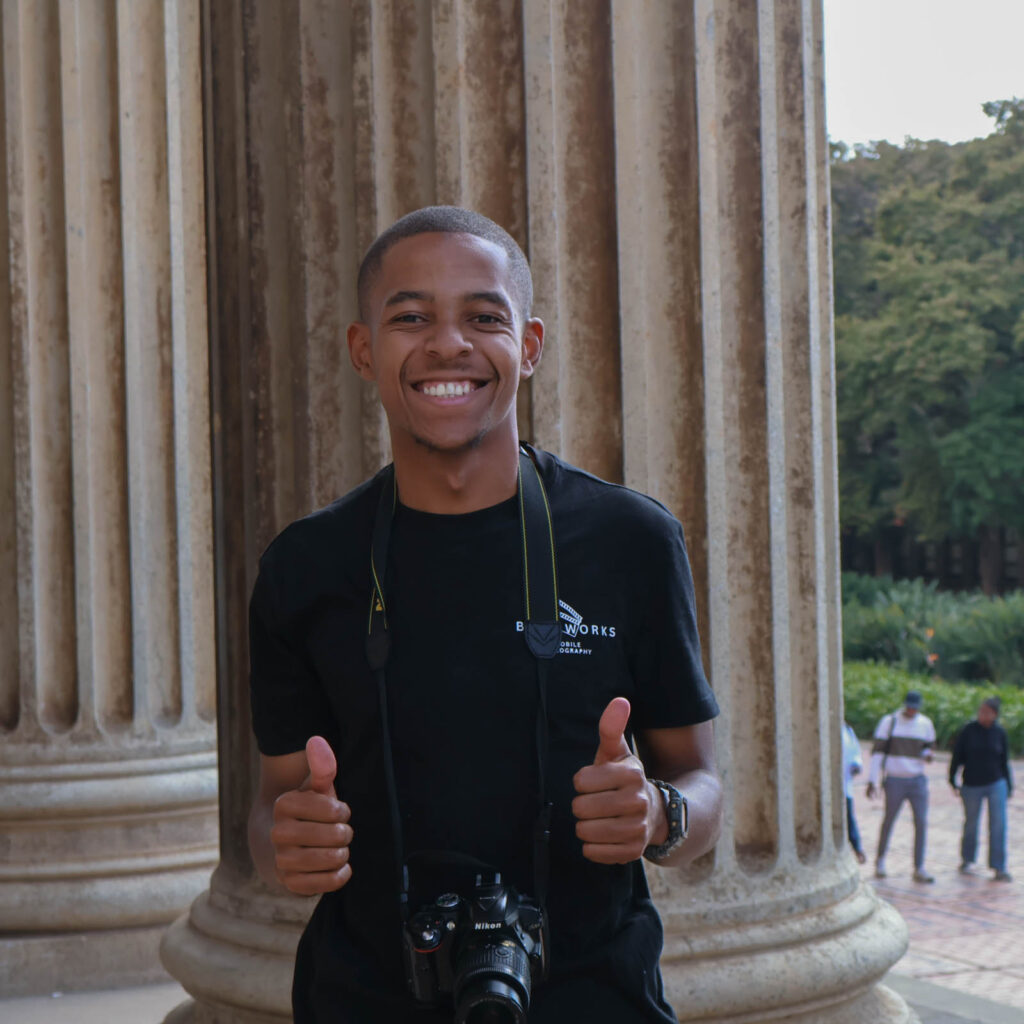
Wits students win their second film competition despite facing finance, logistics, and resource challenges.
Three Wit students won the Nikon ZR Filmmaker Challenge 2026.
As part of the competition, their film was premiered in the SK IMAX Cinema in the Mall of Africa.
The trio plans to start a joint film company.
Three Wits film and television students won the 2026 Nikon ZR Filmmaker Challenge for their short film, Threads of a Memory, which was screened as part of the competition at the SK IMAX Cinema in the Mall of Africa on March, 24.
The three, Sesethu Ledwaba, Blessing Tsebe and Hanani Mbam were partly sponsored by Nikon South Africa who provided them with a Nikon ZR camera and three lenses.
Photo of the three winners with film equipment. Photo: Zebrena Ralph
The trio told Wits Vuvuzela that they competed against some renowned filmmakers in a selection process that they saw only the best eight films being premiered at the Ster Kineker IMAX Cinema.
They had the task of outsourcing their own lighting and tripods which they got from the Wits Film and Television Department. On top of this, they funded their own transport, props, and food for their crew by doing side jobs as students, completing production in just three days. Mbam told Wits Vuvuzela that, “luckily for me I had been working at my res from January, so at least that money I was able to make made things a little easier.”
This win comes after the trio won the Italian-South African Short Film Competition in 2025 with their film, The Art of Tricolore.
Speaking to Wits Vuvuzela, Tsebe said, “It shows that we are a winning formula to some point.”
Despite the Nikon ZR Filmmaker Challenge not having a cash prize, the trio won the Nikon ZR camera, which is a high-performance professional camera.
“It’s better than money” said Tsebe who added that they plan to use it to create more of their own films as a joint film company.
FEATURED IMAGE: Photo of the three winners with film equipment. Photo: Zebrena Ralph
The fund set up to save students leaves many students begging for assistance.
As the second block of the semester begins at Wits University, some NSFAS beneficiaries are not only worried about academic pressures but also about survival. Awaiting allowances has made students anxious about where their next meal will come from and the possibility of being locked out of their residences.
The National Financial Aid Scheme (NSFAS) has gone to shambles. On March 30 2026, the Auditor-General issued a “disclaimer opinion” due to systemic issues that left their books unverified.
The findings revealed funds being paid to over 822 deceased students, 14,000 wealthy ineligible beneficiaries, while legitimate beneficiaries are left to starve, and thousands of fraudulent recipients are benefiting from the fund. The systematic collapse and mismanagement of documents result in hungry students facing possible eviction.
“In the beginning of the year there are four to five funding lists, your name not being on the list means you will not receive an allowance and in that time you have to rely on your family or see for yourself until your name is on the list,” Tariana Botha, a Wits alumni, holds a BA in Psychology and Geography and is now pursing her BA Honours in Psychology, commented,
Perfect Maphumulo, a first-year mining engineering student, shared that his cousin had to borrow money after not receiving his allowance, “He called home and told them he didn’t receive his allowance. His parents had to go borrow money.”
Although some students remain silent about the delay of allowances, they remain hopeful. Waiting for a bank notification with their allowance, the wait is mentally daunting and affects the academics of many students.
The Wits Student Representative Council (SRC) has been making efforts to fill the gaps left by NSFAS through the SRC Access Fund, supported by the university. “NSFAS should be dissolved, and the Department of Higher Education should directly work with universities, and the university should directly work and communicate with the eligible recipients,” Wits SRC President Gilbert Nchabeleng said. The SRC stands with students and continues to fight for them. Until NSFAS is rebuilt and restructured, students will continue to anxiously wait for an allowance.
FEATURED IMAGE: The Financial Aid and Scholarships Office showing students waiting for assistance. Photo: Reatlehile Mashamba
Student photographers at Wits University raise concerns over being denied the opportunity to work during graduation season after missing an accreditation deadline they claim was not clearly communicated.
Student photographers were denied access to graduation due to a permit system.
Many missed the deadline because communication was unclear.
Students are calling for better communication and inclusion in future.
Over the past two weeks, Wits University Campus has been filled with celebrations as graduates marked a significant milestone. For many, taking photos at iconic locations such as the Great Hall has become a tradition. However, this year, some students were forced to make alternative arrangements after unaccredited photographers were denied access.
The university introduced a system requiring photographers to obtain permits to operate during the graduation period. A limited number of registered photographers were allowed to work in designated outdoor public areas, while Campus Protection Services (CPS) removed those without permits.
According to the Examination and Graduation Office (EGO), the application process was posted on the university website ahead of the graduation period. Officials say that the system aims to manage the high volume of people on campus and ensure safety during the ceremonies.
However, several student photographers say they were unaware of the process until it was too late.
A student photographer with they camera around they neck by the Great Hall. Photo: Sanele Sithole
Bakithi Mntungwa, a Bachelor of Education Honours student, said he only learned about the permit requirement shortly before graduations began.
“I only found out about the permit a few days before the first day of graduation, when I was already booked to take photos. By then, the application had already closed around February,” he said.
Other students echoed similar frustrations.
Thabo Mthembu, a Mining Engineering student, said while he understands the reasoning behind the rule, he believes student photographers should have been prioritised.
“I understand the need for regulation, but I had hoped student photographers would be given priority,” Mthembu said.
Mthembu also described difficulties accessing campus with his equipment, despite being a registered student, saying he was denied entry by security.
Students argue that communication could have been improved through official university channels such as email or social media platforms. They pointed to previous opportunities, such as photography competitions, which were widely advertised to students.
“When the applications closed, I was still dealing with registration and financial issues. Checking the website was the last thing on my mind,” Mntungwa added.
While acknowledging the importance of safety and organisation during graduation, both photographers believe that clearer communication and greater inclusion of student creatives could have prevented missed opportunities.
As graduation season has ended, students are calling for more transparent processes and better access in the future so that student photographers are not only present on campus, but part of capturing its most important moments.
Questions were sent to the EGO for comment, specifically regarding concerns raised by student photographers, but no response was received by the time of publication.
FEATURED IMAGE: A student photographer by the Great Hall taking a picture of the landscape. Photo: Sanele Sithole
On Tuesday, March 31, the SRC announced a new structure and reshuffling of their council. They added a new representative to the executive wing and reinstated a member suspended due to a rape allegation late last year.
This change in leadership comes after the resignation of the former Secretary General, Antonett Khoza, on February 26, 2026. In her resignation statement she defined her tenure as being led by a “passion for fighting for access, accountability and dignity of students”.
She added that, “stepping down is not surrender”, but “a strategic withdrawal from a position that no longer allows me to serve effectively under its current conditions”.
The reshuffle resulted in the co-option of an existing member of the executive student governing body by the Dean of Student Affairs. Final year Medical student, Nonhlanhla Siwela, will fill the role of Student Development and Integration Officer.
“Whether elected to a particular position or not, I’ve always strongly believed in advocating for progressive change and making a meaningful difference no matter how small,” she told Wits Vuvuzela after accepting the position.
Alongside these structural changes, an update has also been provided on the sexual and gender-based harm allegations laid against, Musawenkosi Mavuso, in November 2025. After failure to reach the complainant for further information, the conclusion of the inquiry resulted in the lifting of his suspension. Mavuso reassumed his position in the SRC, taking up the portfolio of Bursaries, Fundraising and Stakeholder Relations.
SRC President, Nchabeleng Gilbert, said, “We are glad investigations have been conducted. The SRC reiterated the university findings and find that due diligence has been conducted.”
He added that the changes would not impact existing administrative processes.
The positions and their new representatives are as follow:
Secretary General: Aphelele Qwabi Deputy Secretary General: Matlhatsi Mosima Portfolio of Bursaries, Fundraising and Stakeholder Relations: Musawenkosi Mavuso Student Development and Integration Officer: Nonhlanhla Siwela
What these changes will mean for the student body, remains to be seen.
FEATURED IMAGE: Image of the Wits Great Hall, with students walking in front of the building. Graphic: Amahle Ngqwemla
The increase in the minimum wage amount is not as impactful as the minister of labour and employment would suggest.
The minimum wage amount has increased to R30, 23 per hour from R28, 79 per hour.
The new minimum wage is still not enough to sustain South Africans.
Millions still struggle to cater to their basic needs.
The minimum wage amount is set to increase to R30,23 per hour, from R28,23 per hour as of March 1, 2026. South Africans are beyond frustrated by this small change.
“The income is basically the same, given that the economy is also changing. [The government] increasing the minimum wage doesn’t change the fact that things are also getting more expensive. If, lets say, they were increasing the wages, but the economy’s status was still the same at least [there] would be a bit of a change, compared to right now,” said Rose Mongwe, a third-year bachelor of education student.
The minimal increase, means Mongwe, whose mother is a domestic worker will not get an allowance increase this year. She uses what her mom can give her for toiletries and other personal needs. “It is not [as much] as I would want it to be but then it kind of helps here and there and sustains me when I’m unable to get some money for myself,” she said.
Muhammed Siyad the Regional Investment Growth Manager for Southern Gauteng at Absa said, “At the rate at which inflation is climbing, this increase of the minimum wage amount per hour I don’t feel it would affect any households in a positive sense, the reason for that is everything else is getting more expensive, its making it harder for people to manage based on the current salaries.”
Neo Bapela honours in bachelor of education said, “I feel like the [minimum wages amount] is very little, but also it goes according to peoples’ responsibilities, I might think that the money is enough for me, because I don’t have kids, I don’t have other responsibilities.”
The increase of the minimum wage amount does not keep up with the rising cost of living. Many households continue to stretch out their money, the increase of R1,44 offers little to no relief.
FEATURED IMAGE: Cash and coins. Photo: Bonolo Mokonoto
Technology is advancing and getting involved will help postgraduates not get left behind.
The Wits Postgraduate Orientation introduces students to their chapter as ‘seniors’ on campus.
App development in academic research is encouraged.
Apps can be beneficial but also have various limitations.
From left to right, Simone Dahms Vester, Tasneem Hassem and Lesego Molefe, at the Post Graduate Orientation panel discussion session. Photo: Bonolo Mokonoto
In the age of artificial intelligence, postgraduate research needs to adapt quickly to not just keep up but lead the way. This is what new students were told during their Postgraduate Orientation on January 28, 2026 at the Great Hall.
Beyond using apps and tools that already exist, students were encouraged to be creative and develop their own apps instead of relying heavily on AI for their research. “[With] something like ChatGPT, we need to know who developed it and what data it has been trained on, especially with mental health, a lot of the phrases or tools that have been developed come from the west, so when we transfer it to South Africa there is a mismatch on how we understand mental health” said Tasneem Hassem Senior lecturer in Psychology.
Students were urged to take advantage of digital platforms to create their own apps, using a data collection tool or analysis app. The speakers noted that by identifying everyday research challenges, students can find practical solutions without having any app development background.
Postgraduate students in attendance at the Postgraduate Orientation. Photo: Bonolo Mokonoto
As beneficial as apps can be, they also have their own flaws. Lesego Molefe, a master of science student, shared some concerns regarding the Wits app. “I will always reference the Wits mobile app, it is literally the one stop shop to everything, but there is one problem- it’s that, it’s a bit fragmented” she said. The Wits app needs to bring together the student element, by making it more interactive for it to function as a social media platform.
New technologies should be seen as an opportunity to enhance research rather than an obstacle to tackle.
FEATURED IMAGE: From left to right, Simone Dahms Vester, Tasneem Hassem, Lesego Molefe and Prof Jennifer Fitchett, at the Post Graduate Orientation panel discussion session. Photo: Bonolo Mokonoto
This might be the year the national treasury receives more than two thousand budget tips.
Budget speech to be delivered on February 25, 2026.
Students raise funding, infrastructure, and security concerns.
February 16, 2026, is the closing day to submit tips.
Some university students are eagerly welcoming the Minister of Finance’s call to send budget tips ahead of the second budget speech under the Government of National Unity (GNU), scheduled to be delivered on February 25, 2026.
According to the Parliamentary Monitoring Group, the invitation to send through budget tips began in 1999 under former Finance Minister Trevor Manuel. An effort to get civil society to actively participate in matters of national importance.
Since its inception, citizens’ participation has been limited. In 2023 minister’s office received over 2000 responses. Before and after that, the responses were fewer than a thousand.
Even though the Wits SRC Treasurer General, Somwabo Mhlahlo (22) believes this is one of those things the government does to tick a box, he is determined to contribute to the conversation.
Mhlahlo’s biggest concern is that many students previously funded by the National Student Financial Aid Scheme (NSFAS) are unable to register for the 2026 academic year.
“They have outstanding fees and cannot proceed with their studies because of the NSFAS cap on accommodation, it is the government’s responsibility to settle that debt,” he said. NSFAS currently caps accommodation allowance at R55,000 while residences on campus are currently charging between R55,685- R117,962.
For Sanele Segutya (23), a post-graduate student in Public Management, who spent three weeks in a public hospital in Cape Town due to a leg injury, resource allocation on public health services is most important. To offer services that are almost similar to those offered in private hospitals.
“The fact that I was in a hospital in itself is a privilege. My observations may have been surface level, but the nurses seemed frustrated all the time. At some point they had to discharge patients early because of a shortage of beds,” said Segutya.
Another student who is drafting a tip is eighteen-year-old Tsenolo Dampies, first-year student in Computational and Applied Mathematics. Dampies’ focus is infrastructure and security. “We need more cameras in crime hotspots, and more police stations where people can report crime as we all know that crime is on a rise in South Africa,” he said.
Witsies are using this chance to play a part in building the nation they dream of living in. If you were unaware that you have this power, you are being urged to click on this link, in no more than 300 words, state how you want your government to allocate funds, by no later than Monday February 16, 2026.
FEATURED IMAGE: Image showing South African Rands. Photo: Lulah Mapiye
Booking accommodation is slowly becoming a gamble as trusted sites get flooded with fraudsters.
Students struggle with online registration and travel miles for in-person assistance.
People use Booking.com to defraud customers.
Use of AI consultants blocks customers from getting safe and speedy assistance.
Owam Vinqi, a Wits fourth year student from Port Elizabeth was left without a place to sleep on Thursday, January 15p on Thursday. Vinqi who had spent fifteen hours travelling to Joburg was left stunned after being informed of the non-existence of her booking during check-in at 286 Fox Street, Maboneng.
Vinqi had booked a studio apartment for a two night stay on Booking.com for R810. Money she could barely afford to part with, as her trip was primarily to sort out a registration block due to outstanding fees of R13 000. The last thing Vinqi expected was to fall prey to a scam.
Upon her arrival, a security guard at 286 Fox Street said her booking was invalid, as she had no email with a secret code to present at check-in. The proof of transaction Vinqi had on her banking application was not enough.
“I looked stupid talking to the security. When I tried contacting Sterling [the alleged manager of the apartment] via the Booking.com platform, I received no response.
“I exhausted all my options and finally accepted that I had been scammed,” said Vinqi. She was able to access emergency accommodation in Doornfontein provided by the Wits SRC.
Wits Vuvuzela reached out to Sterling, who refused to disclose his full name and surname, regarding Vingi’s allegations. He denied any knowledge of the booking and explained that Booking.com handles all payments and confirmation letters. He said he only receives his cut days after hosting the guest.
“I do not know if or how she was scammed. If she did not receive a confirmation email, she should take the matter up with Booking.com and they will refund her,” said Sterling.
This incident is one of many global Booking.com scams. In the UK, customers lost a total of £370,000 (ZAR 8 090 645,70) between June 2023 and September 2024 reported The Guardian.
Furthermore, last month, Euronews raised serious concerns regarding the careless nature of Booking.com’s security, specifically its failure to remove fraudulent listings that have become ‘stains’ on the platform’s reputation.
Closer to home, content creator, Ariel Lyndsey, made headlines in December 2025, after she was scammed twice in the Camps Bay area in Cape Town. Despite reporting the first fraudulent listing, she found another deceptive property on the same app, highlighting a dangerous lack of oversight in the platform’s verification process.
Wits Vuvuzela’s efforts to get through to a human consultant at Booking.com were blocked by many AI consultants on calls and Instagram and lastly an international helpline.
Vinqi had exhausted the above options before resorting to opening a fraud case through her bank, and now she is awaiting feedback on the case.
FEATURED IMAGE: Illustration of a student stranded in Maboneng. Photo: Lulah Mapiye
Being a first-year can conjure up a rollercoaster of emotions, and navigating it can turn survival into belonging.
The moment my parents’ car disappeared down the road outside my residence four years ago, reality hit me. Standing there in a new place, surrounded by unfamiliar faces and unpacked boxes, I felt a knot in my stomach and my chest tightened with anxiety. It was bittersweet watching them leave, I felt a mixture of both excitement and fear settling in all at once. As shy as I was, I knew this was an opportunity of a lifetime.
Around me, students laughed as their parents helped them carry boxes upstairs, rooms and corridors buzzed with conversation, and new friendships seemed to form effortlessly. I knew no one. I kept questioning if I truly belonged here. I did not realise then, what I know now, which is that almost everyone around me was feeling the exact same way I did. Even in my loneliness, I promised myself that I would make the most out of this experience.
Walking onto the Wits University campus for the first time can be both exciting and terrifying. Your first year at Wits represents a sense of freedom and possibility, but also pressure and uncertainty, this marks the beginning of a journey that will test you in ways you never expected.
Wits is more than just attending lectures and keeping up with submission deadlines. Outside of classes you will quickly come to realise that this university has so much more to offer. Whether you are grabbing something to munch on at the Matrix, sitting on the Lawns with your new formed friends, or doing the occasional people-watching on the Great Hall steps, these spaces become the heart of student life on main campus.
The fountain separating the Great Hall from the Library Lawns, it brings a relaxing white noise during stressful days. Photo: Bonolo MokonotoThe Matrix, located on east campus. This is a busy student center, with food vendors, banks and the Campus Bookshop. Photo: Bonolo MokonotoThe Main campus bus stop. This is where you will catch the Wits bus that takes you to the other wits campuses and residences. On the same road is AMIC Deck which is the bridge that connects east and west campus. Photo: Bonolo Mokonoto
Hundreds of events are hosted by various clubs and societies and pop- up performances are frequent; this is to remind you that Wits is a community, as much as an academic space. Ensure that you get involved as it will help make campus feel less stressful and more like home.
Speaking of stress, the change from high school to university is drastic and this can be overwhelming. No one is here to remind you of deadlines or check if you are keeping up academically, it is important that you take agency over your own life. First year is not about being perfect, it is about learning how to manage your time efficiently to avoid unnecessary stress later on.
Making friends can be tricky, campus is constantly busy and it is easy to feel alone in the crowd, as was I upon arrival. People might seem like they have it together, but they are silently navigating the confusion and anxiety just as you are. Do not be afraid to talk to the person sitting next to you in a lecture or ask questions in tutorials, you would be surprised how many people feel exactly the way you do.
Zesti Lemonz on west campus, this eatery provides light meal takeaways for students on the go and provides an outdoor seating area to mingle with friends. Photo: Bonolo MokonotoJimmy’s, located on west campus with a corresponding location at the Matrix. Photo: Bonolo MokonotoThe Wits Anglo American Digital Dome is a 360° immersive digital facility on east campus. It provides a state- of -the art venue showcasing science, arts and culture. Photo: Bonolo Mokonto
As the year continues, it is important to know where you can seek out help. Wits offers academic development units such as the Wits Writing Centre, tutors, and libraries that are there to support you. Make use of these facilities early on, there is no shame in seeking help.
Recreational sports facility located on west campus, this is where you can bond with other sports lovers and engage in the ever therapeutic team sport. Photo: Bonolo MokonotoOutdoor gym on west campus close to Barnato Hall Residence. Photo: Bonolo MokonotoA deeply hidden dam and water feature located on west campus next to Barnato. This is known to the seasoned witsies as a secret getaway from the constantly hectic wits campus. Photo: Bonolo MokonotoAlumni House on the lower end of west campus, it houses Olives and Plates a restaurant on campus for all to enjoy. Photo: Bonolo Mokonoto
First year will test you, you might fail a test, or question whether you belong or not. Do not give up, keep showing up and take it one day at a time.
Oh and remember, once a Witsie always a Witsie!
FEATURED IMAGE: The Great Hall at Wits University. Photo: Bonolo Mokonoto
The Vanderbijlpark scholar transport accident exposes how reckless driving and weak enforcement continue to cost lives on South Africa’s roads.
On Monday, January 19, a scholar transport minibus was involved in a devastating collision in Vanderbijlpark, situated south of Johannesburg. The tragic accident resulted in fourteen fatalities, sending shockwaves through Gauteng and the country at large.
As investigations continue, the 22-year-old driver appeared before the Vanderbijlpark Magistate’s Court, where the case took a drastic turn as he abandoned bail and additional charges were added. The National Prosecuting Authority confirmed on Thursday, January 22, that the driver, Ayanda Dludla, now faces 14 counts of murder, upgraded from the initial charges of culpable homicide. Other charges include three counts of attempted murder, one count of driving without a valid permit and one count of operating an unlicensed vehicle.
Initial reports and video footage point to reckless driving during peak traffic. Too often, scholar transports operate in a grey area where unroadworthy vehicles, missing permits and unqualified drivers are treated as a miner issue, rather than a life-threatening risk for the lives of people on the road.
The tragedy that unfolded in Vanderbijlpark is not just a heartbreaking reminder of how dangerous our roads have become; it is an indication of the disappointing system that has repeatedly failed to protect even its most vulnerable users. For years, communities and road safety advocates have warned about reckless driving and weak enforcement from road officials.
The Department of Transport’s recent push to verify scholar transport operators, to ensure proper registration and the possession of valid documentation, is crucial. This raises an uncomfortable question: why did it take the loss of fourteen young lives for this urgency? Road stops after such a tragedy are not enough, enforcement must be consistent and uncompromising, not just reactive.
Scholar transport drivers are entrusted with young lives, and that responsibility needs discipline, patience and respect for the rules of the road. Reckless overtaking, speeding and a complete disregard for traffic laws are acts of negligence with inevitably devastating consequences.
Parents and community members should be empowered to play a role and verifying whether a scholar vehicle is properly registered, checking operating permits, and refusing to use services that cannot prove the above should be normalised. Communities should feel supported and not intimidated or discouraged when reporting unsafe drivers.
The way forward requires more than apologies and condolences. It demands stricter enforcement, routine vehicle inspections and serious consequences. The Vanderbijlpark tragedy must mark a turning point for South Africans. Our children deserve to travel safely to and from school, anything else is a failure we can no longer accept.
Investigations into the accident are ongoing and the case has been postponed to March 5, 2026.
FEATURED IMAGE: Bonolo Mokonoto profile image. Photo: Paul Botes
The engines may be silent for now, but South Africa’s F1’s dream is roaring back to life. With hundreds of millions of rands worth of upgrades and fans ready to “sell their livers” for a ticket, Kyalami’s revival could mark the nation’s return to the global racing map.
Kyalami, founded in 1961, hosted F1 races but lost status due to apartheid sanctions and financial issues.
The decision to host lies with the Department of Sports, Arts and Culture and F1 Management, not Kyalami.
The planned R100-million track upgrades will be fully funded by Kyalami’s owner.
In 2010, the world’s gaze turned to South Africa as people from across the globe waved their flags, cheered, and danced during the FIFA World Cup. The streets of Johannesburg pulsed with energy, and local businesses experienced unprecedented growth. Fifteen years later, a parallel dream is emerging – this time, not in football, but in F1.
Could the roar of engines replace the roar of supporters? Could the return of F1 to Kyalami once again place Johannesburg on the global stage as a world-class African city, one that benefits ordinary citizens as much as the elite?
For lifelong F1 fan Kevin Matla, the idea of F1’s return is more than just news, it’s personal. “For me, F1 is life,” he says, recalling how he’s been following the sport since 2005. The possibility of a local Grand Prix fills him with pride and excitement, especially since the last race in 1993 was held under conditions that excluded many South Africans.
Kyalami’s Grand Prix Circuit has long been a place of transformation. Founded in 1961 with the “Kyalami 9 Hours”, an endurance race, the track rose to global prominence in 1967 when it hosted its first Formula One event, cementing its reputation for motorsport excellence.
Through the 1970s and 1980s, Kyalami thrived as a premier racing destination, until its F1 chapter closed in 1985 following international sanctions against South Africa’s apartheid regime.
Kyalami experienced a short-lived resurgence in the 1990s, hosting races in 1992 and 1993, but financial and political issues brought it to a halt again. By the early 2000s, the circuit had lost its international appeal, relegated to hosting local events and remembered fondly through nostalgia.
For Matla, hosting F1 again would mark a national achievement, boosting tourism, creating jobs, and reigniting pride among South Africans. He believes that while ticket prices may be high, the event will still attract strong local support, “I know there are rumours that tickets are going to be R10 000; people might have to sell their homes or their livers.
FIA Approval: A New Era for Kyalami
In 2014, entrepreneur Toby Venter, CEO of Porsche South Africa, acquired the Kyalami Grand Prix Circuit at an auction, marking a major turning point for the historic track. His multimillion-rand investment transformed Kyalami into a world-class facility that now meets international racing standards. This effort culminated in the circuit earning FIA Grade 1 approval, the highest level of certification required to host Formula One races.
According to Porsche South Africa’s Group Public Relations Manager, Christo Kruger, the certification represents more than just a technical achievement; it’s a symbol of readiness and revival. With this recognition, Kyalami now stands as the only FIA Grade 1 circuit on the African continent, positioning it one step closer to reclaiming its place on the global motorsport stage.
With this recognition, the countdown has officially begun. “According to the FIA rules, Kyalami now has three years from the day of approval to do the upgrades and then the final inspection,” says Kruger. “Homologation [official approval] happens, and we are then accredited with Grade 1, if everything is done within the approved scope,” Kruger says.
A visual of precision and progress, the official circuit layout outlines Kyalami’s 16 turns and 18 camera points, symbolising South Africa’s readiness to meet international racing standards once again.
Photo: Dikeledi Ramabula
The announcement has fuelled excitement within South Africa’s motoring community, reigniting hopes of seeing F1 cars roar through the Midrand circuit once again. Planning for upgrades is already underway, though construction has not yet begun due to Kyalami’s packed calendar of local events, such as the Festival of Motoring and M-Fest.
However, the future of the project ultimately hinges on F1’s commitment to return. Kruger noted that while some improvements will proceed regardless, the scale of investment will depend on whether the international organisers confirm South Africa’s inclusion in the upcoming calendar.
Eyes locked on the track, South African female driver Simphiwe Mohlahlo waits in her BMW, focused and ready for her race on one of the country’s most iconic circuits. For her, Kyalami represents both legacy and opportunity for women in motorsport. Photo: Dikeledi Ramabula
Hands gripping the steering wheel, eyes locked on the track, Nathi Msimanga sits in full focus, ready for the challenge ahead. The determination in his gaze says it all: he’s here to compete, to push limits, and to belong among South Africa’s best. Photo: Dikeledi Ramabula
For Wits mechanical engineering student and professional Toyota Gazoo Racing driver Nathi Msimanga, Kyalami is more than just a circuit, it’s “the most prestigious track in the country;” a place that mirrors the speed and sophistication of international circuits. Yet despite Kyalami’s world-class design, Msimanga remains doubtful about Formula One’s return in 2027, though he believes it could shine a spotlight on South African motorsport.
“If F1 does come here, it’ll force companies, sponsors, and media to finally give our sport the attention it deserves,” he says. He adds that consistent funding, promotion, and government support are key to making racing accessible for all, and to inspiring the next generation of South African drivers.
And for South African female driver Simphiwe Mohlahlo, who competes in the MSA4 and Formula Libre series, Kyalami Grand Prix Circuit represents more than just asphalt and corners, it’s a symbol of legacy and opportunity. “Racing there feels like being part of history,” she says, noting how rare it is for local drivers to experience the track.
Screens, radios, and precision, the nerve centre of every race. From here, officials monitor every lap, every turn, every moment that defines safety and speed. It’s the unseen engine that keeps Kyalami running.
Photo: Dikeledi Ramabula
Mohlahlo believes that a possible F1 return in 2027 would not only spotlight the perseverance of South African motorsport but also open doors for emerging talent, particularly women. She praised initiatives like the F1 Academy for inspiring young girls and called for more national activations, academies, and sponsorship support to grow the sport sustainably. Confident in the country’s ability to host F1, she adds that such an event could invigorate the economy and elevate local representation on the global stage, a dream she hopes to see realised in her lifetime.
How Major Events Put South Africa on the Map
Hosting big sports events has been a game-changer for South Africa, and the potential F1 has the potential to be another.
The 1995 Rugby World Cup stands as one of South Africa’s most powerful symbols of unity and healing after apartheid. When Nelson Mandela wore the Springbok jersey to present the trophy, it became a defining moment that showed the world a nation coming together, united through sport and shared pride.
The iconic Kyalami Grand Prix Circuit, sprawled across Midrand’s picturesque landscape, is more than just a racing track, it’s the pulsating heartbeat of SA’s motorsport. This revered circuit has been the stage for countless thrilling moments. With its rich history and nostalgic charm, Kyalami is a treasured gem in the world of racing, and the nation is eagerly yearning for the day when it will once again reverberate with the thunderous roar of Formula 1 engines, sending shivers down the spines of petrolheads and reviving the country’s glorious racing heritage.
Photo: Dikeledi Ramabula
In 2010, South Africa made history as the first African nation to host the FIFA World Cup, a moment that not only boosted the economy but reshaped the nation’s image. The government invested over R30-billion in infrastructure, from transport and airports to world-class stadiums, creating around 66 000 construction jobs and injecting R7,4-billion into the economy, with R2,2-billion benefiting low-income households. Beyond the numbers, the tournament became a nation-branding triumph, transforming global perceptions of South Africa’s people, cities, and capability to deliver on the world stage.
The World Cup showed the world that South Africa is a great country to visit and host events. Over 500,000 South Africans, including taxi drivers and volunteers, helped make visitors feel welcome. The country got the highest score ever for hosting a World Cup, which was a big achievement. After the tournament, more people came to South Africa for vacation (up 31%) and business (up 47% in Cape Town).
Hosting major events does more than bring sporting success; it reshapes how the world sees a country and strengthens national pride. For Johannesburg, a successful return of F1 to Kyalami could have the same effect, boosting the city’s reputation, inspiring locals, and attracting new investment. Beyond the race itself, it would signal that Johannesburg is not only capable of hosting world-class events but also stands out as a vibrant, globally recognized African city, a symbol of ambition, progress, and pride. Such high-profile events play a key role in nation and city branding, showcasing South Africa’s potential on the international stage while reinforcing Johannesburg’s identity as a world-class African city.
A relic of Kyalami’s F1 past, this worn Goodyear tyre carries the weight of history, rubber that once touched the same tarmac where legends raced three decades ago. It marks the last time South Africa hosted a Formula 1 Grand Prix, a moment that still echoes in the hearts of local fans who remember the roar of engines and the pride of seeing their country on the global stage. Today, it stands as more than just an object of nostalgia, it’s a symbol of unfinished business, a reminder of a dream paused but never forgotten. Photo: Dikeledi Ramabula
According to Professor Mfaniseni Sihlongonyane from Wits University’s School of Architecture and Planning, hosting international events such as F1 presents both opportunities and significant challenges for cities. He notes that infrastructure, funding, and the “critical mass” of participants are key factors in determining whether a country can successfully host and sustain such events. However, Sihlongonyane acknowledges that F1’s return could stimulate multiple sectors, from hospitality and transport to food and automotive industries, creating employment and boosting economic activity. He cautions, though, that South Africa must ensure inclusivity by supporting small businesses, women, and youth through subcontracting and empowerment initiatives. “It shouldn’t just be about large corporations benefiting,” he explains. For him, Johannesburg’s approach should centre on a social contract with F1, one that promotes economic growth while advancing social justice and community participation.
Who Decides F1’s Return?
While Kyalami may be ready to host, the final decision on whether F1 returns to South Africa does not rest in its hands. According to Kruger, the circuit’s role is limited to being the venue. “Kyalami is not really responsible for F1 coming back, that’s very much up to the Department of Sports, Arts and Culture and a promoter,” he explains.
The government, together with F1 Management, will ultimately decide whether South Africa secures a spot on the 2027 racing calendar. Kyalami’s task, meanwhile, is to ensure the track remains in top condition and meets all technical and logistical requirements once approval is granted.
Eighteen eyes on every corner. The circuit’s surveillance system reflects Kyalami’s world-class standards, a blend of technology, safety, and ambition as it prepares for potential FIA-level events. Photo: Dikeledi Ramabula
Behind the scenes, negotiations and financial guarantees have already been submitted, but the costs involved are steep. “The planned track upgrades are expected to cost around R100-million, an amount that will be self-funded by Kyalami’s owner, OT Venter Investments,” Kruger says.
Formula One is a huge money-maker globally. In 2024, it earned over $3.4 billion, with a big chunk coming from cities and countries paying to host races. This shows how valuable it is to host an F1 event. The sport is also super popular, with 5.7 million people attending races in 2022, a big increase from 2019. Kruger acknowledged that while the enthusiasm for F1’s return is strong, the financial reality remains daunting. Hosting fees for international races can range between $25 million and $54 million, depending on the location.
Logistics and Local Impact
Bringing F1 back to South Africa would be a complex operation, one that extends far beyond the racetrack. Temporary grandstands, hospitality suites, and infrastructure upgrades would all have to be set up to meet F1’s international standards. The surrounding roads and access routes to Kyalami would also need attention to accommodate the thousands of fans expected to attend.
Shops and restaurants hum quietly inside Kyalami Corner, just a few minutes from the racetrack. For now, the calm reflects ordinary life, locals grabbing coffee, but if Formula 1 returns, this space could transform overnight. The sound of engines would spill into nearby businesses, bringing a rush of fans, tourists, and international media. For store owners, it’s more than just excitement, it’s the promise of economic revival, a chance to feel the same national buzz last seen during the 2010 FIFA World Cup. Photo: Dikeledi Ramabula
Beyond the logistical hurdles, the project holds the potential to benefit local communities. Kyalami’s management has expressed plans to include fan parks and fan zones that would create space for small vendors and local entrepreneurs to participate, ensuring that the excitement of the event extends beyond the gates of the circuit.
Kruger emphasizes that a return of this scale would not be fleeting. “F1 doesn’t do once-off events. They will want to sign a deal for a minimum of five years to seven, and sometimes up to ten years,” he says. Such a long-term commitment would not only secure South Africa’s place on the global racing calendar but also demand consistent investment in maintenance and event management to keep the circuit world-class.
Despite the enthusiasm surrounding the possibility, Kruger remains grounded about the uncertainty of the outcome. When asked what message he had for South Africans hoping to see the sport return home, his response is simple: “Pray. It’s really not in our hands; we can only stay hopeful that negotiations with F1 Management are successful.”
As South Africa awaits an official decision, the prospect of F1 returning to Kyalami is tantalizingly close. Backed by Toby Venter’s revival efforts, FIA approval, and public excitement, this moment reinforces one thing, Joburg truly is a world-class African city, capable of hosting global events that bring people and opportunities together. The wait may be long, but South Africa’s F1 dream is finally on track and ready to take off.
From the outside, Kyalami stands as both a landmark and a promise, a place where South Africa’s motorsport legacy meets its future ambitions. Once the stage for legendary Formula 1 races, the circuit now waits, carrying decades of history, triumph, and struggle within its walls. For many, this circuit symbolise a new chapter, a nation eager to reclaim its place on the global racing map and prove that world-class competition can thrive again on African soil. Photo: Dikeledi Ramabula
FEATURED IMAGE: Kyalami Grand Prix Racetrack. Photo: Dikeledi Ramabula
A new amendment to the National Credit Act could see students with debt blacklisted as soon as they graduate.
On August 13, 2025, the Minister of Trade and Industry, Parks Tau, submitted draft amendments to the National Credit Act, proposing that educational institutions may report student debt to credit bureaus. If passed, this would mean that graduates could be blacklisted for their debt. Public comment is open until September 12, 2025.
At first glance, this policy looks like accountability. But in reality, it is yet another tool that widens South Africa’s already staggering inequality gap. For wealthy families, paying university fees is not a burden. For the poor, especially the Black majority, it is another chain tying us down.
South Africa is already split in two: those who have, and those who struggle to survive. Instead of building bridges, the ruling party seems determined to burn them down, shutting off access and any chance to ever cross that bridge. The Afircan National Congress continues to oppress young people, creating more obstacles than opportunities. Instead of uplifting us, they are burying us deeper under the weight of policies that do not understand our lived realities.
Not every student has parents who can afford fees for tertiary education. Those who manage through bursaries and student loans, then graduate into an economy that demands work experience for jobs, while internships often pay next to nothing. The lucky few who evade unemployment through entry-level jobs can earn as little as R5000 a month. How must that cover rent, food, transport, and other essentials, and still stretch to settle student debt?
This amendment doesn’t simply manage debt, it weaponises it. It tells young South Africans that their dreams of education come with a punishment clause. That, unless you are privileged, your qualification is a curse that follows you into every financial decision, from applying for a job to renting a flat.
Are our leaders truly this blind? Or are they deliberately working against the success of young South Africans? Each new barrier makes it harder to believe they care.
But we are not powerless. The public has until September 12, 2025, to oppose this amendment. Send your comments to credit@thedtic.gov.za
Raise your voice, share your story, and remind those in power that the future of this country depends on its youth.
To the politicians who continue to oppress us: we will meet you at the ballot box.
In episode six of We Should Be Writing season 7, the team unpacked the evolution of music as a form of expression and protest, through four decades in the South African context. The episode explores the journey of South African music and its consumers from the 80s, 90s, early 2000s and contemporary listeners. From the […]