Inside the Dome, African tales are revived and retold anew.
Wits launches its annual Digital Dome Festival to retell African oral stories through Virtual Reality, dome animation and projections.
Fourth-year digital arts and animation students showcased their film projects.
The Dome takes African stories to the world while creating employment opportunities for students.
“You are already in the future. Others will arrive,” said Professor René Smith, Head of the Wits School of Arts, during the opening of the Digital Dome Festival, pointing to the transformative power of immersive media.
Wits University hosted its Digital Dome Festival between August 21 and 22, 2026 in collaboration with the Wits School of Arts (Digital Arts Division), the Naval Hill Planetarium, the University of the Free State, and cultural institutions including Electric South and the French Institute of South Africa (IFAS).
This year’s theme, Stories Spoken, Stories Seen, was inspired by diverse African oral storytelling traditions passed down through generations. African folktales were retold through immersive digital technologies like dome animations, VR experiences and projections. The theme and festival demonstrate that “Africa can shape the future of immersive media,” said Professor Lynn Morris, Deputy Vice-Chancellor of Research and Innovation at Wits.
Student screenings formed a central part of the programme.
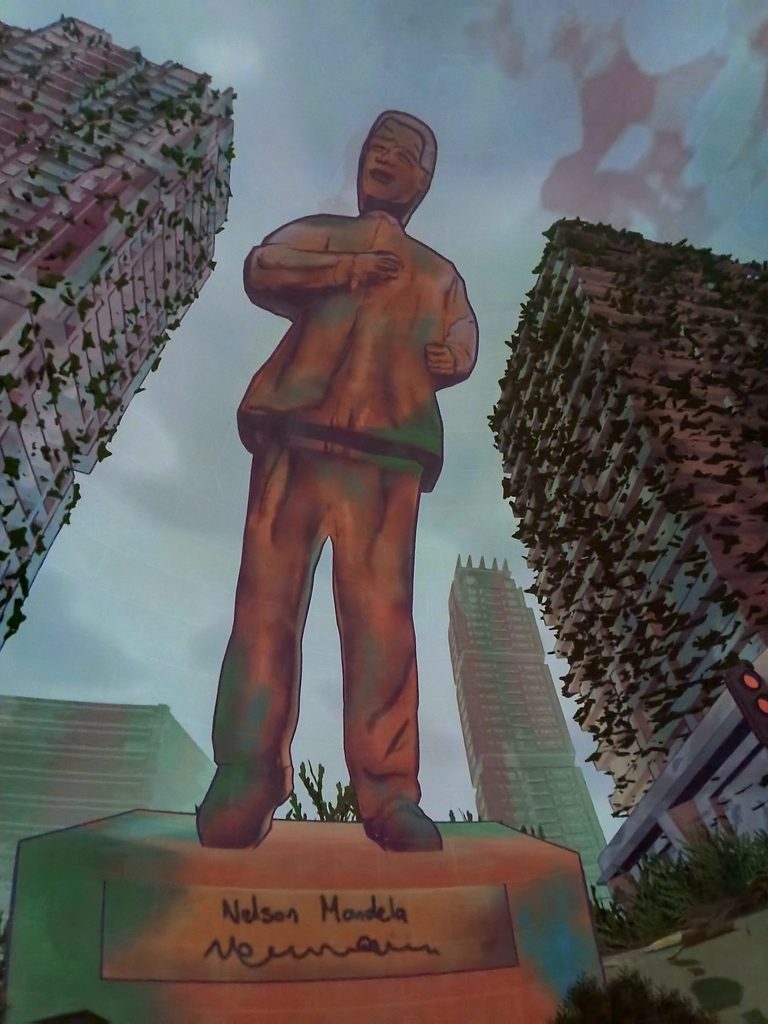
An animated statue of Nelson Mandela from the Wall-E film. Photo by: Naledi Maraisane
The Nanabolele projection stood out. The two-minute film, based on a Sesotho mythological interpretation, follows Princess Thakane, blessed by her grandmother to hunt the Nanabolele — a water-dwelling, dragon-like creature that glows in the dark and travels hidden inside clouds or red smoke. She seeks its glowing hide to make gifts for her brothers returning from initiation.
“We wanted a story that could speak to a large amount of people. We started looking at African mythology and folktales,” said Tlhalefo Boshielo, a fourth-year Digital Arts student in animation and projection mapping. The Nanabolele VR experience placed viewers inside a non-physical world, bringing imagination to life through immersive technology.
On what inspired this year’s theme, Sasha Wessels, Digital Arts lecturer and organiser, said that in high school she was not allowed to learn about African languages or traditions, which felt like a robbery. “I left high school angry. I feel unknowledgeable about the country that I live in.”
Projects can be rented to other global domes for profit, creating employment opportunities for students. For this reason, Wessels does not allow students to use Artificial Intelligence (AI). “The issue with AI is that the moment you implement it, you can’t sell it.” However, she acknowledges AI as a useful tool in an industry long gatekept by the West.
Through immersive technologies, students are archiving, professionalising and making African oral traditions, history and storytelling exportable.
FEATURED IMAGE: Students experiencing VR technology for the first time. Photo by: Naledi Maraisane
South Africa’s growing illicit economy is putting everyday consumers at risk.
South Africa’s illicit economy is estimated to account for 12–15% of Gross Domestic Product.
The Consumer Goods Council South Africa’s #YourChoiceHasPower campaign is urging consumers to make informed choices.
Consumers are caught between affordability, accessibility and safety.
A gun threat against investigative journalist Govan Whittles, dangerous methanol in illegal alcohol and poison sold by street vendors are some of the scenes that stuck out in Someone Always Pays, a documentary series examining South Africa’s billion-rand illicit economy.
The Consumer Goods Council of South Africa (CGCSA) launched its #YourChoiceHasPower campaign alongside the documentary, with the council estimating that illicit trade accounts for between 12% and 15% of South Africa’s GDP.
Photo of panel speakers at the launch of the #YourChoiceHasPower campaign. Photo: Nqobile Mtshali
Illicit trade is usually associated with cigarettes, alcohol and counterfeit clothing, but the problem stretches much further. Food, pharmaceuticals, cosmetics, fuel and chemicals are also sold on the black market, meaning consumers don’t always know whether the products they buy are legitimate or substandard. Chief executive officer of CGCSA, Zinhle Tyikwe said reach of illicit goods is “becoming deeper and scarier.”
Economic pressure and unemployment can make cheaper illicit products attractive, creating a difficult choice between what people can afford and what is legitimate and safe. Tyikwe said, “It’s mainly unaffordability,” that keeps the market alive.
Illicit trade is not confined to poorer communities. Whittles’ team found illicit cigarettes being sold in affluent areas including Rosebank, Parkhurst and Sandton. The investigation also uncovered connections between different illicit industries and organised crime. “It’s all connected. It’s all organised crime,” Whittles said.
That interconnectedness helps explain why the cost of illicit trade extends beyond sales. Dangerous products can have consequences for ordinary people, while legitimate businesses can lose customers. Whittles said, “People pay with their lives,” and those who do not pay with their lives can pay with their livelihoods. His team encountered a shopkeeper who refused to sell illicit tobacco but struggled to attract customers because cheaper alternatives were available elsewhere.
The scale of the illicit economy creates further pressure on law enforcement. Whittles said authorities struggle to intercept and investigate every shipment, while Tyikwe said prosecution remains a problem, arguing that fines imposed on those caught selling illicit products are often insufficient to deter the trade.
The CGCSA says consumers can help disrupt this cycle by buying from legitimate outlets, being cautious when prices seem too good to be true and checking products before purchasing them. Its My CGCSA app allows consumers to scan products and access information about registered brand owners, while suspected illicit goods can be reported through the app.
FEATURED IMAGE: Cigarette’s showcased as examples of illicit goods at the launch of the #YourChoiceHasPower campaign. Photo: Nqobile Mtshali
I Understand What You Do. You Show Us What We Do Not See invites visitors to discover the extraordinary hidden in everyday places.
On 4 August 2026, the Wits Art Museum opened “I Understand What You Do. You Show Us What We Do Not See”, an exhibition that explores the idea of home through photography. Rather than presenting home as simply a physical place, the exhibition challenges visitors to consider how belonging can exist in ordinary spaces and everyday moments that often go unnoticed.
The exhibition celebrates the legacy of renowned South African photographer David Goldblatt in what would have been his 95th year. Inspired by Goldblatt’s belief that photography reveals what is often overlooked, the exhibition explores themes of identity, memory, belonging, and place. It features work by nine predominantly Johannesburg-based photographers documenting diverse experiences of life in and around the city, alongside photographs from the “Of Soul and Joy” photography initiative. The exhibition’s title comes from a memorable encounter in which a stranger described Goldblatt’s work by saying, “I understand what you do. You show us what we do not see.”
That sentiment is reflected throughout the exhibition. A passer-by may see only a busy Johannesburg street or an ordinary neighbourhood, while someone else recognises it as a place of comfort, memory, and belonging. The exhibition encourages viewers to pause and reconsider these familiar spaces, revealing the stories that exist just beneath the surface.
One of the exhibition’s greatest strengths is its curation. Each body of work flows naturally into the next, allowing the conversation around home and memory to develop seamlessly as visitors move through the gallery. Although each photographer presents a distinct perspective, the exhibition never feels disjointed. Instead, every collection builds upon the last, reinforcing the central theme and making it easy to understand the exhibition’s message without it ever feeling repetitive or forced.
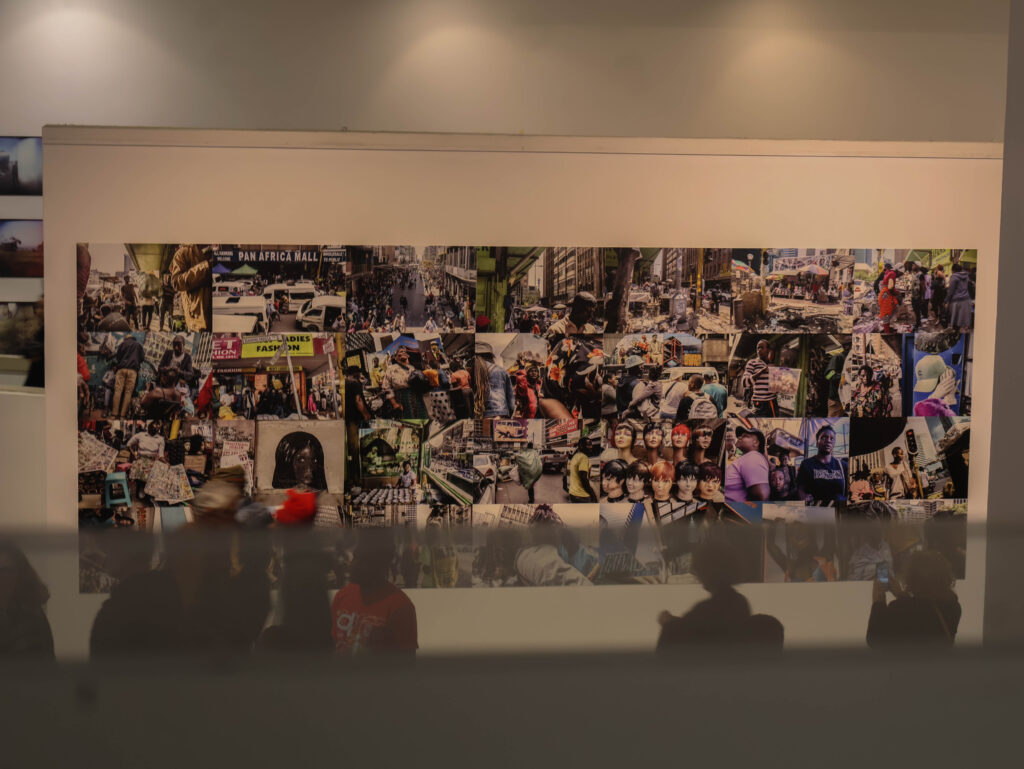
A picture of one of the art works displayed by Sanele Sithole
Among the featured artists, Jabulani Dhlamini’s “Poloko: In Soweto” stood out most. His work explores the hidden histories of Soweto through photographs of homes, portraits, and personal stories. Rather than focusing solely on well-known historical sites, Dhlamini captures everyday spaces that have quietly become symbols of resilience, identity, and belonging. His photographs reveal how residents have transformed apartheid-era houses into places that carry personal and collective memories while also reflecting on the legacy of the 1976 Soweto Uprising and his own family history.
As someone from Soweto, Dhlamini’s work resonated with me on a personal level. The homes, streets, and familiar surroundings he photographs are places I have seen countless times, often without giving them much thought. Seeing these everyday spaces displayed in a gallery reminded me that what feels ordinary to those who live there can also hold extraordinary meaning. His photographs challenged me to look beyond what is immediately visible and appreciate the stories, memories, and histories embedded in places I have always called home.
More than a photography exhibition, “I Understand What You Do. You Show Us What We Do Not See” succeeds in encouraging visitors to slow down and look closer. Its thoughtful curation ensures that the works complement one another, while its central theme of home is communicated with clarity and sensitivity. By the time visitors leave the gallery, they are reminded that home is not simply a place on a map but a feeling shaped by memory, identity, and lived experience. It is an exhibition that quietly asks us to reconsider the familiar and, in doing so, reveals the extraordinary hidden within the ordinary.
Hundreds took to the streets, calling for protection of housing rights and an end to rising xenophobia.
Operation Ubuntu marched to the Premier’s Office to oppose the PIE amendment and rising anti-migrant sentiment.
Housing activists and informal settlers argue that the revision to the PIE Act criminalises poverty.
The march’s memorandum calls for greater state accountability in handling anti-migrant hostility.
On the morning of August 8, a coalition of over 60 social justice organisations under the name Operation Ubuntu led a march to the Premier’s Office demanding an end to xenophobia and a rejection of the proposed amendment to the Prevention of Illegal Eviction (PIE) Act.
The march was one of many coordinated protests taking place in Johannesburg, Cape Town and Durban in response to two issues affecting marginalised communities: ongoing xenophobia and housing insecurity.
Marchers charging through the streets holding banners and placards. Photo: Jamie Ho.
Woman holding a placard condemning xenophobia. Photo: Jamie Ho.
Frustration as protestors march for housing rights and an end to xenophobia. Photo Jamie Ho.
Central to the protest was the recent proposal for an amendment to the PIE Act. Currently, people cannot be evicted from their homes without a court order as the Act operates in accordance with Section 26 of the Constitution, which stipulates that “everyone has the right to access adequate housing”.
Activists fear the proposed amendments would weaken these protections, particularly for people living in informal settlements and other forms of insecure housing. They are particularly concerned that courts could order evictions without requiring municipalities to provide alternative accommodation.
“The municipality cannot have that power of evicting us without meaningfully engaging with us and without even understanding our background,” said Operation Ubuntu coordinator, General Moyo.
Housing activists condemn the proposed revision for failing to address the structural causes of housing insecurity that stem from poverty, entrenched inequality and poor governance. Instead, it places further strain on already vulnerable communities by forcing them out of their homes.
“Critics have long referred to this approach as pounding the tip of the ice-berg or swatting at the flies when a corpse is rotting,” explained Marie Huchzermeyer of Siyafana Sonke, a civic movement aligned with Operation Ubuntu.
Furthermore, the government’s persistent failure to address housing insecurity has left residents with few options. “In 33 years, not one RDP house was built in our community,” said Fagmedah Edeies, who resides in an informal settlement within Eldorado Park. “As a mother, I must remember that I have children and I have grandchildren. Where will they then go if this amendment is passed?”
Data visualisation showing housing backlog. By: Jamie Ho.
Beyond housing insecurity, the march also confronts escalating waves of xenophobia across the nation. “We are in solidarity with all the African brothers and sisters that are facing the crisis,” Moyo affirmed.
In their memorandum, Operation Ubuntu called for greater action from state institutions in handling matters of anti-migrant hostility.
Firstly, it singled out SAPS for not protecting vulnerable migrant communities from vigilantism. “We are calling on the police,” Moyo explained, “to make sure that they abide by their obligation which is to serve and protect without discrimination and without favour.”
Secondly, they highlighted the issue of documentation as a systemic failure by Home Affairs and demanded a two-year moratorium on all arrests and forced repatriations to allow migrants sufficient time to obtain documents.
Thirdly, in light of the upcoming elections, Moyo warned political parties against scapegoating migrants for electoral gain. “We will be watching those that will be campaigning trying to use the platform of hate and violence in communities to get votes.”
Held on the eve of Women’s Day, the march highlighted the broader demand for dignity, security and equal protection. For protestors, xenophobia and housing rights are part of the same struggle: a move to ensure that vulnerable communities, and the women and children within them, are not left without a home or a voice.
A mother holding a placard advocating for women and children safety. Photo: Jamie Ho.
Protestors chanting through the streets against the PIE Act amendment and xenophobic violence. Photo: Jamie Ho.
“Stop treating us like animals” reads sign at protest. Photo: Jamie Ho.
FEATURED IMAGE: A placard advocating for women and children safety during the Operation Ubuntu protest. Photo: Jamie Ho.
A mere Women’s Month special ‘pat on the back’ does not do justice to the contributions women make to South African sport. It is high time we call a spade a spade.
Every August for Women’s Month, a familiar and performative tradition unfolds across South Africa. Corporate brands flood their social media with daring graphics celebrating iMbokodo and sporting authorities release sleek press statements praising the ‘unshakable resilience’ of our female athletes; an obviously calculated, annual performance intended to score cheap public relations points on the backs of women who spend the other eleven months of the year fighting for proper recognition, infrastructure and financial support.
This hypocrisy deserves to be exposed. Resilience should be celebrated as a personal triumph, not weaponised as a convenient excuse for corporate and systemic neglect.
The 2026 Commonwealth Games, a multi-sport event hosted in Glasgow, Scotland, began on 23 July until August 2, 2026. A total of 112 athletes represented Team South Africa, 53 of whom were female athletes, accounting for more than half of the team. Of the 28 medals won, 11 medals, plus 1 shared medal in a mixed event, came from our sportswomen.
On August 1, the Minister of Sport, Arts and Culture, Gayton McKenzie, congratulated Team South Africa on its brilliant performance: “This team went to Glasgow and did us proud.” Post the congratulatory speech, the obvious reality remains unchanged.
These victories were achieved despite the unequal system, considering what our women had to overcome simply to stand on those stages.
After multiple health setbacks, Lara van Niekerk refused to allow hardships to further dictate her success. After successfully defending her women’s 50m breaststroke title in 30.43 seconds, she stated that this victory “means more than the one four years ago because of the difficulties I’ve had to overcome.” Behind her stood a sisterhood of excellence. Aimee Canny won two silver and bronze medals; Erin Gallagher won a silver and three bronze medals; Kaylene Corbett came in with a silver medal and Olivia Nel with a bronze medal. Javelin star Jo-Ané du Plessis, despite having undergone an emergency back surgery for a herniated disc, finished in sixth place.
But why must our sportswomen constantly play the martyr?
Sporting organisations and commercial sponsors thrive on the narrative of resilient women who continuously ‘overcome the odds.’ It makes for a heartwarming marketing campaign, while conveniently skipping over why these odds exist in the first place. Jo-Ané du Plessis was praised for her recovery, but her injury exposes how fragile an athlete’s support system can be. While she received professional medical assistance, the system at large remains broken.
Truthfully, hashtags, shout-outs and branded campaigns during women’s month are not empowering. Financial backing that equals that of sportsmen is.
The South African sports authorities need to put money where their mouth is and start funding our sportswomen like the champions they are. Romanticising the struggles of our athletes to mask administrative incompetence and putting up patronising Women’s Month banners is just not going to cut it anymore.
FEATURED IMAGE: A graphic of South African sportswomen. Graphic by: Naledi Maraisane
Young researchers gather at Wits to present solutions to rising global issues.
Falling Walls Lab Gauteng was held at Wits where students competed for a spot on the international stage in Berlin.
The competition required pitchers to present an idea that addresses global challenges.
Researchers, innovators, and entrepreneurs were given an opportunity to engage with people outside of their disciplines and institutions.
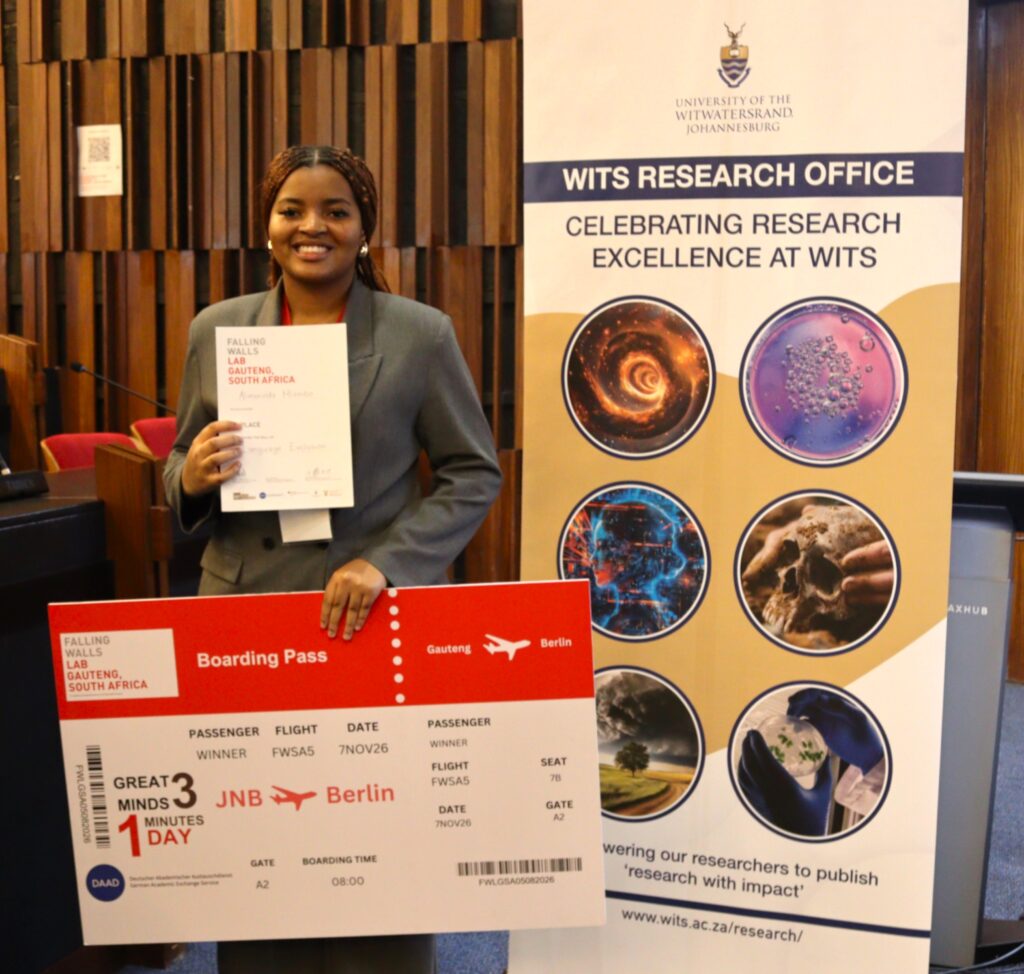
A Wits honours student, Alimerinda Mlambo, will represent Gauteng at the international Falling Walls Lab finale in Berlin after winning the provincial competition, with an AI-powered translation platform designed to break language barriers.
Picture of Alimerinda Mlambo, the winner of Falling Walls Lab Gauteng 2026, and her certificate & ticket to Berlin. Photo: Kerese Govender
The competition, held at Wits on August 5, saw about 20 students drawn from Wits, University of Pretoria, and Tshwane University of Technology, present their innovations aimed at tackling some of the country’s most difficult challenges.
The event was hosted in partnership with the DAAD Information Centre Johannesburg and the Falling Walls Foundation. Participants had just three minutes, including answering judges’ questions, to convince an expert jury that their pitch could help solve global issues.
Mlambo, an Information Systems honours student, took first place with her invention, eLingo AI, which aims to solve language exclusion in public spaces through real-time translations. She used a fictional character by the name of Lerato in her pitch, but the story was inspired by her lived experience of sitting through a conference presentation delivered in French that she could not understand.
When asked if this will cost human interpreters their jobs, Mlambo said, “We’re not trying to replace interpreters. We’re making language accessibility available to organisations that could not afford it otherwise.”
Unlike traditional interpretation services which rely on multiple interpreters, special equipment, and significant expenses and planning, eLingo offers an affordable alternative. The platform already includes all 11-official spoken South African languages and has attracted more than 100 beta users. Mlambo stated that the team has plans to expand to other languages.
She believes this kind of software is especially needed in South Africa, where only a small portion of the country’s population speaks English as a home language. “I want to create a future where people are no longer excluded from conversations they were meant to be a part of,” Mlambo said.
Dr Samia Chasi, Head of Wits Internationalisation and Strategic Partnerships Office and chair of the judging panel, said the competition is much more than selecting a winner. “It gives students an opportunity to present their own research to audiences beyond their own disciplines and institutions,” Chasi said.
“We have very creative and innovative communities in South Africa and Africa, and we can offer our own solutions to the rest of the world. We can’t always look at importing ideas,” Chasi said.
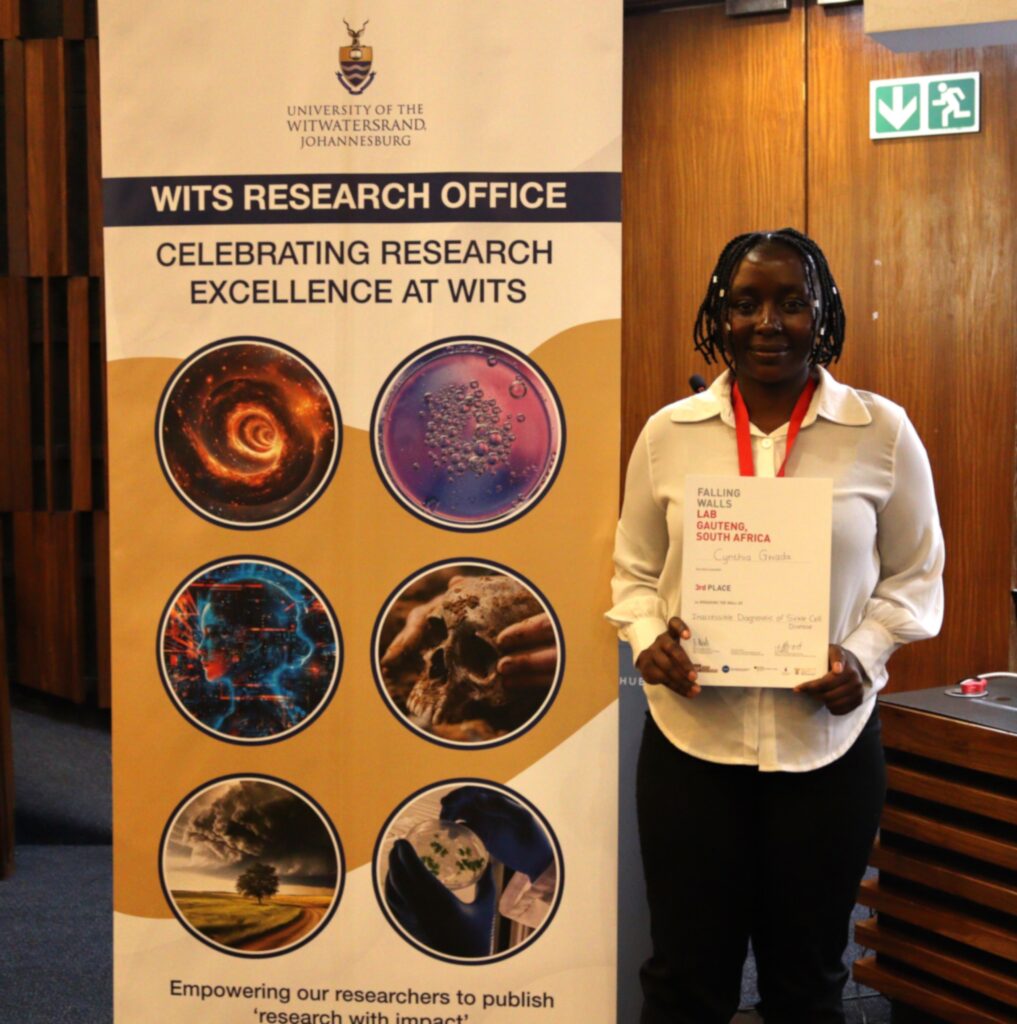
Among the interesting innovations was the third-place winning project by Cynthia Gwada which focused on an affordable diagnosis for sickle cell disease. The solution aims to expand access to rural areas in South Africa so “they don’t have to go to the cities with money that they don’t have,.” Gwada said.
Picture of Cynthia Gwada, third place winner of the Falling Walls Lab Gauteng 2026, and her certificate. Photo: Kerese Govender
Gwada also hopes to expand the diagnostics to other diseases such as malaria and tuberculosis, making diagnosis more affordable and accessible.
As Mlambo prepares to compete in Berlin, she hopes her success will inspire more young black women to pursue careers in male-dominated fields such as hers.
“Don’t wait for a seat at the table. Go and build a table,” she said.
FEATURED IMAGE: Picture of Falling Walls Lab Gauteng 2026 pamphlet and souvenir. Photo: Kerese Govender
Bafana Bafana and Banyana Banyana represent the same nation, but not the same level of support. The difference says more about us than it does about football.
Rather than pretending South Africans do not support Banyana Banyana, the stronger argument is whether the support is visible. When Bafana Bafana competed at the 2025 Africa Cup of Nations, social media timelines filled with countdowns, match previews, public viewing invitations and nationwide calls to rally behind the national team. The yellow jerseys became symbols of national unity, and every fixture felt like a national event.
Fast forward to Banyana Banyana competing at the 2026 Women’s Africa Cup of Nations, and the atmosphere is noticeably different. The defending African champions took to the continental stage without the same intensity of public mobilisation. The contrast is not simply about football. It reflected a deeper pattern in South African sport: we celebrate women’s achievements, but we do not consistently promote them with the same energy.
If the media, sporting bodies and sponsors devote more promotional resources to men’s football, then the public will inevitably become more familiar with Bafana’s journey than Banyana’s. The disparity becomes a self-fulfilling cycle: greater visibility leads to greater support, which justifies even greater visibility.
The irony is that Banyana Banyana have produced extraordinary results. They won the Women’s Africa Cup of Nations in 2022 and have become one of the continent’s strongest national teams. Yet the same CGE report concludes that despite these achievements, they “have not received the same recognition and rewards as their male counterparts, Bafana Bafana.” Success alone has not earned them equal treatment.
Perhaps the most important conclusion from that study is not the numbers themselves but what they mean. The researcher argues that under-reporting women’s sport limits the public’s knowledge of female athletes’ achievements, while the continued trivialisation or neglect of women’s sport creates the impression that it is less important or less worthy of attention.
Recognition also extends beyond media coverage. The CGE points out that SAFA awarded Banyana R1.2 million after winning WAFCON, while previously spending R9 million on vehicles for provincial administrators. It also notes that Bafana players received larger bonuses for reaching the AFCON quarterfinals than Banyana received for winning their continental title. These examples reinforce the message that women’s achievements are too often valued less, even when the results surpass those of the men’s team.
South Africans like to describe themselves as passionate supporters of whoever wears the national jersey. That ideal should not depend on whether the badge is worn by Bafana or Banyana. If we want genuine equality in football, we must stop expecting women to earn support only after they win trophies, while assuming the men’s team deserves nationwide campaigns simply because they are men.
Equal support begins long before kick-off with equal storytelling, equal promotion and equal belief that every national team is worthy of the country’s full attention.
FEATURED IMAGE: A graphic of Banyana Banyana standing under the spotlight. Graphic: Sanele Sithole
A performance project featuring spoken words, chants, movements and musical art. It is a reimagination of Arther Rimbaud’s poem titled ‘A season in Hell’.
A season in Hillbrow, directed by Sibahle Mangena and Gerard Bester… what were my expectations? In all honestly, the performance far exceeded anything I had anticipated. I had expected an hour of a performance that somehow resembled ‘The greatest showman‘, where performers just burst into song mid-sentence. I had even thought to myself how will such an in-depth, poetic masterpiece be turned into musical play?
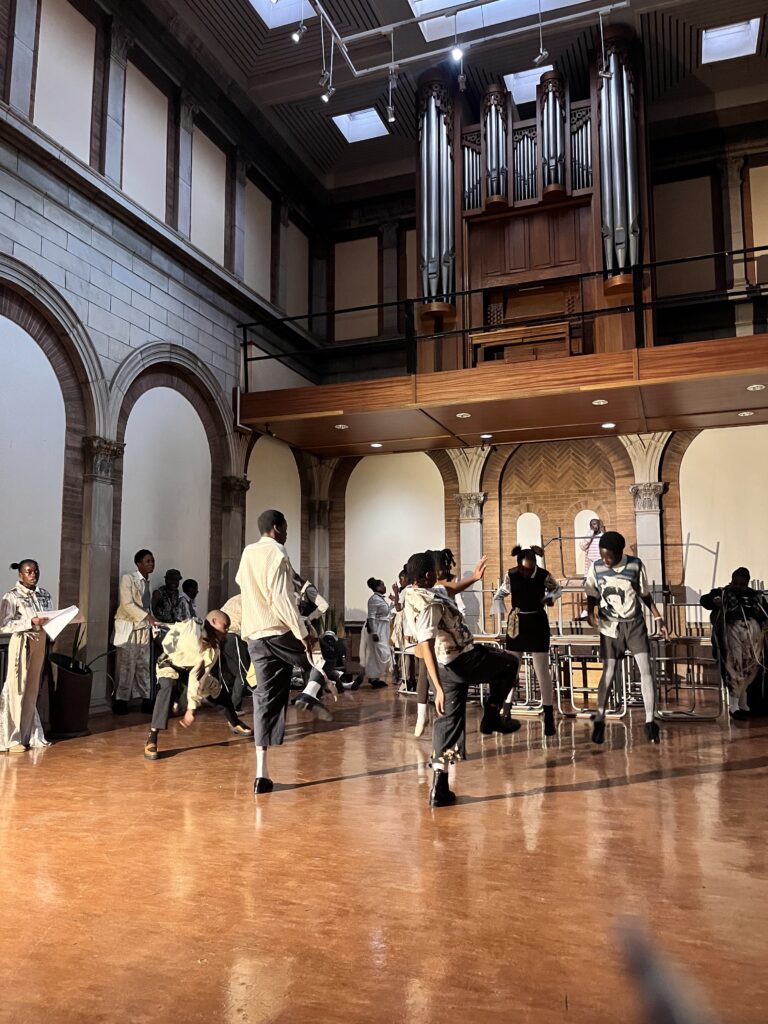
Safe to say, calling this performance a musical would be highly undermining its artistry. A group of high school students from the Windybrow Arts Centre took to the floor of the Southwest Engineering building an immaculate form of storytelling. A form that might make one assume is wiser than their years. Simply using school desks, their bodies, their voices, and most importantly their words.
Still of cast dancing during performance. Photo: Kamogelo Lesabe
The performance started with what seemed like a recitation of the beginning of Arther Rimbaud’s poem. As someone who knows this poem well, I quickly realised, that was far from the truth. Each student in the set up classroom delivered these short, punchy one-liners that incorporated words from the poem and mixed them with the real lived experience of Hillbrow. They mingled a clever play on words that spoke to issues of education, poverty, crime, gangsters, safety, hope and love while maintaining the main themes of suffering, alienation, self-destruction, and rebellion taken from the poem.
They carefully tackled these issues from the wide spectrum of the repercussions of apartheid and xenophobia boiling all the way down to the potholes in the street and how a Mageza drives on the road. They mixed all Nguni languages with the Shakespear kind of English which made the performance identifiable to a South African context. They sang amagwijo with all their emotion, they danced on tables, they even used comedy, which only South Africans would understand, to relate to the audience. They represented the theme of rebellion by not conforming to traditional ways of storytelling but rather speaking out against rigidity, limitation, unbelief, and societal standards. Rebellion against real issues faced by South Africans and contextually South Africans who daily experience life in Hillbrow.
Their costumes were an art of rebellion themselves. Wearing torn skirts, untucked school shirts, ties pinned to their shoulders instead of their necks. Similarly to the stage they performed on which was set as a classroom, how they sat, stood and danced on the desks, how they piled desks on top of one another to create what they called “a castle”. That for me screamed a unique and unconventional take to the interpretation of Rimbaud’s work.
Still of “castle” built with tables. Photo: Kamogelo Lesabe
. It was “powerful work of emergence by emerging voices” said Stacy Hardy, one of the creators of this performance. Work of emergence to address current and detrimental issues in the heart of Hillbrow.
The high schoolers truly outdid themselves in relaying the message of reimagining such an enigmatic poem.
Vuvu Rating: 8/10
FEATURE IMAGE: Cast of A season in Hillbrow performance. Photo: Kamogelo Lesabe
RELATED STORIES:
Wits Vuvuzela: REVIEW: Michael: Discovering the making of the King of Pop, May 2026
Wits Vuvuzela: REVIEW: The revival of Sophiatown, April 2026
Wits Vuvuzela: REVIEW: The Heart is a muscle, April 2026
The programme has changed the lives of thousands, one transplant at a time.
More awareness for liver disease and organ donation is needed to help provide more liver transplantation services.
Accessibility is needed through support from the government and other private medical institutions.
Over 1 million South Africans have been diagnosed with hepatitis – a viral infection affecting the liver – on an annual basis, which can potentially lead to advanced liver disease requiring transplantation.
According to the Liver Centre South Africa, the causes of liver diseases and illnesses can vary from acute liver failure, viral hepatitis or infections, with liver cirrhosis being the lead cause in sub-Saharan Africa.
The programme, established in 2004, is one of the few transplant units in the country and the broader sub-Saharan African region that provides living donor liver transplants in both adults and children.
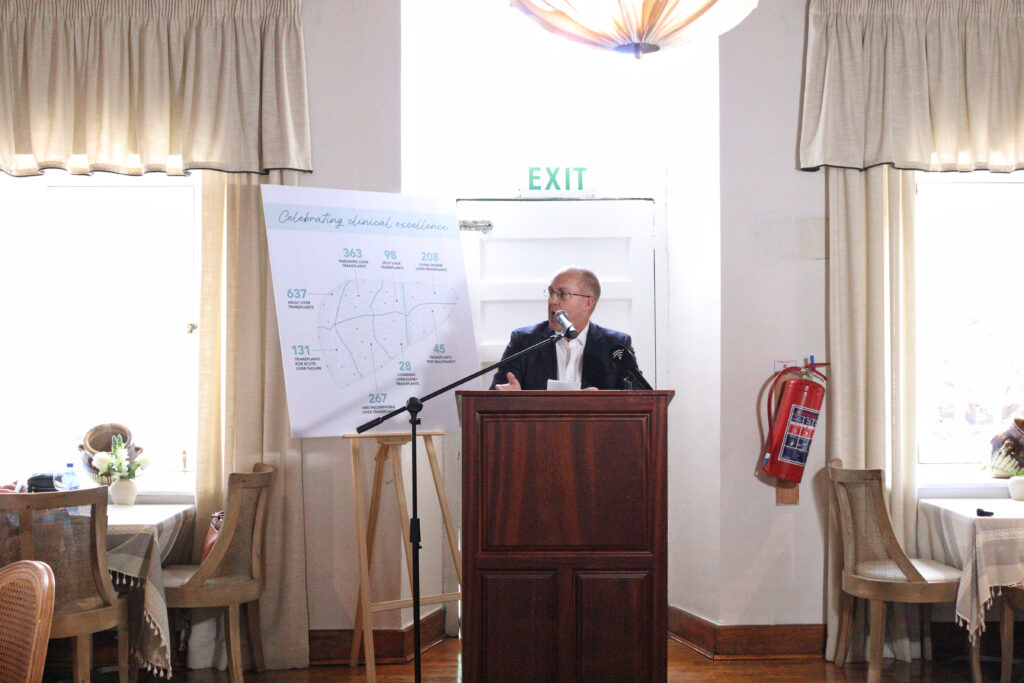
Professor Jerome Loveland addressing attendees of 1000th liver transplant milestone celebration. Photo: Amahle Ngqwemla
Liver transplants are therefore important for removing the affected area and transplanting the healthy organ, to provide patients with a better chance at a longer and healthier life.
Of the 1000 who have gotten a second chance, 637 are adults and 363 children.
Professor Jerome Loveland, the academic head of transplantation at Wits, said none of it would be possible without willing patients and families.
“Where would our tale of hope be without our patients…recipients who entrusted their care with us and those donors whether deceased or living, who gave the gift of life by donating,” he said.
However, there are still concerns around accessibility as many patients do not live in Johannesburg where units like the liver transplant programme are available.
Professor Adam Mahomed – specialist gastroenterologist and hepatologist said, “We have to expand it [training in both public and private sector] and not be limited to just where we are.”
Liver and kidney transplant co-ordinator, Sinesha Moodley, told Wits Vuvuzela that working with public academic hospitals like Charlotte Maxeke helps patients who are unable to travel long distances for treatment.
Professor Charles Sanyika, interventional radiologist, said, “If you are in a big city like Johannesburg, you might know of a transplant unit that might be within reach for you. Yet, someone [doctors and patients] in areas like Matatiele or Qunu [Eastern Cape] might not be aware.”
Attendees at the Wits 1000th liver transplant milestone celebration. Photo: Amahle Ngqwemla
The programme has created relationships with other medical societies on campus like the Wits student surgical society where postgraduate medical students can engage with the clinical training programme.
Although the combination of academic medicine, scientific research, education and healthcare partners has been significant in reaching this milestone, Loveland urges young people to “familiarise themselves with organ donation and be open to considering being a donor should it happen to one’s family.”
FEATURED IMAGE: Professor Adam Mahomed delivering his speech at the Wits Transplant Unit milestone celebration. Photo: Amahle Ngqwemla
After years of working toward a Varsity Football final on unfamiliar soil, Wits Women will finally enjoy home-ground advantage.
Wits Women host Varsity Football at home for the first time.
The team is determined to reach the final.
Matches will take place at Wits Football Stadium on August 8 and 9 before the final on August 19.
Wits University will host Varsity Football women’s fixtures for the first time on August 8 and 9, giving the team a home-ground advantage as they look to reach their first Varsity Football final.
The team opens the tournament with two matches in Pretoria on August 1 and 2 before returning to Johannesburg to host the second bumper weekend. The final is scheduled for August 19.
This opportunity comes as Varsity Football introduces a new bumper weekend format, allowing teams to play two matches before a longer recovery period ahead of the final. Hosting rights are also a first for the Wits women’s football team.
“There had been a rotation, and Varsity Sports opened it to numerous institutions that qualified. We raised our hand, and fortunately Wits will host the second bumper weekend,” said Phuthego Mokgethi, Sports Officer for Football.
Aside from reducing travel, Mokgethi believes hosting will give Wits a competitive edge.
Coach Siphesihle Ngalmane agreed: “We’ve always been knocked out in the semi-finals. This year we want to play in the final, and we’re hoping the final will be here at home.”
The fixtures for the 2026 Varsity Football Women’s tournament on display. Photo: Asisipho Mpahleni
Captain Nthabiseng Ramaisa believes playing in front of Wits supporters could make all the difference.
“It’s not easy playing away,” she said. “Having supporters here is exciting because when we’re away, it’s hard for Wits to organise buses for people to come and watch us.”
She added that away matches often come with added pressure from opposition fans.
“When you get there, people start booing you.”
Ramaisa believes the growing support for the women’s team could inspire more young women to get involved in football.
“More girls can get into soccer, and more girls can participate in sport,” she said.
For first-year player Nokubonga Msimango, the chance to play Varsity Football at home still feels surreal.
“There’s like a superpower playing at home,” she said. “You want to make people proud.”
FEATURED IMAGE: Cheerleaders welcoming the Wits women’s football team at the official launch of the 2026 Varsity Football tournament. Photo: Asisipho Mpahleni
Activists protest to challenge mounting xenophobic violence.
Students and academics at Wits University protest against the escalating violence faced by migrants.
Demonstrators urge law enforcement to treat targeted vigilante attacks as hate crimes.
The picket highlights the need to counter xenophobic hate through conversation and empathy.
A group of activists gathered on Friday outside Wits University’s Jan Smuts entrance, staging a picket against the escalating wave of anti-migrant violence and xenophobic intimidation sweeping through local communities.
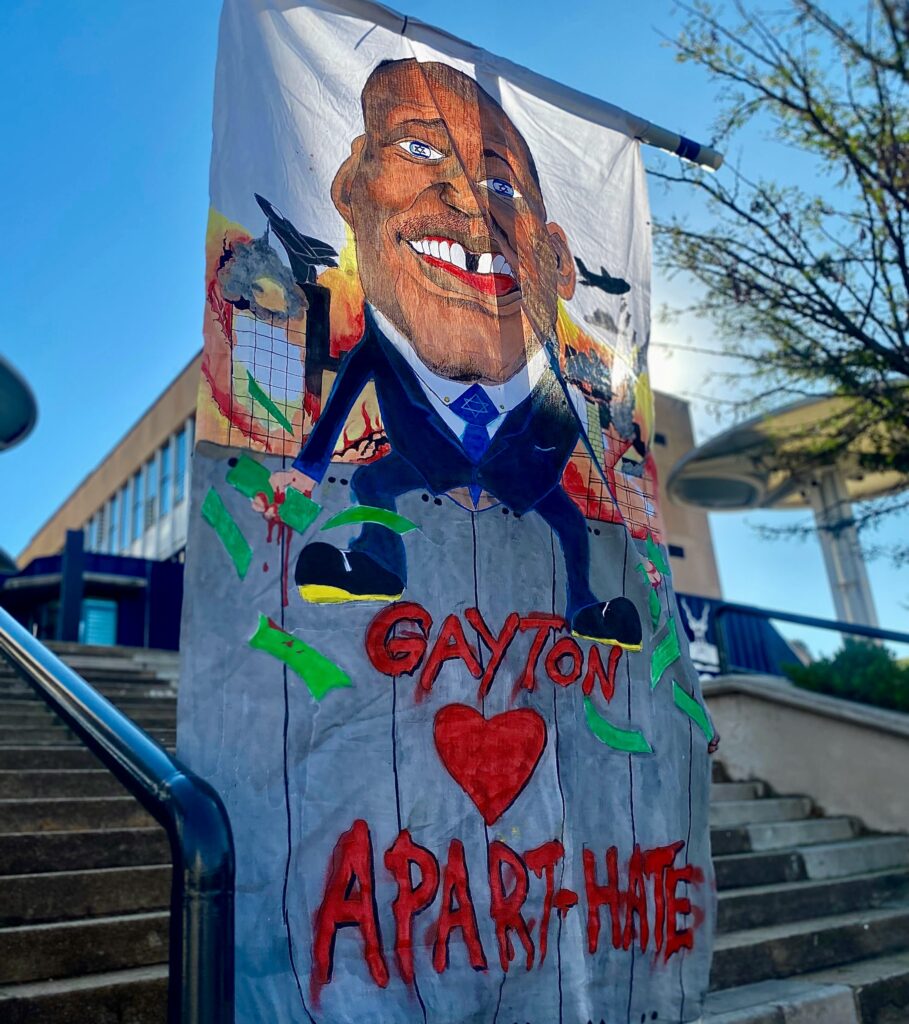
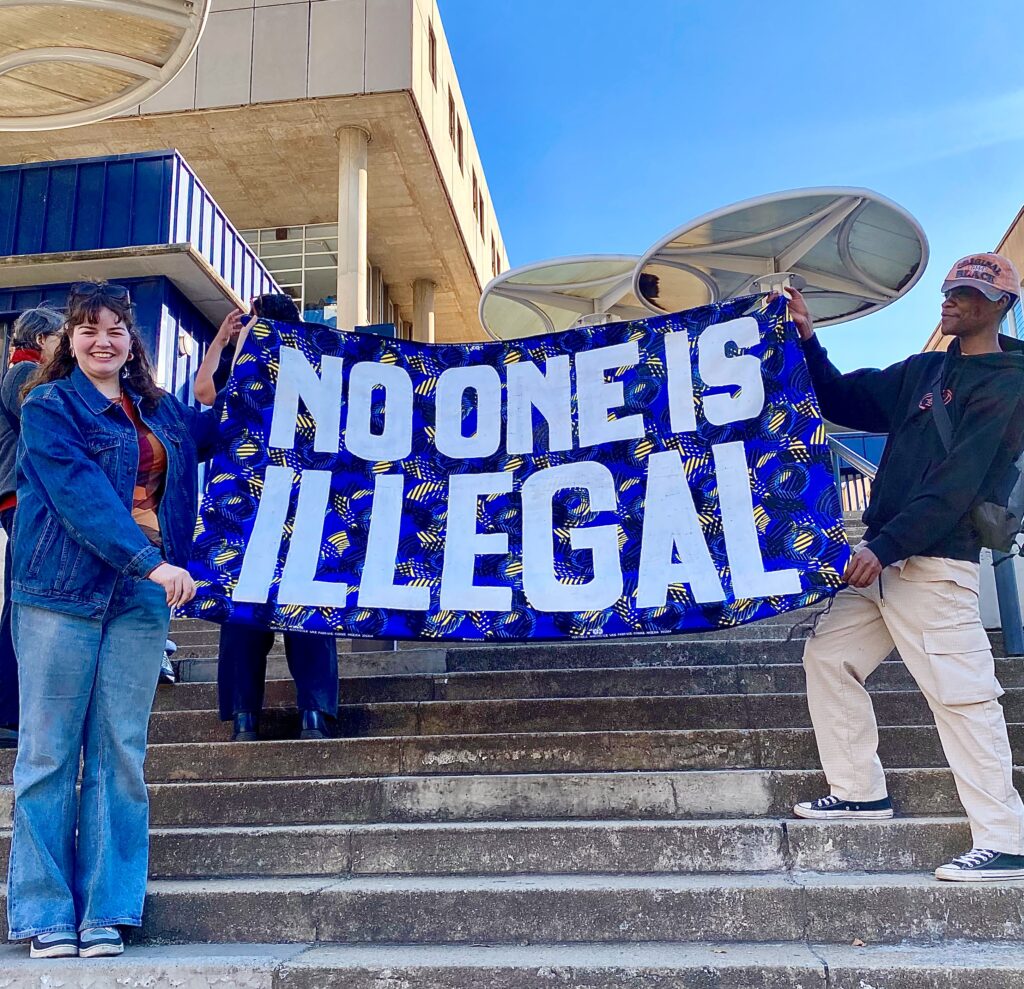
Protesters transformed the university entrance into a focal point for advocacy, displaying prominent banners and hand-painted signs condemning anti-migrant violence. One sign targeted the xenophobic rhetoric of Gayton McKenzie, accusing him of fueling an ‘Apart-hate,’ while others declared, ‘Targeting undocumented migrants is a hate crime’ and ‘No one is illegal.’
This demonstration was organised as a joint effort between Community Arts Mobilisation Project (CAMP), BDS Coalition, Kopanang Africa Against Xenophobia, Wits University Palestine Committee (WAPC) and Siyafana Sonke.
As attacks on migrants grow increasingly hostile, demonstrators call on law enforcement agencies to actively prosecute those inciting violence.
One protestor, Professor Marie Huchzermeyer, said the attacks constitute hate crimes. “This includes not only targeting people on the basis of their culture or country of origin, but also their migration status,” she states.
Dean Hutton, artistic director of CAMP, underscored the role of creative movements in driving social change, noting that artistic expression can “appeal to the soft parts of humans that rhetoric does not touch or move to action.”
Huchzermeyer echoes this view, stating “There is a view in Siyafana Sonke that I am drawn to which tries to win over the adversaries, making it a campaign of love rather than confrontation.”
Picture of two activists holding a banner that reads “No one is illegal”. Photo: Jamie Ho.
The picket is one of several planned demonstrations aimed at countering xenophobic narratives across South Africa. However, with tensions continuing to simmer across multiple provinces, activists acknowledge they face sustained pressure as they push back against organised anti-migrant sentiment.
FEATURED IMAGE: Picture of demonstrator holding a sign reading “Targeting undocumented migrants is a hate crime”. Photo: Jamie Ho.
Every year the days leading up to Africa Day, street vendors start displaying their best cultural outfits because they know the public want to look good for the occasion. However, in the mix of cultural outfits and good cuisine the real meaning behind the celebration of Africa Day gets lost.
Ubuntu, I am because we are, is a traditional African philosophical concept and the foundation on which the Organisation of African Unity (OAU) was built on. The birth of the OAU, now known as the African Union (AU), on May 25, 1963, is the core reason why we celebrate Africa Day. 32 independent African states came together to fight colonialism and promote unity. This day is meant to strengthen the Pan African spirit, celebrate cultural diversity, reflect on progress and rewrite the narrative of Africa’s story.
Sadly, the meaning behind the celebration of this day has been watered down, and it has become just another day of dressing up, eating delicious food or a surge in sales for street vendors. Ntando Makhubu, a journalist at The Post Newspaper, wrote in his article that he spoke to a street vendor in Pretoria who said “For me, for us, it means a boom in business” which highlights how unaware some members the public are about the true intent of Africa Day.
Africa Day is only recognized as a public holiday in a handful of African Union member states, only six to nine of the 54. Mako Muzenda, a former freelance writer for Daily Maverick, wrote an article saying that the “25th of May is about statements and fanfare, not about making serious moves.” Africa Day has become more performative than educational or impactful, and this is another reason why the public’s awareness regarding Africa Day is low.
There are multiple articles promoting Africa Day celebrations that involve food, cultural dances, and dressing up. However, there are few speaking to the core reason of Africa Day and how Africa has grown or managed to rewrite its own story after colonization.
The lack of awareness shows how easily African history and unity can fade from public consciousness when not diligently taught. As the African Proverb says, “Until the lions have their own historians, the history of the hunt will always glorify the hunter.” This means if Africans do not actively preserve, teach and celebrate their own history and the foundation that it was built on, it will continue to be forgotten or overlooked.
Featured Image:Headshot of Chrislyn Majiedt, this week’s editor.
In episode six of We Should Be Writing season 7, the team unpacked the evolution of music as a form of expression and protest, through four decades in the South African context. The episode explores the journey of South African music and its consumers from the 80s, 90s, early 2000s and contemporary listeners. From the […]