Wits University reclaims African narratives through the South African premiere of Kancícà at the Digital Dome, proving 8K innovation is a powerful tool for cultural memory and heritage.
The Wits Anglo American Digital Dome is pivoting from its traditional scientific roots to become a hub for African mythology and storytelling.
Kancícà utilises high-end gaming engines and 360-degree 8K animation, positioning Wits at the global forefront of immersive digital production.
The project serves as a “portal” for students to explore the future of work, AI, and African leadership within the global digital ecosystem.
The interior of the Anglo American Digital Dome. Photo: Supplied
While the Johannesburg Planetarium officially completed its R90-million transformation into the Wits Anglo American Digital Dome in November 2024, a recent premiere suggests the facility is entering a new era of cultural significance.
On 8 May, the Dome hosted the South African premiere of Kancícà, an immersive experience that moves beyond traditional astronomy to signal a turning point for how the continent tells its own stories. The launch positions Wits as a leading hub for cutting-edge digital experiences rather than a mere consumer of Western technology.
Dr Moumita Aich, instrumental in the Dome’s research integration, notes that 8K full-dome technology allows for a “shared emotional experience,” emphasising that this technology creates new forms of public engagement while preserving heritage.
“The scale and detail make African histories and traditions feel alive and immediate,” says Aich. “In this way, the Dome becomes more than a scientific space: it becomes a place for cultural memory and reimagining African narratives through immersive storytelling.”
Festival director Alby Michaels explains that Kancícà focuses on creating work “by Africans, for Africans, and especially through an African lens”. The production uniquely utilised Unreal Engine, a high-end gaming engine, to render 2D and 3D animation for the full-dome experience. “It opens up the doors for more experimentation… so that we can become the leaders in our own narratives,” Michaels says.
For Wits students, Michaels sees the Dome as a laboratory for the “future of work”. “I’m hoping an engagement like this will open a little door, even a portal, for imagining the future in a better way for all of us,” he told Wits Vuvuzela.
Audience members from outside of Wits, Constant Volschenk and Bongiwe Ndulula, highlight the immersive nature of the dome, which relies on a 35-degree viewing angle in reclining seats. “The main scenes are in front of you, and the surrounding is the background of the scene,” says Volschenk. Ndulula was particularly moved by a spiritual scene involving a boat in a storm, noting that the 360-degree view offers a vital shift in perspective.
Following its premiere, the programme is now open to the public at the Wits Anglo American Digital Dome from 25 April to August 2026. As Aich suggests, if you have not yet watched this wonderful show, it is a necessary gateway into the future of African digital heritage.
FEATURED IMAGE: Exterior picture of the Anglo American Digital Dome. Photo: Daniella Ripamonti
The Melville Art Mile reactivates the creative heritage of the suburb.
Once a month, the Melville Art Mile creates a walkable art experience in the heart of student life in Johannesburg, Melville.
Artists, are given the opportunity to exhibit their work in a way that is accessible to all.
Melville is reclaiming its spot as Johannesburg’s creativity hub.
Ask anyone who has been a university student in Johannesburg; they have been to or at least heard of Melville. From the cute cafes to the busy bars to the grand graffiti adorning almost every crevice of the area, Melville creates a vibrant, friendly atmosphere that differs from its neighbouring suburbs.
The suburb has begun to center itself as Johannesburg’s creativity hub. Student culture has shifted the legacy of the environment from a quiet, calm Afrikaaner area to the lively, artsy dynamic it has become.
One event captures the soul of the suburb, the Melville Art Mile, a monthly event along the Melville Strip.
Canvases spill out onto the streets, loud laughter can be heard all around, and handmade trinkets are on display. This is the scene that greeted me when I visited on Thursday, May 7. The event invites people to enjoy a night of art, music, and community by providing an accessible way to curate and consume art, a welcome detour, especially for students.
Artwork by Indoni on exhibit at Melville Art Mile. Photo by: Kerese Govender
The Melville Art Mile offers opportunities for young emerging artists to display their work. This provides them with the push they might need to fulfil their dreams. A singular compliment on their brushstrokes from a stranger or even a few new followers on Instagram, is sometimes all it takes to get one foot out the door.
Many artists credited Melville in their artistic journeys as this environment is one of the only places that one can paint without anyone disturbing them, in reference to graffiti art. “Melville has always been known as an artist sanctuary.” Aubrey Moloto, the founder of Melville Art Mile, told this reporter.
Thalia Ngcobo, a young artist with work on display at the event, shared, “This is a great opportunity especially for those who are starting out, because starting out is scary. Doing this is the first step in your career.”
The Melville Art Mile is considered an “open market for artists because there’s nowhere in Johannesburg where you are able to sell your artworks to a public audience and receive all the comission,” Moloto explained while discussing the benefits of exhibiting at this event. “All you need to do is fill out an online form that can be found via the organisation’s social media pages and wait to be selected. Melville artists and businesses are prioritised as “this is for them, by them,” he further commented.
Artist Alex Dibakwane and his artwork, Ancestral Disputes, on exhibit at Melville Art Mile. Photo by: Kerese Govender
Moloto shared that the initiative of the organisation is to remind the city as well as everyone around it that Melville, at its core, is a creative space. Another goal is to boost the economy of the area.
Every turn that you take, every street you walk down, and every exhibit you enter, shows you exactly what Melville is becoming – a space for creatives to exist without (too much) worry.
The neighbourhood is more than just its dangerous reputation. Moloto hopes to “shake that narrative” through the First Thursday monthly Melville Art Mile events. The organisation’s driving force is to regenerate Melville’s creative roots and bring back life to the local businesses by boosting the economy and providing work for everyone in the neighbourhood, from students to residents to artists.
“Melville is a great example of what Johannesburg should be,” explained Neil Badenhorst, a frequent attendee at Melville Art Mile.
According to event attendees, art has a pretentious culture attached to it. In theory, art is meant to be something accessible and interactive, a source of community. However, in practice, it has become a very clinical experience. The welcoming and vivid feel has been disrupted by an elitist and alienating crowd.
Yet, this is not the case in Melville. In Melville, art is for everyone.
It belongs to those who cannot afford a ticket to an art gallery. It belongs to those who can sketch in their sleep. It belongs to those who do not understand the difference between acrylic, watercolour, or gouache. It belongs to those who can mould a block of clay into a masterpiece.
FEATURED IMAGE: Attendee looking at artwork on display at the Melville Art Mile. Photo by: Kerese Govender.
University of the Witwatersrand (Wits) Women’s Rugby showed early-season resilience and unity despite a 27-0 opening defeat to Zondi Women’s Rugby club on Saturday.
Wits Women’s Rugby opened their 2026 league season with a 27-0 defeat to Zondi Women’s Rugby Club at Wits Rugby Stadium.
Despite the loss, Wits showed resilience, strong defensive organisation, and growing team unity throughout the match.
The match reflected the continued growth of the Wits Women’s Rugby programme since its establishment in 2019.
The Wits Women’s Rugby team opened their league season at Wits Rugby Stadium on Saturday May 9, 2026, producing a spirited performance against a physically dominant Zondi side in a match that tested both their structure and resolve.
From kick-off at 13:20, Wits showed intensity at the breakdown, organised defensive sets, and confidence in possession despite sustained early pressure from the visitors. Zondi controlled the territory for much of the first half, scoring their first try midway through after winning a turnover inside Wits’ 22. Wits responded with improved defensive organisation and stronger carries, matching Zondi’s physicality in several exchanges. Zondi added another try just before half-time to take a 10-0 lead into the break, but the Wits team continued to contest every phase with discipline and commitment.
Their strongest moments came in defense, where disciplined communication and collective organisation reflected the side’s growing cohesion. Even during difficult phases of play, players responded to the coach’s instructions, quickly regrouping after errors and maintaining their defensive structure under pressure.
Pinned deep in their own half on several occasions, Wits absorbed repeated phases of pressure through committed tackling and strong on-field communication. The forward pack showed determination in the scrums, while ball carriers consistently worked hard to gain metres in contact despite Zondi’s physical dominance.
Wits Women’s Rugby forwards contest possession during a scrum against Zondi in their opening league fixture at Wits Rugby Stadium on Saturday. Photo: Alice Dhlamini
The second half brought renewed energy from the home side. Substitutions lifted the tempo, defensive organisation improved, and Wits showed greater confidence in building play. A yellow card during a crucial stage shifted momentum further in Zondi’s favour, but Wits still maintained their intensity and rate throughout.
Even as the scoreline widened, the home side continued fighting until the final whistle, earning respect from supporters and coaches alike for their commitment.
Captain Nikitha Dlabane, a final-year biomedical sciences student, said the performance reflected the growing unity developing within a relatively inexperienced Wits side, explaining that despite the pressure of the occasion, the players “stayed together as a team” and continuously encouraged one another throughout the match. She added that the side drew confidence from strong scrummaging, effective carries, and organised defensive folding, although she acknowledged that there is still room for improvement as the squad continues to develop.
“This game was tough because a lot of our girls are very new,” she said, “but we stayed together as a team. We encouraged each other all the way, and I feel like that is what makes the team.”
Dlabane also highlighted the technical aspects that gave Wits confidence during the match.
Head coach Winsdon Grootboom praised his side’s “never-say-dying attitude” despite the defeat, highlighting the determination shown by a squad that included “six or seven women” making their first rugby appearance. Although he admitted that “pressure creates mistakes” at crucial stages of the match, Grootboom said he was encouraged by the way the players “fought until the end” and continued trying to execute the structures and patterns they had worked on in training.
The Wits Women’s Rugby team warm up ahead of their season opener against Zondi Women’s Rugby Club at Wits Rugby Stadium on May 9, 2026. Photo: Alice Dhlamini
Wits player Mamokgopane Tsotetsi, a second-year industrial engineering student, said preparation played an important role in helping the team remain composed ahead of the fixture, with the squad focusing on “scrums, structures, lineouts, and all the basics” during training. She added that constant communication and encouragement on the field helped the side maintain its intensity during difficult passages of play.
Beyond the result, the fixture reflected the growing visibility of women’s rugby at Wits, with supporters highlighting the significance of women’s presence in a traditionally male-dominated sport. Second-year Bachelor of Arts student in South African Sign Language and political studies, Tshimangadzo Sigoba, described it as “refreshing seeing women taking up space in rugby,” while supporter One Segano noted that women’s rugby is gaining greater exposure and media attention on campus.
The crowd responded loudly throughout the afternoon, particularly after Zondi’s opening try, as tension built with Wits searching for opportunities to break through defensively. A Wits injury late in the match added further intensity to an already physical encounter, while the home side’s number one forward stood out with powerful ball carries and strong work around contact areas.
While the scoreboard may not have favoured Wits, the match stood as a testament to the team’s rapid progress and the rising profile of women’s rugby at the university since its establishment in 2019. As the season unfolds, the Wits Women’s Rugby team looks set to continue inspiring players and supporters alike with their unwavering determination.
A graphic highlighting Wits Women’s Rugby’s season opener against Zondi Women’s Rugby Club reflects the team’s resilience, unity, and determination despite a challenging start to the season. Graphic: Emmanuel Molebatsi
FEATURED IMAGE: Wits Women’s Rugby players chase down a Zondi ball carrier during their league opener at Wits Rugby Stadium on May 9, 2026. Despite a 27-0 defeat, Wits showed defensive resilience and growing cohesion throughout the match. Photo: Alice Dhlamini
A unique Mother’s Day storytelling event at Melville Koppies used African folklore to reconnect adults with childhood, motherhood, and tradition.
A Mother’s Day storytelling at Melville Koppies, Sunday 10 May.
It was a unique Mother’s Day experience where mothers could embrace their inner child.
Grace compared the process of the smelters to what motherhood is and showed us how it relates to mothers and what they go through.
As the birds chirped and the cold morning wind rushed through the branches at the Melville Koppies Nature Reserve, attendees made their way up the hill towards the lecture hut; they were in for an exciting time ahead. “A lot of people here come to me and say, ‘I haven’t had a story being told to me in 50/60 years and it just lit up my life’. And all the adults came to me after today’s storytelling and said, ‘I was a child again, thank you so much,” said Merle Grace, the voluntary storyteller at Melville Koppies Nature Reserve.
Grace had prepared two stories: an anti-colonial African parable titled “Fly Eagle Fly,” retold by Christopher Gregorowski, and ‘Kasanko’s Dream’ by Gcina Mhlophe about ironmaking. chosen specifically for Mother’s Day. “I wanted a story about something female and strong, that is not on the knows, and I found the story ‘Kasanko’s Dream’” said Grace. “I thought it was the perfect Mother’s Day story, because the process of ironmaking and fertility were seen as very similar in those days,” she said.
Merle Grace telling the story ‘Kasanko’s Dream’ on Mother’s Day. Photo: Chrislyn Majiedt
Grace, upon conducting research, found out that smelters, like the one they have on the Melville Koppie, were used for ironmaking. The process was seen as a holy and sacred process of making something out of what seems like nothing. The furnace was often symbolically linked to a woman’s womb, as both were believed to produce life and strength through hidden processes.
Iron was formed inside the furnace where no one could see the transformation taking place until the final product emerged, in the same way that a baby develops unseen inside a mother’s womb. To Grace’s understanding, the ritual around fertility and smelting were very similar for the iron Age farmers and miners 500 years ago.
Smelters were used to extract iron from iron-bearing rocks by heating the ore in a furnace with burning charcoal. Early African settlers such as the Sotho and Tswana built clay furnaces, often symbolic of a womb and the birthing process of iron. The settlers would refine and shape the metal into specific tools and weapons.
“What’s very special about sitting here is while she is telling a story the birds just start singing, there is always a bird doing something so you really feel like you are in a different place,” says Jenny Grice, acting chairperson and head guide and primary event coordinator for the Melville Koppies Management Committee. The combination of nature and storytelling made the audience forget that they were in the city, and everyone just embraced the moment.
Grace kept the audience on their toes – quite literally – by having them stretch and jump between the stories, to allow for one story to sink in and to prepare for the next one. Everyone gladly joined her and laughed in between stretches. She captivated the audience, whose eyes locked on her as she spoke.
Through storytelling, connecting with nature and embracing their inner child, the audience experienced a truly different kind of Mother’s Day –one that felt deeply meaningful and extra special.
“This was the most interesting Mother’s Day,” said one of the women in attendance when the storytelling was complete. The attendees were eager to speak to Grace after, most of them thanking her for the wonderful experience and the opportunity to embrace their inner child.
Feature Image: Merle Grace a voluntary storyteller at Melville Koppies Nature Reserve pointing at the trees. Photo: Chrislyn Majiedt
As the cold begins to settle and the due dates creep closer, the Wits Hindu Students Society creates a home away from home by hosting a Thunee tournament on campus.
The Wits HSS recently held its annual Thunee tournament.
Prizes were up for grabs ranging from R200 to R1000.
The aim of the tournament was to preserve the culture of the game and create a community for its players.
With money to be won and a game you love to play, what could be more exciting? On Friday, May 8, the Wits HSS hosted its annual Thunee tournament at the Margo Steele building.
Up for grabs – R1000 for first place, R400 for second place, and R200 for third place. These prizes are a culmination of the money raised by entry fee tickets, which cost R100 per team.
The game dates back to the 1860s, when Indian indentured labourers arrived to work on the sugar cane fields in what was then known as Natal. A game that helped them find connection and preserve culture amid their enslavement in a strange land.
Even though the game has evolved since, all you need is three of your best friends or complete strangers and a special pack of 28 Playing Cards.
“To continue hosting these tournaments will play a very big part in keeping Thunee alive at Wits, because naturally certain things skip generations, and we’re trying to prevent that.” explained Aadit Aheer, the former chairperson of Wits HSS.
The tournament was not just limited to Wits students but also open to members of the community. There were three teams made up of self-named ‘uncles.’
Five hours. Two calm initial rounds. A captivating quarterfinal. A chilling semi-final. A crazily competitive final.
While the game is about tricking opponents and reaching a total of 105 first, it is also about communication—how well you and your partner know each other, what a slight eyebrow raise, or nostril flare could mean.
As the tournament shifted from a fun night with friends to an intense evening of eye contact, smack talk and cards hitting the table, only four teams remained.
It was Uncles 3 versus Call & Loss, and Uncles 2 versus EN-SYNC.
The entire crowd peaking over their shoulders as they played for the top prize.
The night ended with Uncles 3 winning first place, Call & Loss taking second place and Uncles 2 coming in third.
The winners of first and third place graciously donated their prizes to the Wits HSS Temple and a first year they had played against, respectively.
Directions to Thunee tournament. Photo by: Kerese Govender
A hand of cards held by a player. Photo by: Kerese Govender
Names of teams playing in the tournament and a pack of cards. Photo by: Kerese Govender
Second place winners of the Thunee tournament, Savani Govender and Ashen Naidoo. Photo by: Kerese Govender
Deck of special cards for Thunee tournament. Photo by: Kerese Govender
Winners of Thunee tournament, Colonel Lionel Chetty and Kevin Peramaul, with the chairperson of the Wits HSS, Ushdir Singh. Photo by: Kerese Govender
“We would like to give this money back to charity,” said Colonel Lionel Chetty, member of Uncles 3. “For us, it is not just a game. It brings people together.” he further commented.
Thunee is more than just a game. It is the beginning of friendships. All it takes is one look at the table to your left, a quick question, “You know how to jol thunee?” and the rest is history. It serves as a semblance of home for those who leave everything and everyone, they know, to attend Wits. Whether it is at your grandparents’ dining room table or at the Matrix, the game lives on.
FEATURED IMAGE: Directions to Thunee Tournament. Photo by: Kerese Govender
Today, apartheid-era spatial planning and car-centric design continues to shape commuting in Johannesburg, as cycling reemerges as an affordable and sustainable way to move around.
Johannesburg, South Africa’s most populous city, has a long and complex history with bicycles. Today, commuting is a daily struggle shaped by Apartheid, inequality, and inadequate infrastructure – factors which make cycling a difficult option for many.
A 2025 News24 report, citing the World Bank, revealed that “low-income commuters spend more than 50% of their earnings to get to work.” The bicycle is a tool for affordability, sustainability and freedom. However, in a city designed for cars, we need to reimagine urban space, to make it safer for pedestrians and cyclists while integrating public transport.
In the early 1900s, Johannesburg was celebrated as a cycling city. In an article published in the Guardian, Njogu Morgan, a postdoctoral research fellow at Wits University, quoted a 1903 newspaper stating that “nearly every third inhabitant rides a bicycle.” For white residents, cycling was fashionable and modern. However, for black residents, bicycles were often a necessity, but their freedom to ride was restricted and policed.
By the 1930s, rising incomes from the gold economy led to many white residents buying cars, and motoring became a symbol of wealth. Under apartheid, spatial segregation forcedblack workers into distant townships, far from job opportunities. Cycling became associated with black-working class commuters and was stigmatised as a ‘poor man’s mode of transport’.
Since, unsafe roads, long distances and investments in highways pushed bicycles aside completely. By the mid-1990s cycling had almost disappeared from the streets.
Modern Johannesburg was designed around cars instead of people. Urban Planner Phano Liphoto documented his morning journey on TikTok, his story sparked hundreds of responses from people who faced similar situations of waking at 4am and returning home after dark.
Commuter cycling is re-emerging as a cheaper and more environmentally friendly alternative, and it’s becoming increasingly popular among students, including myself. I’m fortunate to live relatively close to Wits University, making cycling a practical option. Many people told me it would be impossible to commute by bike in Johannesburg, warning that, especially as a white woman, it would be far too dangerous. Yet, I have found the city is absolutely cyclable, though it is far from being well supported.
With very few dedicated cycles lanes, and those that do exist are often blocked by taxis and cars. Bike lanes that had been introduced in the 2010s were criticised as “luxuries for the rich”, even though evidence showed lower-income workers were the main cyclists. Many cycle lanes are just painted on the ground, and according to a 13-year-old study “painted bike lanes without physical barriers are often more dangerous than nothing at all.”
On my route to campus, a cycle lane suddenly appears along a busy road, only to disappear in the middle of traffic. But, with some planning and the use of back streets, cycling is manageable and a great option. There are also groups, such as Banditz Bicycle Club and Girls on Bikes, that are advocating for more people to take up commuter cycling, offering affordable bikes and helping to map safer routes. Groups like Young Urbanists have proposed low-cost upgrades and protection, including in their “Stage 01 of Reclaiming Our Cycling Lanes ”briefing for Cape Town.
Transport experts argue that a cycling infrastructure cannot succeed on its own. Stigma also remains a concern. As Morgan explores in the book Anxious Joburg there is a complex relationship between identify and transport and “identities are constructed through transport behaviour.”
As Director of Wits University’s Centre for Diversity Studies, Professor Nicky Falkof, stated in an interview on YouTube, “There also needs to be a significant shift where people stop thinking bicycles are a lower-class form of transport.” This highlights the link between transport and identity and explains why bike lanes often go unused. They were built without broader cultural and systemic support.
Reclaiming the bicycle is not just about transport, it is about ending spatial violence and redesigning cities to prioritise people. While South Africa faces challenges from its past, there is an opportunity to build a more inclusive and connected urban space.
Some people still measure degrees based on its employability. Is this a fair standard to use when degrees are not obtained solely to get jobs?
Are Bachelor of Arts (BA) degrees really “useless”? Many people on social media think that it is simply because of the apparent employment challenges BA graduates face. This idea is further portrayed by governments cutting funding for specifically humanities degrees. As seen in the United Kingdom, the University of Hertfordshire scrapped courses such as History, English Literature and Linguistics to name a few, due to a declining demand making the courses no longer financially viable.
The common perception of BA degrees is that, because they are not professional or specialised degrees, they are mostly academic, and unemployment among BA graduates is high. It would be unfair for people to use this criteria to label Bachelor of Arts degrees as “useless”.
According to Statistics South Africa’s Quarterly Labour Force Survey (2025), “possessing a tertiary education, especially a degree, enhances one’s likelihood of securing employment.” The report also shows the more employable sectors for the youth such as Elementary occupations (which require short training) at 25.3%, trade at 24.5%, sales and services at 20.0%, community and social services at 19.8%. This highlights that unemployment is not tied to a specific field of study but is embedded in a country’s economic challenges. The real divide is between graduates and non-graduates in a struggling economy like South Africa’s, but to assume that employment is the only reason degrees are pursued is incorrect.
Graphic showing the top four employable field in South Africa according to Statistics Soth Africa Quarterly Labour Force 2025 report. By: Zebrena Ralph
Professor Paul Ashwin, from Lancaster University, argues that “rather than the employment and salaries of graduates, the central educational purpose of university education is to transform students through their engagement with knowledge”.
Degrees are obtained for different reasons. While some people prepare for specific career paths like healthcare or law, the purpose of higher education goes far beyond employment. A university degree enables knowledge acquisition, critical thinking and personal growth. To label a degree as “useless” because some graduates — including Bachelor of Arts graduates — face unemployment is inaccurate and reveals a deeper misunderstanding of what a university degree is meant to achieve.
BA career paths are unique, hence the stigma. Graduates from specialised fields like Science, Technology, Engineering and Mathematics (STEM) often move into clearly labelled graduate programmes, making these career paths appear neat and measurable. BA graduates, however, rarely follow a linear path. Their broad skills allow them to move into media, marketing, governance, research and corporate roles, often shifting between industries over time. These careers are diverse and non-linear, thus harder to track statistically. Tracey Ashington, a graduate recruiter, explains, that “many jobs are not advertised at all… This is known as the hidden job market.”
BA careers are therefore not nonexistent — they are simply harder to map.
Ironically, employers often complain about graduates lacking the very skills a BA degree develops. According to LinkedIn, adaptability, teamwork, problem-solving and communication skills are seen as core workplace competencies. In an era of automated and artificial intelligence, the ability to interpret information, understand people and think ethically are becoming more valuable.
Perhaps the biggest problem with the ‘useless BA degree’ narrative is that the sole purpose of studying is employment. Reducing tertiary education to a degree being a ticket to getting a job ignores its role in developing thinkers, citizens and problem-solvers, not just employees.
FEATURED IMAGE: Graphic showing the top four employable field in South Africa according to Statistics Soth Africa Quarterly Labour Force 2025 report. By: Zebrena Ralph
Winnie Madikizela-Mandela, Albertina Sisulu, and Adelaide Tambo are often remembered as women who stood behind great men while their husbands were imprisoned, exiled, or silenced by Apartheid. However, that memory is incomplete.
These women are not simply supporting figures in South Africa’s liberation story; they are central characters in it. They were organisers, political actors, caregivers, and leaders who carried families, communities, and, in many ways, the struggle itself on their backs.
The new Netflix documentary The Trials of Winnie Mandela offers a deeply moving portrait of Mama Winnie — from her youth to her marriage, to becoming one of Apartheid’s fiercest opponents, and later enduring public scrutiny during the Truth and Reconciliation Commission. What the documentary captures so powerfully is not just Winnie Mandela’s politics, but her resilience.
When Nelson Mandela was imprisoned for 27 years, Winnie kept his name alive. While the apartheid state tried to crush resistance, she remained visible, vocal, and defiant. At home, she was left to raise two daughters under immense pressure. In public, she became the face of resistance. In private, she still had to be a mother, provider, protector, and head of the household. She was expected to be everything.
That reality is not unique to Winnie Mandela. It is the lived reality of millions of South African women today.
According to Statistics South Africa, approximately 6.1 million households or 37.9% of all households in South Africa were headed by women in 2018, with female-headed households being most common in rural provinces such as the Eastern Cape (46.9%), Limpopo (45.8%), and KwaZulu-Natal (45.0%). More recent figures show that by 2024, that number had risen to 42.4% of households nationwide, meaning more than two in every five South African homes are led by women.
This is not a small social trend; it is the backbone of South African society. And yet, despite carrying homes, raising children, and often being the sole breadwinners, women continue to receive little recognition for their labour. Their sacrifices are normalised. Their struggles are overlooked. Their strength is expected.
Instead of appreciation, many are met with criticism, scrutiny, and impossible standards much like Winnie Mandela herself, whose legacy is too often reduced to controversy rather than the weight of what she carried.
A graphic of resilient women. Graphic and photos: Sanele Sithole
I think of women like my own mother, and countless others whose names will never appear in documentaries or history books, but whose work has held families together against impossible odds. These women build homes from very little. They sacrifice quietly. They endure endlessly, yet we rarely tell their stories in full.
South African history has long celebrated men as heroes, while women are remembered as wives, widows, or footnotes to male greatness. Women were never standing beside history; they were making it.
The question is no longer whether women deserve recognition.
The real question is: when will we finally honour the women who have been carrying this country, often alone, all along?
FEATURED IMAGE: A graphic of resilient women. Photo by: Sanele Sithole
The film is vibrant, emotional, and filled with the kind of energy that reminds audiences why Michael Jackson became known as the King of Pop in the first place
The new biographical movie Michael, does not merely attempt to tell the story of the King of Pop; it attempts something far more difficult — to search for the fragile human being buried beneath decades of noise, headlines, applause, and controversy.
From its opening moments, the movie bursts with life, overflowing with rhythm, colour, and excitement. Yet at the same time, ironically carrying an almost dreamlike sadness.Childhood dissolves beneath stage lights. Innocence disappears behind screaming crowds. The young Michael is portrayed not as a child discovering joy, but as a child being sculpted into perfection.
Still from Michael of Jafaar Jackson performing. Photo: Supplied/The Bioscope
Jaafar Jackson, who is Michael Jackson’s nephew, delivers a performance that was much more than an imitation, he literally captured the spirit that made Michael so captivating. The concert recreations are absolutely breathtaking, the camera follows him with almost religious awe as he glides across stages drenched in light filled with dazzling and electric choreography and infectious energy that make it impossible not to smile.
Whether recreating the moonwalk or commanding massive crowds, the performance radiates the charisma that made Michael Jackson one of the most influential entertainers in history.
He does not simply recreate the voice, the posture, famous gestures through the utterly shocking resemblance; he captures the contradiction at the centre of Michael Jackson himself which is the collision between extraordinary confidence on stage and profound vulnerability away from it.
Some scenes feel so alive that they almost blur the line between cinema and reality. The film stops feeling like a biography and becomes pure sensation. The heartbeat, rhythm, memory. Seeing people holding themselves down to their seats when the Thriller dance comes on. People humming softly to songs like Billie Jean and Human Nature, excluding that one person in the back who thought no one could hear them. Each song arrives carrying emotional weight, reminding audiences how deeply his music embedded itself into global consciousness. The film understands that Michael Jackson’s art was never background noise. It was cultural atmosphere.
Still from Michael of Thriller. Photo: Supplied/The Bioscope
In my opinion what makes Michael especially powerful is its refusal to portray fame as glamorous. While delving deeper into Michael’s superstardom it also shows his vulnerability, creativity, and desire to connect with others through his art. The quieter scenes give the movie emotional depth without overshadowing its celebratory tone. It balances spectacle with humanity, particularly through its portrayal of Michael’s complicated relationship with his father. Some of the film’s most emotional scenes emerge from this tension. Moments where achievement and pain seem inseparable.
Of course, no biographical film can perfectly capture a life as enormous and complicated as Michael Jackson’s and the complexity of telling Michael’s story is perhaps most visible in the absence of Janet Jackson from much of the film, despite her importance within both the Jackson family and popular culture itself.
There are moments where certain parts of the story could have been explored more deeply. But rather than becoming trapped in controversy or darkness, Michael the film reminds viewers why people fell in love with Michael Jackson in the first place while fully encapsulating one truth; Michael Jackson was never allowed to exist as an ordinary person. He lived beneath a microscope powerful enough to distort everything it touched.
Michael Jackson’s legacy continues to transcend through generations. Sitting in the cinema, it becomes impossible not to notice the unique atmosphere surrounding the movie. Older audiences reliving memories of growing up with Michael Jackson’s music, while younger viewers experience his artistry with fresh fascination and excitement. The theatre itself begins to feel like a meeting point between generations connected by the same songs, dances, and emotions. Few artists possess that kind of timeless cultural power and eternal presence. Michael Jackson was one of those rare figures who did not simply make music, but created moments that became and still become part of people’s lives.
I recommend you to experience this magic for yourself!
Vuvu Rating: 10/10.
FEATURED IMAGE: Michael Poster. Photo: Supplied/ The Bioscope
RELATED STORIES:
Wits Vuvuzela: REVIEW: The revival of Sophiatown, April 2026
Wits Vuvuzela: REVIEW: The Heart Is A Muscle, April 2026
Wits Vuvuzela: Movie Review: Sew The Winter to my Skin, February 2019
Bleeding every month against our will is already too much to deal with.
South Africa treats sex like a public health crisis and periods like a personal problem. You can walk into almost any campus clinic, any bathroom, any office, and find a bowl of free condoms. No questions asked. Try finding a free pad. Sex is a choice; bleeding is not.
This is not just a South African oversight, but a continuous pattern rooted in a system that has historically centred male bodies as the default. Male needs are treated as public health priorities, and female biology a private inconvenience.
The hypocrisy is costing South African girls their education, according to Dr Lydia Chibwe from the University of Pretoria, roughly 30% of school-going girls in this country skip school each month. That means missed classes, stifled opportunities, and compromised dignity.
I have noticed something rather absurd: I can access free condoms more easily than I can access pads. And those condoms are usually made for men. Which is odd because sex is a choice, periods are not. A simple walk into most female bathrooms on campus, and you will not find a single dispensing machine for pads or tampons. If there are any, they are always empty. If your period arrives unexpectedly, or if you just cannot afford products that month, you are on your own.
In the South African economy, sanitary products have become a luxury that many girls cannot afford, so they resort to toilet paper, newspaper, or even socks, which are not designed to sit against the body for hours, catching blood. Not only is that undignified, but it is a health risk that can cause infections, rashes, and toxic shock syndrome.
There is a shift in conversation in Africa. At a regional level, the African Coalition for Menstrual Health Management has been pushing for menstrual health to be recognised as a human right, not a private issue. In Kenya, two days of paid menstrual leave for employees was introduced in December 2025.
Conversations about allocating national budgets for sanitary products in schools in the above countries are being had. Yet, South Africa has only removed Value Added Tax (VAT) on menstrual products.
Condoms displayed on the table in the Campus Health Clinic reception area. Photo: Naledi Maraisane
Access and cost aside, women and girls still have to deal with the pain.
Period cramps are not just ‘discomfort’, but they can be so severe that you pass out; I know, because it has happened to me. The pain is unbearable, and yet, in South Africa, we do not get sick days for it. There is an expectation to sit in lectures, meet deadlines, and show up to work while our uteruses contract like they are trying to escape our bodies. We push through because “that is just what women do.”
Add cultural stigma to that, and it gets worse. Many girls are taught that periods are dirty, shameful, and not to be discussed. So, they do not ask for help. They do not ask for pads. They just disappear for a week each month and fall behind.
We are always fighting to belong in spaces that were not built for us. The last thing we need is to be shunned for bleeding against our will every month. We should not have to work and study through agonising pain, while still struggling to afford and access basic menstrual products and services. If society can make space for free condoms, it can make space for free pads. Because equality does not start when we stop bleeding, it starts when we stop being punished for it.
FEATURE IMAGE: An empty sanitary pad dispensary box located in Solomon Mahlangu’s basement female bathrooms. Photo: Naledi Maraisane
RELATED STORIES:
Wits Vuvuzela, Project Revolutionize works to end period poverty on campuses, Aug 31, 2023
Wits Vuvuzela, Menstruation is nothing to be ashamed about, Apr 07, 2018
Wits Vuvuzela, Push to end ‘period poverty’ at Wits, Apr 08, 2022
Wits Vuvuzela, The period of menstrual cups has come, Aug 06, 20218
Wits Vuvuzela, Tackling period poverty one dispenser at a time, May 05, 2023
At Wits, decolonisation remains incomplete as English dominance continues to limit true multilingual inclusion in learning and assessment.
In 2015, during the #FeesMustFall movement, South African universities were forced into a reckoning that extends beyond protest and policy reform. At the University of the Witwatersrand, this moment led to a language policy that introduced English, isiZulu, Sesotho, and South African Sign Language (SASL) into its academic framework. Yet, as Wits advances through its 2023 Strategic Framework, a plan guiding the university’s goals around transformation, inclusion, research, and global competitiveness, though a contradiction remains: the institution speaks of decolonising knowledge while leaving the language of learning largely unchanged.
Decolonisation without linguistic transformation is incomplete. A curriculum may diversify its content but if access to knowledge remains dependent on English, exclusion is not removed but relocated into the medium of instruction. This dynamic can be understood through what Miranda Fricker terms epistemic injustice, which is a condition in which certain forms of knowledge are undervalued because of the language in which they are expressed. In this context, students are not excluded from knowing, but from having their knowledge fully recognised unless it is articulated in English.
As Steve Biko warned, “the most potent weapon in the hands of the oppressor is the mind of the oppressed”, a condition sustained not only through content, but through the very language in which knowledge is delivered and recognised. His insistence that education must cultivate critical consciousness rather than reproduce subordination sharpens this argument: when students are compelled to translate their intellectual lives into English to be legible, the system does not liberate thought; it disciplines it.
This is not abstract. In lecture halls across Wits, language shapes how students learn and are assessed. In science and health sciences courses, students encounter, process, and are tested on complex ideas in English, even when understanding often begins in other languages during peer discussion. Learning in familiar languages can improve comprehension, participation, and confidence, reduce cognitive load and also allow students to engage more fully with complex material.
In engineering tutorials, students switch to isiZulu or Sesotho in order to unpack difficult concepts, only for that cognitive work to disappear in formal assessment, where only English counts. In Sociolinguistics, this is understood as code-switching, a skilled practice rather than a deficiency. What appears as hesitation is, in reality, intellectual labour: students are learning disciplinary content while translating it across linguistic systems; a demand not equally placed on all. They are not struggling with content; they are performing unpaid intellectual labour to make that content legible within a single dominant language.
Wits visibly acknowledges four languages on campus signage, raising questions about the absence of South Africa’s other official languages in learning and assessment. Photo: Alice Dhlamini.
This extends beyond technical disciplines and reflects a broader experience across faculties where language shapes who can fully access knowledge.
As third-year industrial engineering student Tshedza Tsiololi explains, “some engineering terms, such as dynamic system or torque, do not translate easily into everyday language… This makes learning time-consuming, especially in the absence of accessible translation tools”. This translation process carries material consequences. When comprehension is delayed, so too is performance, affecting assessment outcomes, time to completion, and the cost of education. Language barriers are therefore not only pedagogical concerns but structural inefficiencies.
The result is not a lack of understanding but a delay in it. Students carry an invisible cognitive burden, constantly translating their thinking. Language cannot be treated as a secondary issue in curriculum reform.
Language shapes how knowledge is accessed, processed, and recognised. When a medical student must translate reasoning to communicate with a patient, or an engineering student is assessed in a language that can flatten thinking processes, language becomes a gatekeeping mechanism. Yet the persistence of English is often justified through its role in global academia. While not unfounded, this argument is incomplete. Countries such as Germany, Japan, and South Korea demonstrate that strong language production can occur in national languages alongside English. Multilingualism is not a barrier to global relevance but a source of intellectual flexibility.
Wits’ current approach reflects both progress and limitations. As noted by the Head of African Languages, Dr Soyiso Khetoa, “the university’s focus on English, South African Sign Language, isiZulu, and Sesotho is informed by demographic research”. Institutional efforts, such as language-learning applications, support isiZulu acquisition. However, this raises a deeper question: what happens to students whose linguistic identities fall outside these dominant categories?
A comparative perspective complicates this further. In Tanzania, the adoption of Swahili under Julius Nyerere aimed to democratise education and strengthen national identity. This model significantly expanded access and participation at foundational levels, enabling students to learn in a familiar linguistic context. While access improved at foundational levels, challenges emerged in higher education, including limited technical terminology. This illustrates that linguistic transformation is both possible and complex, requiring sustained commitment rather than selective implementation.
Accommodation based on geographic prevalence may be efficient, but it is not neutral. It creates new margins. Students who speak other African Languages remain excluded, not because their languages lack value, but because they fall outside institutional feasibility. In this way, multilingualism risks becoming selective rather than transformative. South Africa’s own history offers parallels. Institutions such as Stellenbosch University and the University of Pretoria have shown that full academic systems can be developed in Afrikaans, raising the question of why similar levels of investment have not been extended to African languages in a democratic context, while also revealing how language can function as both inclusion and exclusion.
Bert van Pinxteren argues that expanding the language of learning is expensive and complex. “Developing academic terminology in African languages, training staff, and redesigning assessments require time and resources”, he notes. These challenges are real, but difficulty is not a justification for permanence. Technology tools, from translation software to AI-assisted terminology development, are reshaping what is feasible. The limitation is increasingly institutional: whether universities are willing to invest in systems that reflect their students’ realities.
When African languages are used informally for explanation but excluded from formal assessment, universities reinforce a hierarchy where legitimacy remains tied to English. Inclusion becomes conditional.
Restricted-access signage at Wits mirrors ongoing debates around who is fully recognised within the university’s linguistic and academic spaces. Photo: Alice Dhlamini.
The 2015 policy was a meaningful step, but without implementation, it risks becoming symbolic. If students must translate their intellectual lives into one dominant language to be recognised, decolonisation remains incomplete. The issue is the distinction between symbolic and material transformation: policy signals intent, but assessment determines whose knowledge is legitimised.
A serious commitment to transformation does not require abandoning English. It requires building multilingual academic systems where English is one of several legitimate languages of learning. This could include bilingual modules, expanded language support, and discipline-specific terminology across a broader range of African languages.
And perhaps the most uncomfortable question is this: must students once again protest to be heard? The 2015 moment demonstrated that institutional change often follows student pressure. If language remains a barrier, it raises concerns about whether dialogue alone is sufficient.
Decolonisation, if it is to mean anything, must be a dialogue, not only between institution and student, but between languages themselves. The question is not whether English will remain at Wits; it will. The question is whether students will continue to think in multiple languages but be recognised in only one language. Until students can be recognised in the languages in which they think, decolonisation remains a translation exercise, not a transformation. More fundamentally, it is whether Wits is willing to move from being a university that is merely in Africa to one that is truly of Africa.
FEATURED IMAGE: A student points toward an emergency assembly point at Wits, symbolising urgent questions around language, access, and transformation in higher education. Photo: Alice Dhlamini.
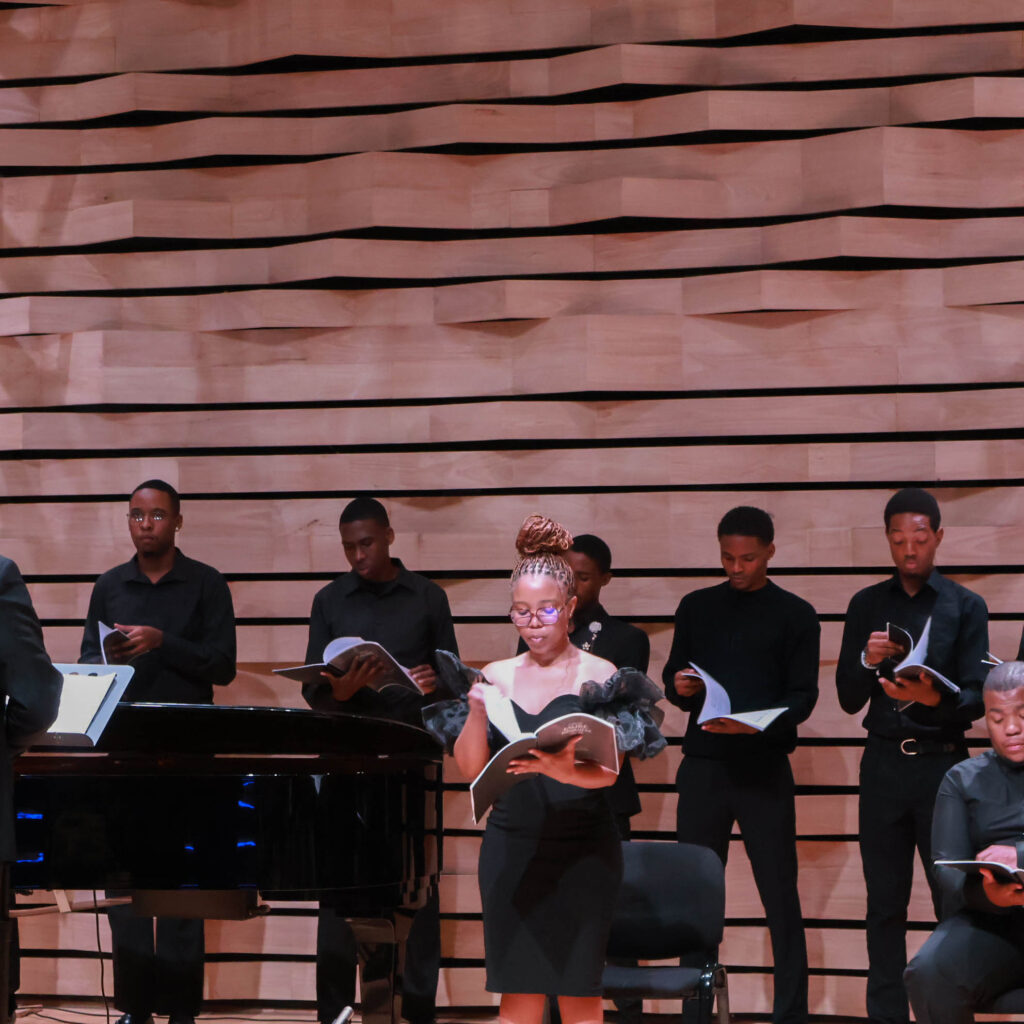
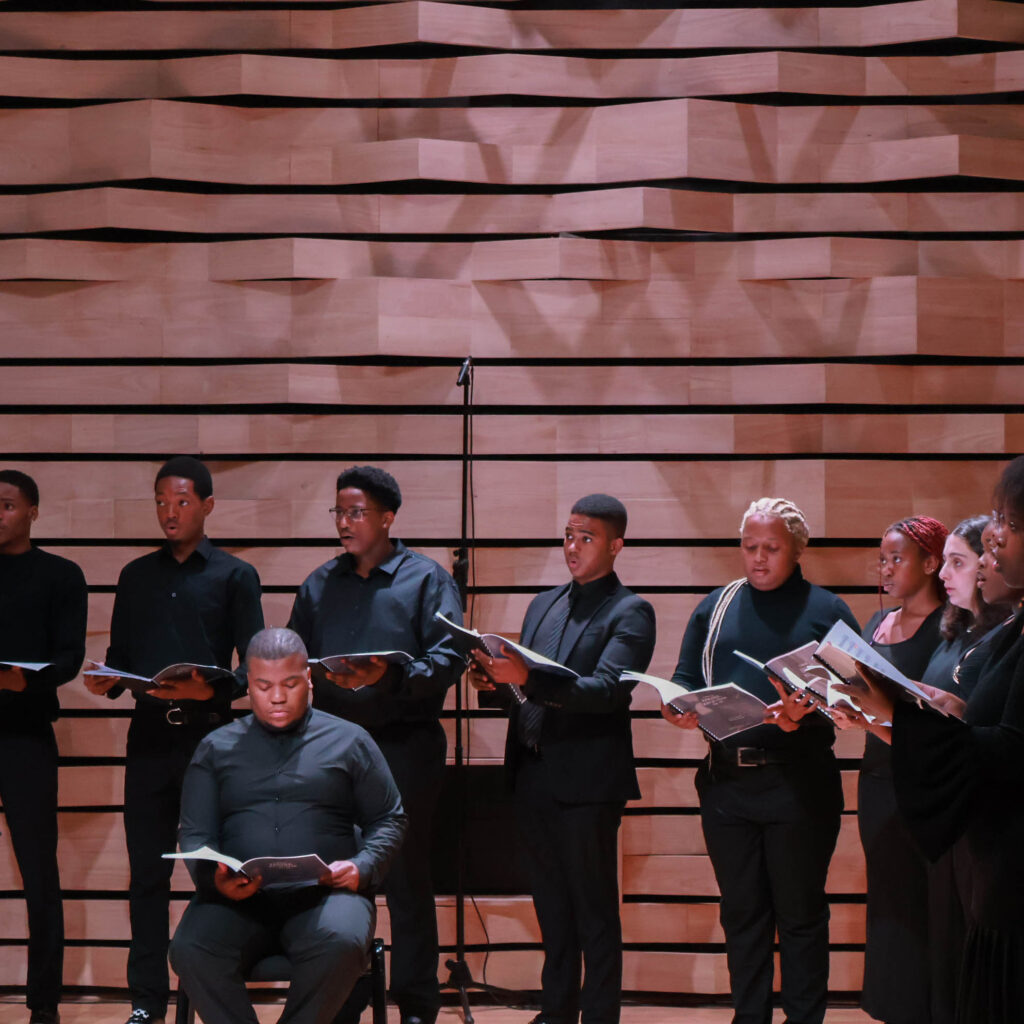
The inaugural Wits International Vocal & Chamber Music Festival begins on a powerful note, blending music, memory and meaning in a moving tribute to the youth of the Soweto Uprising.
The first-ever Wits International Vocal & Chamber Music Festival launched with a powerful opening concert at Seabrooke Music Hall.
The programme centred on Gabriel Fauré’s Requiem, honouring the children of the 1976 Soweto Uprising.
Performers delivered a technically refined and emotionally gripping experience that set a high standard for the festival.
A quiet anticipation filled the Seabrooke Music Hall on Wits East Campus on April 22, as audiences gathered for the opening of the inaugural Wits International Vocal & Chamber Music Festival. What unfolded was not just a performance, but a deeply moving musical tribute rooted in history, memory and collective reflection.
Hosted by the Wits Music Department, the festival spans eight concerts running from April 22 to May 2 across various venues on campus. This festival is the first of its own at Wits hosted by the department. The opening set the tone with a powerful presentation by the Wits Music Department Choir, accompanied by pianist David Butlin and conducted by Head of Department Musa Nkuna.
The programme drew from Gabriel Fauré’s Requiem, Op. 48, reimagined as a memorial for the children of the 1976 Soweto Uprising. Through seven movements, the performance carried a spiritual weight, each hymn a plea for rest, peace and refuge from suffering. The reinterpretation grounded the classical work in a distinctly South African context, bridging European composition with local history.
A picture of Charmaine Nkuna. Photo by: Sanele Sithole
Soprano Charmaine Nkuna, and bass Thato Morutle delivered standout solo performances, their voices cutting through the hall with clarity and emotional depth. Their presence added a personal dimension to the piece, elevating the performance from technically strong to profoundly affecting.
As the choir entered the stage dressed in black, the symbolism was immediate. The uniformed ensemble visually reinforced the tone of mourning and remembrance, aligning with the concert’s dedication to lives lost. What followed was a seamless performance marked by strong ensemble unity and precision — not a single note out of place.
The emotional impact resonated with the audience. First-year Film and Television student Luthando Skenjana described the experience simply: “It was an amazing performance; I quite enjoyed the show.”
For organisers, the festival represents more than a series of concerts. Choir chairperson Lesedi Masela, final-year Bachelor of Music student, described it as “a high-impact platform that brings together choral, chamber and orchestral performances within one integrated programme.”
Masela emphasised the significance of the festival’s timing, marking 50 years since the Soweto Uprising. “The opening concerts being requiems reflect that commemoration,” he said, adding that hosting performances across multiple venues transforms the festival into “a full-scale artistic ecosystem.”
That ambition is evident. Beyond musical excellence, the festival aims to create an immersive cultural experience — one that is intellectually engaging while remaining emotionally accessible. The opening concert achieved this balance, offering both technical sophistication and a deeply human narrative.
At its core, the performance was about young people remembering young people — a generational echo carried through music. It is this layering of meaning that makes the festival stand out, positioning it as both an artistic and commemorative space.
If opening day is anything to go by, the Wits International Vocal & Chamber Music Festival is not just an event to attend, but one to experience.
Vuvu Rating: 10/10
A picture of the choir. Photo by: Sanele Sithole
FEATURED IMAGE: A picture of the choir on stage. Photo by: Sanele Sithole
In episode six of We Should Be Writing season 7, the team unpacked the evolution of music as a form of expression and protest, through four decades in the South African context. The episode explores the journey of South African music and its consumers from the 80s, 90s, early 2000s and contemporary listeners. From the […]