Street skate culture is alive and thriving in the heart of Jozi.
F City hosts a skate competition in Selby.
Young skaters flock to the event to show off their tricks.
Skate culture facilitates youth development and community building.
Picture of skater mid-trick. Photo: Jamie Ho.
Picture of skater mid-trick. Photo: Jamie Ho.
Picture of skater mid-trick. Photo: Jamie Ho.
Picture of skater mid-trick. Photo: Jamie Ho.
Picture of skater mid-trick. Photo: Jamie Ho.
Picture of skater mid-trick. Photo: Jamie Ho.
Picture of skater mid-trick. Photo: Jamie Ho.
On Saturday April 25, wheels were rolling and sneakers were skidding in Johannesburg’s inner-city as F City Market brought skateboarding to the streets of Selby.
The afternoon was filled with cheers as a group of young skaters from central Johannesburg crowded around a small wooden ramp, eager to showcase their skills. The prize: a brand new skateboard courtesy of Crispy Skateboards.
This was young Isheanesu Hove’s first day doing a double kickflip: a move which crowned him the winner of the competition. “Skating to me, it means life,” Hove says, proudly clutching his newly won board. “It inspires me.”
This event is one of many hosted by F City Market in collaboration with Crispy Skateboards to bring skating back to its roots. Joe Dludla and Rhandzi Rhay, two students who founded the movement, were spurred by the lack of skating events in Johannesburg.
With most events being larger-scale or enclosed in skate parks, Dludla and Rhay saw a need to create an alternative space on the streets of Braamfontein for the youth by the youth.
Street skating is central to what Dludla calls the “core culture of skateboarding,” an activity that isn’t limited to skate parks, but open on the streets and accessible to all. “It’s a very small niche scene, so we need to keep it alive,” he adds.
At its core, the space is dedicated to uplifting the youth and providing them with a platform to hone their skills. Each month, F City hosts a youth development mentorship programme in collaboration with Growing Alexandra Skate Club, which aims to cultivate growth and creativity among the youth of Jozi.
As this initiative is still relatively new, it is in desperate need of volunteers. Dludla and Rhay encourage anyone with a skillset to share their craft– from skateboarding to graffiti to music. “We’re trying to influence the next generation of kids,” Rhay says.
The event extends beyond just skating; it’s a culture rooted in creativity and artistic freedom. As co-founder of Crispy Skateboards, Kaelik Dullaart says, “It’s the music. It’s the aesthetic. It’s the attitude. It’s the community.”
Drawn together by a love for skating, the space has become more than just an event; it has become a family.
As the sun set, the kids departed as a group back to their homes in town; skateboards ablaze beneath their feet.
Picture of the young skateboarders on Webber Street. Photo: Jamie Ho.
FEATURED IMAGE: Picture of a skater suspended in the air mid-trick. Photo: Jamie Ho.
The Pretoria Correctional Service Museum displays a blood-stained cloth from a flogging and a wooden “whipping triangle” used for corporal punishment.
At the Gallows, 3,500 names are engraved on memorial slabs, including Solomon Mahlangu and the Vulindlela family, executed by the apartheid state.
I thought I was going on a class tour. At Kgoši Mampuru II, I realised I was walking into South Africa’s past.
We visited two museums that tell two sides of the same story. The first was the Pretoria Correctional Service Museum, which shows how the prison system was run. The second was the Gallows Memorial Museum, where 3,500 people were executed. I walked in as a student but I left carrying weight I didn’t expect.
The two museums work together. The Pretoria Correctional Service Museum shows the mechanics of control, how people were fed, clothed, worked, and punished. The Gallows shows the final price of that control, 3,500 lives ended by the state.
We began at the Pretoria Correctional Service Museum. Correctional officer Dimakatso welcomed us and explained that phones and cameras were not allowed inside, and then she guided us through the exhibits. We saw wood carvings and sculptures made by inmates.
The punishment displays were the most difficult part for me. A wooden “whipping triangle” showed where inmates were tied for corporal punishment, and stun belts were used to immobilise them. When I saw a white cloth stained with blood from a flogging, I gasped.
A contraband section held makeshift knives shaped from spoons and dagga pipes, which is why Dimakatso said metal dishes have been replaced with plastic. She added that inmates can study and work, although the pay is little. We ended the tour with a look at a replica of Nelson Mandela’s cell.
At the Gallows, we handed our devices before Mr Kgomo took over. His tone was firm and commanding, stating that we were privileged to be there. He showed us engraved memorial slabs with 3,500 names of the hanged, including political prisoners like Solomon Mahlangu and the Vulindlela family, and I kept asking myself how an entire family could be executed.
The first room we entered was a church beneath the hanging chamber. On execution days, bodies were lowered by 9am for families to view in closed coffins, and relatives were told “he’s no more.” I hate coffins, and my heart raced as I understood how easily dignity was stripped away.
We then climbed the 52 steps to the gallows where prisoners took their last walk. As we ascended past dark images and words on the walls, my heart pounded and I sighed with every step because the weight of what happened there felt physical.
At the top, photographs of the hanged made my eyes fill with tears that didn’t drop, and when I saw the seven ropes in the chamber my heart sank while Mr Kgomo described each stage of the process. I realised that living now is a privilege we take for granted.
We left in silence. Everyone was speechless.
As a journalism student, I cannot separate theory from place anymore. I walked the 52 steps. Visits like this should be compulsory for us, because we cannot report on justice or the law fairly if we do not face the past physically. I arrived curious but I left sad, shaken, and more responsible.
FEATURED IMAGE: A portrait of Khutso Ngwatoana. Photo: Alaistar Russell
Wits Journalism students step inside Kgosi Mampuru II Correctional Centre, confronting the haunting legacy of South Africa’s penal history.
Wits Journalism students visited Kgosi Mampuru II prison and learned about inmate survival, punishment, and daily life behind bars.
They climbed the 52 steps to the gallows, reflecting on the country’s execution history and its human cost.
The gates at Kgosi Mampuru II don’t simply close, they announce an ending. It is a metallic finality that vibrates in your marrow, leaving an unshakable awareness of what it means to be confined, and the fragile privilege of walking free. Exactly at 10:42 am on April 15, 2026, 17 of us from the Wits Journalism programme stepped through that threshold. We traded lecture halls for a space defined by the physics of control. As a student journalist, I am trained to observe, but here, the walls watch you back. An involuntarily warning began to ring in my ears, an indirect message from the architecture itself, “Do not come here.”
Our tour guide, Dimakatso, unveiled a world of “jail language” and survival. She described “two full chickens”, prison slang for the two boiled eggs served with pap at 14: 00 pm which would be your last meal until the next day. She showed us how inmates creatively hollowed Sunlight soap to hide cell phones. In the era of AI, these inmates use primitive ingenuity to stay connected. Sitting on benches crafted by prisoners, I felt a sting of irony, for someone like me, only taught to build cardboard bridges at school, these prisoners learn to build from scratch to survive, and gain skills that might one day free them from that space.
The atmosphere turned clinical and cruel when Dimakatso introduced the “Triangle Step”. She described hot water-soaked wood being bent during a beating, making my body involuntary cringe. My mind flashed to the moment of impact, feeling the sting of a system that once relied on pain as its primary language. Hanging on the triangle step was a bloodstained cloth, an enduring reminder of punishment inflicted on the condemned. I cannot omit this, as it questions what I was never taught in high school. This history was deliberately left out, it sparked questions about justice, pain, and how history is curated.
Next, we moved to the gallows. Mr. Kgomo told us to “fasten our emotional seatbelts”, a fitting warning. We transitioned from the museum of survival to the tomb of execution. I stood before the names on the wall, thinking of Section 11 of the South African Constitution: the right to life. I felt a wave of relief; the 1996 abolition of the death penalty had ended this brutal form of justice. Yet, as we approach April 27, Freedom Day, the irony burns: this day marks our liberation, but these gallows mark how many never lived to see it. Yet, the past is not distant. Between 1902 and 1989, roughly 3,500 people were executed, a grim reminder of state-sanctioned brutality. As I ascended the 52 steps, I imagined faces, some praying, some screaming, others singing hymns, climbing those heavy stairs. By step 52, my chest felt like it was crushed, a tear slipped unnoticed, masking my professionalism.
At the top, the brutality became clinical, detached from emotion. I learned how a prisoner’s BMI (body mass index) was used to select the correct noose, and how a pulse after the fall meant the execution was not complete. We stood where Solomon Mahlangu, whose blood nourished the “tree of freedom”, once stood. As the gates hissed shut behind us, and warnings lingered, I became haunted. The 52 steps symbolise not only punishment but a society still grappling with its past, a past where thousands paid the ultimate price between 1902 and 1989. Is this reflection of the gallows? It is a mirror that confronts the dark architecture of consequence, forcing us to question the true weight of justice and the whispers of history that echo through these steps.
19 : 00 pm, execution time starts. Photo by: Emadul Islam Akash. (Pexels)
We celebrate Freedom Day on April 27, 2026, however, the 52 steps remind us that freedom was counted out in bodies long before it was counted in ballots.
FEATURED IMAGE: Journalism and Media Studies Honours students from Wits University enter Kgosi Mampuru II Management Area. Photo by: Alice Dhlamini.
As soon as my foot crosses the threshold, I am sucked into the cold, bleak walls of the gallows. Looming before me are my 52 last steps. In a single file, we follow the warden.
49.
50.
51.
With each footfall, the weight in my heart grows heavier. It’s like trudging through water, with my feet being pulled down deeper and deeper. Steadily, we approach that dreaded chamber of death.
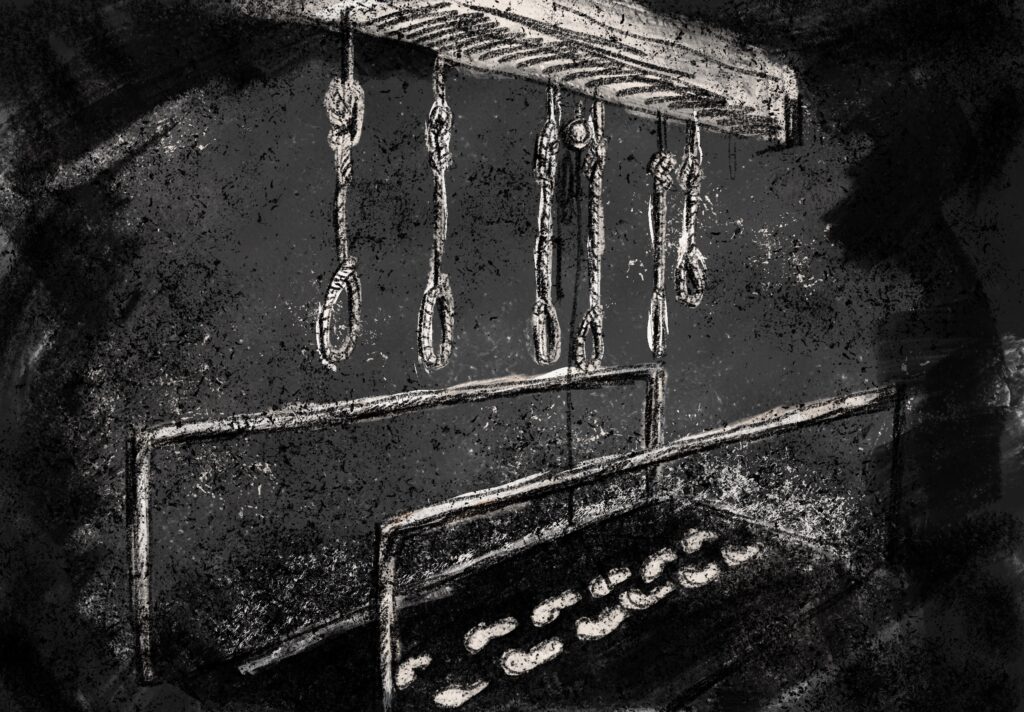
Like a constant buzz of electricity, the air is charged with the crackle of violence. Hanging from the ceiling are nooses, dangling like serpents twisting and curling their vicious tails.
We line up alongside the gallows, necks craned; eyes widened at these troubling ropes. At our feet: a wooden trapdoor which can be opened at the pull of a lever. This rickety platform is the only thing standing between life and death: the final step before the drop.
The clock is ticking. As the warden makes his way across the room, I feel my chest constrict as if the ropes have twisted around my heart. The air is now so thick; my tongue feels like lead and my neck prickles with sweat. Time’s almost up. His hand reaches for the lever.
As we all surround that limp trap door, nobody makes a sound. I can still feel it settling all around me: that cold, deafening silence. Even as we depart from the gallows, it clings to me long after.
Drawing of the gallows in Kgosi Mampuru II prison. By: Jamie Ho.
It has been 32 years since the end of Apartheid, a period where 3 500 people were sentenced to death by the state. In the modern age, it has become concerningly easy to shrug off these injustices as a thing of the past, a forgotten by-gone.
In the gallows of Kgosi Mampuru II prison, however, history is anything but gone. It echoes through the halls, up the stairs, around the hanging rope: a lively, tangible pain that sends a jolt through your bones. It sits heavy in the air: the agony of men marching solemnly to their deaths. That violence bleeds from that pocket of history. It lives in that prison.
The day we visited the gallows, I left with a newfound understanding of the past: that just because it has passed does not mean that it is gone.
The freedom that we have today came at a hefty cost; it was built from bloodied death chambers, scavenged from towers of corpses, hacked from beating hearts that were stuffed in boxes.
It is anything but the past; it is alive, and it weaves itself indefinitely into the fabric of the present, informing the very freedom we have today. It lingers in the triumph of being able to walk freely on an open street. It sits in the warmth and laughter of a community braai. It pumps through the veins of a liberated nation.
Before Solomon Mahlangu was executed he said, “Tell my people that I love them and that they must continue to fight; my blood will nourish the tree that will bear the fruits of freedom.”
As we observe Freedom Day, we must remember the thousands of lives the fruits of our freedom are staked on. We cannot let their memories die in vain. It is our one duty: to honour their sacrifice and let the past mean more than just the past.
FEATURED IMAGE: A portrait of Jamie Ho. Photo: Alaistair Russel
Walking into The Gallows Museum at Kgosi Mampuru II Correctional Centre, the first thing that hits you is not a sound, but the absence of it. We fell into a heavy, suffocating silence. It did not feel right to speak. The atmosphere was tense, sombre, and thick with a history that was never meant to be heard outside these walls. We were not just touring a building; we were retracing the final, mechanical minutes of 3500 lives.
The dehumanisation was in the details. The “procedure” began at 06:50 AM, and by 07:30 AM, it was over, fast and efficient. Life was extinguished with the punctuality of a business transaction. A wave of nausea hit me hearing how seven people were hanged at a time, their bodies later hosed down with a power washer, like equipment in a slaughterhouse, because the state could not be bothered to afford them individual dignity. They were shoved into coffins, and that coffin was shown to families for mere seconds to hide the trauma of the noose and then buried in unmarked graves. They did not just want these men dead; they wanted them erased.
It was a place designed for the mass production of death, a literal “human abattoir.” The ropes had metal rings to ensure the break was instantaneous, a cold, metallic “mercy” in a room that lacked a soul. If a pulse survived the drop, they were simply hoisted back up and hanged again. It was a loop of terror. Our guide explained that some in charge, like warden Christiaan Barnard, openly enjoyed the work because of how well it paid, even believing he would be forgiven because he was “just doing his job.” To keep the killings quiet, they even soundproofed the room to muffle the thunder of the trapdoors hitting the frame.
We climbed the 52 steps in the shadow of painted silhouettes, counting them one by one. I thought of the prisoners who would sing holy songs on their way up, their voices a haunting contrast to the “last request” they were offered at the top. It felt like a final, cruel joke to bark those requests in Afrikaans, a language many did not even understand, moments before they were led into the room where the ropes awaited. It was in this final room, the gallows, that I saw the plaque for a 22-year-old Solomon Mahlangu, barely younger than I am, who once stood on this same trapdoor.
This experience hit me with a force I did not expect. I realise now that we talk about “liberation” as a concept, but we rarely look at the apparatus that tried to crush it. Our democracy is not just built on grand speeches and signed documents; it is built on the silence of these men and the sacrifice of leaders like Solomon Mahlangu, whose words remain painted on these walls: “My blood will nourish the tree that will bear the fruits of freedom.” Standing where the hearse once sat, permanently waiting, I realised that as Freedom Day approaches, I carry the weight of those 52 steps with me.
We can never truly understand our present if we forget the system that tried so hard to wash this history away. I pray that the souls who passed within those walls have finally found the eternal rest and peace that was denied to them in life.
The Atlas of Uncertainty offers a profound perspective on African migration, redefining our understanding of belonging.
Atlas of Uncertainty opens at Wits Origins Centre.
Various artists, writers and researchers celebrated their work during the opening ceremony.
The exhibition holds significance in today’s divided society.
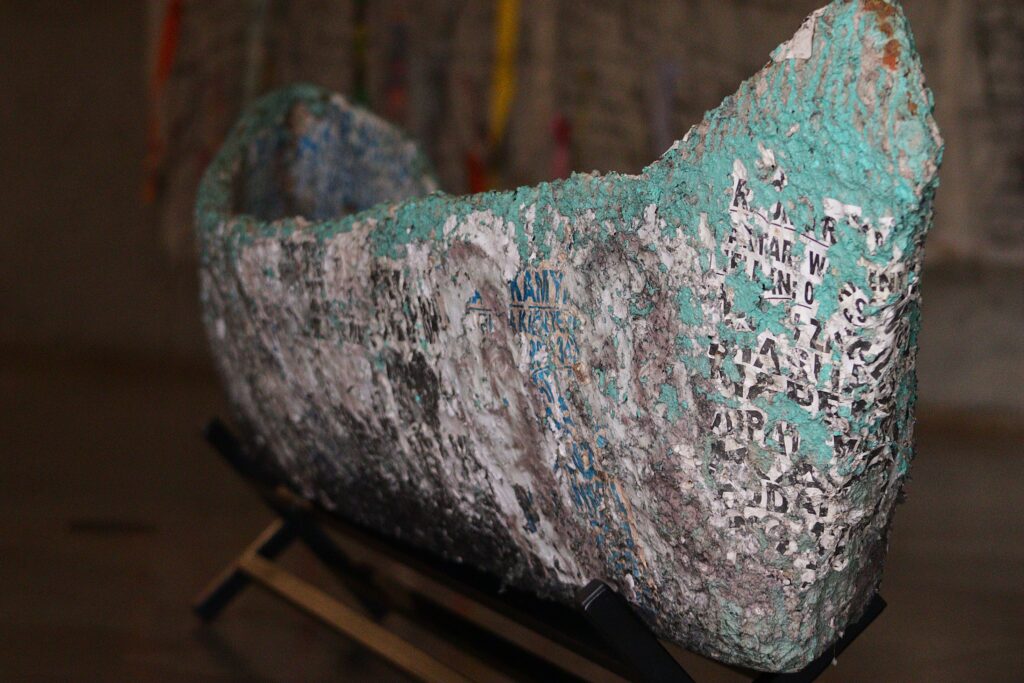
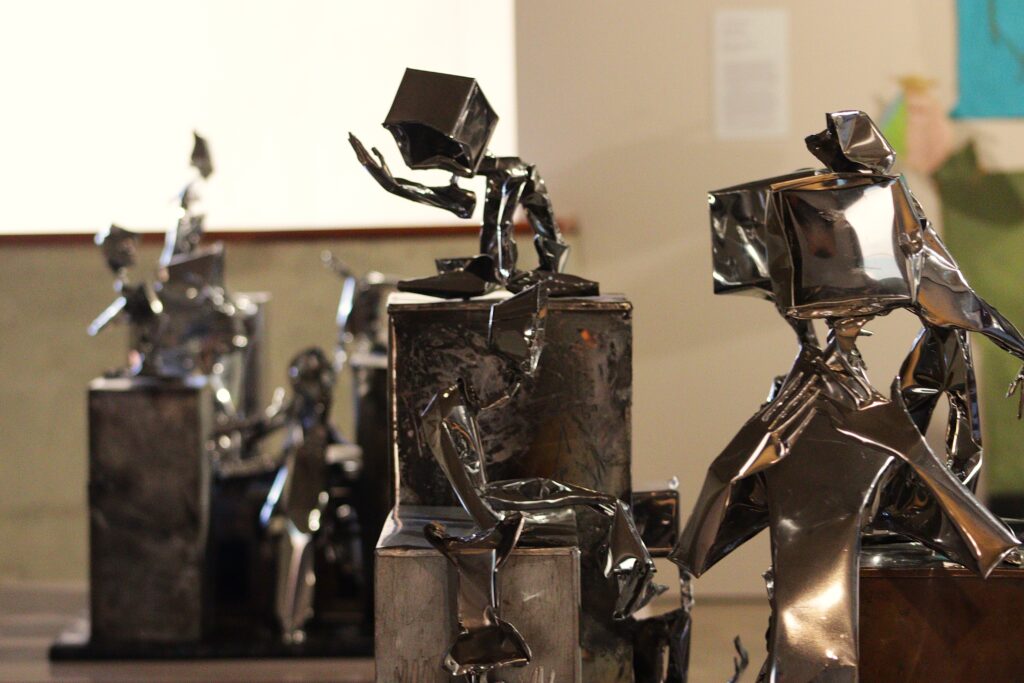
Picture of papier-mâché boat sculpture entitled ‘Mashuna and Hakuna nija’ by artist Onys Martin. Photo: Jamie Ho.
The Atlas of Uncertainty exhibition opened at the Wits Origins Centre on Saturday, April 18, inviting visitors to question the current agenda around migration, urbanisation and belonging in Africa.
From a paper-mâché boat constructed from receipts to a woven tapestry stitched with burlap, the exhibition offers a more humanising lens for viewing the global phenomenon of mobility: not as burdensome, but as inherent to humanity.
Rooted in three African cities, Johannesburg, Accra, and Nairobi, the Atlas looks beyond the borders that divide us. Migration researcher Loren B. Landau highlights that the current scholarship neglects to capture the complexities of Africa, thereby revealing a need to move “from the counting to the feeling; from the census to the senses.”
To understand the vast complexities that define the continent, the Atlas is not only working across borders, but across different media, disciplines, platforms and ways of thinking. Urban sociologist Caroline Wanjiku Kihato explains that this “lets different ways of knowing sit alongside one another, without forcing them into a single voice.”
The Atlas of Uncertainty is a powerful revision of how we understand African cities. It uproots mainstream narratives surrounding migration, opening the space up for uncomfortable yet necessary conversations.
Spatial practitioner, Carina Kanbi provides some insight into the actual making of the project and how its themes of migratory politics were mirrored over the course of its conception.
Going all the way back to 2023, when the project first began, she notes challenges faced by the artists working across borders, not only in physically transporting the works, but also in handling bureaucratic restrictions between countries. “The exhibition did not begin this morning,” she explains. “It very much began in transit.”
And staying true to this theme of mobility, the Atlas will remain a piece of art that will remain in perpetual movement. While it is on exhibition until July 3 at the Origins Centre, it is also planned to showcase in Accra and Nairobi in 2027.
Each piece of the Atlas reverberates with the passion of its creators. Each tassel holds weight.
Each shard aches with feeling. As the cracks of division deepen in our world, the value of this exhibit lies not only in its ability to challenge the status quo, but in its ability to reach where data and statistics cannot, to reconnect with our ability to be human.
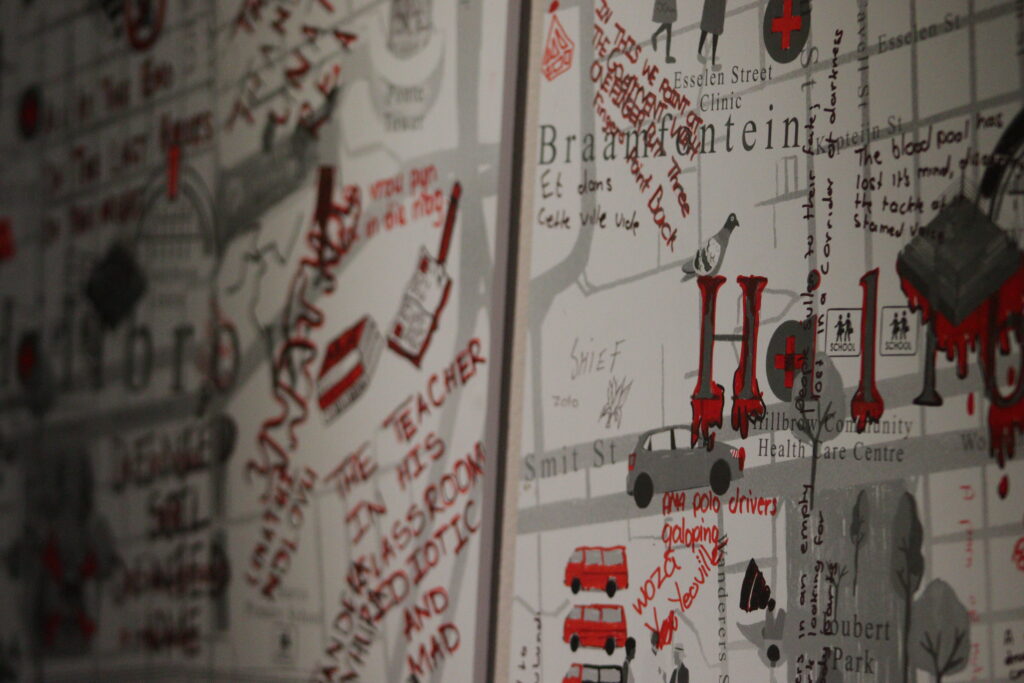
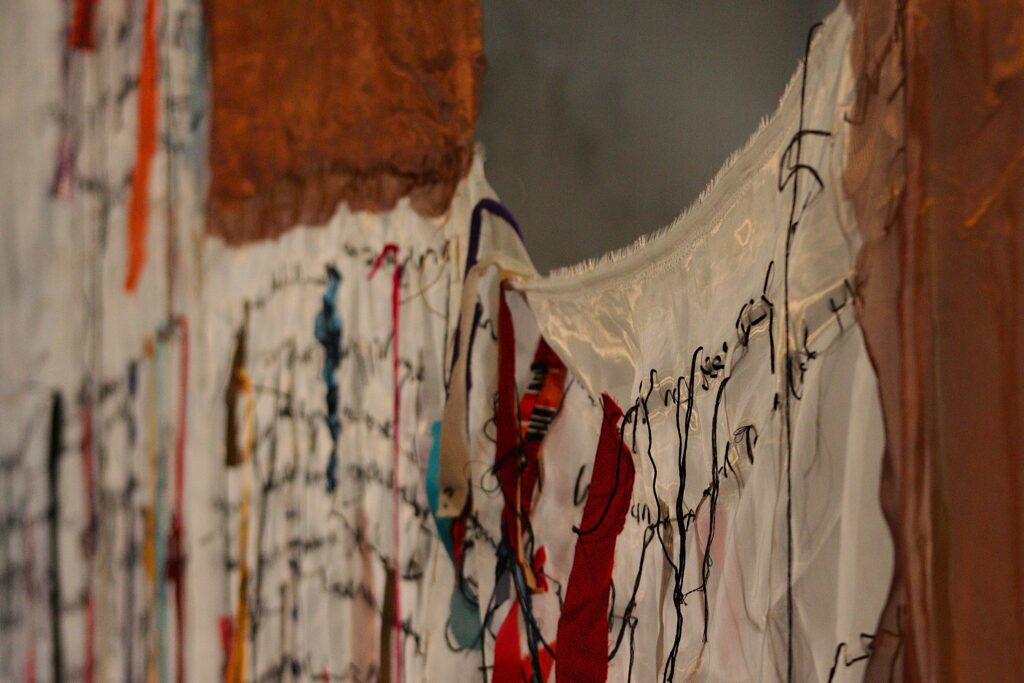
Close-up of artwork titled ‘I am the Graffiti on the Cracked Wall‘ by Windybrow Arts Centre. Photo: Jamie Ho.Picture of ‘Strangers and Spaces’ by Austine Adika. Photo: Jamie Ho.Close-up of ‘A Map of Dreams and Realities’ by Billie McTernan. Photo: Jamie Ho.
FEATURED IMAGE: Picture of artwork titled ‘When We Travel, Where Do We Settle?” by Wezile Harmans. Photo: Jamie Ho.
The play Sophiatown balances the tragedy of displacement and forced removals with the joys of human connection, jazz, singing and dancing.
It is Saturday, April 11, 2026, and the theatre kid in me is geeking throughout the entire experience of witnessing the revival of Sophiatown on stage. A legacy, a history so rich, words cannot begin to describe the greatness embodied through the characters, the storytelling and the finer details that reflected the true intentionality in honouring and remembering Sophiatown.
Upon arrival, I was excited and deeply curious about what the play Sophiatown would actually be about. The audience sat in the lounge area of the Wits Theatre, anticipating the journey we were about to embark for the next two hours. Chatter and joy filled the lobby as we patiently waited for the show to start.
Boy, were we in for a true treat! Drum rolls and a groovy jazz tune is how we were introduced to Sophiatown, a fitting opening for a place known for its sonically rich cultural heritage and legacy. One of the main characters, Jack, took us back in time. It is the 1950s: typewriter on the desk, a bookshelf in the background, blue lights and the interior of a warm family home, await the rest of the characters.
Jack, an aspiring journalist, resurrects the legacy of Drum magazine by calling out names of the 1950 Drum legends such as: Can Themba, Lewis Nkosi, Bloke Modisane, and Todd Matshikiza, he highlights how they paved the way for African storytelling in Sophiatown at that point in time. Soon after, the rest of the characters join in on a chorus and soothes our ears with a sweet melody, the peanut gallery begins to cheer, and we have officially taken off.
The play is truly nothing short of amazing, and it importantly showcases how Sophiatown can never be solely understood through a singular lens or a singular story. It is culturally rich, consisting of diverse people, multiple races and different lived experiences. We are taken through a story of history, as the play reflects the severity of living under the apartheid regime which pushed for racial segregation and alienation. As one of the main characters Mingas says, “Sophiatown is not just about clubs and jazz, it is about war.”
The play explores the plight of BantuEducation, and the complexities of interracial relationships as we see through the arrival of a white Jewish girl, Ruth Golden, who is originally from Yeoville. She finds herself in Sophiatown after seeing an advertisement in the Drum magazine for the “diamond lady, number 17.”
Ruth’s presence at 65 Gerty Street in Sophiatown reflects the different living conditions between the white people and black people. Ruth is forced to adapt to life in Sophiatown, in a smaller house where everyone shares rooms, it enhances the complex relational dynamics between characters such as Lulu and Princess, Mingas, Jack and Fafi and the mother who all occupy the home.
Above all else, the play highlights the brutality of forced removals in Sophiatown with reference to the Native Resettlement Act of 1954. The apartheid regime used to remove black people from their homes, through bulldozing houses and destroying the infrastructure. The wound of displacement is so deeply felt by the audience as the characters are forcefully moved to Meadowlands.
Actors of Sophiatown play on stage. Photo by: Sikelelekile Pahlana
The play effectively and harmoniously balances light-heartedness through humour, singing and dancing with the seriousness of how violent the apartheid regime was.
The play asks to be remembered, embraced, and treated as a real point in time because it was and forever will be. We are urged into carrying the memory of Sophiatown with us and be conscious enough to ensure we never forget the pain, the joy and the collective fight it took for us to taste freedom, not idealistically yet in reality – to feel the things, the legends of those times always hoped to one day be a witness to.
I spoke to the writer, Malcolm Purkey, who said the play Sophiatown was created 40 years ago, in 1986 and it still stands today, a true testimony to its importance and relevance. When I asked him what he wanted people to take away from the play, he said, “If we found the right way, we could live together with respect. The gap of poverty and inequality is still there, and the war is not over,” Sophiatown reminds us of our common humanity and truly reflects the times, with dignity.
We are reminded, as Don Mattera once articulated, “Memory is a weapon!” Our history, South African history awaits you on the stage, it is worthwhile to go check it out and experience it for yourself. The play runs from April 11 to May 8, 2026. You will laugh, you may shed a tear, yet you will not regret it.
Vuvu Rating: 10/10.
FEATURED IMAGE: Picture of stage during Sophiatown play. Photo by: Sikelelekile Pahlana
Rising fuel costs are forcing Wits students to choose between paying for their daily commute and basic essentials like meals and data
The recent fuel hikes have increased taxi fares by R6 per trip, costing students an extra R240 monthly.
Daily commuters are walking long distances to save fare money, resulting in late arrivals and lost study time.
Two weeks after South Africa’s fuel increase, some Wits University students who commute daily say rising transport costs are already affecting their ability to attend lectures, manage time, and meet basic living expenses.
According to Bloomberg, petrol is currently around R 23 per litre, following recent increases in global oil prices and local fuel adjustments.
While the increase in fuel prices continues to place pressure on household budgets, its impact has now extended directly into the public transport costs.
The National Taxi Alliance (NTA) confirmed that taxi fares have already increased by R6 per trip. For daily commuters, this translates into an estimated additional R12 per day for a return trip, about R60 per week, and roughly R240 per month.
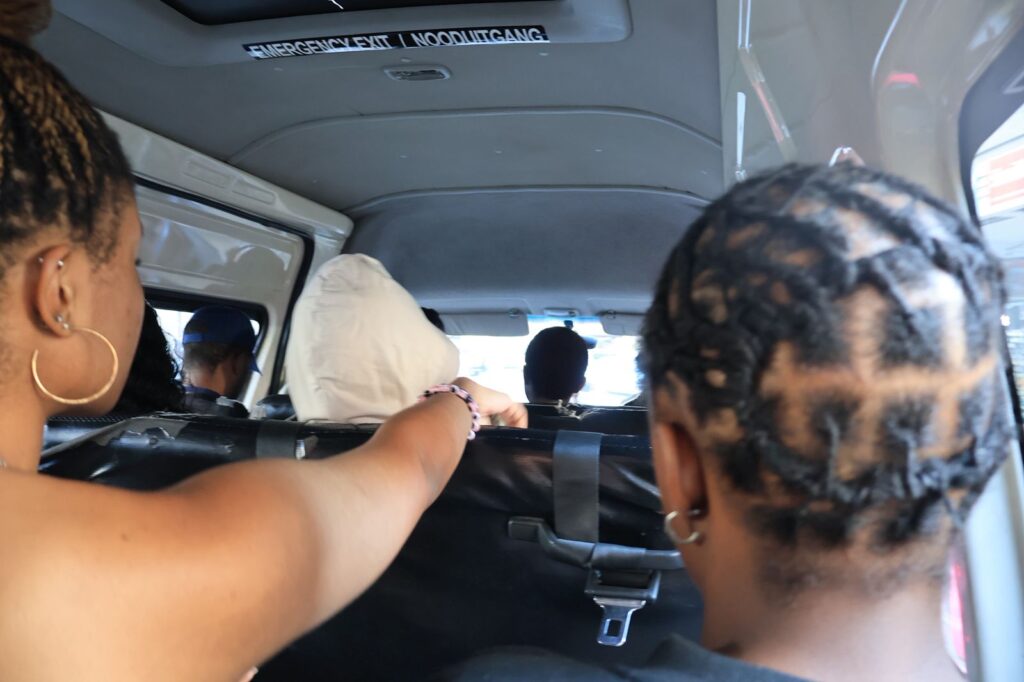
A Wits student passing their taxi fare to the front of the vehicle. Photo: Alice Dhlamini
For students who rely on taxis from the surrounding areas, the increase has turned daily travel into a financial strain.
“I live off campus in Benoni, and I have to travel every day to get to class,” says Afrika Mbangiso, an honours in Psychology student.
“From Wanderers Taxi Rank in Johannesburg, I have to walk the rest of the way to Wits just to save money for lunch or sometimes, for my trip back home,” Mbangiso adds.
It has also affected her punctuality and workload. “I am sometimes late for class, meaning it’s more work that I must catch up on later”, she adds. For students like her, longer commutes and additional walking reduce time for rest, studying, and academic preparation.
Nontobeko Zulu, a Postgraduate Certificate in Education (PGCE) student, argues that the increase has forced what she calls a “displacement of funds”. “For many of us, these aren’t just transport fares, they represent a radical displacement of funds,” Zulu says.
FEATURE IMAGE: A picture of a passenger passing forward taxi fare, which has increased by R6 per trip due to petrol hitting R23 per litre. Photo: Alice Dhlamini
A deeply human reflection on fathers and sons, masculinity, healing and what gets passed down through generations
Imran Hamdulay’s feature debut, The Heart Is A Muscle, is a moving exploration of intergenerational passing, the complexities of masculinity and the relationship between fathers and sons. Set within Cape Town’s layered history, the film was South Africa’s official entry for Best International Feature Film at the 98th Academy Awards (Oscars) 2026.
The Cape Flats, an area shaped by apartheid and systematic marginalisation, has been misrepresented in cinema. It is often reduced to a single narrative of crime and conflict. Hamdulay pushes against this stereotype. The history of violence is acknowledged but never dramatised. Instead, he reflects on fear, hope and defiance. The Cape Flats feels like more than just a setting, it becomes a character in itself. Fractured but resilient, carrying its complexities, dignity and fragile connections.
During a Johannesburg screening at The Bioscope Independent Cinema on March 11, Hamdulay was in attendance and explained how the story was inspired by a real-life incident. While at a barbecue, he saw a friend’s son briefly go missing. In that moment, Hamdulay witnessed fear and anger in his friend like never before. This sparked his curiosity and the film’s narrative, which begins with a young couple discovering their five-year-old son has disappeared. The story continues to follow Ryan, the young father, as he confronts his own brokenness, masculinity and the unspoken histories passed down through generations.
Still from The Heart Is A Muscle. Photo: Supplied/The Bioscope
Shot entirely on location, it captures both Cape Town’s grittiness and colour. Hamdulay has explained that he tried to lead every part of the production with kindness. From the set, the shoot, the camera, to the performances. The cinematography reflects this, emphasising intimate, character-driven storytelling. Imagery such as the ocean creates feelings of isolation and unresolved emotions. Close-ups reveal personal histories through subtle traits. Instead of over-rehearsing, a lot of time was spent discussing the characters beforehand and how the actors themselves related to the story. Keenan Arrison, cast as Ryan, delivers a raw, lived-in performance, and the film’s emotion lies in the pauses, silences and gestures.
Still from The Heart Is A Muscle. Photo: Supplied/The Bioscope
The film asks: What do we inherit from our fathers? And how can we become better versions of ourselves in difficult circumstances? Masculinity is usually discussed through power and control, but Hamdulay looks at the importance of softness and healing. What begins in feelings of apprehension transitions into a meditative reflection, heightened by a score that balances tension and vulnerability.
Although the film is set in South Africa, The Heart is a Muscle also speaks to an international audience. At its core, it is a reflection on belonging. It is not only about fathers and sons but about facing inherited pain and finding a path to forgiveness and change. Hamdulay has created a film that is intimate, layered and deeply human.
FEATURED IMAGE: The Heart Is A Muscle poster. Photo: Supplied/The Bioscope
On Tuesday, March 31, the SRC announced a new structure and reshuffling of their council. They added a new representative to the executive wing and reinstated a member suspended due to a rape allegation late last year.
This change in leadership comes after the resignation of the former Secretary General, Antonett Khoza, on February 26, 2026. In her resignation statement she defined her tenure as being led by a “passion for fighting for access, accountability and dignity of students”.
She added that, “stepping down is not surrender”, but “a strategic withdrawal from a position that no longer allows me to serve effectively under its current conditions”.
The reshuffle resulted in the co-option of an existing member of the executive student governing body by the Dean of Student Affairs. Final year Medical student, Nonhlanhla Siwela, will fill the role of Student Development and Integration Officer.
“Whether elected to a particular position or not, I’ve always strongly believed in advocating for progressive change and making a meaningful difference no matter how small,” she told Wits Vuvuzela after accepting the position.
Alongside these structural changes, an update has also been provided on the sexual and gender-based harm allegations laid against, Musawenkosi Mavuso, in November 2025. After failure to reach the complainant for further information, the conclusion of the inquiry resulted in the lifting of his suspension. Mavuso reassumed his position in the SRC, taking up the portfolio of Bursaries, Fundraising and Stakeholder Relations.
SRC President, Nchabeleng Gilbert, said, “We are glad investigations have been conducted. The SRC reiterated the university findings and find that due diligence has been conducted.”
He added that the changes would not impact existing administrative processes.
The positions and their new representatives are as follow:
Secretary General: Aphelele Qwabi Deputy Secretary General: Matlhatsi Mosima Portfolio of Bursaries, Fundraising and Stakeholder Relations: Musawenkosi Mavuso Student Development and Integration Officer: Nonhlanhla Siwela
What these changes will mean for the student body, remains to be seen.
FEATURED IMAGE: Image of the Wits Great Hall, with students walking in front of the building. Graphic: Amahle Ngqwemla
Rirhandzu Shilubane uses her platform to challenge beauty standards and empower women and children.
In a world increasingly shaped by changing beauty standards where weight-loss culture dominates and more young people feel pressured to change their bodies, Rirhandzu Shilubane is working to rewrite that narrative. When she entered the room, she did so with bright energy and a welcoming smile that immediately put one at ease. She has a presence that reflects both confidence and intention.
Shilubane, is a 24-year-old third-year law student at Wits University. She is also a Top 14 finalist in the Face of Plus-Size South Africa 2026 pageant. For her, the pageant is not about appearance, but about the impact.
“I’ve always known that I wanted to be a vessel of change,” she says. “Even before I fully understood what that looked like, I knew I wanted to work in a space where I could contribute to something bigger than myself- especially in advancing rights and justice.”
Her academic journey reflects this purpose. “I became interested in how laws actually work in people’s lives, how we make sure rights are not just written but realised.”
Her decision to enter pageantry is rooted in deeply personal experiences. Growing up, she often felt excluded because of her body size during pageants at her primary school.
Rirhandzu Shilubane, Top 14 finalist in the Face of Plus-Size South Africa 2026 pageant. Photo: Dzulani Muthaphuli/ Plain World PicturesRirhandzu Shilubane, Top 14 finalist in the Face of Plus-Size South Africa 2026 pageant. Photo: Dzulani Muthaphuli/ Plain World Pictures
“I wanted to be part of something that tells young girls, especially those who look like me, that they are worthy, that they are seen,” she says. “Representation matters. When you see someone who looks like you taking up space, it gives you permission to do the same.”
Through her initiative, Elevate Her and Children, Shilubane has translated advocacy into action, running food and clothing drives, supporting a children’s home, and organising programmes centred on dignity and care.
“Dignity is a basic right,” she says. “Sometimes we think it’s something abstract, but for many children, it’s about being acknowledged, being cared for, being given space to just be children.”
Her advocacy for body positivity is equally extensive. “It’s not just about plus-size women,” she explains. “It’s about everyone. You could wake up tomorrow in a different body, but if you’re not at peace with yourself, nothing changes. Body positivity is about being comfortable in your own skin, regardless of size, shape, or appearance.”
Despite criticism that often surrounds beauty pageantry, Shilubane remains steady in her purpose. “I understand the criticism, because some spaces do reinforce harmful standards,” she acknowledges. “But for me, this platform is about deconstructing those ideas. Even if I only reach one person, if one girl starts to see herself differently, then that is enough.”
Rirhandzu Shilubane, Top 14 finalist in the Face of Plus-Size South Africa 2026 pageant. Photo: Dzulani Muthaphuli/ Plain World Pictures
Her resilience, she says, is rooted in her upbringing. “My mother taught me that when a door closes, you don’t stop- you find another way in,” she says.
Looking ahead, Shilubane hopes to use her law degree to expand access to justice and empower communities through education. “People are not voiceless,” she says. “They have voices, they just need platforms that amplify them. I want to be part of creating those platforms.”
Her message to young women is both simple and profound: “When you fully embrace who you are, you give others the freedom to do the same. And that is where real change begins.”
FEATURED IMAGE: Rirhandzu Shilubane, Top 14 finalist in the Face of Plus-Size South Africa 2026 pageant. Photo: Dzulani Muthaphuli/ Plain World Pictures.
The pressure of the beauty maintenance day is piling up and emptying the pockets of many.
There was a time when “beauty maintenance” meant styling your hair and maybe getting it trimmed before school picture day. That was all that was required of you. Now? The expectations for women in particular feel endless – lashes, nails, hair, waxing, eyebrow shaping, facials, wig installs – the list just keeps growing. What used to be simple personal grooming has evolved into a full-time job, that requires a whole day off.
Let me be clear: personal grooming is important. Looking after yourself can boost your confidence, self- esteem, improve hygiene, and contribute to your overall self-care. There is nothing wrong with wanting to feel put together. However, somewhere along the way, beauty maintenance stopped being about feeling good and started feeling like a requirement.
Hair being braded. Photo: Bonolo Mokonoto
A full “maintenance day” for me can easily cost up to R1500. That’s a significant amount of money to spend. Between work, transport, and everyday expenses, budgeting for lashes and nails every few weeks isn’t always realistic. Social media and societal pressures can make beauty maintenance feel necessary.
Nails being cured under a UVA light. Photo: Bonolo Mokonoto
Braamfontein and Johannesburg CBD has a huge selection of beauty salons and maintenance spots. On almost every corner there are nails, brows, or hair services on offer. The options are endless, but unfortunately, the quality isn’t always guaranteed. Many students have experienced rushed appointments, unprofessional service, or results that don’t match the price paid.
The bigger issue, though, is the societal pressure attached to it all. When i walk into a lecture hall and the majority of people have their nails done and frontals installed, it makes me feel like I do not fit in. There is this unspoken expectation that to be “put together,” you must have your lashes done, nails fresh, edges laid, and brows perfectly shaped. And for young women, especially myself, navigating identity and confidence, that pressure can weigh heavy.
A wig getting prepared to get installed. Photo: Bonolo Mokonoto
I think beauty regiments should be about self-expression, self-care and evoke joy. They should make you happy, not anxious about keeping up with the trends. It should feel like self-love, not a compulsory checklist, added onto your budget.
So, before you book your next appointment, do it because you genuinely love how it makes you feel, not because it’s trending.
FEATURED IMAGE: Hair being braded. Photo: Bonolo Mokonoto
In episode six of We Should Be Writing season 7, the team unpacked the evolution of music as a form of expression and protest, through four decades in the South African context. The episode explores the journey of South African music and its consumers from the 80s, 90s, early 2000s and contemporary listeners. From the […]